
The owner budget beyond the contract price: allowances, owner-furnished items, crew, insurance, contingency vs reserve, currency and a risk register. Free xlsx.
A yacht owner signs one large number with the Yard, and it is easy to treat that number as the cost of the yacht. It is not. Around the contract price sit variation orders, allowances that can overrun, items the Owner buys directly, the owner's own team, insurance, crew who join before delivery and the cost of getting the yacht into service. On top of that sit the things nobody can price yet. This lesson builds the owner-side budget that holds all of it, separates contingency from management reserve, shows what the variation order total does to the contingency, deals with currency, and sets up an owner-side risk register that the budget can be checked against. It ends with a monthly budget report and a workbook you can use.
The yard side of the same subject is covered elsewhere and is not repeated here. How a yard estimates and controls the cost of a newbuild is in Cost Estimation and Budget Control for a Newbuild Vessel, and the principles of a working risk register, specific triggers and named owners, are in Risk Management in Shipyard New-Build Projects. The site's Newbuild Cost Breakdown Structure and Shipyard Risk Register Template are the yard-side versions of the two halves of this lesson's template.
This is not financial, tax, insurance or legal advice. Taxes and duties, insurance cover and currency hedging are decisions for the Owner with qualified advisers. The project manager's job is to make sure every one of them has a line, a number and a date.
Illustrative project: Project YP-48 is fictional. Its parameters are chosen from publicly reported industry ranges so the numbers are realistic, but no real yard, owner or yacht is described.
YP-48 at month 15
YP-48 is a 48 m full custom motor yacht with a design target of 499 GT, for private use and charter with 12 guests, built to the Red Ensign Group Yacht Code Part A (July 2024 edition). The contract runs 30 months from 4 January 2027, the flag is the Cayman Islands and the class society is Lloyd's Register, both illustrative choices explained in Rules Before Lines. The parties are introduced in Anatomy of a Superyacht Newbuild.
As everywhere in this series, money is an index: the contract price is 100. That matters more in this lesson than in any other. Every owner-side figure below is an illustrative teaching value, not a benchmark. Nothing here says what an owner's representative, a tender or a year of insurance costs on a real 48 m yacht, and the owner-side total the example arrives at is a product of the example's inputs, not a rule of thumb. Put your own figures into the same structure.
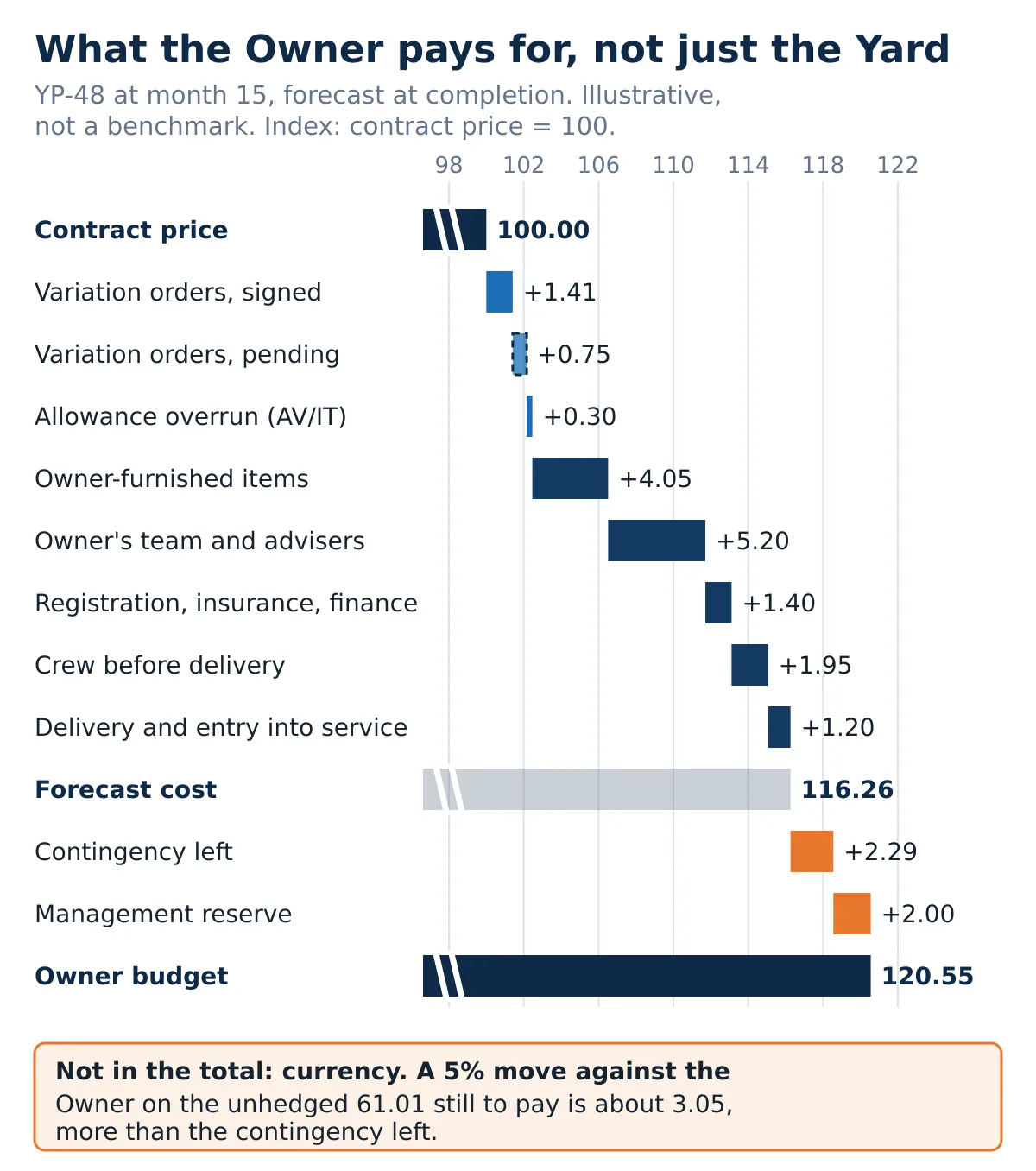
The budget is shown as at the end of month 15 (3 April 2028), the same date as the change log in Owner Change Requests and Variation Orders on a Yacht. By then milestones 1 and 2 are paid (25 of 100) and milestone 3 has been certified, as followed in Building the Milestone Payment Plan and Its Evidence Pack and Measuring Progress and Writing the Weekly Owner Report. Four variation orders are signed for 1.41, and 0.75 more is pending.
Where the owner budget starts
The owner budget begins with the contract, because the contract decides what is not in the price. On YP-48 three documents set the boundary:
- The price clause and its exclusions. The contract review lesson asked what the price includes: design and engineering, class and flag approval fees, trials, delivery location, crew training, spares, consumables, loose items and the tender outfit. Every "excluded" answer is an owner budget line.
- The owner-furnished items list. What the Owner buys directly, with delivery dates and the interfaces the Yard prices. Every item on it is an owner budget line.
- The bid normalisation. From Design Brief to Yard Shortlist adjusted each bid for missing scope. For the example we assume the gaps found in Yard B's bid (the low loose furniture allowance, the tender garage crane, trial costs and crew familiarisation) were closed in the contract, so the contract price of 100 matches Yard B's like-for-like figure. Class and flag approval fees were already in Yard B's price.
Anything that appears in none of the three and still has to be paid for is a line the owner budget has to invent. That is where most surprises come from.
The lines outside the contract price
The owner budget is easier to build, and to explain to an Owner, in a few groups. Each group below says what goes in, where its scope boundary is written down and what tends to go wrong. The amounts are in the YP-48 table further down.
The contract and its adjustments. The contract price, the variation orders and the reconciliation of allowances. Variation orders are the Owner's own changes; the allowances are covered in the next section. Both are paid to the Yard, so they sit with the contract, but they are not fixed until the end.
Owner-furnished items. On YP-48 the Owner buys the tenders and water toys, the art and a stock of loose inventory: linen, tableware, small galley items and uniforms. Two things make this group harder than it looks. The items are chosen late, often after the Owner has seen the interior, so their budget is set before their specification exists. And each one has an interface cost on the Yard's side (a garage, a davit, a fixing, a power supply) that belongs in the Yard's price or a variation order, not in the item's own budget. The next module of this series deals with the procurement side; here the point is that each item has a budget line and a delivery date that the schedule already depends on.
The owner's team and advisers. The owner's representative and any site team, the Design Studio's work after signature, legal, tax and insurance advisers, and independent specialists. On YP-48 the specialists are a noise and vibration consultant, engaged after the contract review turned "to superyacht standards" into measured limits (finding F-09), and a paint inspector. These lines are almost all time-based, so they grow with delay. Legal commentary on yacht build contracts is blunt about the consequence: refund guarantees do not usually cover a buyer's side costs such as its site team or financing, so if the build goes wrong, this group is money the Owner does not get back.
Registration, insurance and finance. Registration with the flag and any flag or class work the contract leaves out; insurance; bank charges and the cost of any currency hedging. Insurance deserves a careful look. During the build the hull is covered by the Yard's builder's risk policy, which the contract review checked for amount, named insured and loss payee. Owner-furnished items on the Yard's premises may not be covered by it, and the contract review asked who insures them. From delivery the Owner needs the yacht's own cover, typically hull damage, third-party liability and crew, and above 300 GT the code also requires a Wreck Removal Convention certificate, which is backed by insurance, as Rules Before Lines listed. The first premiums fall due at delivery, so they belong in the project budget, not in the first year's running costs.
Crew before delivery. Senior crew usually join well before delivery; a crew agency writing about new builds describes the captain, chief engineer and heads of department doing drawing approvals, inspections, factory tests and yard meetings, with junior crew arriving later for training and to take supplies on board. Salaries, accommodation near the Yard, travel and training run from the day each person joins. On YP-48 the build captain is on site from month 9 and the rest of the crew arrive for commissioning and the handover period in months 28 to 30 of the master schedule. Like the owner's team, this line grows with every week of delay.
Delivery and entry into service. Whatever the contract leaves to the Owner after acceptance: the delivery trip or transport to the first cruising area, fuel, stores and provisions, consumables and spares beyond the contract, and setting up management and charter arrangements.
Taxes and duties. Not shown as a figure in this lesson. They depend on where the Yard is, where delivery takes place and how the yacht will be used, which is why the contract review sent the question to counsel and a tax adviser. The budget still needs a line for them, even if its first entry is "to be advised by", with a name and a date.
Allowances inside the contract
An allowance (in construction, often called a provisional sum) is an amount put into the contract price for work that is not yet defined well enough to price. When the work is defined, the allowance is replaced by the value of the work actually done, and the contract sum goes up or down by the difference.
YP-48 has two: AV/IT at 3.50 and loose furniture at 2.00, both set at the Owner's figures during bid normalisation. The contract review asked the questions that decide how they behave: how each allowance is spent, who approves the spend, and who keeps the unspent balance. On YP-48 the answers are that the Owner's side selects, the Yard orders at the agreed mark-up, and both overspend and underspend adjust the contract price.
The owner budget treats an allowance as part of the contract price and keeps a separate line, allowance reconciliation, for the expected difference. That line starts at zero. At month 13 the Yard's budget quote for the draft AV/IT specification comes in 0.30 above the allowance, so the line moves to 0.30. The money comes from contingency, because a low AV/IT allowance was a risk in the register from the start (R-09). The specification is still waiting for the Owner's sign-off, so the risk stays open.
The YP-48 owner budget at month 15
The table has one row per line. "Current budget" is the budget at signing plus any transfers from contingency and any budget changes the Owner has approved. "Committed" is what is ordered or contracted; "forecast" is what the line is expected to cost in the end.
| Group | Budget line | At signing | Current | Committed | Paid | Forecast |
|---|---|---|---|---|---|---|
| Contract | Contract price (includes the allowances, class and flag approval fees, trials) | 100.00 | 100.00 | 100.00 | 25.00 | 100.00 |
| Contract | Owner changes (variation orders) | 2.00 | 2.00 | 1.41 | 0.40 | 2.16 |
| Contract | Allowance reconciliation | 0.00 | 0.30 | 0.00 | 0.00 | 0.30 |
| Owner-furnished | Tenders and water toys | 2.20 | 2.65 | 1.90 | 0.60 | 2.65 |
| Owner-furnished | Art and installation support | 0.80 | 0.80 | 0.10 | 0.10 | 0.80 |
| Owner-furnished | Loose inventory | 0.60 | 0.60 | 0.00 | 0.00 | 0.60 |
| Team and advisers | Owner's representative and site team | 2.40 | 2.50 | 2.50 | 1.20 | 2.50 |
| Team and advisers | Design Studio after signature | 1.60 | 1.60 | 1.60 | 0.90 | 1.60 |
| Team and advisers | Legal, tax and insurance advisers | 0.60 | 0.60 | 0.40 | 0.30 | 0.60 |
| Team and advisers | Independent specialists | 0.50 | 0.50 | 0.20 | 0.10 | 0.50 |
| Registration, insurance, finance | Registration and items outside the contract | 0.20 | 0.20 | 0.00 | 0.00 | 0.20 |
| Registration, insurance, finance | Insurance | 0.90 | 0.90 | 0.05 | 0.05 | 0.90 |
| Registration, insurance, finance | Financing and bank charges | 0.30 | 0.30 | 0.10 | 0.10 | 0.30 |
| Crew and service | Crew before delivery | 1.80 | 1.95 | 0.30 | 0.15 | 1.95 |
| Crew and service | Delivery and entry into service | 1.20 | 1.20 | 0.00 | 0.00 | 1.20 |
| Total, budget lines | 115.10 | 116.10 | 116.26 | |||
| Contingency | 3.00 | 2.45 | 2.29 after forecast | |||
| Management reserve | 2.00 | 2.00 | 2.00 | |||
| Owner budget | 120.10 | 120.55 |
YP-48, illustrative, not a benchmark. Index: contract price = 100. The "paid" figure for variation orders assumes, for the example, that a signed VO is invoiced with the next milestone instalment; VO-01 was paid with milestone 2.
Three things in the table are worth reading slowly.
The total moved by 0.45, and not because of a risk. At month 14 the Owner chose a larger limo tender than the one budgeted at signing. That is new scope the Owner wanted, so it went through as an Owner-approved budget change (BC-01) that raised the tenders line and the total. It did not come out of contingency. The same decision produced CR-06, the larger tender garage door, which is still pending in the change log.
Committed runs ahead of paid on the time-based lines. The owner's representative and the Design Studio are fully committed at month 15 because their contracts run to delivery. A line like that can only go over budget through an extension, which is exactly what delay causes.
One line is over. The variation order line was given 2.00 at signing. Signed changes are 1.41; if the pending items are accepted at the Yard's figures, the total is 2.16, which is 0.16 over the line.
Contingency and management reserve
The two reserves answer different questions, and mixing them is how an owner budget stops meaning anything.
The PMBOK Guide draws the line clearly. Contingency reserve is budget set aside for identified risks, the known unknowns; it is part of the cost baseline and can be sized as a percentage, a fixed amount or from quantitative analysis. Management reserve is budget withheld for unforeseen work within the project's scope, the unknown unknowns; it is outside the baseline but part of the total budget, and using it is a change to the baseline that has to be approved.
On a yacht, that becomes three rules:
- Contingency is for risks in the register. Every draw names the risk it is for. If a draw cannot name a risk, either the register is missing a risk (add it) or the money is for something else.
- The Owner's wishes are not risks. A bigger tender, a better sound system or a new cabin layout is new scope. It is funded by an Owner-approved budget change, as BC-01 was, or by a variation order within the change line. Paying for it out of contingency hides a decision the Owner made and leaves less money for the risks.
- Management reserve is the Owner's. On YP-48 the Owner alone releases it, and only for something that was in nobody's register. The representative proposes contingency transfers with the risk ID; the Owner signs them.
How YP-48 sized them. At signing, the owner's side added up the expected value of each cost risk in the register (probability times cost if it happens) and the Owner set the contingency a little above that sum, at 3.00, because risks that share a cause tend to arrive together. The management reserve of 2.00 was the Owner's own decision. Neither figure is a recommendation for a real project.
The draws so far. Three transfers by month 15, 0.55 in total, each tied to a risk:
| No | Date | To line | Amount | Risk | Reason |
|---|---|---|---|---|---|
| CD-01 | 2027-10-04 | Crew before delivery | 0.15 | R-02 | Captain hired three months early to speed up interior and AV/IT decisions |
| CD-02 | 2028-02-12 | Allowance reconciliation | 0.30 | R-09 | Yard's budget quote for the draft AV/IT specification 0.30 above the allowance |
| CD-03 | 2028-03-06 | Owner's representative and site team | 0.10 | R-01 | Extra inspector while the Yard runs a second shift on the superstructure |
CD-01 and CD-03 are responses to risks, not risks that happened. Paying for a response from contingency is legitimate when the response was chosen to reduce a risk in the register; the register records that the response is in place.
What the variation order total does to the contingency
The change log in the variation order lesson closes month 15 with 1.41 signed and 0.75 pending, 2.16 if everything is accepted as proposed. The owner budget reads those figures directly: the variation order line is committed at 1.41 and forecast at 2.16.
Against a change line of 2.00, the forecast is 0.16 over. Until the pending items are decided, the owner budget shows that 0.16 as a forecast variance and reduces the contingency available by the same amount: 2.45 remaining, 2.29 after the forecast. It is not transferred yet, because the largest pending item, CR-06, has a decision date of 10 April 2028 and could still be rejected or reduced.
Two consequences follow for the Owner:
- The decision on CR-06 is also a budget decision. Its 0.70 is most of the pending exposure. The decision paper the representative sends the Owner therefore shows the change line and the contingency with and without it, next to the 21 days the Yard has claimed.
- Once the change line is used up, every further change is paid from contingency or needs a budget change. The Owner decides which. On YP-48 the rule is a budget change, for the reason above: changes are choices, and contingency is for risks.
The delegation letter in Who Does What on a Yacht Build gives the representative a cumulative change limit of 1.5. That is an authority limit, not a budget. The two are tracked separately and neither replaces the other.
Currency
The contract is priced in one currency. The Owner's money is often held in another. Every instalment not yet paid is then a future purchase of the contract currency at a rate nobody knows, and over a 30-month build that is the largest single number the owner's side is exposed to.
A European Commission economic paper on exchange rate exposure makes the distinctions that matter here. The risk that the value of committed future payments changes is transaction risk, and it can be hedged with standard instruments, forwards in particular: an agreement to buy a set amount of foreign currency at a set date at a rate fixed today. Options protect against an adverse move while keeping the benefit of a favourable one, but cost a premium. Hedging long, uncertain cash flows is harder, because amounts and dates that later change leave the buyer over- or underhedged. Matching, holding funds in the contract currency, is the natural alternative.
A yacht build has exactly that pattern: fixed milestone amounts on dates that move with the schedule, and variation orders that add amounts nobody knew at signing.
On YP-48, at signing the Owner's finance office bought the contract currency forward for milestone 3 (15.00). At month 15 the rest is unhedged: 75.00 of contract payments still to pay plus 1.01 of signed but unpaid variation orders, less the hedged 15.00, leaves 61.01. The owner budget does not forecast the rate. It tests a move. A 5% move against the Owner on 61.01 is about 3.05 in index terms, more than the 2.29 of contingency left after the forecast.
That is why currency is kept outside the contingency. A contingency big enough to absorb it would be mostly idle money; a contingency sized for the other risks would be wiped out by one bad quarter. The owner budget reports the exposure every month on its own line, and the choice between hedging, matching and carrying the risk goes to the Owner and the Owner's bank. If milestones move, any hedge tied to their dates has to be revisited, which is one more reason the payment forecast should come from the live schedule, as the payment plan lesson recommended.
The owner-side risk register
The yard keeps a risk register for its own exposure. The owner's side needs its own, because many of its risks are not the Yard's: late owner decisions, owner-furnished items, owner-side certification, currency, and the costs of delay that land on the Owner rather than the Yard.
The PMBOK Guide's description of a risk register gives the core: a unique ID, a clear description that separates cause and effect, a risk owner, responses, and, where useful, the category, status and triggers, the events or conditions that show a risk is about to happen. The site's risk management article adds the practical part: an owner is a named person, not a department, and a trigger is something that person checks on a set cadence.
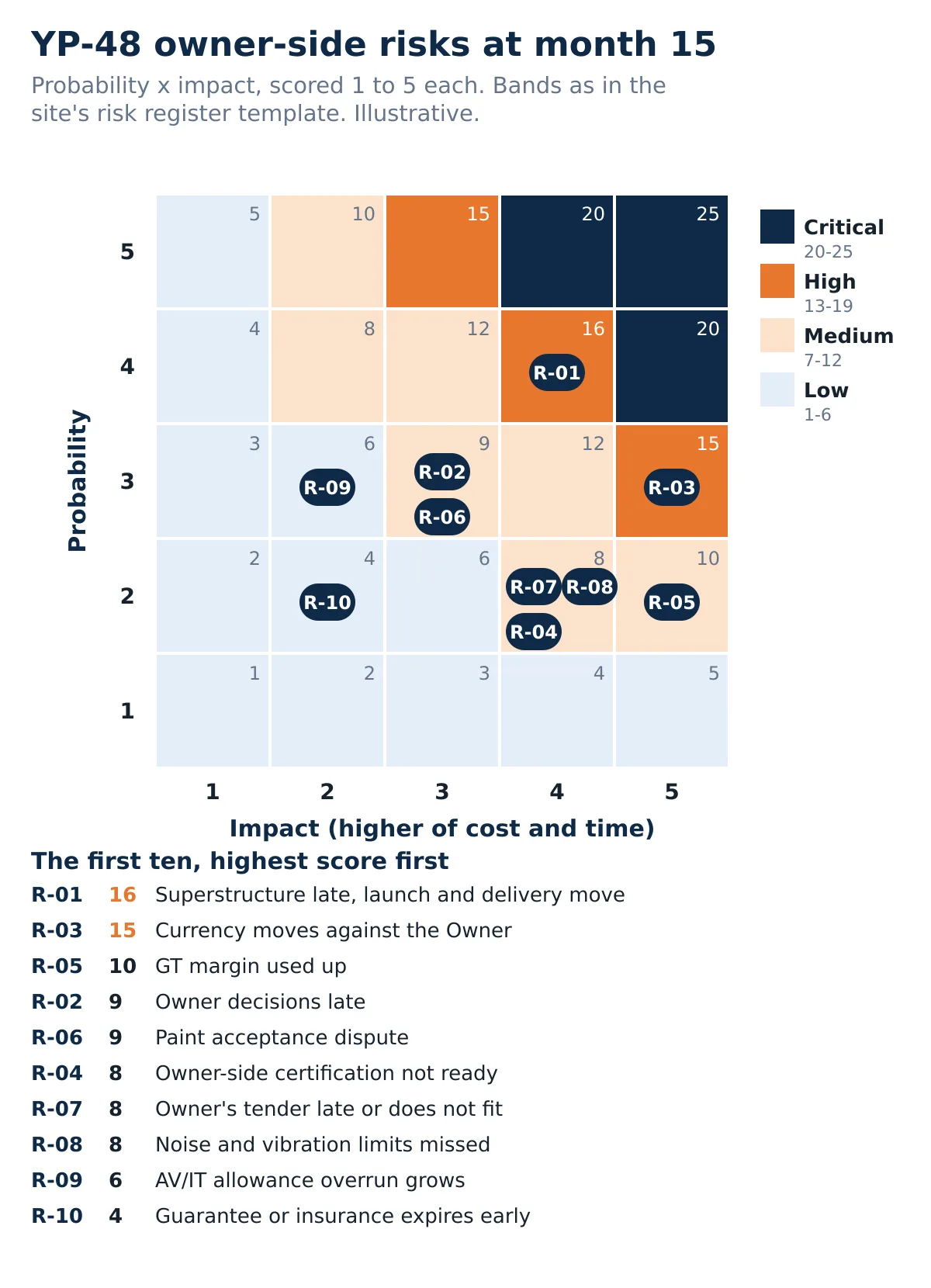
Scoring. YP-48 scores probability and impact from 1 to 5 and multiplies them, one of the numeric schemes the PMBOK Guide describes for a probability and impact matrix. Impact takes the higher of the cost and time scores, one of the ways the guide mentions for combining several objectives into one priority. The scales are written down before the first review and kept for the whole project:
| Score | Probability | Cost impact (index) | Time impact |
|---|---|---|---|
| 1 | up to 10% | under 0.1 | under 1 week |
| 2 | 11 to 30% | 0.1 to under 0.3 | 1 to 2 weeks |
| 3 | 31 to 50% | 0.3 to under 0.6 | 2 to 4 weeks |
| 4 | 51 to 70% | 0.6 to under 1.2 | 1 to 2 months |
| 5 | over 70% | 1.2 or more | over 2 months |
The score falls into the same bands as the site's Shipyard Risk Register Template: Low 1 to 6, Medium 7 to 12, High 13 to 19, Critical 20 to 25. The scales above are YP-48's choices; set your own before the first review, in your own currency if you do not use an index.
The first ten at month 15.
| ID | Risk | P | I | Score | Owner | Trigger | Response |
|---|---|---|---|---|---|---|---|
| R-01 | Superstructure behind plan moves launch and delivery | 4 | 4 | 16 High | Owner's representative | Joining forecast later than month 16 | Weekly critical path review; crew and delivery costs tied to the forecast date |
| R-03 | Contract currency strengthens against the Owner's funds | 3 | 5 | 15 High | Owner's finance office | Rate 2% or more against the budget rate | Hedging decision for milestones 4 to 7 this month |
| R-05 | GT margin used up before the design is complete | 2 | 5 | 10 Medium | Owner's representative | T7 margin below 2.0 GT (now 2.7) | Every change screened for GT; no enclosed volume without an offset |
| R-02 | Owner decisions late (stone samples, AV/IT specification) | 3 | 3 | 9 Medium | Owner's representative | A decision passes its needed-by date | Decision papers in each weekly report; captain on site |
| R-06 | Paint acceptance dispute delays delivery | 3 | 3 | 9 Medium | Owner's representative | Paint hold point failed | Reference panel and method agreed before fairing |
| R-04 | Owner-side certification not ready at delivery | 2 | 4 | 8 Medium | Build captain | Registration, manning, crew certificates not planned by month 24 | Owner-side certification tasks in the master schedule |
| R-07 | Owner's tender late or does not fit the garage | 2 | 4 | 8 Medium | Build captain | Tender builder misses its factory test | Interface drawing approved; date in the owner-supply annex |
| R-08 | Noise and vibration limits missed at trials | 2 | 4 | 8 Medium | Owner's representative | Predictions show less than the agreed margin | Consultant reviews predictions and mounts before installation |
| R-09 | AV/IT allowance overrun grows further | 3 | 2 | 6 Low | Owner's representative | Final specification priced above the budget quote | Two priced options before sign-off |
| R-10 | Refund guarantee or insurance expires before the forecast delivery | 2 | 2 | 4 Low | Project manager with counsel | Forecast delivery within 3 months of expiry | Extension requested as soon as the trigger is hit |
YP-48, illustrative. Probabilities and impacts are teaching values.
Several of these come straight from earlier lessons. R-05 is the GT margin tracked in the design freeze lesson, R-02 is the decision list in the weekly report, R-08 is contract finding F-09, and R-10 is the guarantee expiry the contract review told the planner to put in the risk register.
From the register to the contingency. The score ranks risks for attention; it does not size money. For that, YP-48 also records for each risk the probability as a percentage and the cost if it happens, and multiplies them into an expected value, the same arithmetic the PMBOK Guide uses for expected monetary value in decision trees. At month 15 the expected values of the nine risks the contingency is meant to cover add up to 1.45. Currency (R-03) is left out on purpose: its expected value of about 1.22 is managed by the hedging decision, not by the contingency.
The PMBOK Guide calls the next step reserve analysis: comparing the contingency remaining with the risk remaining, at any point in the project, to see whether the reserve is still adequate. On YP-48 the check is 2.29 of contingency after the forecast against 1.45 of expected risk, a ratio of about 1.6, which the owner's side reports as covered.
Two warnings keep that ratio honest. First, adding expected values assumes the risks are independent, and several of these are not: R-01, R-02 and R-06 all push the same delivery date, and a late delivery also lengthens the owner's team, crew and insurance lines. The risk article on this site explains why correlated risks make a simple matrix look better than reality. Second, the expected value of a risk is never what it costs if it happens. If R-05 happens, it costs 1.50, not 0.23. The ratio says whether the contingency is roughly the right size; it does not say that any single risk is covered.
The monthly owner budget report
The weekly report in the previous lesson is about progress. Money moves more slowly and is reported monthly, as one page in the month-end weekly report or as a separate note to whoever controls the Owner's funds. On YP-48 it has six parts:
- Headline. Forecast at completion against the current budget, contingency left after the forecast against expected risk, currency exposure. Three numbers, each with last month's figure beside it.
- Budget table. The table above, with a variance column and the lines that moved this month highlighted.
- Movements. Every contingency transfer and every Owner-approved budget change in the month, each with its risk ID or decision reference.
- Risks. New, closed and changed risks, and the coverage check. Any risk whose trigger has fired is listed first.
- Cash call. What the Owner has to fund in the next three months: milestone instalments from the payment plan tracker, signed variation orders, and the owner-side lines. Dates come from the live schedule, not from the baseline.
- Decisions needed. On YP-48 at month 15: CR-06 by 10 April, the hedging decision for milestones 4 to 7, and the AV/IT specification.
The headline for month 15 might read: "Forecast 116.26 against a current budget of 116.10, over by 0.16 on variation orders if the pending items are accepted. Contingency left after the forecast is 2.29 against expected risk of 1.45. The unhedged 61.01 still to pay would cost about 3.05 more if the contract currency moved 5% against us; a hedging decision is needed this month."
The template: T12 Owner Budget Tracker and Risk Register
The workbook has the budget and the risk register, each in a blank and an example version.
- Budget. One row per line: group, line, budget at signing, committed, paid and forecast at completion are inputs. Formulas pull transfers from contingency and Owner-approved budget changes from two logs under the table (by line name, chosen from a drop-down), and calculate the current budget, variance, percent committed and a flag for a forecast over budget, commitments over budget or payments over commitments. The summary gives the owner budget at signing and now, contingency drawn, remaining and after the forecast, the expected value of the risks it covers, the coverage ratio with a check, and the currency exposure for the move you choose to test.
- Risk register. One row per risk: category, cause and trigger, probability %, cost impact, time impact in weeks, whether contingency covers it, owner, response, status and review date. Formulas turn the percentage and impacts into P and I scores on the scales above, multiply them, set the level with a colour, and calculate the expected value. The summary counts open and High or Critical risks and totals the expected value inside and outside the contingency.
The examples are YP-48 at month 15, with the budget, the three contingency transfers, the tender budget change and the ten risks from this lesson.
Download: Owner Budget Tracker and Risk Register (T12), xlsx
The variation order figures come from the Owner Change Request Form and Change / VO Log (T9), and the GT margin behind R-05 from the Drawing Approval Register and Weight / GT Tracker (T7).
Before you send the monthly budget
Check that:
- every item the contract excludes and every owner-furnished item has a budget line, even if its first figure is an estimate with a name and a date;
- allowances are shown inside the contract price, with their expected over- or underspend on a separate line;
- the variation order line matches the change log, signed and pending;
- each contingency transfer names a risk, and each piece of new scope the Owner chose is a budget change, not a contingency draw;
- the management reserve has been touched only by the Owner;
- time-based lines (owner's team, crew, insurance) have been re-forecast against the current delivery forecast, not the contractual date;
- currency exposure is reported on its own line with the unhedged amount and the move tested;
- every open risk has a named owner, a trigger and a review date, and the coverage check has been run;
- the cash call for the next three months uses dates from the live schedule.
The next module of this series turns to procurement: who buys what, how the makers list and the owner-furnished items are managed, and how long-lead packages are tied to the schedule.