

Turn yacht contract milestones into a payment plan: provable definitions, evidence packs, security checks, a cash-flow curve and a free xlsx tracker.
A payment milestone is only as good as the proof behind it. This lesson turns the milestones of a yacht contract into a working payment plan: a written definition for each milestone, a list of the evidence that proves it, a route from the Yard's claim to the Owner's payment, and a cash-flow curve that shows who is carrying the money at each stage. It ends with a tracker you can use on your own project.
The lesson builds on earlier material and does not repeat it. Milestone Payments in Superyacht Contracts explains why milestone definitions cause so much friction, and why "ready for delivery" is the hardest of them. Reviewing a Yacht Yard House Contract gives the checklist questions for the payment, security and dispute clauses. The Master Schedule for a Yacht Build places the payment milestones in time. Here we take those three and build the tool that connects them.
This is not legal advice. The contract and your counsel decide what a milestone requires and what happens when it is disputed. The project manager's job is to make the agreed terms measurable, collect the proof and keep the record straight.
Illustrative project: Project YP-48 is fictional. Its parameters are chosen from publicly reported industry ranges so the numbers are realistic, but no real yard, owner or yacht is described.
The plan for YP-48
YP-48 is a 48 m full-custom motor yacht designed to stay under 500 GT, for private use and charter with up to 12 guests, built to the Red Ensign Group Yacht Code Part A (July 2024 edition). The contract runs 30 months from signature to delivery, with seven payments including the signing instalment and a 12-month warranty. The flag is the Cayman Islands and the class society is Lloyd's Register, both illustrative choices explained in Rules Before Lines. The parties are the Yard, the Owner and the Owner's representative, introduced in Anatomy of a Superyacht Newbuild.
All money is an index: the contract price is 100. The months come from the YP-48 master schedule. The shares are an illustrative split chosen for teaching. There is no standard split for yacht milestone payments; industry guidance commonly describes six to eight payment stages, and the weighting is negotiated project by project.
| No | Payment milestone | Month | Share (illustrative) | Cumulative |
|---|---|---|---|---|
| 1 | Contract signature | 0 | 10 | 10 |
| 2 | Keel laying | 5 | 15 | 25 |
| 3 | Main engines installed and aligned | 14 | 15 | 40 |
| 4 | Hull and superstructure joined | 16 | 15 | 55 |
| 5 | Launch | 24 | 15 | 70 |
| 6 | Sea trials complete | 28 | 10 | 80 |
| 7 | Delivery | 30 | 20 | 100 |
Eighty of the hundred are paid before delivery. How that compares with the alternatives, from an even split to a delivery-heavy tail, is covered in How a Shipbuilding Contract Works. What matters in this lesson is that each of those seven lines needs a definition, an evidence list and an owner on each side before the first claim arrives.
Writing a milestone definition that can be proved
A milestone definition answers one question: on the day the Yard says "done", what exactly has to be true, and how will both sides know? A useful test is to read the definition aloud to someone who has never seen the yacht. If they could walk on board with it and say yes or no, it works. If they would need to ask what you meant, it does not.
Good definitions tend to contain the same five parts:
- Object. Which part of the yacht, named precisely enough to find: a block number from the block plan, both main engines and both gearboxes, the full length of the superstructure joint.
- State. What condition the object is in: erected and aligned, chocked and bolted, welded and inspected, afloat and moored. Avoid words that describe a start ("commenced", "begun") or a feeling ("substantially complete").
- Standard. Which approved document the state is measured against: the approved drawing, the alignment calculation, the pre-launch list in the contract annex, the trial programme.
- Witness. Who must see it: the Owner's representative, class, the equipment maker's engineer, or a combination.
- Record. Which document proves it. If the record does not exist yet, name the form that will be used.
Here is the difference in practice, using YP-48 wording. The example assumes a steel hull and an aluminium superstructure, as in the master schedule lesson.
| Weak wording | Why it fails | YP-48 definition (illustrative) |
|---|---|---|
| Keel laid | For a hull built upside down, which part is "the keel"? | Keel block K1, as listed in the block plan annex, completed, set in its position in the hull assembly and tack-welded to the adjacent block, with class attendance recorded |
| Engines installed | Engines sitting in the engine room are not installed in any useful sense | Both main engines and gearboxes landed on their seatings, chocked and bolted; shaft lines fitted; alignment measured and recorded within the limits of the approved alignment calculation |
| Superstructure fitted | Landed, tacked or fully welded and tested? | Superstructure landed and the steel-to-aluminium connection completed along its full length per the approved drawing; NDT of the joint completed and accepted; class inspection of the joint closed with no open findings |
| Yacht in the water | Floating tells you nothing about what was finished first | Afloat and moored at the Yard with every item on the pre-launch list in the contract annex complete, and class records for those items attached |
The engine example is not academic. A surveyor quoted in industry guidance on yacht payment terms warns that engine milestones are often written loosely, and that "shaft line and temporary alignment" should be spelled out rather than leaving the milestone at engines placed in the room. Where the approved alignment procedure requires a final check afloat, say which milestone that check belongs to. In YP-48 it belongs to Launch.
Three more rules keep definitions workable.
One milestone, one state. Do not combine a physical state with an unrelated condition ("hull joined and interior design approved"). If the second condition slips for reasons outside the Yard's control, the payment becomes a hostage to it.
Say what may stay open. A milestone with zero tolerance for open items invites argument over trivia. A milestone with unlimited tolerance means nothing. The launch definition above solves this with a named list: the listed items must be closed, everything else may stay open.
Decide what a variation does to the definition. Owner changes can alter the work inside a milestone, and the milestone article shows how quickly "complete" becomes a moving target. The practical fix is procedural: every variation order carries a line stating whether it changes a payment milestone definition, and if so, the new wording. The owner-side change process gets its own lesson later in this series; until then, the yard-side mechanics are in Change Order and Variation Order Processes.
The evidence pack
The evidence pack is the set of documents that proves a milestone definition has been met. It should be agreed per milestone before the first claim, ideally as a contract annex or a document signed off at the kick-off meeting, so that nobody is negotiating the proof while money is waiting.

Industry legal commentary recommends a simple sequence: the Yard signs off a milestone as complete and presents it to the buyer's technical representative for counter-signature. The evidence pack is what the Yard presents and what the representative checks. The owner's representative's wider role is covered in The Owner's Representative.
A pack usually draws on five kinds of record.
The signed joint inspection record. The core of the pack: a short form listing the definition's conditions one by one, with the result of the joint inspection against each, signed by the Yard and the Owner's representative. Everything else supports this document.
Survey and inspection reports. Dimensional checks, NDT reports, the Yard's own quality records. They prove the "standard" part of the definition, so each one should reference the drawing or procedure it measures against.
Class records. Class surveyors inspect against the society's rules and the plans class has approved; that is the technical scope classification societies describe for themselves. A class record proves what class saw and accepted. It does not, by itself, prove a contractual milestone, which is a commercial definition agreed between Owner and Yard. The two often overlap, and many yacht definitions make a class record one of the conditions, but they are not the same document. How class survey points fit into a build programme is covered in Managing Classification and Regulatory Milestones and Quality Assurance and Classification Society Surveys.
Test records. Alignment readings, pressure tests, trial results. They carry measured values and should state the acceptance limit next to each value, so the reader does not have to look it up.
Dated photographs. Useful, never sufficient. A photo shows that something existed at a moment, not that it met a standard. Photos earn their place when they are taken during the joint inspection, show an identifier (block number, equipment tag, frame number), carry the date and position, and are filed under the milestone they support. A folder of undated progress pictures is not evidence.
For YP-48, the pack for milestone 3 looks like this:
| Evidence item | Type | What it must show | Provided by | Checked by |
|---|---|---|---|---|
| Alignment record | Test record | Measured values within the approved alignment calculation, signed by the Yard and the engine maker's engineer | Yard | Owner's rep |
| Chocking record | Test record | Chock and bolt records for each engine and gearbox | Yard | Owner's rep |
| Class attendance record | Class record | Installation inspected; any open findings listed | Yard | Owner's rep |
| Product certificates | Certificate | Maker and class certificates matching the serial numbers installed | Yard | Owner's rep |
| Joint inspection record | Signed record | Walk-down of the engine room against each condition of the definition | Yard and Owner's rep | Both |
| Photo set | Photo set | Both engines on their seatings and shaft lines fitted, tags visible | Yard | Owner's rep |
The packs for the other six milestones are in the example sheet of the tracker at the end of this lesson.
Two habits make packs easy to audit later. Give every document a reference that starts with the milestone number (MS3-ALN, MS3-CLS), and keep one folder per milestone under the project's document control, not in someone's email. The general rules for that are in Document Control and Technical Data Packages.
From claim to payment
Every payment milestone should follow the same route, so the Owner's side knows where each claim stands and how long each step may take.
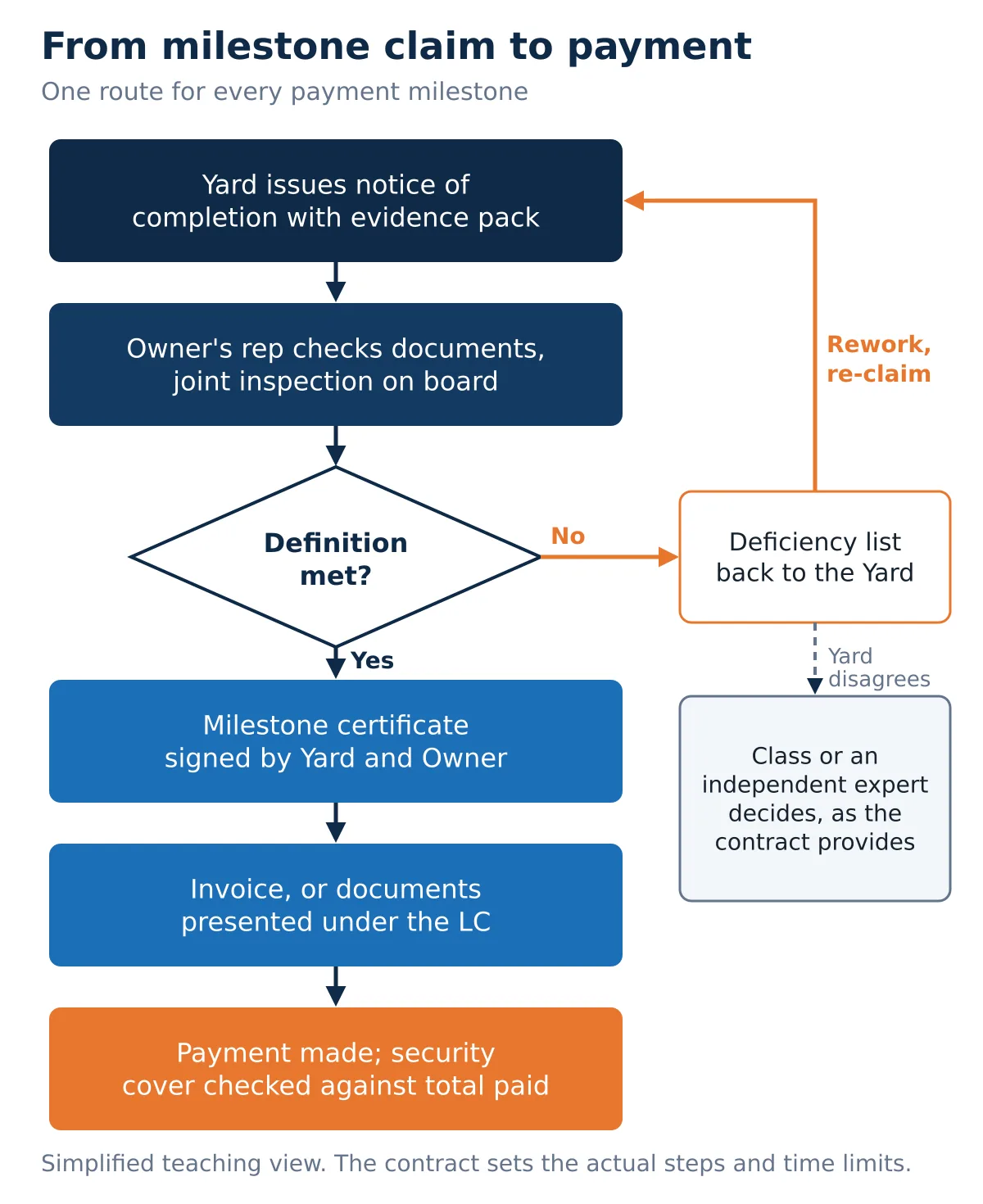
The time limits matter as much as the steps. Check what the contract says about the period the Owner has to inspect and either certify or reject, and the period to pay after certification. Put those periods into the tracker as dates, not as clause references. If the Owner's side lets a period run out, the Yard may argue that the milestone was accepted by default, or that payment is late.
A rejection should come back to the Yard as a deficiency list tied to the definition: which condition is not met, and what evidence is missing. "Not satisfied with the engine room" is not a deficiency. "Alignment record for the port shaft line not signed by the maker's engineer" is.
Where security fits in
The payment plan and the Owner's security are two views of the same exposure. Every instalment the Owner pays before delivery is money handed over for a yacht it does not yet own, unless title passes during construction. The tracker therefore carries one extra check: is the security in place at least equal to the total paid so far?
Refund guarantee. Where title stays with the Yard until delivery, the Owner's protection is a refund guarantee covering the pre-delivery instalments with interest. Reviewing a Yacht Yard House Contract lists the wording checks. For the payment plan, two things matter. First, the guarantee must be in hand before the first instalment; YP-48 builds that into the definition of milestone 1. Second, the guaranteed amount must keep up with the payments. In YP-48 the pre-delivery instalments total 80, so a guarantee for 80 covers the whole build. If a guarantee is issued in steps, each step should be a condition of the payment it covers.
Title during construction. Legal commentary notes that yacht owners often take title during the build where the yard cannot obtain credit lines for refund guarantees. In that case the evidence packs double as the record of what has been built and paid for. Ask counsel how title to equipment delivered but not yet installed is recorded, and keep that list next to the tracker.
Letter of credit. Some contracts pay instalments through an irrevocable letter of credit: a bank undertakes to pay the Yard when the documents named in the credit are presented. Under the ICC rules commonly applied to documentary credits (UCP 600), the credit is separate from the underlying contract, and the bank examines the documents presented, not the yacht; it has up to five banking days after presentation to decide whether they comply. The practical consequence is simple: the bank will pay against exactly the documents the credit lists. If the credit only requires the Yard's own certificate and invoice, the Owner's representative's check is bypassed. The document list in the credit should therefore include the milestone certificate countersigned by the Owner's side, and the wording of that certificate should be agreed together with the credit. Industry guidance on yacht payment terms makes the same point from the other side: letters of credit protect the owner only when the trigger terms are precisely drafted.
The cash-flow curve
The payment plan says what is paid and when. It does not say whether the payments are in step with the value being built. For that, put the cumulative payments next to an estimate of physical progress on the same index.
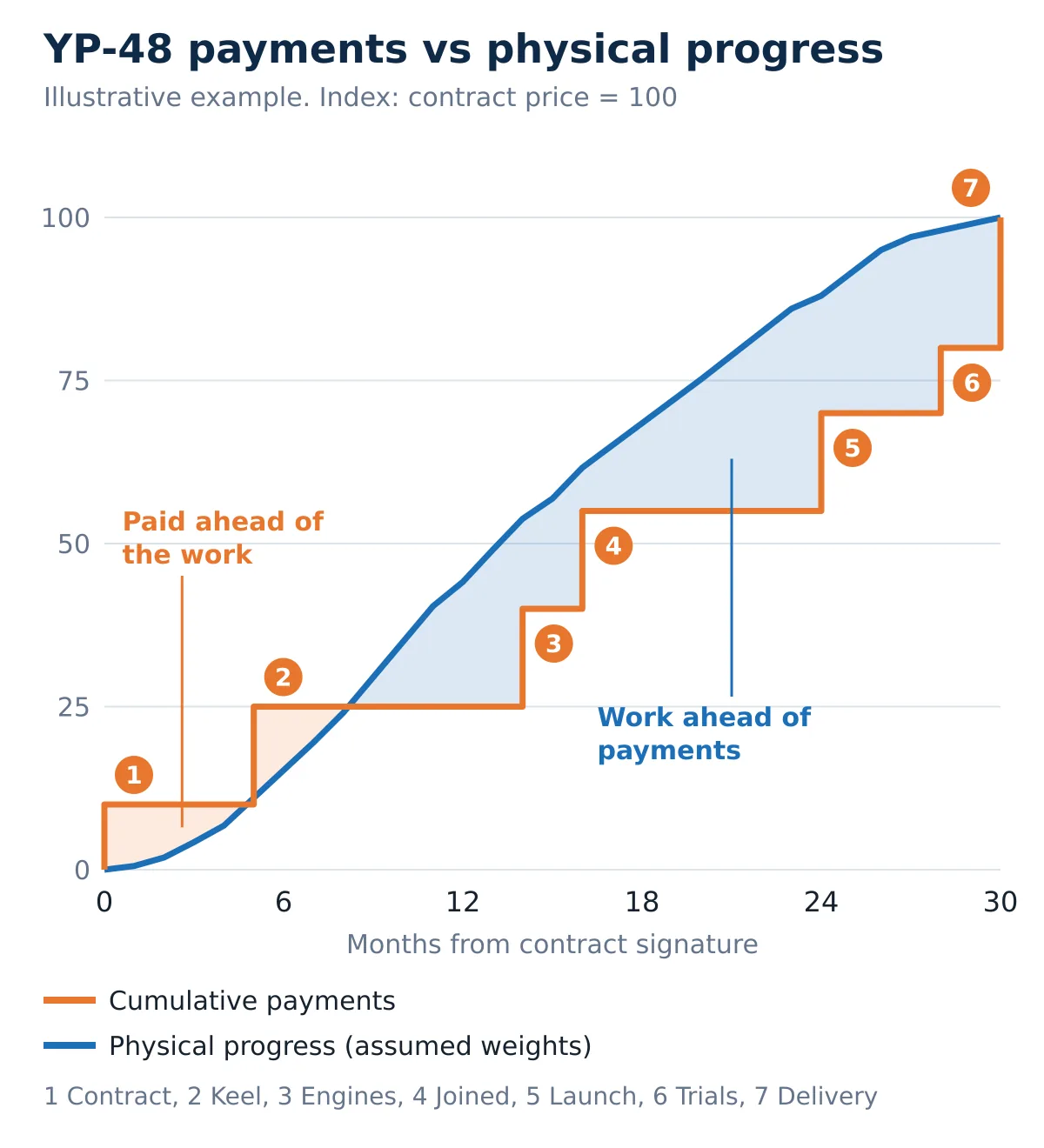
The blue curve is built from the YP-48 master schedule. Each schedule activity was given an assumed share of the total value (engineering 11, major equipment and packages 25, structure 20, systems 13, paint and exterior 11, interior 14, commissioning and trials 6) and that share was spread evenly over the activity's duration. The weights are a teaching assumption, not data. On a real project the Yard's cost plan or your own estimate replaces them, and actual progress replaces the forecast every month. The method is the same one used for earned value; if it is new to you, see Earned Value Management on a Shipyard Project.
Reading the YP-48 curve:
- Months 0 to 8: the Owner is ahead. Signature and keel laying put 25 on the table while little has been built. The gap is widest just after keel laying, at about 14 points in month 5. This is the period the refund guarantee exists for.
- Month 8 to delivery: the Yard is ahead. From about month 8 the value built exceeds the payments, and the gap grows to roughly 33 points just before the launch payment in month 24. The Yard is financing that difference, which is where its interest in claiming milestones early comes from.
- The last 20. At month 28 about 98 of 100 has been built and 80 paid. The delivery payment is the Owner's leverage over the finish, the open items and the documentation, which is exactly why the delivery definition has to be tight.
The curve is a negotiation tool before signature and a monitoring tool after. Before signature it answers the checklist question from the contract review: is the cumulative amount paid at each milestone roughly in line with the value built by then? After signature, redraw it monthly with actual progress and forecast milestone dates from the current schedule, not the contract months. Two signals deserve attention. A payment curve moving left (the Yard proposing to bring a milestone forward or split it) widens the Owner's exposure. A progress curve flattening while milestones hold their dates usually means a claim is coming before the work is ready.
The same forecast gives the Owner's side its funding plan. Whoever releases the money needs dates, and those dates should come from the live schedule with a margin for the inspection and certification periods.
When a milestone is disputed
Most milestone claims are settled by the joint inspection. Industry legal commentary suggests that disputes are rare where definitions are clear-cut, which is the best argument for the work in the sections above. When one does arise, handle it in this order.
- Answer within the contract period, in writing. Reject with a deficiency list, as above. Silence is the worst answer, because a missed deadline can turn into deemed acceptance or a late-payment claim.
- Separate the kind of disagreement. Is it about facts (is the alignment within limits?), about meaning (does "complete" include the item the variation added?), or about something outside the milestone altogether? Only the first is a technical question.
- Use the technical route for technical facts. Legal commentary recommends that the contract let class or an independent expert assess whether a milestone has been reached, and describes expert determination as much faster and cheaper than arbitration for technical disputes. Whether your contract has that route, and whether the decision is binding, is a question for the contract review.
- Send questions of meaning to counsel. An interpretation dispute is a legal question. Arbitration is the last step, not the first; see Why Yacht Disputes Go to London Arbitration for why it usually ends up in London.
- Keep the project moving. Check whether the contract allows payment of an undisputed part of the instalment, and whether work must continue during the dispute. Withholding payment outside the contract's procedure is risky: shipbuilding contracts typically let the builder charge interest, suspend work and eventually terminate after non-payment. Follow the procedure, not instinct.
- Record everything in the tracker. Status "Disputed", the date, the deficiency list reference and the next deadline. When the dispute is settled, the evidence pack for that milestone should tell the whole story without anyone's memory.
The tracker: T6 Milestone Payment Plan and Evidence Tracker
The template puts the plan and the evidence checklist on one sheet, so the two cannot drift apart.
- Payment plan (top). One row per milestone: definition, evidence summary, who is responsible at the Yard, who verifies, survey or inspection reference, certificate date, status, share, payment date and notes. Formulas give the cumulative share, the paid-to-date total (only rows marked Paid count), the gap between cumulative share and your estimate of physical progress, and a count of evidence items marked OK for each milestone.
- Checks (under the plan). The shares must total 100, and the security cover must be at least the amount paid. Both cells turn orange when they fail.
- Evidence checklist (below). One line per document, linked to its milestone by number, with type, what it must show, who provides and checks it, date received, file reference and an OK column.
- Status list. Planned, Claimed, Certified, Invoiced, Paid, and Disputed while a claim is contested.
The "Example (YP-48, illustrative)" sheet shows the plan at month 14: milestones 1 and 2 paid, milestone 3 claimed with five of six evidence items accepted and the joint inspection record still open. The "Blank" sheet has the same layout for your own project.
Download: Milestone Payment Plan and Evidence Tracker (T6), xlsx
A simple monthly routine keeps it useful: update the status and evidence columns after each inspection, refresh the physical progress estimates from the latest progress report, redraw the curve, and check the security line before every payment. The EVM Tracker Template can supply the progress figures if you already run earned value on the project.
Before the first claim
Most payment disputes can be prevented before the Yard sends its first notice. Before signing off the payment plan, confirm that:
- every payment milestone has a definition with an object, a state, a standard, a witness and a record;
- every definition has an agreed evidence list, and the forms (joint inspection record, milestone certificate) exist;
- inspection, certification and payment periods are in the tracker as dates;
- the security in place is at least the total that will have been paid at each milestone;
- if payment runs through a letter of credit, its document list matches the milestone certificate;
- the variation order form asks whether a change alters a milestone definition;
- the route for a disputed milestone (class, expert, counsel) is known to everyone on the Owner's side.
The next lesson in this series moves from money to design: the specification, the general arrangement and the design freeze that the rest of the schedule depends on.