
Where each party's job stops on a yacht build: owner, rep, captain, designers, naval architect, yard, class and flag, with a RACI matrix and free template.
A commercial newbuild has three principals: the owner, the yard and class. A yacht newbuild has the same three, plus a group of people the owner hires directly: a representative, a future captain, a design studio, often a broker at the start and sometimes an independent naval architect. Each of them has a contract, a fee and a view of what the yacht should be. None of them works for the yard, and several of them can speak to the yard.
That is why roles on a yacht build need to be written down, not assumed. This lesson goes through each party, draws the line between the ones that are most often confused, and ends with a responsibility matrix (RACI) for our example project, which you can download and adapt.
Anatomy of a Superyacht Newbuild introduced the parties in one paragraph each. The case for having an owner's representative at all is made in The Owner's Representative: Why Yacht Builds Need a Role Commercial Shipbuilding Doesn't. Neither is repeated here. This lesson is about boundaries: where one party's job stops and the next one's starts.
Illustrative project: Project YP-48 is fictional. Its parameters are chosen from publicly reported industry ranges so the numbers are realistic, but no real yard, owner or yacht is described.
The organisation of YP-48
YP-48 is a 48 m full custom motor yacht with a design target of 499 GT, built for private use and charter with 12 guests under the REG Yacht Code Part A, July 2024 edition. The contract runs 30 months from signing to delivery with seven stage payments, and the contract price is expressed as an index of 100. The flag is the Cayman Islands, a Red Ensign Category 1 register, and the class society is Lloyd's Register; both are illustrative choices explained in Rules Before Lines.
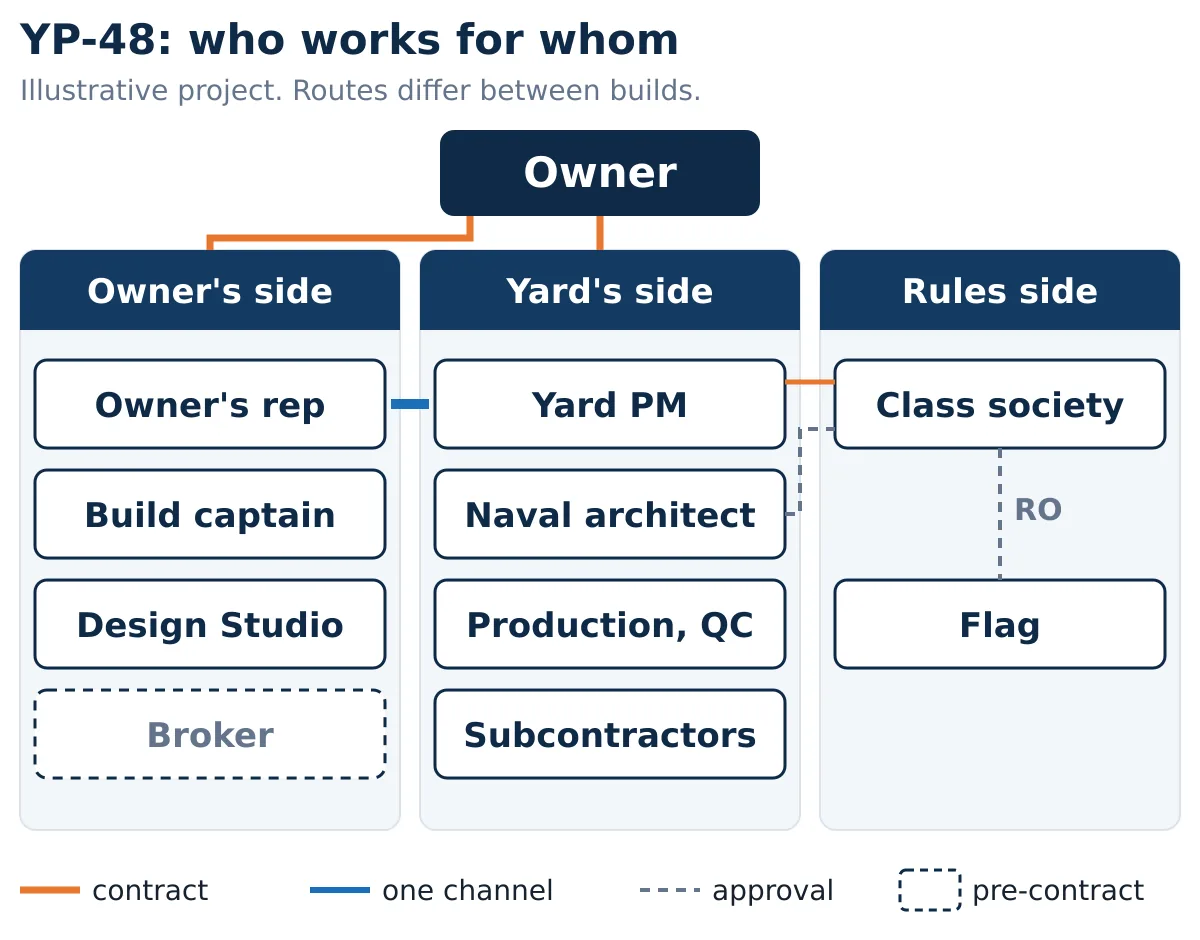
For this lesson we fix how the parties are contracted. On a real project these choices vary, and the choice changes who carries which risk.
- The Owner holds contracts with the Yard, the Design Studio and the owner's representative.
- The Design Studio does both exterior and interior design.
- The naval architect is engaged by the Yard. On other projects the naval architect sits in the design studio or works for the owner directly.
- The build captain is employed by the Owner and joins during the build.
- A broker helped with the yard shortlist and the negotiation. In YP-48 the broker's role ends at contract signature.
- Class is requested by the Yard under the build contract. The flag's approval work is partly delegated to that class society acting as a Recognised Organisation (RO).
The Owner's side
The Owner
The Owner is the only party who can change what is being bought: the price, the delivery date, the scope and the look of the yacht. Everything else can be delegated. On paper that makes the Owner accountable for a long list of decisions. In practice the Owner is rarely on site, often decides through a family office or a management company, and has limited time for technical detail.
Some duties cannot be passed to the yard at all. The UK Ship Register's guidance to builders of large yachts points out that items such as crew qualifications and ISM requirements are outside the builder's control and sit with the owner. A build contract that promises a fully certified charter yacht at delivery therefore depends on things only the owner's side can do, and the guidance suggests adjusting the contract wording accordingly.
The practical task for a project manager is to find out early which decisions the Owner will take personally and to put a date on each of them in the schedule. The master schedule lesson shows how to give each owner decision its own activity: The Master Schedule for a Yacht Build.
The owner's representative
The owner's representative is the Owner's technical and commercial agent at the yard: reviewing drawings, inspecting work, checking milestone claims, handling change requests and keeping the Owner informed. The role has become a profession of its own. A dedicated qualification for yacht owner's representatives has been developed in partnership with the Superyacht Builders Association (SYBAss) and other industry bodies, and graduates can apply to a representatives' register set up as a SYBAss initiative.
The boundary that matters most is authority. A representative who can approve nothing turns every question into a wait for the Owner. A representative with no written limit can commit the Owner to cost the Owner never saw. The answer is a delegation letter, issued by the Owner, copied to the Yard and referred to in the contract. It says what the representative may decide alone and what goes back to the Owner. The YP-48 version is at the end of this lesson.
The representative does not design the yacht, does not run the Yard's schedule and does not instruct the Yard's subcontractors. Those limits protect the Owner: a representative who instructs a subcontractor directly has just given the Yard a reason to claim that the work is no longer its responsibility.
The build captain and heads of department
Many owners bring the future captain, and later the chief engineer and other heads of department, into the build. Their value is operational: they know how the yacht will be run, cleaned, maintained and crewed. Crew agency guidance describes their work on new builds as drawing approvals, on-board inspections, designer meetings, factory acceptance tests, yard progress meetings, managing the owner's supply, harbour acceptance tests and commissioning of their own areas.
The captain and the representative overlap in almost every one of those activities, which is where friction starts. A simple rule settles most of it: the captain advises on operation, the representative decides within the delegation letter, and both speak to the Yard through the same channel. Where the captain disagrees, the disagreement goes to the Owner in writing, not to the Yard on the deck.
The broker
Before contract, a broker or new-build adviser often helps the Owner choose a designer and a yard and negotiate the price and terms. Large brokerage houses describe exactly that service for their new-build clients. On the sale and purchase side of the market, brokers are usually paid a commission on the deal.
Two boundaries follow. A broker is not an owner's representative, even when both services are offered by the same firm, and the Owner should know how each adviser is paid and by whom. After signature, a broker has no role in the RACI unless the Owner gives them one in writing. In YP-48 the broker's work ends at the contract and the broker does not appear in the matrix.
The design side
The most common confusion on a yacht build is between the designer and the naval architect. Owners tend to say "the designer" for both. Contracts should not.
Exterior designer
The exterior designer, sometimes called the stylist, owns the profile, the proportions and the look of the decks. The work sets the general arrangement the Owner falls in love with, which is why late exterior changes are expensive: a larger window or a longer superstructure is a styling change for the designer and a structural, weight and tonnage change for everyone else.
Interior designer
The interior designer owns the layout inside the approved general arrangement, the materials, the finishes and the loose furniture. On a yacht the interior is a long package of its own, with samples, mock-ups and owner approvals that run for most of the build. Heavy materials such as stone and solid timber make the interior designer a regular consumer of the weight budget.
Naval architect
The naval architect is responsible for the yacht floating on her lines and performing safely at sea: hull form, stability, structure, weight and, very often, the engineering of propulsion and other systems. Boat International describes the growing split between the artistic side of yacht design and the technical discipline of naval architecture, with the naval architect still at the centre of turning a concept into a buildable yacht.
For a project manager the naval architect's most useful output is the weight and GT budget. On a 499 GT yacht every design change has a tonnage price, and the naval architect is the one who can tell you what it is. The naval architect also prepares or checks much of what goes to class for plan approval.
Where the naval architect sits changes the risk. If the Yard employs the naval architect, as in YP-48, the Yard is answerable under the contract for the design's technical performance. If the Owner employs the naval architect, the Owner may carry part of that risk, and the contract has to say who is responsible for what when the yacht comes out heavy.
Who owns what in the design
| Topic | Exterior designer | Interior designer | Naval architect | Yard engineering |
|---|---|---|---|---|
| Profile and styling | Owns | Consulted on views | Checks weight and stability | Checks buildability and cost |
| General arrangement | Owns the concept | Owns interior zones | Checks structure, escape routes and GT | Develops production drawings |
| Hull form and speed | Consulted | Owns | Consulted | |
| Structure and scantlings | Owns or checks | Details and builds | ||
| Weight and GT budget | Consumes | Consumes | Owns | Reports actual weights |
| Materials and finishes | Owns outside | Owns inside | Checks weight and fire rules | Procures and installs |
The table uses words, not RACI letters, because design work is iterative. The matrix further down puts letters on the decisions.
The Yard's side
The Yard builds the yacht to the contract and the approved plans and carries the construction risk until delivery. Inside the Yard the owner's team usually meets:
- The yard project manager, the owner's representative's counterpart and the single channel for instructions to the Yard.
- Engineering, which turns the design into production drawings and submits plans for approval.
- Production and the trades, including subcontractors for interiors, paint, AV/IT and specialist systems.
- Quality control, which inspects the Yard's own work before it is offered to the owner's team and to class.
The owner's side should never manage the Yard's people or subcontractors directly. The Yard's quality staff and the owner's representative may look at the same weld or the same veneer panel, but they are checking against different things: the Yard against its own standard and the plans, the representative against the contract specification. The Yard stays accountable for workmanship even after the representative has walked past it. Contracts often say whether owner approval of a drawing or sample shifts any responsibility to the Owner; Reviewing a Yacht Yard House Contract has the questions to ask.
Class and flag
Class and flag are not parties to the build contract and do not work for the Owner. They apply rules. Knowing where those rules end is one of the most useful things a yacht project manager can know.
The class society
According to the IACS paper on the role of classification, the class process during construction consists of reviewing the design plans, attending the construction at the yard, attending the production of key components such as steel, engines and generators, and attending sea trials, before a class certificate is issued on the builder's or owner's request. The same paper is clear about what the certificate is not: it is not a warranty of safety, fitness for purpose or seaworthiness, only an attestation that the vessel complies with the society's rules.
The paper also lists items that generally fall outside classification unless a specific notation brings them in, including manoeuvring performance, hull vibration, the number and qualification of crew and spare parts. On a yacht, several of these are acceptance criteria that matter to the Owner. Noise and vibration in a guest cabin, for example, are not something class will reject the yacht for unless the rules or a notation cover them. They have to be written into the contract specification and verified by the owner's team.
The effectiveness of class also depends on the builder cooperating openly during construction, which makes the Yard, not the Owner, the day-to-day counterpart of the class surveyor.
The flag
The flag administration certifies the yacht against the statutory rules, for YP-48 the REG Yacht Code Part A. For a charter yacht, the flag's certification is what allows commercial use. A Red Ensign Category 1 register can register ships of unlimited tonnage and type.
Flags can authorise Recognised Organisations, usually class societies, to carry out statutory surveys and certification on their behalf. The IMO framework for this is the Code for Recognized Organizations, and the flag state keeps responsibility and oversight even where the work is delegated. The split is set by each flag. The UK Ship Register's guidance for large yachts, for example, gives the hull and machinery part of the code to the class society, keeps the remaining sections for its own surveyors, and advises submitting the drawing list early so that approval questions do not appear at the end of the build.
For the project manager, the flag split has to be known before the approval register is built: which drawings go to class, which to the flag, and which to both. On YP-48 that split will be fixed once the register is chosen. The general approach to class and regulatory milestones in a schedule is in Managing Classification and Regulatory Milestones.
The YP-48 responsibility matrix
A RACI matrix gives every activity four kinds of involvement: R for the party that does the work, A for the party that is accountable for the outcome, C for parties consulted before the decision and I for parties informed afterwards. The central rule is one A per row. The commercial version of this exercise, and why a generic RACI prevents nothing, is covered in Stakeholder Management Between Owner, Yard and Class.
Two conventions make the yacht version work:
- For approval rows, the A sits with the body whose signature closes the item, for example class for class plan approval. The Yard remains contractually responsible for obtaining the approval; that obligation lives in the contract, not in the matrix.
- A/R means the same party does the work and answers for it, which is normal for the Yard's own schedule and trials.
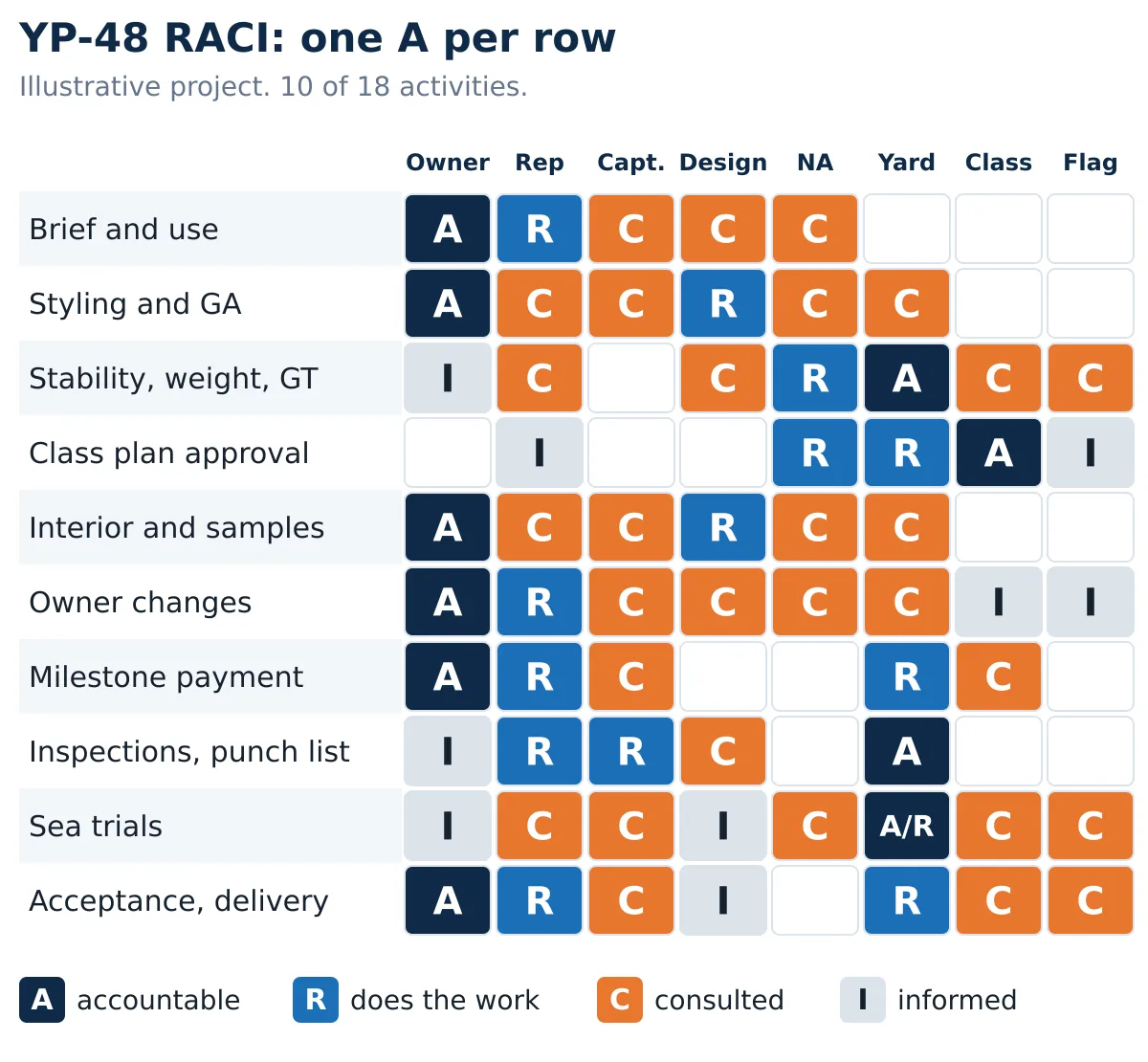
The full matrix for YP-48:
| Activity | Owner | Rep | Capt. | Design | NA | Yard | Class | Flag |
|---|---|---|---|---|---|---|---|---|
| Design brief and intended use (charter, guests, cruising area) | A | R | C | C | C | |||
| Choice of code, flag and class society | A | R | C | I | C | C | ||
| Yard selection and contract negotiation | A | R | C | C | ||||
| Exterior styling and general arrangement | A | C | C | R | C | C | ||
| Hull form, stability, weight and GT budget | I | C | C | R | A | C | C | |
| Class plan approval (hull and machinery) | I | R | R | A | I | |||
| Code plan approval for items the flag keeps | I | R | R | C | A | |||
| Interior design, samples and mock-ups | A | C | C | R | C | C | ||
| Owner change request: scope, price and time | A | R | C | C | C | C | I | I |
| Master schedule and progress reporting | I | C | I | I | A/R | |||
| Milestone completion and payment release | A | R | C | R | C | |||
| Owner-furnished equipment supply | A | R | R | C | C | |||
| Workmanship inspections and punch list | I | R | R | C | A | |||
| Harbour acceptance tests and sea trials | I | C | C | I | C | A/R | C | C |
| Crew recruitment, manning and safety management | A | C | R | I | C | |||
| Acceptance and protocol of delivery | A | R | C | I | R | C | C | |
| Registration and statutory certificates | R | C | C | R | R | A | ||
| Warranty claims in the first year | A | C | R | R |
Reading the matrix row by row shows where YP-48 is exposed:
- The Owner holds the A on eleven of the 18 rows. That is normal for a yacht, but each of those rows needs a decision date and a route for getting the Owner's answer. If the Owner is unreachable for three weeks, the rows marked A are where the schedule stops.
- The owner's representative is R on eight rows and A on none. Everything the representative does is done for the Owner, which is exactly why the delegation letter below matters.
- The build captain is R only where operations are involved: owner's supply, inspections, crew and warranty. On design rows the captain is consulted, not deciding.
- The naval architect is consulted on the exterior, the interior and owner changes. Leaving that C out is how a yacht drifts over its tonnage target one small change at a time.
- Class and flag never hold an A on a commercial row. They are A only on their own approvals.
A communication matrix is a different tool. It sets who reports what to whom, how often and through which channel. The Owner-Yard-Class Communication Matrix template covers that side and works alongside the RACI.
The delegation letter: authority in numbers
The RACI says who decides; the delegation letter says how far. For YP-48 the Owner has set the following limits for the owner's representative. The values are illustrative and expressed against the contract price index of 100.
| Decision | Owner's rep may decide | Goes to the Owner |
|---|---|---|
| Owner change request, price effect | Up to 0.25 per request and 1.5 in total | Above either limit |
| Owner change request, delivery date effect | None | Any effect on the contractual delivery date |
| Change affecting GT budget, class notation or exterior profile | None | Always |
| Drawing comments within the approved specification | Yes, within the contractual review period | If the comment changes scope |
| Interior samples and finishes | Technical acceptance only | Look and feel always |
| Milestone completion certificate | Signs the technical certificate | Payment release |
| Acceptance at delivery | Recommends | Signs the protocol |
Three details make the letter work. The cumulative limit stops a series of small approvals adding up to a large one. The date limit is absolute, because a delivery date moved by accident is very hard to move back. And the letter goes to the Yard, so the yard project manager knows when an instruction from the representative is binding and when it still needs the Owner. How change requests are then priced and processed is covered in Change Order and Variation Order Processes, and milestone certificates in Milestone Payments in Superyacht Contracts.
Where the boundaries blur
The matrix is tested by situations it does not name. Four patterns are worth rehearsing on YP-48, and each has a matrix answer.
The designer talks to the yard. The Design Studio sends a revised detail straight to the Yard's joinery subcontractor to save a week. The Yard builds it, and later claims a variation. Matrix answer: the Design Studio is R for design, not for instructions. Revised drawings go through the owner's representative to the yard project manager, and the Yard prices them before work starts.
The captain changes an item on the deck. During an inspection, the captain asks the Yard's foreman to move a switch panel in the engine room. Matrix answer: an owner change request, row R09. The captain is C; the representative raises it; the Yard prices it; the Owner or the representative decides within the letter.
The GT creep. Several interior upgrades are each within the representative's price limit, but together they push the weight and volume towards the tonnage line. Matrix answer: the naval architect is C on every interior and change row, and any change touching the GT budget goes to the Owner regardless of price.
Class passes it, the Owner rejects it. A cabin meets the class rules but the noise level at the bed is above what the Owner expected. Matrix answer: class was never accountable for comfort. The criterion should be in the specification, and the owner's team verifies it at trials under row R14.
Template: Yacht Build RACI Matrix (T2)
The template is the matrix and the delegation table from this lesson in a working spreadsheet. It has three sheets:
- "Read me" explains the letters, the one-A rule and how to adapt the columns.
- "Blank" has the activity list and empty RACI cells, with a drop-down for R, A, C, I and A/R, and a check column that flags any row without exactly one A.
- "Example (YP-48, illustrative)" is the filled matrix and delegation table for the fictional project.
Download: Yacht Build RACI Matrix (T2), xlsx
Adapt the columns before the rows. If your naval architect works for the Owner, or your design is split between two studios, change the columns first and then work through each row. Agree the matrix at the kick-off meeting with the Yard present, and issue it with the delegation letter as a controlled document.
Before the next lesson
Take the Blank sheet and fill it for a yacht project you know. Mark every row where you hesitated over the A: those are the decisions most likely to stall. The next lesson looks at the rule framework (code, flag, class and the 500 GT line) that several of those decisions depend on.