DP2 and DP3 are not class notations. How IMO equipment classes map to DNV, ABS, LR and BV, and what the choice does to design, FMEA and trials.
In an offshore vessel specification, the dynamic positioning requirement often takes up a single line: "DP2" or "DP3", sometimes with a class society's notation after it. That line decides how many engine rooms the vessel has, how its cables are routed, what goes into the FMEA, how long the DP trials take and which documents the owner will ask for at delivery. It deserves more attention in contract review than it usually gets.
This article is written for planners, project managers and contract staff on the yard or owner side. It explains what the IMO equipment classes actually require, how the class societies' notations map onto them, and where DP work shows up in the build schedule. It is not a design guide. The rule texts referenced below are the documents to work from.
Where the DP classes come from
The reference point for all DP classes is an IMO document, not a class rule. The current version is MSC.1/Circ.1580, Guidelines for vessels and units with dynamic positioning (DP) systems, approved in June 2017. It replaced MSC/Circ.645 from 1994. The IMO recommends applying the 2017 guidelines to vessels constructed on or after 9 June 2017. Vessels built between 1 July 1994 and that date may continue under Circ.645, although the operational section of the new guidelines is recommended for all vessels.
These are guidelines, and flag administrations apply them. In practice, most of the detailed requirements a yard builds to come from the notation rules of the chosen class society, which are written to line up with the IMO classes. Some society rules go further than the IMO text.
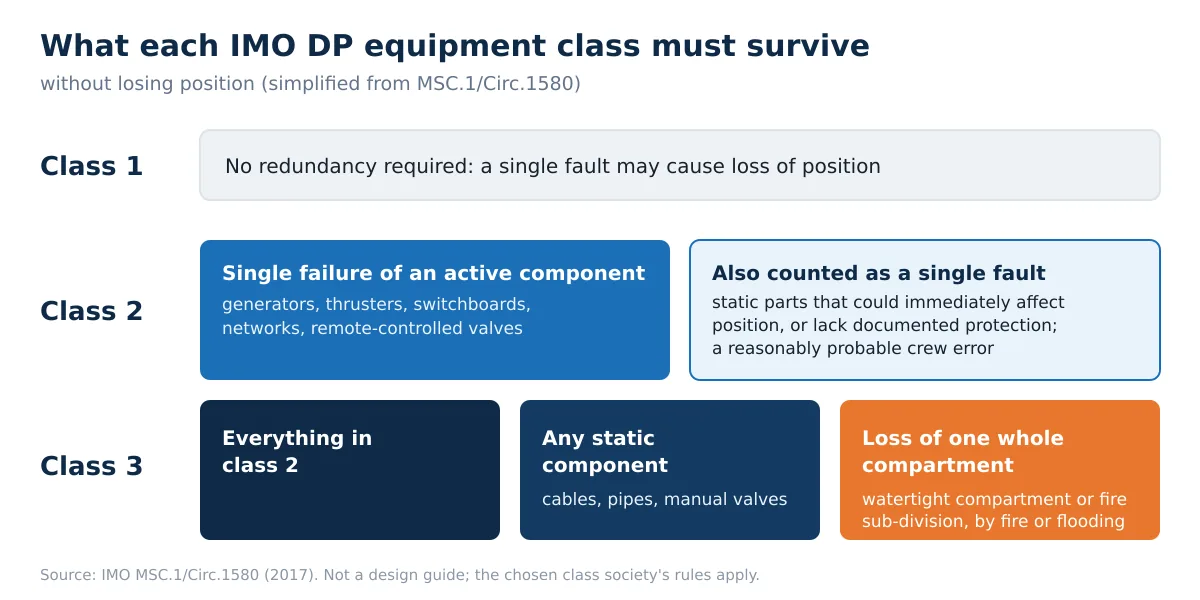
The IMO groups DP systems into three equipment classes and defines each one by what the vessel is allowed to lose:
- Equipment class 1: a single fault may lead to loss of position or heading. The power system and the DP control system need not be redundant.
- Equipment class 2: a single fault in any active component or system (generators, thrusters, switchboards, networks, remote-controlled valves) must not cause loss of position. Static components such as cables, pipes and manual valves count as failure points if they could immediately affect position keeping or if their protection is not properly documented.
- Equipment class 3: everything in class 2, plus any static component assumed to fail, plus the loss of every component in any one watertight compartment or any one fire sub-division through fire or flooding.
For classes 2 and 3, a single inadvertent act by the crew also counts as a single fault if it is reasonably probable. A vessel assigned a class is considered suitable for DP operations in that class and the classes below it.
The difference between class 2 and class 3 is where the build cost goes. Class 2 is about duplicating active equipment. Class 3 is about physical separation: the circular calls for redundancy of all components and A-60 separation between them, a backup DP control system in a room separated from the main DP control station by an A-60 division, and redundant cables and pipes that do not run through the same compartment (or, where that cannot be avoided, run in A-60 ducts).
"DP2" is shorthand, not a notation
No class certificate says "DP2". Industry uses DP1, DP2 and DP3 as shorthand for the IMO equipment classes, but what the yard delivers is a notation from a specific society, and each society names them differently.
| IMO equipment class | DNV | ABS | Lloyd's Register | Bureau Veritas |
|---|---|---|---|---|
| Class 1 | DYNPOS(AUT) | DPS-1 | DP(AM) | DYNAPOS AM/AT |
| Class 2 | DYNPOS(AUTR) or DPS(2) | DPS-2 | DP(AA) | DYNAPOS AM/AT R |
| Class 3 | DYNPOS(AUTRO) or DPS(3) | DPS-3 | DP(AAA) | DYNAPOS AM/AT RS |
Notation names are revised from time to time, so check the edition of the chosen society's rules that applies to the contract. Some societies also have a manual or lower notation with no IMO equivalent, which is left out here.
A few points the table does not show:
- DNV has two families. DNV's own conference paper on its DP qualifiers describes DPS(2) and DPS(3) as correlating with the older Circ.645, and DYNPOS(AUTR) and DYNPOS(AUTRO) as correlating with Circ.1580, with additional DNV requirements on top. DNV also offers enhanced-reliability notations, DYNPOS(E) and DYNPOS(ER), and qualifiers for closed bus-tie operation (CB, CBS, CBT), which produce notation strings such as DYNPOS(AUTR-CBT).
- ABS adds optional layers. The ABS Guide for Dynamic Positioning Systems states that DPS-1, DPS-2 and DPS-3 are in line with IMO equipment classes 1, 2 and 3. On the owner's request, ABS can add a "+" symbol for additional station-keeping and static-component requirements, enhanced system (EHS) notations and station keeping performance (SKP) notations.
- Notations are optional. ABS states that its DPS notations are not a requirement for classing the vessel and are assigned only at the owner's request. The vessel can be in class without one. The notation is something the buyer orders and pays for.
For the contract, this means "DP2" in a specification is not enough. The specification should give the exact notation string for the named society, including any qualifiers. "DYNPOS(AUTR)" and "DYNPOS(AUTR-CBT)" are different scopes of design and testing, and so are "DPS-2" and "DPS-2 with EHS-E".
The capability level trap
A second set of numbers causes confusion. DNV's standard DNV-ST-0111, Assessment of station keeping capability of dynamic positioning vessels, first issued in 2016, defines DP capability levels 1, 2 and 3. These are calculation methods. Level 1 is a prescriptive quasi-static calculation, Level 2 uses enhanced methods for environmental loads and thruster forces, and Level 3 includes the dynamics of the vessel, the environment, the thrusters and the control system.
A capability level says nothing about redundancy. A specification that asks for "DP Capability Level 3" is asking for a type of analysis, not for an equipment class 3 vessel. If both appear in the same specification, check that the drafter meant both.
The capability analysis still matters for the contract. The IMO guidelines expect DP capability polar plots for the fully operational condition and for the condition after the worst-case single failure, drawn for the environmental conditions of the intended operating area. Those plots are what the owner's commercial team will show to charterers.
Who decides which class a vessel needs
The IMO text leaves the operational choice to the parties: the class needed for a particular operation should be agreed between the company and its customer on the basis of a risk analysis of what a loss of position would cause. If they do not agree it, the flag administration or the coastal state may decide. The ABS Guide adds that some coastal states set minimum DP equipment classes for work in their waters.
Because the class is agreed between the operator and its customers, it is normally settled by the owner's commercial plans before the yard is involved.
What the yard needs from the buyer is a stable decision early. Moving from class 2 to class 3 after contract signature is not a variation you can add like an extra crane. Class 3 adds physical separation requirements that class 2 does not have, so the change reaches the machinery arrangement, the compartment subdivision and the cable routing, which are part of the basic design.
What changes on the drawings between class 2 and class 3
For the planning team, class 3 means more design scope and more interfaces rather than just more equipment:
- Subdivision. Redundancy groups have to sit in separate watertight compartments and fire sub-divisions, so the general arrangement usually needs more machinery spaces, with A-60 boundaries between them.
- Cable and pipe routing. Redundant cables and pipes may not share a compartment, or must run in A-60 ducts where they do. The ABS Guide lists a cable routing layout as a required submission for DPS-3.
- Backup DP control. A separate backup DP control station in its own A-60 room is an extra space for accommodation and bridge design to find.
- Auxiliary systems. Fuel, cooling water, lubrication and hydraulic systems for each redundancy group have to be separated too.
For class 2 the separation requirements are lighter, but the IMO text still asks that piping and cables be located "with due regard to fire hazards and mechanical damage", and the FMEA will test whether the redundancy concept survives in the actual installed arrangement.
What the contract and specification should pin down
A buyer and a yard can avoid most DP disputes by writing the following into the specification or its annexes. Our article on how a shipbuilding contract works covers how the specification, class and makers list sit in the contract package; this is the DP-specific layer on top.
- The exact notation, society and qualifiers, as discussed above.
- The worst-case failure design intent (WCFDI). The IMO defines this as the minimum DP capability that must remain after the worst-case failure, usually expressed as how many thrusters and generators can fail at once. It is the basis of the whole design and of the FMEA.
- The capability basis. Which environmental conditions the capability plots must show, and whether any capability figure is a contractual guarantee with a tolerance, or information only. This is a commercial point for the parties to agree; the IMO guidelines do not address it.
- Who produces the FMEA, who reviews it and what counts as acceptance. The IMO requires an FMEA for classes 2 and 3; it does not say who writes it.
- The operating configurations to be tested. If the owner wants to run with closed bus-ties, that has to be analysed and tested. The ABS Guide requires the FMEA to cover all configurations the vessel will operate in over its life, including closed bus configurations.
- The documents due at delivery. The ABS Guide's documentation list includes a DP operations manual, the FMEA and proving trial documents, the station keeping capability analysis with polar plots, a DP system and periodic verification and testing plan, and a fault ride through test plan. The IMO guidelines list what the DP operations manual should contain, from location and watchkeeping checklists to annual test procedures and the blackout recovery procedure.
- The DPVAD. The Dynamic Positioning Verification Acceptance Document is issued by the flag administration or its recognized organization after survey and testing. Make clear who applies for it and that it is a delivery document.
Where DP work sits in the build schedule
DP work runs as two parallel threads through the project, and the schedule should show both.
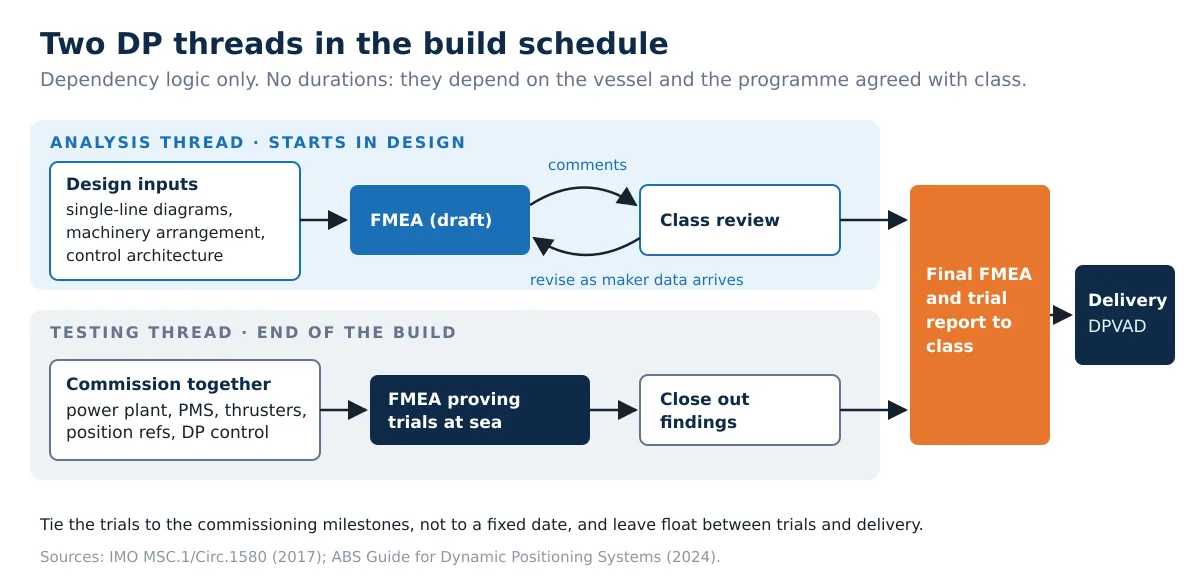
The analysis thread starts in design. The FMEA is defined by the IMO as a systematic analysis down to the sub-system level; it has to show that no single failure causes loss of position and has to confirm the worst-case failure design intent. It depends on the electrical single-line diagrams, the machinery arrangement and the control system architecture. Plan it as a document chain with class review loops, not as a single task, and expect it to be revised as equipment makers' data arrives. The ABS Guide lists FMEA of the DP control system and the basic design of DP redundancy among the documents submitted for review. IMCA's guidance on FMEA (IMCA M 166) and OCIMF's 2020 DP FMEA assurance framework are the industry references the FMEA practitioner will likely work to.
The testing thread comes at the end. Under the IMO guidelines, the initial survey includes a complete survey of the DP system and FMEA proving trials for classes 2 and 3. The ABS Guide describes the proving trials as tests, based on simulated failures under conditions as realistic as practicable, that confirm the vessel keeps position after the loss of each redundancy group, identify and prove the actual worst-case failure, and validate the design intent. After the trials, the final FMEA and the proving trial report, updated with actual results, go to class.
For a planner, the practical consequences are:
- DP proving trials cannot start until the power plant, power management system, thrusters, position reference systems and DP control system are commissioned together. Link the trials to those commissioning milestones in the schedule instead of pinning them to a date.
- Proving trials need sea time and suitable weather. Where they overlap with general sea trials, agree the programme with class early. Our sea trials and delivery article and the sea trial checklist cover the general trial programme.
- Findings from the proving trials have to be closed out and documented before the FMEA can be finalised. Leave float for this between trials and delivery.
The classification and regulatory milestones lesson shows how to carry class review loops in MS Project. The FMEA and its review cycle fit the same pattern.
After delivery: the survey cycle
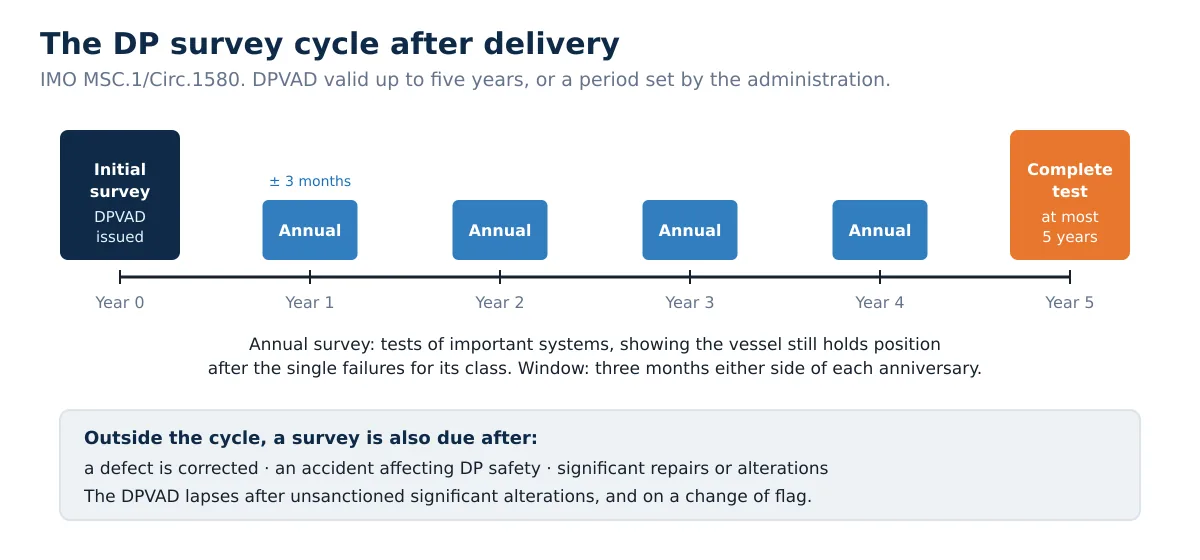
The DP requirements do not end at delivery, which matters to repair and conversion yards as much as to newbuilders. Under the IMO guidelines:
- The DPVAD is valid for up to five years, or a period set by the administration.
- An annual survey falls within three months either side of each anniversary of the DPVAD, with tests of important systems to show the vessel still keeps position after the single failures for its class.
- A complete test, equivalent to the initial one, is repeated at intervals of no more than five years.
- A survey is also required after a defect is corrected, after an accident affecting DP safety, or after significant repairs or alterations.
- The DPVAD stops being valid if significant alterations are made without the administration's sanction, and when the vessel changes flag.
The industry's annual trials practice is described in IMCA's code of practice for DP annual trials programmes (IMCA M 190).
For a repair yard, the practical point is the alterations clause. Any work that touches generators, switchboards, thrusters, the DP control system or the separation between redundancy groups can trigger a survey and testing before the vessel returns to DP work. Put it in the work scope and the schedule at the quotation stage, not after the vessel is alongside.
Questions to ask when you receive a DP specification
- Does it state the exact notation string for a named society, or just "DP2"/"DP3"?
- Is the worst-case failure design intent written down?
- Are "DP capability level" and "DP equipment class" used correctly and not mixed up?
- Which operating configurations (for example closed bus-ties) must the FMEA and trials cover?
- Who writes the FMEA, who accepts it, and when is it due relative to the design freeze?
- Is DP capability a guaranteed figure or information only?
- Which DP documents, including the DPVAD, are listed as delivery documents?
The notation line in the specification is short, but it should be one of the first items checked in contract review.
For how the major class societies approach their rulebooks more generally, see our comparison of LR, DNV, ABS and RINA yacht rules, and for the class survey relationship during the build, quality assurance and classification society surveys.
Sources
- IMO MSC.1/Circ.1580, Guidelines for vessels and units with dynamic positioning (DP) systems, 16 June 2017.
- ABS, Guide for Dynamic Positioning Systems, February 2024 edition.
- A. Karlsen (DNV), "New DNV DP notation qualifiers for closed bus-ties", MTS Dynamic Positioning Conference, October 2023.
- Lloyd's Register, Rules for Ships, Part 7, Chapter 4, Dynamic Positioning Systems.
- DNV, DNV-ST-0111, Assessment of station keeping capability of dynamic positioning vessels.
- IMCA M 166 (FMEA guidance) and IMCA M 190 (DP annual trials programmes).
- OCIMF, Dynamic Positioning Failure Mode Effects Analysis Assurance Framework: Risk-based Guidance, June 2020.