
How a commercial newbuilding contract works in practice: price, milestone payments, refund guarantees, delay and performance LDs, changes, warranty.
A shipbuilding contract is usually read closely twice: by the lawyers who negotiate it, and by the same lawyers when something goes wrong. In between, the people who actually run the project (the yard's project manager and planners, the owner's site team, the commercial staff on both sides) work under it every day, often from a summary they have never checked against the text. This article explains how a commercial newbuilding contract is put together, clause by clause, from the point of view of the people who have to deliver it.
The standard forms themselves (SAJ, BIMCO NEWBUILDCON, the Norwegian form, AWES) are compared in our article on standard contracts in ship newbuilding and repair. Here the focus is on the mechanisms most of those forms share, and on what each one means in practice. The figures used are illustrative: the real numbers are always negotiated, and a given contract can differ from the typical ranges in either direction.
The contract price
Fixed price is the commercial norm
Almost every commercial newbuilding is sold at a fixed, lump-sum price. The builder agrees to design, build, equip, test and deliver the vessel to the agreed specification for a stated sum, adjusted only in the ways the contract itself allows. The consequence is simple and important: if steel costs more than the yard estimated, if productivity is lower than planned, or if the yard's subcontractors fail, the yard absorbs the cost. The fixed price is the yard's risk.
The price normally covers everything the yard has to do to deliver the ship described in the specification: design and engineering, materials, yard-supplied equipment, labour, class and statutory approval fees, and trials. What it usually does not cover is equally worth knowing: owner-furnished equipment, spare parts beyond the class requirement, stores and consumables, fuel and lubricants remaining on board at delivery, the owner's own crew and supervision costs, flag registration and the delivery voyage.
What can still move a fixed price
"Fixed" does not mean the number on the front page is the number paid at delivery. The final price moves through a handful of defined routes:
- Variation orders agreed during construction, up or down.
- Changes in class rules or regulations that come into force after signing and require physical changes.
- Liquidated damages for late delivery or performance shortfalls, deducted from the price.
- Escalation clauses, where the parties have agreed one, typically for steel or another major input tied to an index. These are less common than in some other industries, and when they exist they usually apply only outside an agreed band.
A commercial manager's final account is essentially the contract price plus or minus each of these, with the evidence for each item.
Other pricing models, and where they appear
Cost-plus and target-cost arrangements exist in shipbuilding, but mainly outside merchant work. Under cost-plus, the buyer reimburses the builder's actual costs plus a fee. Under target cost, the parties agree an expected cost, and overruns and savings are shared on an agreed ratio, often up to a ceiling. These models appear where the design is too immature for anyone to price it responsibly: prototypes, research vessels, some offshore units and, above all, naval programmes. Our article on why the US Navy doesn't use fixed-price contracts the way commercial shipowners do explains why lead ships of a new class are rarely fixed price.
Turnkey versus owner-furnished equipment
In a pure turnkey contract, the yard buys and installs everything. Many owners, however, supply some equipment themselves: a cargo system they have standardised across a fleet, a navigation package, mission equipment. This owner-furnished equipment (OFE, or buyer's supplies) creates an interface the contract has to define precisely: what arrives, when, in what condition, with which documents and certificates, and who is responsible for installation, commissioning and performance. Late or defective OFE is one of the most common grounds for a yard's claim for extra time and money, so the delivery dates for owner's items belong in the master schedule as clearly as the yard's own procurement.
Payment instalments and financial security
Milestone payments, not progress payments
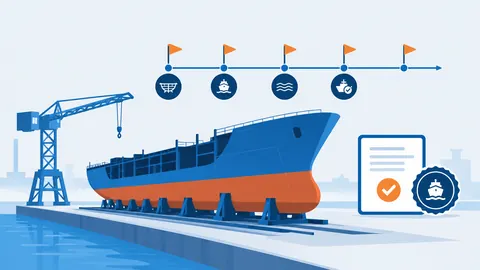
Newbuilding contracts pay the price in instalments tied to physical events, not to the costs the yard has incurred. Five instalments is a common pattern, four before delivery and one at delivery:
- on signing (often conditional on the refund guarantee being issued),
- on steel cutting,
- on keel laying,
- on launching,
- on delivery.
Each milestone must be defined precisely enough to be proved. Keel laying, for example, is usually tied to the placing of the first block on the building berth or in the dock, and SOLAS has its own "similar stage of construction" test for the keel-laying date. Where the contract's definition is vague, the milestone is where the first commercial argument of the project happens. The superyacht sector shows how difficult this gets when forms are bespoke; our article on milestone payments in superyacht contracts covers it in detail.
Front-loaded and delivery-heavy schedules
How the price is split across the milestones matters as much as the milestones themselves. At one end is an even split, for example 20 percent at each of the five events. At the other end are schedules where most of the price is paid on delivery. Structures where the pre-delivery instalments are modest and the delivery instalment is around half the price or more are widely used, and some contracts go further, with roughly 30 percent before delivery and 70 percent on delivery.
On a USD 30 million vessel the difference is large:
| Milestone | Even split | Cumulative paid | Delivery-heavy example | Cumulative paid |
|---|---|---|---|---|
| Signing | 20% (6.0M) | 6.0M | 10% (3.0M) | 3.0M |
| Steel cutting | 20% (6.0M) | 12.0M | 10% (3.0M) | 6.0M |
| Keel laying | 20% (6.0M) | 18.0M | 10% (3.0M) | 9.0M |
| Launching | 20% (6.0M) | 24.0M | 10% (3.0M) | 12.0M |
| Delivery | 20% (6.0M) | 30.0M | 60% (18.0M) | 30.0M |
With the even split, the yard has most of the money before the ship floats, and the buyer's exposure to the yard is large. With the delivery-heavy schedule, the yard must finance most of the construction itself, and the buyer has little at risk until the end. Which one a contract ends up with depends on the market: in a buyer's market yards accept heavier tails to win orders, in a seller's market buyers pay earlier. For the yard's project team, the schedule determines how painful a slipped milestone is. A launch that slips a month on a front-loaded contract delays a large payment. On a delivery-heavy contract, it is the delivery date itself that controls the yard's cash.
Refund guarantees and the builder's security
Title to the vessel normally stays with the builder until delivery, so every pre-delivery instalment is money the buyer has handed over for something it doesn't yet own. The buyer's protection is the refund guarantee: an undertaking from a bank, on the builder's behalf, to repay the pre-delivery instalments with interest if the buyer lawfully cancels the contract. Buyers will generally not pay the first instalment until an acceptable refund guarantee is in hand. BIMCO publishes a standard refund guarantee for shipbuilding contracts, and NEWBUILDCON includes a specimen guarantee as an annex.
The wording of the guarantee matters as much as its existence. Whether it pays on demand or only after an arbitration award, what happens if arbitration is started, and which law governs it all decide how quickly a buyer actually gets its money back. Guarantees issued by some banks, for example, allow payment to be held back while arbitration on the underlying cancellation is pending.
The builder needs security too, since it may be building a ship for a single-purpose company with no other assets. That usually comes as a performance or payment guarantee from the buyer's parent company or a bank, covering the later instalments. If the buyer fails to pay, the contract will typically allow the builder to suspend work, charge interest and, after a period, terminate.
Delivery date, delays and liquidated damages
Permissible and non-permissible delay
The contract fixes a delivery date. Every delay against that date then falls into one of two categories. Permissible delays extend the delivery date without penalty. Non-permissible delays are the builder's responsibility and eventually cost it money.
Permissible delays typically include:
- Force majeure: events beyond the builder's control as defined in the contract, such as natural disasters, fire, war, epidemics, government action and, depending on the wording, strikes that are not specific to the yard.
- Buyer's delays: late payment, late approval of drawings beyond the agreed turnaround, late or defective owner-furnished equipment, and the time consequences of the buyer's own modifications.
- Changes in rules and regulations after signing that require extra work.
The builder usually has to claim a permissible delay by written notice within a short period after the event starts, and again when it ends, with an estimate of the effect. Contracts differ on whether a late notice loses the claim, but a yard that doesn't notify on time is always in a weaker position. Yard-internal problems (poor productivity, a subcontractor's failure, rework, a local labour shortage) are generally non-permissible.
How delay liquidated damages work
Late delivery is compensated through liquidated damages: an agreed amount per day of delay, deducted from the price, so the buyer does not have to prove its actual losses. The usual structure has three parts.
- A grace period. Delivery within a set number of days after the contractual date, commonly around 30 days, carries no damages.
- A daily rate. After the grace period, a fixed amount per day applies, set commercially with the vessel's expected earnings in mind. Some contracts step the rate up after a certain number of days.
- A cap. Damages stop accruing after a maximum number of days, often in the region of 150 to 180 days after the grace period, and the buyer then gains the right to cancel.
Suppose a contract has a 30-day grace period, USD 8,000 a day of damages and a cap of 180 days. A ship delivered 45 days late costs the yard 15 days of damages (USD 120,000). A ship delivered 100 days late costs 70 days (USD 560,000). Once the delay passes the cap plus the grace period, no further damages accrue, but the buyer can walk away and recover its instalments through the refund guarantee. In the SAJ form, for example, the buyer may rescind if delivery is delayed by more than 210 days. That right, not the daily damages, is usually the real pressure on a late yard.
For the yard's planner, this structure should shape how the schedule is read. The first 30 days of slippage are commercially cheap, the next few months cost a known daily sum, and beyond that the whole contract is at risk. Float against the contractual delivery date is money.
Performance guarantees
Speed, consumption and deadweight
The contract also guarantees how the ship will perform, because that determines what it can earn. The usual guaranteed items are:
- Speed at a stated draught and engine output, measured on sea trials in defined weather conditions and corrected as the specification requires.
- Fuel consumption of the main engine, normally verified on the engine maker's test bed rather than at sea, at stated conditions and fuel calorific value.
- Deadweight at the design or scantling draught, calculated from the inclining experiment and lightweight survey.
- Where relevant, cargo capacity (cubic capacity, container intake), and sometimes noise and vibration limits.
Tolerance, damages and rejection
Each guarantee typically has three bands. Inside a small tolerance there is no penalty. Beyond it, liquidated damages apply on an agreed scale, per fraction of a knot, per percent of extra consumption or per tonne of missing deadweight. Beyond a larger rejection threshold, the buyer can refuse the ship and cancel the contract. Tolerances of a few tenths of a knot on speed (commonly 0.25 to 0.5 knots) and around 3 percent on fuel consumption are typical. Rejection rights on speed commonly start somewhere around 0.8 to 1 knot below the guarantee.
An illustrative set of terms for a 50,000 dwt bulk carrier might look like this:
| Guarantee | Guaranteed | No penalty down to | Liquidated damages (example) | Buyer may reject if |
|---|---|---|---|---|
| Trial speed | 14.5 knots | 14.2 knots (0.3 kn tolerance) | per 0.1 kn below 14.2 | below 13.6 knots |
| Main engine fuel consumption | as guaranteed at stated load | +3% | per 1% above tolerance | more than an agreed % above |
| Deadweight | 50,000 t | an agreed tonnage below | per tonne below tolerance | shortfall above an agreed tonnage |
Damages for performance are normally capped too, and a buyer who rejects the ship usually recovers its instalments with interest instead of collecting damages. On these clauses the practical work is in the measurement: which trial conditions apply, how the speed is corrected, whose calculation of deadweight governs. That is why the trial programme and measuring methods are agreed long before the ship goes to sea.
The contract documents
What the package contains
"The contract" is really a set of documents:
- the contract itself, with the commercial and legal terms,
- the technical specification, describing the ship system by system,
- the general arrangement plan and other contract drawings,
- the makers list, naming the approved suppliers for main equipment,
- any agreed amendments, riders and addenda.
Order of precedence
These documents will contradict each other somewhere. The contract therefore sets an order of precedence: usually the contract terms first, then the specification, then the plans. Where the specification and a contract drawing disagree, the specification wins. Project teams tend to discover this clause at the moment a disagreement starts. It is worth reading at the beginning.
Class, flag and the makers list
The contract names the classification society and the class notations the ship must achieve, and the flag whose statutory requirements apply. The yard is responsible for delivering the ship in class, with the statutory certificates, and typically free of outstanding recommendations. Class also has a practical role during the build: its surveyors witness key tests and its approval is often a condition of a milestone. See our article on quality assurance and classification society surveys for how that works on site.
The makers list matters more than it appears. If the buyer insists on one supplier from the list and that supplier is late, the question of whose delay that is will depend on how the list and the procurement obligations were written.
Modifications and variation orders
Changes during construction are inevitable. The contract distinguishes three sources:
- Buyer's modifications: changes the buyer asks for, to be agreed with their effect on price, delivery date and performance.
- Changes in class rules or regulations after signing: usually for the buyer's account where they are mandatory, again with agreed adjustments.
- Builder's proposals, such as equipment substitutions when a maker cannot deliver, which normally need the buyer's consent.
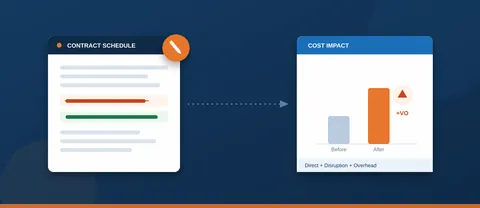
The mechanism is the variation order: a written agreement, before the work is done, of what changes and what it does to price and time. A common point of friction is that under some forms the builder need not carry out a buyer's modification until the price and time consequences are agreed, while the buyer wants the work to go ahead to protect the schedule. Many modern contracts add a disputed-variation route so that work can continue while the amount is settled later.
The other recurring problem is informal instruction. A superintendent asks for something on the deck, the yard does it, and six months later there is a claim for extra work that nobody signed. Our guide to variation order processes and cost impact calculation covers the procedure and the pricing in detail.
Supervision, trials and delivery
The buyer's site team
The buyer normally stations a supervision team at the yard, led by a site manager or chief superintendent. The contract gives them access to the ship, the yard's workshops and, usually, major subcontractors' works to inspect material and workmanship and witness tests. It also limits them. Supervisors can comment, reject work that does not meet the specification, and witness tests, but they cannot change the contract, and their approval of a detail does not usually relieve the yard of its obligations. Comments generally have to be made promptly and in writing, which is why a disciplined site team keeps a register of every comment, its status and its answer. The relationship between owner, yard and class is covered in our article on stakeholder management between owner, yard and class.
From shop tests to sea trials
Testing runs in stages. Major equipment is tested at the maker's works before shipment. Installed systems are tested alongside the quay (harbour or quay trials). An inclining experiment establishes the lightship weight and centre of gravity, which feed the deadweight calculation and the stability booklet. Finally, sea trials test the ship under way: speed runs, endurance, manoeuvring, crash stop, steering, anchoring, and whatever else the specification requires. The results of sea trials feed directly into the performance guarantees above, which is why the trial conditions and correction methods are agreed in advance.
Delivery and acceptance
After successful trials, the builder gives notice that the ship is ready and the parties work through the outstanding items. Minor deficiencies that do not affect the ship's safe operation are usually listed and scheduled for completion after delivery, sometimes against a retention from the delivery payment. Delivery itself happens when the protocol of delivery and acceptance is signed and the delivery instalment is paid. At that moment title and risk pass to the buyer, and the builder hands over the builder's certificate, class and statutory certificates, the bill of sale and a statement that the ship is free of liens and encumbrances. Our article on sea trials and delivery follows this phase from the project team's side.
The guarantee period
After delivery the builder remains responsible for defects for a guarantee period, usually 12 months. The guarantee covers defects caused by faulty design, material or workmanship that appear in that period. Items that are repaired under the guarantee often get a further guarantee of their own, frequently six months, with an overall limit (for example 24 months from delivery).
The exclusions are as important as the cover. Guarantees typically exclude:
- normal wear and tear,
- damage from improper operation, maintenance or handling by the buyer,
- consequential losses such as loss of hire or earnings,
- owner-furnished equipment, which the buyer must pursue with its own supplier.
Claims have to be notified in writing within the period, or within a short window after it, often around 28 days. A claim that isn't notified in the way the contract requires may simply be lost. Repairs are normally done at the builder's yard. Where that is impractical, the contract usually allows repairs elsewhere, with the builder's liability limited to what the repair would have cost it at its own yard.
Many builders place a guarantee engineer on board for the first months of operation. The engineer helps the crew with unfamiliar systems, assesses reported defects and speeds up the yard's response. For the owner's technical manager, the guarantee engineer is often the most useful single person in the first year.
Termination and cancellation
When the buyer can cancel
The buyer's rights to cancel (often called rescission in the forms) usually arise from:
- Prolonged delay beyond the permitted maximum.
- Performance falling below the rejection thresholds.
- Builder's insolvency or failure to proceed with the work.
- Total loss of the vessel before delivery where the builder does not rebuild it.
On a valid cancellation, the builder must repay the instalments received with interest. If it doesn't, the buyer claims under the refund guarantee. This is the whole point of the guarantee, and why its terms matter so much. Case law on cancellation notices shows how narrow the margin for error can be: a buyer that cancels on the wrong date or without following the contractual notice procedure may itself be in breach.
When the builder can terminate
The builder's rights usually arise from the buyer's failure to pay an instalment after notice, failure to take delivery of a compliant ship, or the buyer's insolvency. The builder then typically keeps the instalments already paid, may complete and sell the ship, and applies the proceeds to its costs and the unpaid price. Any surplus goes to the buyer, and any shortfall can be claimed from it.
Insurance, disputes and governing law
Until delivery, the ship is at the builder's risk. The builder insures it under a builder's risks policy, typically for at least the amount of the instalments paid and the value of owner's supplies on board. The buyer's interest is often protected by being named on the policy or through an assignment. If the ship is damaged, the proceeds normally go towards repairing it and completing the contract. If it is a total loss, the contract sets out whether the builder rebuilds or refunds.
Most international newbuilding contracts are governed by English law with arbitration in London, although Singapore arbitration is also common and other jurisdictions appear. Many forms also allow technical disputes, such as whether work complies with class requirements, to be referred to the classification society or an expert, so the ship can keep moving while a commercial dispute is arbitrated. The superyacht sector shows the same pattern; see why yacht disputes go to London arbitration.
How the contract shows up in the project
For the project team, each of these clauses turns into a document, a log or a deadline. A well-run project connects them to the schedule from the first week. Our article on planning a new shipbuilding project from contract to keel laying covers how that starts.
| Clause | What the project needs | Who usually owns it |
|---|---|---|
| Milestone payments | A definition of each milestone agreed in advance, and an evidence pack (class confirmation, joint inspection record) ready on the day | Yard commercial manager, owner's site manager |
| Delivery date and LDs | Contract milestones at the top of the schedule, float measured against the contractual delivery date, grace period and cap visible to management | Planning manager |
| Permissible delay | A delay notice log: event, date notified, critical path effect, evidence, date closed | Project manager |
| Drawing approval | A register of drawings submitted, due date for comments, comments received, so late approvals can be shown | Engineering coordinator |
| Owner-furnished equipment | OFE delivery dates in the master schedule, receipt inspections recorded | Procurement lead, owner's site team |
| Variation orders | A VO register: request, proposal, agreed price and time, status, and a rule that no unsigned change is built | Commercial staff on both sides |
| Performance guarantees | Trial programme and measurement methods agreed early, weight control through construction | Naval architect, trials manager |
| Guarantee claims | A defect log with dates, notices sent and responses, within the notice periods | Owner's technical manager, yard after-sales |
Most shipbuilding disputes are decided on documents. A project team that keeps these records from the start rarely needs to reconstruct them later, and a team that doesn't will be at a disadvantage whatever the merits of its position. The contract should also be one of the inputs to the project risk register: the grace period, the cap and the rejection thresholds are exactly the kind of limits a risk review should track.
How repair and conversion contracts differ
A repair or conversion contract deals with a ship that already exists, and the main difference follows from that: the scope is not fully known when the contract is signed. Opening tanks, blasting the hull or dismantling machinery reveals corrosion, cracks and worn parts that no survey could see beforehand.
Repair contracts therefore rely much more on unit rates and day rates than on a single fixed price:
- rates per tonne or kilogram of steel renewed, often varying with location and difficulty,
- hourly or daily labour rates for trades,
- daily charges for dock occupancy and services,
- fixed prices for the defined items in the repair specification.
Time pressure is also different. A newbuild delay postpones a ship's first employment. A repair delay keeps an earning ship out of service and can block the dock for the next vessel. Variations are constant rather than occasional, so approvals have to be fast, often the same day. Guarantees are generally shorter than for a newbuild and limited to the work the repair yard actually did. BIMCO's REPAIRCON is the standard form most often used for this work; it is described in our article on standard contracts in ship newbuilding and repair.
Conversions sit in between: a defined engineering scope that can be priced like a newbuild, combined with renewal and repair work on the existing structure that behaves like a repair.
Reading your own contract
Every clause described here is negotiated, and the typical figures in this article are only a starting point for understanding what a given contract says. If you work on a newbuild, read the contract's delivery, delay, performance, modification and guarantee clauses yourself, note the actual numbers and notice periods, and make sure they are reflected in the schedule, the registers and the people responsible for them. This article is a practical explanation for project professionals, not legal advice: for any decision with contractual consequences, the contract text and specialist maritime counsel are what count.
Cover photo: Hyundai Heavy Industries’ Ulsan shipyard, by Wvdp via Wikimedia Commons (CC0).