Why US Navy shipbuilding contracts range from fixed-price to cost-plus-award-fee, and what that risk-allocation spectrum means for a commercial shipbuilding project manager.
For a commercial shipbuilding project manager, the idea of a U.S. Navy ship being built under a cost-reimbursement contract can initially seem unusual. In commercial shipbuilding, the normal expectation is familiar: the shipyard studies the owner's specification, develops the design and construction plan, prices the work, and accepts responsibility for delivering the vessel for an agreed price, subject to the contract's change and adjustment mechanisms.
U.S. Navy shipbuilding operates under a different risk model. The fundamental question is not simply "What will this ship cost?" It is "How much of the technical, cost, and schedule uncertainty is sufficiently understood that the contractor can reasonably be asked to bear it?"
That distinction is reflected in the U.S. federal acquisition system. Contract-type selection is governed principally by Federal Acquisition Regulation (FAR) Part 16, with additional Department of Defense rules and guidance in DFARS Part 216, including Subpart 216.4 for incentive contracts. FAR policy explicitly recognizes that fixed-price contracting is preferred when requirements and costs can be estimated with reasonable certainty, while cost-reimbursement contracting is appropriate when requirements cannot be sufficiently defined or performance uncertainty makes accurate cost estimation impractical.
For naval shipbuilding, this creates a spectrum rather than a simple fixed-price versus cost-plus choice. A mature production program may move toward fixed-price incentive arrangements, while a technically demanding development or first-of-class program may require substantially more cost risk to remain with the government. (For how this plays out on the subcontracting side of a program, see our article on How Subcontractors Work on US Military Shipbuilding Programs.)
The basic difference: who owns the uncertainty?
The easiest way for a commercial shipbuilding planner to understand the U.S. defense approach is to think of contract type as a mechanism for allocating risk.
Consider a conventional commercial newbuild. The shipowner may provide a specification and basic design requirements, but the shipyard normally develops a substantial portion of the engineering solution before contract price and schedule are finalized. If the design is based on a proven vessel type, established equipment, familiar construction methods, and a relatively stable specification, the shipyard can estimate the labor, material, subcontracting and overhead requirements with reasonable confidence.
The shipyard therefore has a basis for saying:
"We understand what we have to build, we understand approximately how we will build it, and we can accept responsibility for delivering it for this price."
That is the environment in which firm-fixed-price contracting becomes practical.
A major defense program can be fundamentally different. The government may be procuring a weapon system rather than simply a hull. The vessel can incorporate new sensors, combat systems, propulsion arrangements, weapons, software, survivability requirements, communications systems, electrical infrastructure, cooling capacity or other technologies. Some requirements can continue to mature while design and manufacturing activities are progressing.
In that situation, the uncertainty is not necessarily something the shipyard can eliminate through better estimating. Some of it is genuine technical and program uncertainty.
FAR Part 16 therefore makes an important distinction: cost-reimbursement contracts are intended for circumstances in which the government cannot sufficiently define the requirement for fixed-price contracting or where the uncertainties of performance prevent costs from being estimated accurately enough for a fixed-price arrangement.
That is the central reason a Navy contract can look so different from the commercial shipbuilding contract a planner may already know.
Contract type is a risk-allocation decision
There is no single "Navy contract." The U.S. defense acquisition system provides multiple contract structures because different phases of a program carry different levels and types of uncertainty.
A simplified spectrum relevant to naval shipbuilding can be viewed as follows:
- Firm-Fixed-Price (FFP): the contractor generally assumes the greatest direct cost risk.
- Fixed-Price-Incentive-Firm (FPIF): the contractor accepts significant cost responsibility, but final profit is adjusted according to a negotiated formula and the contract contains a price ceiling.
- Cost-Plus-Incentive-Fee (CPIF): allowable costs are reimbursed, while the contractor's fee is adjusted according to a predetermined cost or performance formula.
- Cost-Plus-Fixed-Fee (CPFF): allowable costs are reimbursed and the negotiated fee is generally fixed rather than being adjusted through an incentive formula.
- Cost-Plus-Award-Fee (CPAF): allowable costs are reimbursed and an additional fee can be earned based on government evaluation of performance against defined criteria.
- Indefinite-Delivery/Indefinite-Quantity (IDIQ): fundamentally a different contracting mechanism used when the government knows it needs supplies or services but does not know the exact future quantity or timing at contract award.
This list should not be interpreted as a universal ranking of every defense contract by risk. Actual risk allocation depends on the clauses, incentives, ceilings, targets, options and other terms in the individual contract. Nevertheless, it is a useful way to understand the broad movement from substantial contractor cost responsibility toward greater government assumption of cost uncertainty.
FAR describes FFP contracts as appropriate where the government can describe the requirement sufficiently and expects the contractor to bear responsibility for performance costs. FPIF contracts occupy an intermediate position: they establish target cost and target profit, use a formula to adjust profit based on actual cost, and establish a ceiling price.
Cost-reimbursement contracts work differently. Under FAR, allowable incurred costs are reimbursed subject to the contract, while an estimated total cost is established for funding and management purposes. The contractor normally cannot exceed the applicable ceiling without the required government approval.
Why commercial shipbuilding can tolerate more fixed-price risk
The important point is not that commercial shipowners are somehow less concerned about technical uncertainty. They face plenty of it. The difference is often the degree to which the product, design basis and construction process are already understood.
A commercial ship may be based on a proven hull form or an existing series. Its cargo capacity, principal dimensions, propulsion concept, accommodation arrangement and major equipment may be well established. Even when the vessel is customized, the shipyard may have extensive historical data from similar vessels.
This gives the yard a valuable asset: production knowledge.
Historical man-hours, material consumption, subcontractor prices, procurement lead times, fabrication rates and commissioning experience provide a basis for estimating the next ship. The shipyard can therefore convert uncertainty into a commercial price with considerably more confidence.
A first-of-class military vessel can be different. The shipyard may be constructing the physical ship while the wider weapon-system architecture is still being integrated and validated. The design may involve technologies with limited production history. Interfaces between systems can generate additional engineering work. Government-furnished equipment and changing technical requirements can affect the construction sequence.
Those risks are difficult to convert into a reliable fixed price before sufficient design and production knowledge exists. Consequently, a government may decide that forcing the shipyard to price all of this uncertainty into an FFP contract would simply produce a very high risk premium, discourage competition, or encourage defensive behavior around changes and technical problems.
The alternative is to retain some of that uncertainty on the government side while creating financial incentives for the contractor to control the costs that it can actually influence.
FPIF: why a mature Navy program can look more like commercial shipbuilding
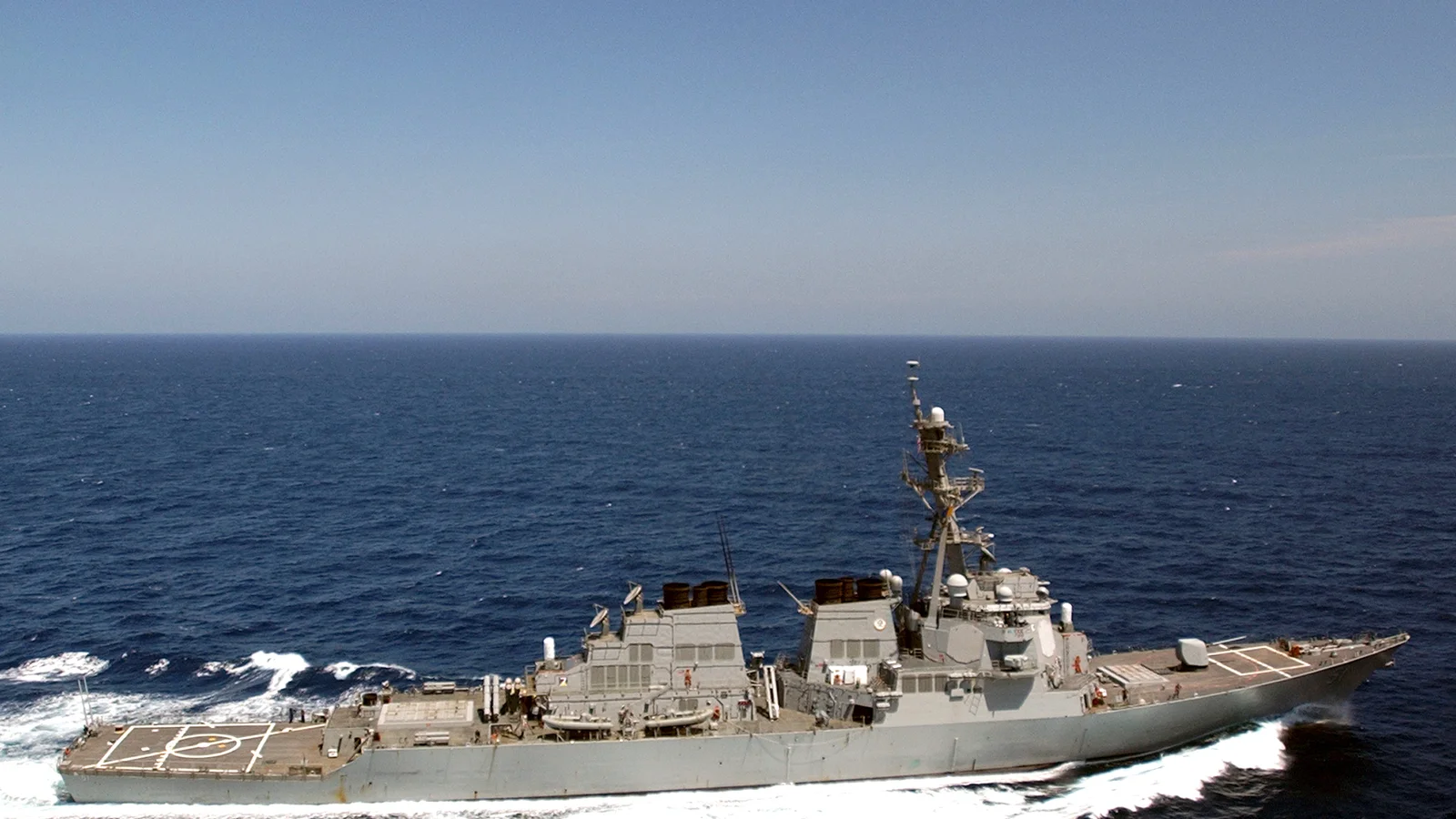
The Arleigh Burke-class destroyer (DDG-51) provides a useful real-world illustration of this transition.
The DDG-51 program is not a first-of-class program being designed from scratch today. It has a long production history, and the Navy has accumulated substantial design and construction knowledge. Flight III introduced important capability changes, including the AN/SPY-6(V)(1) air and missile defense radar, but the Navy's procurement strategy continued to rely on a mature DDG-51 production foundation.
In its procurement announcements for Flight III ships, the Navy explicitly described the configuration as relying on a stable and mature design. The Navy awarded multiyear procurement contracts for Flight III ships using Fixed-Price-Incentive-Firm (FPIF) arrangements.
This is an important distinction. "Fixed-price incentive" is not the same thing as a pure commercial FFP contract.
Under an FPIF arrangement, the government and contractor negotiate a target cost and target profit. A formula determines how the contractor's profit changes as actual cost moves away from the target, and a price ceiling limits the government's exposure under the negotiated structure. FAR describes this as an arrangement in which the contractor accepts a degree of cost responsibility while retaining an incentive for effective cost control and performance.
For a project manager, the practical logic is straightforward:
The more the Navy knows about the design and production process, the more confidently it can ask the shipbuilder to accept cost responsibility.
That is exactly why the DDG-51 Flight III example is useful. It does not demonstrate that Navy ships are generally "fixed price." It demonstrates that a mature production environment can support a contract structure much closer to the commercial shipbuilding model.
It is also worth noting that the maturity question was not simply assumed. In August 2016, GAO-16-613 examined whether the Navy had sufficient knowledge of the Flight III design and associated costs and risks to proceed responsibly with multiyear procurement, and recommended the Navy allow more time to increase design knowledge before committing. The FPIF contracts that were ultimately signed with the two build yards followed further detail-design progress beyond that point: consistent with the idea that additional design maturity supported the eventual contract structure.
Columbia class: when the risk moves in the opposite direction
The Columbia-class ballistic missile submarine illustrates the other side of the spectrum.
This is a new submarine class with substantial design, technology and production challenges: described in GAO reporting in terms of design development, component and technology development, prototyping and the transition into production.
Most importantly for the contract-type discussion, the construction of the first two Columbia-class submarines was structured as a Cost-Plus-Incentive-Fee (CPIF) contract: a cost-reimbursement arrangement under which the government generally assumes the risk of a cost overrun, while the incentive-fee mechanism is intended to motivate effective cost management.
This makes sense when viewed through the risk-allocation model. The Navy was not simply buying another proven submarine from a mature production line. It was introducing an entirely new class and managing significant design, technology, supplier and production uncertainty.
Congressional Research Service reporting on the program has also described the Navy's original strategy of using a CPIF arrangement for the first two Columbia submarines and then moving toward fixed-price contracting for later boats as production knowledge accumulates. That illustrates an important defense-acquisition principle: contract type can evolve as program knowledge improves.
The lesson for a commercial shipbuilding planner is therefore not that "Columbia uses cost-plus because military ships are complicated." That explanation is too simplistic. The more useful lesson is:
The government can deliberately postpone transferring full cost risk to the shipyard until sufficient design and production knowledge exists to make that transfer realistic.
Why CPIF is not simply "the government pays whatever the shipyard spends"
This is another area where commercial terminology can cause confusion.
A cost-reimbursement contract does not mean that the contractor has no financial incentive. CPIF is specifically designed to create an incentive around cost performance. FAR describes CPIF as establishing a target cost, target fee, minimum and maximum fees, and a formula that adjusts the contractor's fee according to the relationship between actual allowable cost and target cost.
In simplified terms, the government accepts more of the underlying cost risk, but the contractor still has a financial reason to control costs.
This creates a different management environment from FFP. Under FFP, a shipyard that spends more than planned can directly damage its own margin unless the additional cost is recoverable under the contract. Under CPIF, the government generally bears much more of the underlying cost risk, while the contractor's fee can move according to the agreed incentive mechanism.
The contract therefore has to compensate for the fact that the contractor is no longer motivated by exactly the same economic mechanism as an FFP shipbuilder. That is one reason why defense acquisition puts so much emphasis on cost reporting, earned value, schedules, technical reviews, performance measurement and government oversight.
CPFF and CPAF: when the incentive mechanism changes
Cost-Plus-Fixed-Fee (CPFF) is another cost-reimbursement structure. The contractor receives allowable costs under the contract together with a negotiated fixed fee. Because the fee is not adjusted through a CPIF-style cost formula, the cost incentive is structurally different.
CPAF adds another mechanism: the award fee. Under a Cost-Plus-Award-Fee contract, the contractor's reimbursable costs are accompanied by a fee structure containing a base amount where applicable and an award amount that may be earned during performance. The award is intended to motivate performance in areas such as cost, schedule and technical performance.
This sounds attractive because not every aspect of shipbuilding performance can be captured by a simple formula. For example, a government program office may want to recognize technical problem solving, management of difficult interfaces, engineering quality or responsiveness to emerging problems.
But award fees introduce another challenge: subjectivity.
The award-fee problem: incentives must actually measure outcomes
GAO has repeatedly examined the effectiveness of award-fee contracting across federal agencies, including the Department of Defense.
A recurring finding, documented across reports including GAO-06-66 and GAO-09-630, has been that award fees have not always been clearly linked to acquisition outcomes such as cost, schedule and technical performance. That work led to recommendations and policy changes intended to make award-fee criteria more closely connected to measurable outcomes and to prevent contractors from receiving fees that were not justified by performance.
GAO's later work, including GAO-17-291, found that the Department of Defense had moved toward greater use of objective incentive structures and reduced reliance on award fees, having recognized that award fees had not always been linked to acquisition outcomes.
This is an important lesson for project managers because it demonstrates that more complicated contracting does not automatically produce better performance incentives. If a fee is based on subjective evaluation but the evaluation criteria are poorly connected to actual cost, schedule or technical outcomes, the fee mechanism can become administratively elaborate without creating a strong behavioral incentive.
For a shipbuilding planner, the practical question is therefore not merely:
"Does this contract contain an incentive?"
The better question is:
"What measurable behavior or outcome does the incentive actually cause the contractor to manage?"
What replaces the commercial fixed-price assumption?
This is where Earned Value Management (EVM) and the Integrated Master Plan / Integrated Master Schedule (IMP/IMS) become especially important. (For a full worked walkthrough of building an IMP/IMS on a defense shipbuilding program, see our article on Building a Project Plan for a Military Shipbuilding Program.)
In a commercial fixed-price project, the contract itself carries a powerful message: the contractor has promised to deliver defined work for an agreed price and schedule. If internal costs increase or productivity falls, much of that consequence remains inside the contractor's business.
A cost-reimbursement defense contract cannot rely on that assumption to the same extent. The government therefore needs visibility into how the contractor is performing.
Under DFARS provisions for applicable contracts, the contractor's Earned Value Management System must comply with the guidelines of ANSI/EIA-748. The relevant DFARS clause (252.234-7002) also connects the EVMS with management procedures for producing timely, reliable and verifiable information for the Contract Performance Report and Integrated Master Schedule.
That is not administrative decoration. It is part of the risk-control architecture.
EVMS: measuring whether the money is producing planned progress
A commercial planner may already be familiar with planned value, earned value and actual cost. The defense environment formalizes these concepts into a management system.
The basic question is: what work was planned to have been accomplished, what work has actually been accomplished, and what did it cost to accomplish it?
This gives the government an analytical view of performance rather than relying solely on invoices or a percentage-complete statement from the shipyard.
For a shipbuilding project, that distinction is important. A statement such as "Block 101 is 80% complete" does not necessarily tell the government whether the project is performing efficiently. The statement becomes more meaningful when it can be related to the authorized work scope, time-phased baseline, budget and actual cost.
EVMS therefore helps provide visibility into cost and schedule performance while the work is still underway. It is not a system that eliminates project risk: it is a measurement and management framework that gives the customer earlier information about deviations from the plan.
IMP and IMS: turning a complex defense program into an integrated schedule
The Integrated Master Plan (IMP) and Integrated Master Schedule (IMS) provide another important part of the control system.
The IMP establishes the program's major events, accomplishments and criteria used to demonstrate progress. The IMS translates the program into a time-phased network of activities and relationships that can be used to manage execution.
For a large naval program, the schedule is therefore more than a shipyard production schedule. It can connect design maturity, engineering activities, procurement, manufacturing, integration, testing, government-furnished equipment, system demonstrations and other program-level events.
The result is a much more integrated view of program performance. This matters because the government's risk under a cost-reimbursement contract is not eliminated: it is managed through visibility, control and intervention. That is a fundamental difference from the commercial fixed-price assumption.
The Navy is not simply choosing between "cheap" and "expensive" contracts
It is tempting to interpret contract-type selection as a financial negotiation: the government wants a lower price, while the shipyard wants protection against cost growth.
The actual issue is more fundamental. A contract price only has meaning when the parties have enough knowledge to estimate the underlying work.
If the requirement is stable and the design is mature, transferring cost responsibility to the contractor can be economically sensible. FAR's incentive-contract guidance reflects this logic by stating that fixed-price incentive contracts are preferred when costs and performance requirements are reasonably certain and the contractor can assume an appropriate share of cost risk.
If the design is still evolving or technical uncertainty makes cost estimation unreliable, transferring all of that risk to the contractor may not produce the result the government actually wants. The government might receive a very high risk premium, extensive contractual disputes, conservative contractor behavior, or a contract that requires substantial modification as uncertainty becomes reality.
A cost-reimbursement structure can instead acknowledge the uncertainty explicitly and establish mechanisms for controlling it.
Where IDIQ fits, and where it does not
IDIQ is sometimes included in discussions of Navy contracting and can therefore create confusion for people coming from commercial shipbuilding.
IDIQ is not simply another point on the fixed-price-to-cost-plus risk spectrum. It is an indefinite-delivery contracting mechanism. FAR describes an indefinite-quantity contract as one in which the government orders supplies or services during a specified period, within stated minimum and maximum quantities, when the precise future quantity is not known at award.
In Navy activities, IDIQ structures are particularly visible in recurring services, maintenance, repair, modernization and sustainment. NAVSEA's regional maintenance center IDIQ multiple-award contracts, for example, cover non-nuclear surface combatant repair, maintenance and modernization availabilities: recurring work where the exact future scope and timing isn't known at award.
IDIQ should therefore not be presented as the normal Navy contract type for constructing a new destroyer or submarine. New-construction shipbuilding uses the FFP-to-CPAF spectrum described above, while IDIQ is primarily useful where the government knows it will need recurring work but cannot determine the exact future requirements at the initial contract award.
What this means for a commercial shipbuilding project manager
For someone moving from commercial shipbuilding into U.S. defense programs, the biggest adjustment is not learning another contract abbreviation. It is learning to think differently about risk ownership.
Under a commercial FFP newbuild, the project manager's central question may be: "How do we deliver the contracted vessel within our price and schedule?"
Under a cost-reimbursement defense contract, the question becomes broader: "How do we demonstrate that the program is progressing against its authorized scope, schedule and cost objectives, while identifying and managing uncertainty before it becomes uncontrolled?"
That changes day-to-day project management. Cost reporting becomes more important because actual allowable costs are part of the government's management picture. Schedule integrity becomes critical because the government needs reliable information about future events and dependencies. Baseline management becomes more formal because changes must be distinguished from ordinary performance variance. Earned value becomes relevant because physical progress must be related to the time-phased baseline and actual expenditure.
Engineering changes also take on a different significance. In a commercial fixed-price environment, a change normally raises the immediate question of whether it is within or outside the contracted scope and whether a variation or change order is required.
In a defense development environment, some changes are also evidence that the underlying technical baseline is continuing to mature. The project manager therefore needs to understand not only the contractual effect of a change but also its effect on the program baseline, schedule network, cost forecast, technical performance and downstream integration.
The real lesson: contract type determines the management system
The contrast between DDG-51 Flight III and Columbia is useful because neither represents a universal Navy rule.
DDG-51 Flight III demonstrates how a mature production program can support FPIF contracting. The Navy explicitly characterized the Flight III configuration as relying on a stable and mature design, and the production contracts used FPIF structures.
Columbia demonstrates the opposite situation: a new class with substantial design and technical uncertainty, where the first two submarines were constructed under a CPIF arrangement.
The difference is therefore not simply commercial ship versus military ship. It is largely about how much is known when the government must decide who should carry the risk.
As a program becomes more mature, design uncertainty can decrease, production history accumulates, estimating confidence improves and the government can potentially transfer more cost responsibility to the contractor. That is why contract-type selection should be understood as part of program strategy rather than as a procurement formality.
For a project manager, the contract type determines much more than how invoices are paid. It influences who owns cost risk, how schedule performance is measured, how technical uncertainty is handled, how incentives work, how much reporting is required and how closely the government must monitor the contractor's internal performance.
In a commercial fixed-price shipbuilding project, the contract can place substantial responsibility for managing uncertainty inside the shipyard. In a defense cost-reimbursement program, some of that uncertainty deliberately remains with the government. In exchange, the government requires a much stronger management-information system: defined baselines, earned value, integrated schedules, performance reporting, technical reviews and formal oversight.
That is the fundamental reason U.S. Navy contracts can look so different from the fixed-price shipbuilding contracts familiar to commercial shipowners.
The contract type is not merely a commercial term. It determines the architecture through which cost, schedule, technical performance and risk are managed throughout the program.