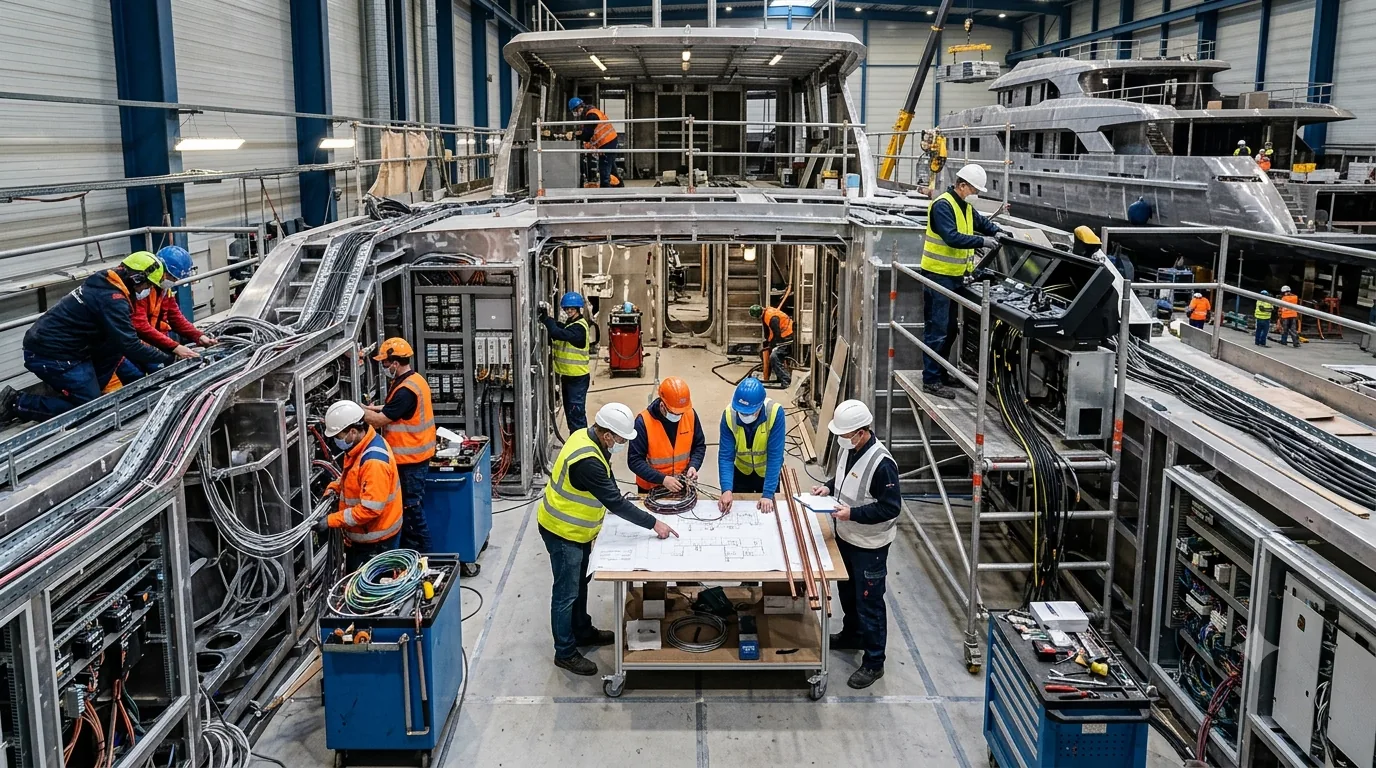
Once the hull is closed, dozens of trades work shoulder to shoulder in the same compartments. Outfitting is a coordination problem before it is a technical one.
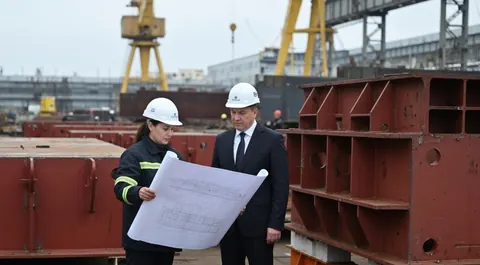
Once the hull closes in, an engine room compartment can have pipefitters, electricians, HVAC installers and insulation crews all working within a few meters of each other, on systems designed independently by different engineering disciplines and now competing for the same physical volume. Outfitting fails less often because a trade couldn't do its work and more often because five trades scheduled to be in the same space at once weren't actually coordinated to be there in a sequence that works.
Where Clashes Actually Get Found
A clash caught in the 3D model costs a design change. The same clash caught when a pipe and a cable tray are both physically routed into the same 200mm of overhead space costs a rework order, and worse, it costs it at exactly the point in the schedule when workface congestion is already highest. The gap between these two outcomes is almost always a sequencing problem rather than a modeling problem, the clash was visible in the model weeks earlier, but nobody checked that specific zone against the current design revision before releasing both trades to install.
Early Outfitting: Why the Stage Matters More Than the Sequence
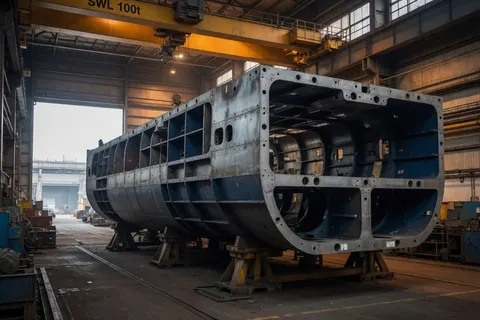
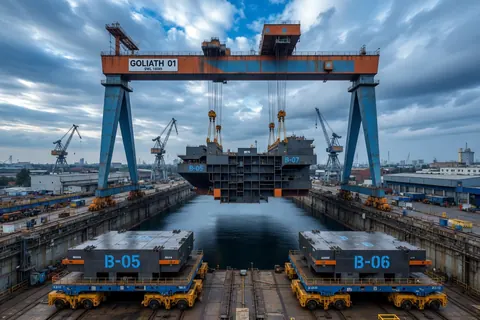
Installing a system at the block or grand-block stage, before erection, gives a trade full access from every side, at working height, with a crane available to bring materials in. The same installation after erection means working through hatches and existing structure, often overhead, with far less room to maneuver. This is why pre-outfitting philosophy pushes as much work as practical to the block stage, but it only works if the block's design is genuinely frozen at that point, a late design change to a pre-outfitted block is more expensive to accommodate than the same change would have been on an un-outfitted one.
Zone-Based Planning, and Where It Breaks Down
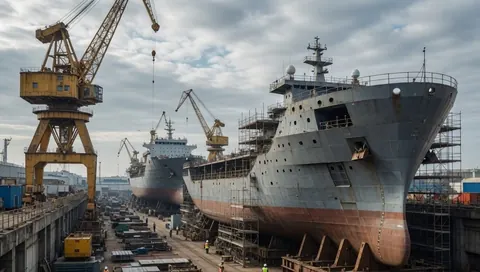
Dividing the vessel into zones (engine room, accommodation block, deck areas) and planning trades against zones rather than against the whole vessel is standard practice, but a zone plan only works if it accounts for trade sequence within the zone, not just trade presence. "Electrical and piping are both scheduled in the engine room this month" is not the same statement as "piping completes its overhead runs before electrical installs cable trays in the same space," and treating the first as sufficient is how workface congestion happens even when the high-level schedule looks reasonable.
A Concrete Interface Problem
Consider a ventilation duct and a fire-suppression pipe run both needing to cross the same bulkhead penetration. If the penetration was sized and located in the model for the duct alone, because the fire-suppression routing was finalized later by a different discipline, the conflict doesn't show up until someone tries to install the second system and finds the first one already occupying the space. This is exactly the kind of interface that a "terminal point" or interface-ownership convention, deciding in the specification phase which discipline's routing takes precedence through a shared penetration, is meant to prevent, and exactly the kind that a generic "coordinate between trades" instruction does nothing to catch.
What Actually Goes Wrong at the Workface
- A work package is issued with a materials list but no actual confirmation the materials are on site. The crew shows up ready to install and loses the shift to material discovery instead.
- A coordination meeting reviews the schedule but not the current 3D model state. Two trades leave believing they're aligned because their activity dates don't overlap, without checking whether their physical routing does.
- A drawing revision goes out to one trade but not the others sharing that zone. The trade working from the old drawing installs correctly against information that's no longer current.
- Progress is tracked by trade, not by zone. Piping can show 90% complete in a zone that's actually blocked from completion because electrical hasn't cleared the space it needs.
Where Digital Tools Change the Outcome
Clash detection run once at design freeze catches the clashes that exist at that moment; clash detection run again against the actual as-built model, after revisions from individual trades get incorporated, catches the ones introduced afterward, which in practice is where a meaningful share of real clashes come from. Digital work packages that push the current drawing revision directly to the crew, rather than relying on a printed set that ages the moment it's issued, close the gap between what the model says and what the trade on the floor is actually looking at. Neither tool does anything for a yard that isn't otherwise disciplined about zone sequencing and interface ownership, they make a coordinated process visible, not a coordinated process happen on their own.
Outfitting coordination succeeds or fails on whether interfaces between trades were resolved on paper before multiple crews were released into the same physical space, not on how sophisticated the modeling tool was that could have caught the conflict earlier.