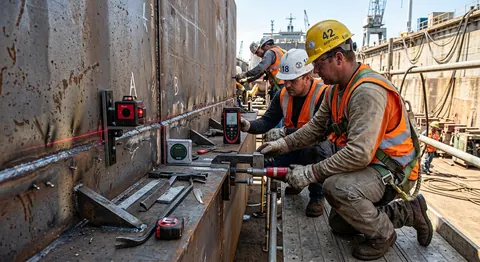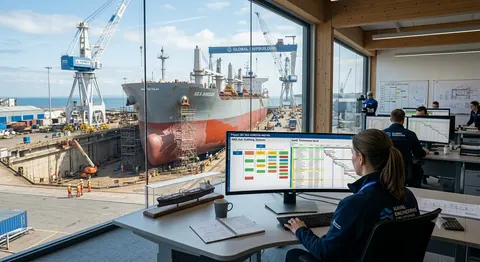

Modern hulls are built as blocks and erected like a giant kit. Sequencing those blocks is where a newbuild schedule is won or lost.
The activities in a ship block assembly and construction schedule — cutting, panel fabrication, sub-assembly, blasting and painting, outfitting, block erection sequencing — are real physical operations bound by real physical constraints: how many blocks a panel line can feed at once, how many bays a shipyard has, how much a paint hall can process before it becomes the pacing item, what a crane can actually lift and reach. A schedule built without those constraints in mind can look perfectly logical on screen and still be impossible to execute on the shop floor.
Block Hierarchy and Schedule Detail
A common production hierarchy runs from panels (flat or curved stiffened plates off the panel line) to sub-assemblies, then to blocks (an engine room block, a bow block, a stern block), with blocks sometimes joined into grand blocks before erection. Yards don't all use identical terminology or the same breakdown levels, some add an intermediate "unit" stage, but the underlying production logic is broadly similar: this is a Product Work Breakdown Structure, organized by physical zone and production stage rather than by ship system, and it's a deliberately different structure from the system-oriented structures commonly used for engineering, equipment and class approval. The level of breakdown chosen determines how much detail you can realistically control in the schedule: too coarse, and a block sits in "in progress" for weeks with no useful visibility; too fine, and the schedule turns into more line items than any planner can realistically track and update. Whether grand-block assembly makes sense for a given project depends less on vessel size alone than on the yard's lifting capacity, transport route and erection strategy, joining blocks on the ground only pays off if the crane and the dock can actually handle what comes next.
Sequencing and Production Dependencies
Most activities within a block follow simple Finish-to-Start logic. The relationships worth watching closely are Start-to-Start and Finish-to-Finish, and in practice these rarely apply to two whole-block activities at once, fitting and welding more often overlap by panel, zone or assembly stage than block by block: welding can start on one completed zone while fitting continues on another, but NDT on that zone can't finish until the last weld inspected there is complete. Modeling this at the whole-block level when the real dependency is zone-by-zone is a common source of schedules that look fine on paper but don't match how the work actually proceeds.
Capacity Constraints, Not Just Calendar Dates
A schedule that shows three blocks starting fabrication on the same Monday is only realistic if the panel line, the assembly bays and the available fitters can actually support three blocks starting at once. The question a schedule needs to answer isn't only "when can this activity start," it's "what has to be available for it to start," material, drawing, bay space, crane time, and a free slot in whatever process comes next. This is where paper schedules and shop-floor reality diverge most often: durations get estimated per block in isolation, then multiple blocks get stacked into the same week without checking whether the yard's actual throughput can absorb that load. Our lesson on resource leveling and crane/dock capacity planning covers how to check this systematically.
The Bottleneck That Gets Underestimated: Blast and Paint
Welding and fitting get most of the planning attention, but blast and paint capacity is one of the more common places a block schedule quietly falls apart. A block generally can't move to outfitting or erection until it's been through the blast and paint hall, and booth capacity, environmental controls and coating cure times are generally less flexible than reallocating labor. When several blocks converge on the paint hall at once because upstream activities ran in parallel, the hall itself, not welding or fitting, becomes the pacing constraint, and a schedule that never modeled it as one won't show the problem until blocks are already queued and waiting.
Why Pre-Outfitting Timing Matters So Much
Shipbuilders sometimes cite the "1-3-8" rule of thumb, documented in the context of U.S. Navy submarine construction and referenced more broadly across the industry: performing the same outfitting task takes roughly 1 unit of labor effort in the workshop, about 3 once that work is done on-block, and around 8 after erection or once the vessel is afloat, largely because access gets progressively more restricted by surrounding structure and equipment. The exact ratio varies by ship type, yard and trade, but the direction is consistent enough to matter: a schedule that treats pre-outfitting as a nice-to-have rather than a scheduled, resourced activity is deferring labor cost, not avoiding it.
Common Block Scheduling Failures
- The duration is correct, but the start date isn't. The activity's estimated duration may be realistic on its own, but the production resource it needs, a bay, a crane window, a paint slot, is already committed to another block.
- Engineering release is checked once, not tracked. The first drawing release is confirmed at the start, but later revisions affecting fabrication don't get reflected back into the production sequence.
- Material availability is assumed, not scheduled. An activity starts on the plan because the material is "due" by that date, not because it has actually arrived and been inspected.
- Pre-outfitting is tracked as a percentage, not a sequence. A block can be reported at 70% outfitted while the one installation required before erection is still the piece that's missing.
- The erection date is protected by compressing everything upstream. Instead of resolving the capacity or interface problem causing the slip, durations get trimmed elsewhere to preserve the milestone on paper.
A Simple Illustration
Consider a block with a handful of outfitting packages and a template duration of ten working days for fabrication. That number means little on its own until it's checked against what has to be true for it to hold: does the panel line have a free slot in the required window, is the assembly bay clear, is the crane available for the lift into blast and paint, and is the paint hall not already booked by another block. If any one of those isn't true, the problem isn't the duration, it's the capacity behind it, and no amount of adjusting the activity's duration in isolation will fix that.
Progress Measurement
A block schedule is only as useful as the progress reporting behind it. "70% complete" needs to mean something repeatable, whether progress is measured against weighted work packages, physical quantities installed, or a defined set of milestones, rather than a supervisor's estimate that resets with every reporting cycle.
The Schedule Is Not the Forecast
The baseline shows what was planned. The update shows where the work actually is. The forecast shows where a block is likely to finish given both. Treating these three as interchangeable, especially assuming the baseline still holds because nobody has formally revised it, is how a schedule keeps reporting a completion date everyone privately knows is no longer realistic.
Where Digital Tools Add Value
A 3D model matters when clash detection changes a production decision, catching a pipe run or a piece of equipment that won't fit in the intended installation sequence before it becomes a rework order in the dock. Tools serve different parts of this workflow rather than one interchangeable category: naval-architecture platforms like NAPA cover hull form, stability and, increasingly, structural design as well, while detailed outfitting design more often runs through platforms like AVEVA Marine or, on the production-drawing side, ShipConstructor. On the schedule side itself, the underlying logic usually still lives in a conventional CPM tool (Primavera P6 or Microsoft Project), with 4D linking, through tools such as Synchro or Navisworks, layered on top to visualize the sequence against the model. None of this replaces a disciplined WBS and honest durations underneath it; a badly structured schedule visualized in 4D is still a badly structured schedule, just easier to look at.
A block construction schedule earns its keep by being checked against the yard's real constraints, panel line and paint hall throughput included, and updated against real progress, not by looking complete on the day it's issued.