How a superyacht newbuild runs from design to the warranty year: phases, parties, differences from commercial shipbuilding and a free parameter sheet.
This lesson opens the Superyacht Project Management track. It sets out the shape of a yacht newbuild from first sketch to the end of the warranty year, names the people who will be around the table, and introduces the example project that every later lesson uses. If you come from commercial shipbuilding, most of the vocabulary will be familiar. The weighting is not, and that is where this lesson spends most of its time.
The general lifecycle of a ship project is covered in Shipbuilding Project Lifecycle: An Overview. Read it first if terms such as keel laying, outfitting or delivery protocol are new to you. Here we only look at what changes when the product is a private yacht.
The example project: YP-48
Illustrative project: Project YP-48 is fictional. Its parameters are chosen from publicly reported industry ranges so the numbers are realistic, but no real yard, owner or yacht is described.
Every lesson in this track works on the same imaginary build so that the templates, schedules and registers connect to each other. The parties are called the Owner, the Yard and the Design Studio. No real company or person stands behind those names.
| Parameter | YP-48 value | Why this value |
|---|---|---|
| Type | Motor yacht, full custom | Semi-custom is discussed as the alternative in later lessons |
| Length overall | 48 m | Most yachts under 500 GT are around 45 m long, and about 55 m has been reported as the practical ceiling for staying under 500 GT |
| Gross tonnage | Below 500 GT, design target 499 GT | Above 500 GT the yacht picks up SOLAS equipment, ISPS and ISM obligations |
| Use | Private and charter (commercial use) | Commercial use of a yacht of 24 m or more brings it under the REG Yacht Code, Part A |
| Guests | 12 | Part A covers yachts carrying no more than 12 passengers |
| Rules | REG Yacht Code, Part A, July 2024 edition | The current edition published by the Red Ensign Group |
| Flag | Cayman Islands (Red Ensign Category 1 register) | Category 1 registers can take ships of any tonnage and type |
| Class | Lloyd's Register, notation copied from its rule book | Plan approval and surveys of hull and machinery by class |
| Hull and superstructure | Steel hull, aluminium superstructure | Working assumption for the example |
| Contract price | Index 100 | No currency figure is used anywhere in the track |
| Stage payments | 7, including the one at signing | Six to eight stages are described as typical |
| Contract to delivery | 30 months | Inside the published ranges for yachts of this size |
| Interior outfitting | About 12 months | Inside the reported range of 6 to 18 months |
| Warranty | 12 months from delivery | The common reference period |
The flag and the class society are chosen in Rules Before Lines: the Cayman Islands and Lloyd's Register, both illustrative choices. That lesson explains the criteria a real project would weigh.
A few of these choices deserve a sentence each.
Why 499 GT. Gross tonnage is a measure of enclosed volume, not weight. For a yacht, crossing 500 GT moves the vessel into a heavier regulatory regime, with more safety equipment, security and safety management obligations, and more crew certification. Designers therefore work hard to keep a yacht just under the line, and a naval architect quoted by Boat International put the cost of crossing it at around USD 5 million on the build, plus higher running costs every year. For a project manager, this turns GT into a controlled budget item. Every design change that adds volume has to be checked against it, in the same way a commercial project watches lightship weight.
Why charter. An owner who will charter the yacht needs it certified for commercial use. That decision, taken before the lines are drawn, sets the code, the survey regime and a long list of equipment requirements. Lesson 3 goes through the consequences.
Why an index instead of a price. Published price ranges for a new yacht of this size come mostly from brokers and disagree with each other. Rather than build lessons on a weak number, the contract price is set to 100 and every payment, variation and budget line is shown as a share of it. You can multiply by your own figure.
Why 30 months. Broker guides describe superyacht builds as taking 24 to 48 months or longer, and Boat International gives a range of one to five years from contract. Thirty months is a plausible middle for a full custom 48 m motor yacht at a yard with a free slot. It is a planning assumption for the example, not a benchmark.
You can download all of these parameters as a working spreadsheet at the end of this lesson.
The phases of a yacht newbuild
The phases below are in the order they start. On a real build they overlap heavily, and the overlaps are where most of the scheduling work lies.
Concept and design before contract
The owner, usually with a broker or an owner's representative, sets out what the yacht is for: how many guests, where it will cruise, whether it will be chartered, what it must feel like on board. A design studio turns that brief into exterior styling, a general arrangement and an outline specification. For a full custom yacht this work is paid for by the owner and happens before any yard has signed anything.
The length of this phase varies too much to put a number on it.
Yard selection and contract
The outline specification goes to a shortlist of yards. Bids come back with a price, a slot in the yard's programme and a delivery date. The chosen yard then negotiates its own contract form with the owner's lawyers. Unlike commercial shipbuilding, where standard forms such as SAJ or BIMCO NEWBUILDCON are a common starting point, yacht contracts are almost always drafted by the yard. The reasons are covered in Why There's No NEWBUILDCON for Superyachts.
The signature of the contract is month 0 of the YP-48 schedule.
Engineering and plan approval
After signature the yard's engineering team, the naval architect and the design studio develop the design into construction drawings. Class approves the plans that fall under its rules, mainly hull and machinery. Plans that fall under the yacht code are approved either by the class society acting for the flag as a Recognised Organisation (RO) or by the flag administration itself, depending on how the flag has split the work. The UK Ship Register advises sending the drawing list early so that approval questions do not surface at the end of the build.
Hull and superstructure
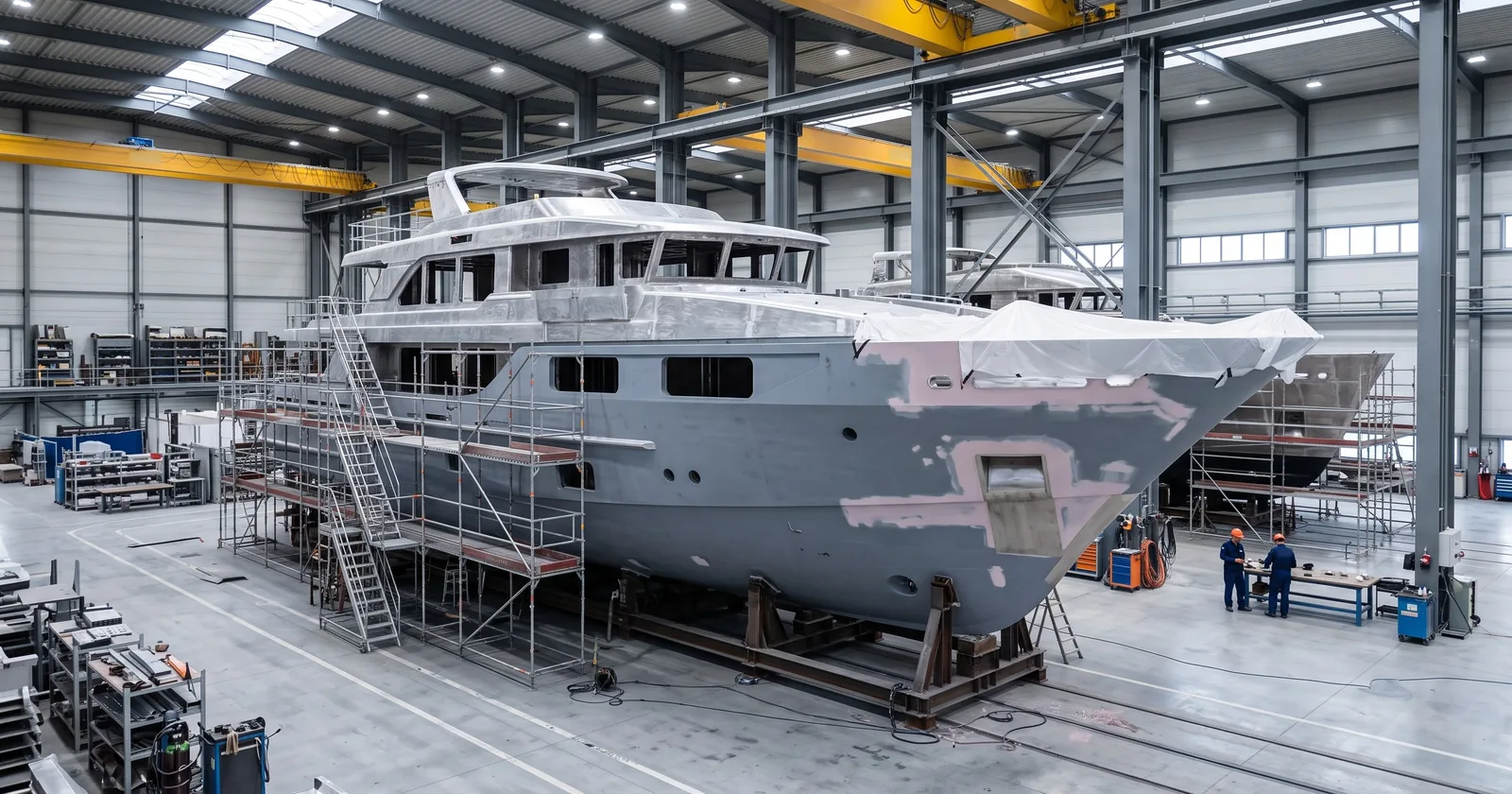
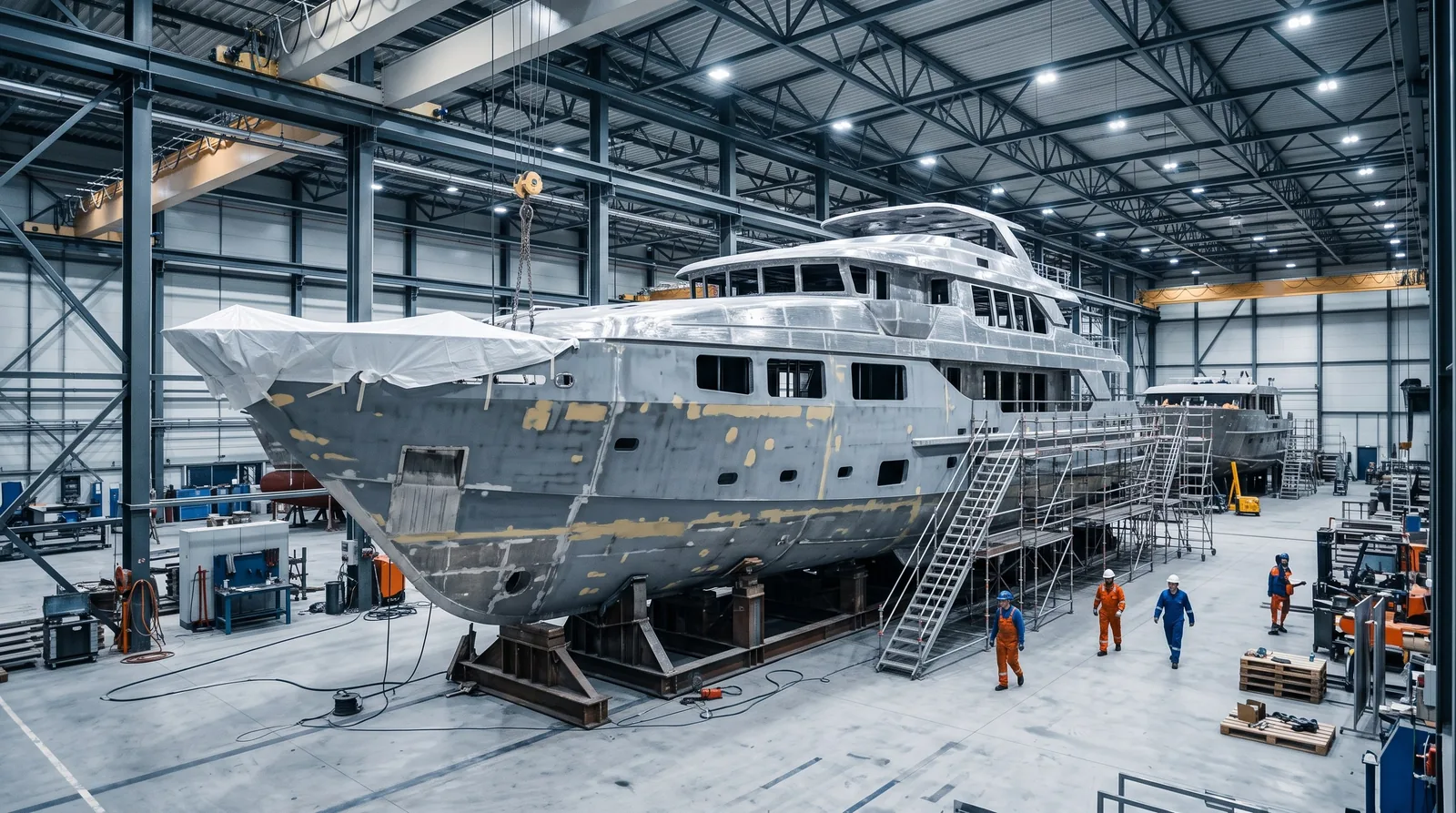
Construction starts with steel cutting and keel laying. Metal yacht hulls are often built upside down and turned over once the shell is complete. The aluminium superstructure is usually built separately and joined to the hull later, by welding or with adhesives and mechanical fasteners depending on the materials. Class surveyors inspect the structure as it goes up.
Systems installation and interior outfitting
Engines, generators, stabilisers, piping, HVAC and electrical systems go in, followed by the interior. On a yacht the interior is not a finishing trade. Boat International puts outfitting at anywhere from six to 18 months, and for YP-48 we assume about 12. Joinery, stone, soft furnishings and AV systems are often made by specialist subcontractors with their own long lead times, samples and owner approvals.
Paint and fairing
The exterior finish is a visible, contractual quality item on a yacht. Fairing and painting need controlled conditions, and once the topcoat is on, other trades have to work around it. On YP-48 the paint window runs from month 20 to month 26.
Launch, commissioning and harbour tests
At launch the yacht enters the water for the first time. Commissioning of systems usually starts before launch and continues afloat. Harbour acceptance tests prove each system alongside before the yacht goes to sea.
Sea trials
Sea trials check performance and integration at sea. Yard and surveyor guidance lists speed and endurance runs, manoeuvring, anchoring, tender launch and recovery, and noise and vibration measurement among the typical items. Yachts are judged on comfort as well as performance, so the noise and vibration figures in the specification carry real weight at acceptance. The general approach to trials and delivery is covered in Sea Trials and Delivery: Closing Out the Newbuild.
Delivery
At delivery the owner pays the final instalment, receives title, certificates and documentation, and the crew take over. Under a milestone payment contract the yacht usually remains the yard's asset until that final payment is made and title passes, which is why the definition of each milestone matters so much. See Milestone Payments in Superyacht Contracts.
Warranty year
The build does not end at delivery. Warranty checks happen within the first 12 months of cruising, and claims have to be logged, assessed and closed with the yard and with equipment makers whose own warranties may run on different terms. Lesson 24 is dedicated to this year.
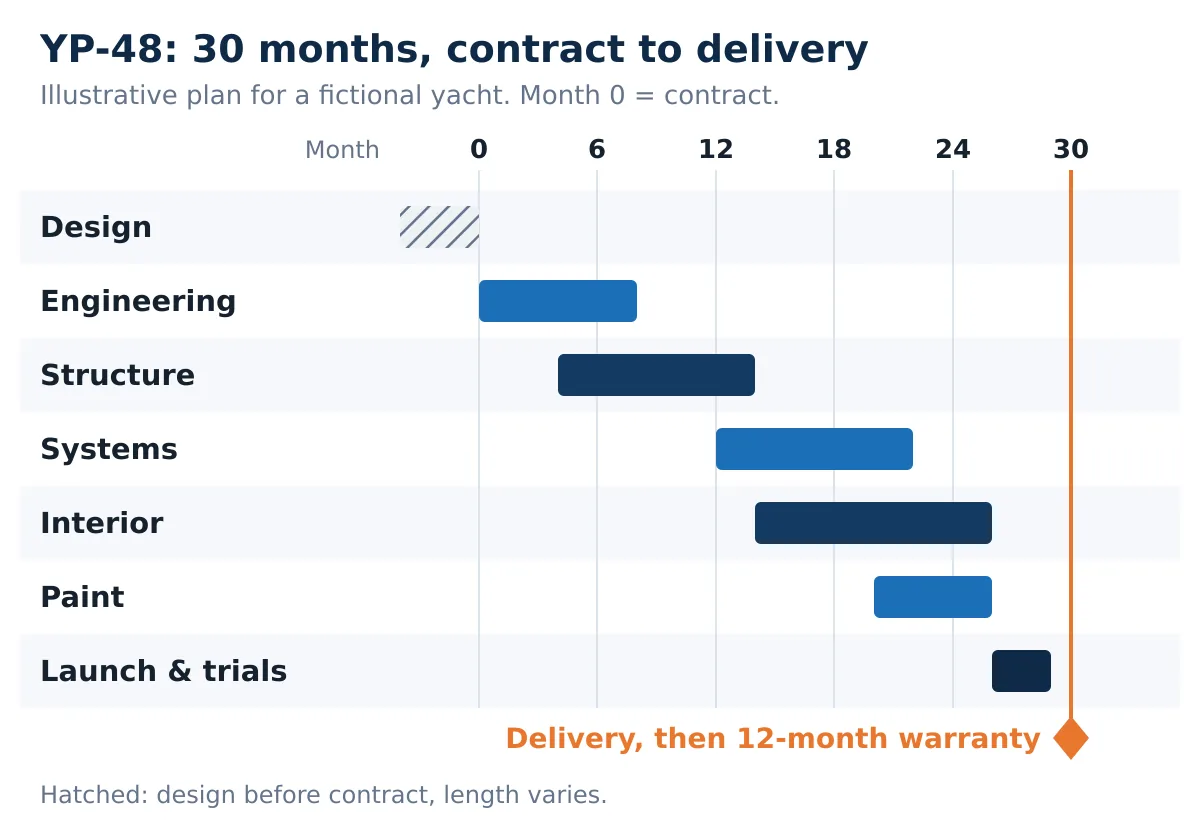
Read the chart as a sketch. Engineering continues well past month 8 on a real project, and the interior bar hides dozens of packages with their own sequences. Lesson 8 builds the detailed master schedule behind it.
Who is involved
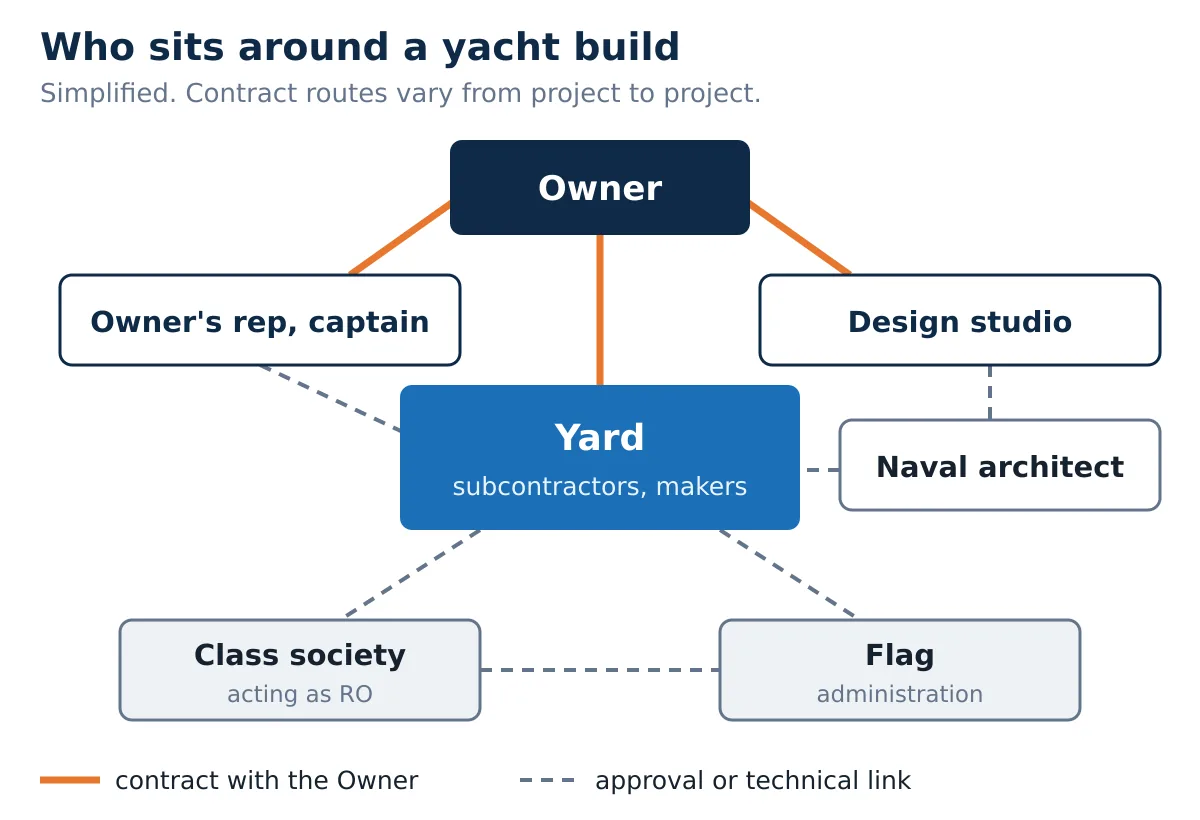
The Owner. A private individual or a company holding the yacht for one. The owner makes the decisions that matter most, often from a distance and in between other commitments.
The owner's representative and the build captain. The owner's eyes on site. The representative checks progress and quality, reviews milestone claims and keeps change requests in order. Many owners also bring in the future captain or chief engineer during the build. Commercial shipbuilding has site supervision, but a professional role acting for a private owner is specific to yachts, as discussed in The Owner's Representative.
The design studio. Exterior and interior designers who own the look of the yacht. They are often contracted directly by the owner and stay involved through the build to approve finishes and details.
The naval architect. Responsible for hull form, stability, weight, tonnage and structure. Depending on the project the naval architect sits in the yard, in the design studio or in a separate office.
The Yard. Builds the yacht under the contract, manages subcontractors and equipment makers, and carries the construction risk until delivery.
Class and flag. The class society approves plans and surveys hull and machinery against its rules. The flag administration certifies the yacht against the code, doing the work itself or delegating it to the class society as an RO. For a charter yacht the flag's certificate is what allows commercial operation.
Stakeholder management in the commercial setting is covered in Stakeholder Management Between Owner, Yard and Class. Lesson 2 turns this list into a responsibility matrix for YP-48.
What changes compared with commercial shipbuilding
If you have planned tankers, bulk carriers or ferries, the phases above will look familiar. What differs is where the effort, risk and argument sit.
A one-off, not a series. Commercial yards gain from repetition: the second ship of a series is cheaper and faster than the first. A full custom yacht is always a first of class. There is no previous hull to learn from, and the schedule has to carry the learning inside itself.
The contract is the yard's document. Commercial buyers can start from a standard form that both sides know. Yacht owners negotiate a house form written by the yard, and the owner's side has to check it clause by clause. Lesson 5 provides the checklist.
Rules follow use, not only size. A commercial ship's regime follows its type and tonnage. A yacht's regime also follows how the owner intends to use it. Choosing charter and a 499 GT target on day one fixes a large part of the design envelope.
The interior carries the schedule. On a cargo ship the accommodation is a small part of the work. On a yacht the interior, together with the exterior finish, is what the owner sees and judges, and outfitting alone can take more than a year. Late owner decisions on interior details are one of the main sources of change.
Acceptance is partly subjective. Speed and fuel consumption can be measured. Paint quality, joinery finish and noise at a guest cabin bed are harder to agree on unless the specification sets measurable criteria before work starts.
The owner is personally present. Decisions pass through one person, their family office and their advisers, not a fleet technical department. Communication and decision tracking become project controls in their own right, covered in Lessons 10 and 11.
Market context for the sector, including where yachts are built, is in Where Superyachts and Offshore Wind Vessels Are Actually Built and Superyachts and Offshore Wind Vessels, 2021-2026.
How this track is organised
The track has 26 lessons in seven modules. Each lesson takes one part of the YP-48 build, shows how to run it and, where it helps, provides a template with a blank sheet and a filled YP-48 example. Titles below are working titles; lessons are linked here as they are published.
| Module | Lessons |
|---|---|
| Project foundations | Anatomy of a Superyacht Newbuild (this lesson); Who Does What on a Yacht Build; Rules Before Lines: Code, Flag, Class and the 500 GT Decision |
| Contract and design | From Design Brief to Yard Shortlist; Reviewing a Yacht Yard House Contract; Building the Milestone Payment Plan and Its Evidence Pack; Specification, General Arrangement and the Design Freeze |
| Planning, control and owner communication | The Master Schedule for a Yacht Build; Owner Change Requests and Variation Orders; Measuring Progress and Writing the Weekly Owner Report; Owner Communication: Meetings, Decisions and Managing Expectations; Owner-Side Budget, Contingency and Risk |
| Procurement | The Yacht Procurement Map; Long-Lead Packages: Propulsion, Generators, Stabilizers; Interior, AV/IT and Specialist Subcontractor Packages |
| Construction | Hull and Superstructure; Systems Installation and Technical Spaces; Interior Outfitting: Mock-ups, Samples, Approvals and Weight Control; Paint and Fairing; Inspection and Test Plans and Punch List Management |
| Testing, delivery and aftercare | Commissioning, Harbour Acceptance Tests and Launch; Sea Trials for a Yacht; Delivery Day; The Warranty Year |
| Service boats | Tenders as a Project Within the Project; Planning a Support Vessel Alongside the Yacht |
The track assumes you know basic scheduling. If you need a refresher, Building the Newbuild Work Breakdown Structure and Managing Classification and Regulatory Milestones are good starting points.
Template: Yacht Project Parameter Sheet
The first template is the parameter sheet behind the YP-48 table above. It lists the decisions that every later plan depends on, and for each one it records the value, the basis for it, who decides and by when. The status column separates what is decided from what is only assumed or still open.
The file has three sheets. "Read me" explains the columns. "Blank" has the parameter names filled in and everything else empty. "Example (YP-48, illustrative)" is the filled version for the fictional project.
Download: Yacht Project Parameter Sheet (T1), xlsx
A simple rule makes the sheet useful: any line still marked Assumed or Open after the contract is signed goes onto the risk register, with an owner and a date. On YP-48 that currently applies to the flag, the class society, the crew number and the tender sizes.
Before the next lesson
Before moving on, fill in the Blank sheet for a yacht you know or are about to work on. Note which lines you cannot fill and who would have to decide them. Lesson 2 takes those names and builds the responsibility matrix around them.