
Measure yacht build progress with rules of credit, read the S-curve, set traffic lights you can defend and write the weekly owner report. Free docx and xlsx.
Most owners never see the yacht being built. They see it through a report. If that report is vague, late or too optimistic, the Owner learns about a problem when it is already expensive, and trust between the Owner's side and the Yard goes with it. This lesson covers the two jobs behind a good weekly owner report: measuring how much of the yacht has really been built, and telling the Owner what that means in a form they can read in five minutes and act on.
We work through one report for the example project, written at the end of month 14. The lesson builds on earlier ones and does not repeat them. Building the Milestone Payment Plan and Its Evidence Pack set out the progress weights and the evidence rules. The Master Schedule for a Yacht Build gave us the baseline and the critical path. Who Does What on a Yacht Build decided who reports to whom. The earned value method itself is covered in Earned Value Management on a Shipyard Project; here we use one piece of it and point to the rest.
Illustrative project: Project YP-48 is fictional. Its parameters are chosen from publicly reported industry ranges so the numbers are realistic, but no real yard, owner or yacht is described.
YP-48 at month 14
YP-48 is a 48 m full-custom motor yacht with a 499 GT design target, for private use and charter with 12 guests, built to the REG Yacht Code Part A (July 2024 edition). The contract runs 30 months, the contract price is an index of 100, and the flag is the Cayman Islands and the class society is Lloyd's Register, both illustrative choices explained in Rules Before Lines. The parties are the Yard, the Owner, the Design Studio and the owner's representative, as introduced in Anatomy of a Superyacht Newbuild.
According to the baseline, by the end of month 14 the yacht should be here:
- Detail engineering and interior detail design finish this month.
- The steel hull has been complete since month 11. The aluminium superstructure is in the last of its seven months and should be complete in month 15, with joining to the hull in month 16. Both are on the critical path.
- Propulsion, generator sets and stabilizers are at the Yard. Main engines are installed and aligned; generator and stabilizer installation runs to month 15.
- Piping, HVAC, electrical and cabling started in month 12. Interior outfitting starts in month 15.
- The AV/IT order is due now, because interior detail design has just finished and AV/IT has only one month of float.
Two other threads from earlier lessons meet here. On payments, milestones 1 and 2 are paid (25 of 100) and milestone 3, "Main engines installed and aligned", has been claimed, with five of six evidence items accepted and the joint inspection record still open. On design, Specification, General Arrangement and the Design Freeze left the naval architect's estimate at 496.3 GT and the weight index at 104.4 against a budget of 105, both inside their warning bands, with a request to enclose a sun-deck bar rejected this month and a request for a larger tender garage door still pending.
All of that has to reach the Owner in one report. First, though, the report needs a number it can defend.
Measuring physical progress
Physical progress answers one question: how much of the yacht has been built, as a share of the whole? On YP-48 "the whole" is the weighted scope from the payment plan lesson: engineering 11, long-lead equipment and packages 25, hull and superstructure 20, systems 13, paint and exterior 11, interior 14, commissioning and trials 6, a total of 100. Each group is split over its schedule activities, so every activity carries a weight. Multiply each activity's weight by its percentage complete, add them up, and you have a progress figure on the same 0 to 100 scale as the plan.
The percentages are where honesty is won or lost. A supervisor's "about 80%" is an opinion. A count of sections welded and inspected is a measurement. Earned value guidance makes the same ranking: guidance published by the US Centers for Medicare & Medicaid Services lists the ways of measuring progress in rough order of preference, prefers discrete, objective measures wherever reasonable, and puts subjective percent complete near the bottom because of the judgement involved. For a yacht, that translates into a small set of rules of credit, agreed with the Yard before the first measurement:
| Kind of work | YP-48 rule of credit (illustrative) | Evidence behind the number |
|---|---|---|
| Engineering | Drawings approved or issued, as a share of the drawing list | Drawing register (T7) |
| Equipment packages | Steps: ordered 10, drawings approved 20, factory test passed 30, at the Yard 40 | Order, approval record, FAT report, delivery note |
| Hull and superstructure | Sections welded and inspected, weighted by steel or aluminium weight | Section list with inspection records |
| Main engine installation | Steps: landed 40, chocked 30, aligned and recorded 30 | Chocking and alignment records |
| Systems | Pipe spools fitted, cable metres pulled, systems tested, weighted | Yard quantity sheets, sample-checked on board |
| Paint | Steps per zone: fairing, primer, filler, topcoat | Zone sheet, paint inspection records |
| Interior | Rooms by stage, weighted | Room-by-room status sheet |
| Short tasks and handovers | 0/100: nothing until done | Signed record |
Three habits keep the measurement credible.
Measure the plan the same way. YP-48's baseline curve, taken over from the payment plan lesson, spreads each weight evenly across the activity. The step rule for equipment does not: a package earns nothing between order and drawing approval, then jumps. If the plan and the measurement use different rules, the gap between them shows the difference in method, not in progress. On a real project, build the baseline with the same rules of credit you measure with.
Let the Yard measure, and check it. The Yard has the quantities. The owner's side should not produce a rival set of numbers, but it should sample: walk two or three areas each month with the Yard's sheet in hand and count. If the sample matches, the figure stands. If it does not, the rule or the counting gets fixed before the report goes out.
Keep milestones separate from percentages. A payment milestone has either been reached, with its evidence pack signed off, or it has not. On YP-48 the engines are 100% installed by the step rule, so they earn their full weight in progress, but milestone 3 stays "claimed" in the report until the joint inspection closes. Mixing the two ("milestone 3 is 95% complete") invites the argument the payment plan lesson was written to prevent.
The YP-48 measurement at month 14
This is the month-end measurement behind the week 61 report. The planned column comes from the baseline schedule; the measured column is invented for teaching. Values are rounded, so columns may not add exactly.
| Group | Weight | Planned % | Measured % | Planned value | Measured value |
|---|---|---|---|---|---|
| Design and engineering | 11 | 100 | 95 | 11.0 | 10.4 |
| Long-lead equipment and packages | 25 | 85 | 81 | 21.3 | 20.2 |
| Hull and superstructure | 20 | 86 | 83 | 17.1 | 16.7 |
| Systems installation | 13 | 33 | 30 | 4.3 | 3.9 |
| Paint, interior, commissioning | 31 | 0 | 0 | 0 | 0 |
| Total | 100 | 53.8 | 51.2 |
Measured divided by planned gives a physical progress index of 0.95. If you know earned value, you will recognise this as a schedule performance index measured in weighted scope rather than money; the formulas and the cost side are in the EVM lesson and in Earned Value Management (EVM) in Shipbuilding. On a fixed-price yacht contract, the owner's side does not usually see the Yard's actual costs, so the cost indices are the Yard's business. The physical index is the part the Owner can measure and verify.
The index is useful and easy to misread. At 0.95, YP-48 looks slightly behind across the board. The line items say otherwise:
- The aluminium superstructure, on the critical path, is at 78% against a planned 86%. That is roughly two weeks of work, on the one chain that decides the delivery date.
- The joinery package (85%) and interior detail design (85%) are behind because two stone samples and the AV/IT specification are waiting for the Owner. These are near-critical, with about a month of float.
- Glazing, with nine months of float, is behind by the step rule and does not matter yet.
A single index averages a critical problem with harmless ones. That is why the report never shows the index without the critical path beside it: which activities have float, how much, and how that changed since last week, read from the live schedule as described in the master schedule lesson.
The S-curve: plan, measured and what the gap means
The S-curve plots cumulative planned progress against time, with the measured points on top. It is the one chart most owners learn to read quickly.
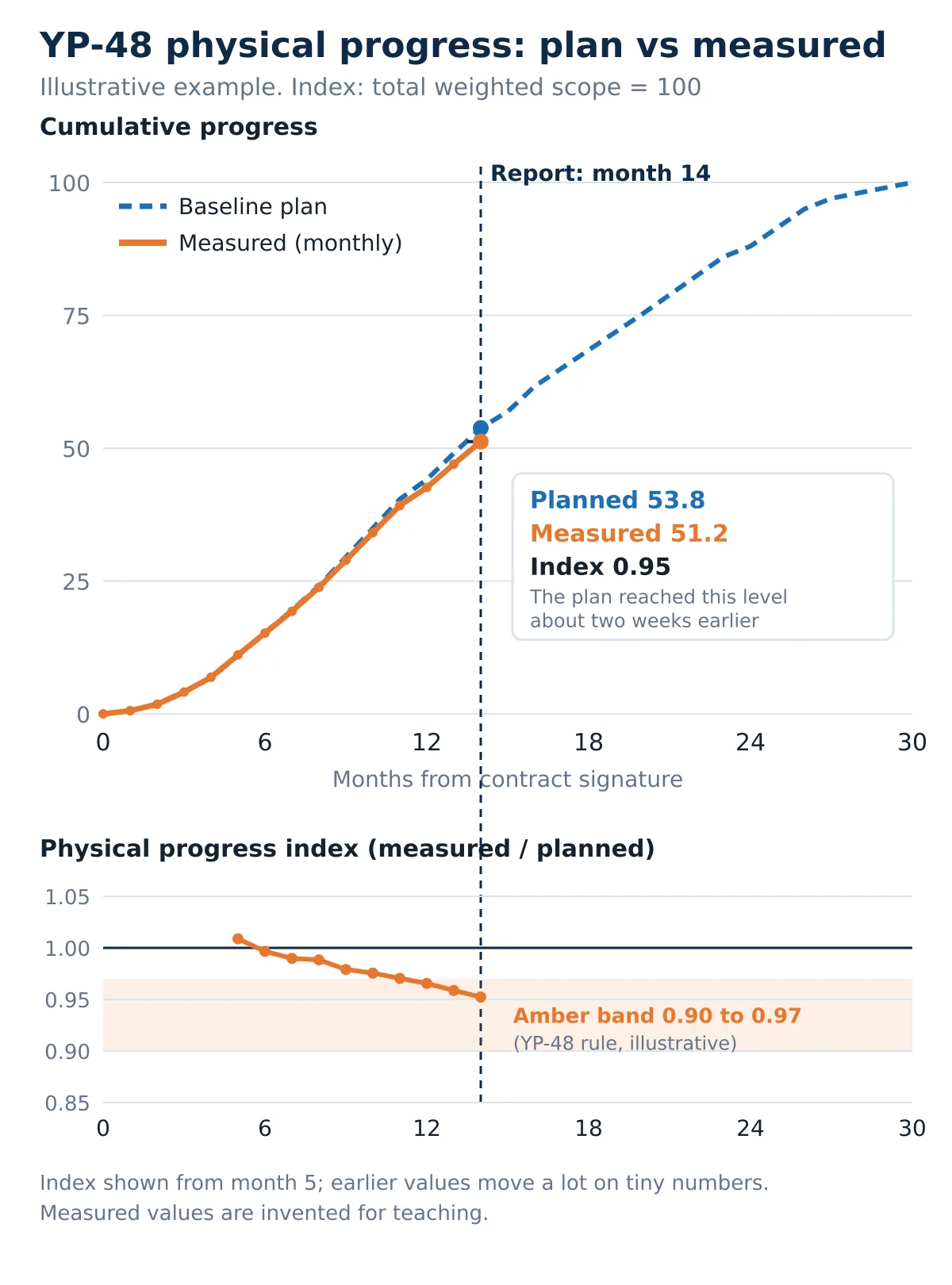
Three readings come out of this chart, and the report should state all three.
The gap in points. 51.2 measured against 53.8 planned.
The gap in time. Read across from the measured point to the plan curve: the plan reached 51.2 about half a month earlier. "About two weeks behind" is easier for an owner to hold on to than "2.6 points", but it is an average across the whole yacht, not a delivery forecast. The delivery forecast comes from the critical path.
The trend. The index has slipped a little every month since month 8, from 0.99 to 0.95. No single month looked alarming. Taken together, they show a steady drift that started when superstructure work began. A trend like this is worth raising while it is small, because the Yard can still act on it.
A few rules keep the curve honest over 30 months:
- Never redraw the baseline to fit the actuals. If an approved variation order changes the scope or the date, draw a revised baseline and keep the original on the chart, labelled.
- Plot measurements, not forecasts, as the solid line. A Yard forecast can go on the chart as a separate dotted line, clearly labelled as the Yard's.
- Measure monthly, report weekly. A full weighted measurement is a month-end job. Weekly movement on the few critical items (here, sections of superstructure welded and inspected) goes into the weekly report as a short line, and the S-curve is updated in the report for the week that closes the month.
- Show the index only once it means something. Early in the build the planned values are tiny, and a small change moves the ratio a lot. YP-48 starts plotting the index at month 5.
The photo record
Photographs are the part of the report the Owner looks at first, and the part most often wasted. The payment plan lesson explained why a photo supports evidence but cannot prove a standard. For the weekly report, the job is different: photos should show change since last week, in places the Owner can recognise.
A workable photo discipline:
- Fixed viewpoints. Choose eight to ten positions at the start of construction (the same corner of the engine room, the same view along the superstructure) and photograph them every week. A series from one position shows progress far better than a new angle every time.
- Identify every photo. A reference such as
YP48-W61-03, the date, the location (frame number or room name) and one line saying what it shows and why it matters. "Superstructure, aft, frames 8 to 14: last two sections tacked, welding started week 61" is a caption. "Progress" is not. - Keep the file data. Digital cameras and phones record the time a picture was taken, and often its position, inside the file under the Exif standard. Keep the originals in the project archive, so the date on a photo can be checked later, and put resized copies in the report.
- Select, do not dump. Six to eight photos in the report, the full set in the archive, filed by WBS code or milestone.
- Photograph what is behind, not only what is finished. If the report says the superstructure is late, one photo should show the unwelded sections.
- Respect site rules. Check what the contract and the Yard's rules allow, avoid identifiable people, and never publish construction photos without the Owner's consent.
Open issues and decisions required
Every weekly report carries two lists that are easy to merge and should never be merged.
Open issues are problems someone is working on: a late delivery, a non-conformity, an interface question between two subcontractors. Each has an owner, a due date and an age. The report shows how many are open, which are new, and the oldest. A list of 40 items with no dates is a diary, not a control tool.
Decisions required are questions only the Owner can answer. They belong on page one, every week, even when the list is empty, because an empty list is also information. Each one carries four things:
- Needed by. A date read from the schedule, not a wish. The master schedule lesson put owner decisions into the logic for exactly this reason.
- Options. What the Owner is choosing between, with cost, weight or tonnage effects where they apply.
- Recommendation. The owner's side's view, with one line of reasoning.
- What moves if it is late. In weeks of float, and then in days of delivery.
The YP-48 decisions at week 61 (illustrative):
| Ref | Decision | Needed by | If late |
|---|---|---|---|
| D-14 | Master bathroom stone: sample A or sample B | End of week 62 | Stone fabrication and joinery for that area start late; interior outfitting has about one month of float |
| D-15 | Sign off the AV/IT specification so the order can be placed | End of week 63 | Every week late uses a week of the one-month float; after that, AV/IT installation, commissioning and delivery move |
| D-16 | CR-06, larger hydraulic tender garage door: accept or reject once the Yard's price and the naval architect's check arrive | End of week 63 | Structural work around the opening must finish before the hot-work cut-off at month 16; the weight margin of 0.6 would fall to 0.3 if accepted |
Decisions already taken also go in the report, once: "CR-05, sun-deck bar enclosure: rejected, would have taken the tonnage estimate over 500 GT." The Owner should never have to remember what they decided last month.
Traffic lights you can defend
Most owner reports use red, amber and green. The colours are only useful if they follow rules agreed in advance. Without rules, colour becomes a mood, and moods drift towards green. Project managers call this a watermelon report: green on the outside, red inside. Nobody sets out to write one. It happens when red is treated as blame, when the report repeats the Yard's own assessment, or when a problem is expected to be recovered "next month".
A useful public reference for defining the colours is the delivery confidence guide that the UK government's Infrastructure and Projects Authority issues to its assurance review teams. For time, it describes green as on or ahead of schedule, amber as behind with realistic plans to recover, and red as behind and likely to be delivered late. Two further points in the guide apply directly to an owner report. The rating is a judgement of the project as it stands, on its current trajectory, before any recommended fixes are carried out. And a project that would need extraordinary, unplanned effort to succeed is rated red.
The YP-48 rules, agreed with the Owner at kick-off (illustrative):
| Dimension | Green | Amber | Red |
|---|---|---|---|
| Schedule | Critical path forecast on or before the baseline; index 0.97 or above | Critical path behind, with a recovery plan that is resourced, dated and started; or index 0.90 to 0.97 | Forecast delivery after the contract date on current performance; or no realistic recovery plan; or index below 0.90 |
| Milestones and payments | Next milestone forecast on its date; evidence on track | Evidence item overdue, or a milestone forecast late without moving delivery | Milestone claim disputed, or forecast late in a way that moves delivery |
| Design, GT and weight | Both margins above their warning thresholds | A margin inside its warning band | Estimate above the GT target or the weight budget |
| Quality | Findings closed within the agreed period | Findings overdue, or a repeat finding | A finding that blocks a milestone or a class approval |
| Changes | All changes priced and signed before work | Work proceeding on an instruction not yet priced | A disputed variation affecting price or delivery |
Applied to week 61:
- Schedule: amber, trend down. The superstructure is about two weeks behind on the critical path. The Yard's own report shows green, because it assumes the second welding shift that started this week will recover the time. The recovery plan is real (people assigned, started, dated), so the rules give amber, not red. The report also says what would turn it red: if the last two superstructure sections are not welded and inspected by the end of week 63, joining moves into the second half of month 16, and hot-work completion, paint, launch and delivery move with it.
- Milestones and payments: green. Milestone 3 is claimed with one evidence item open and the joint inspection booked.
- Design, GT and weight: amber, unchanged. Both margins are inside their warning bands, and one pending request would use half of what remains of the weight margin.
- Quality and changes: green. Nothing overdue; CR-06 is not being worked until it is decided.
Four habits prevent the drift towards green:
- Rate each dimension separately, and never average. An amber schedule and four greens do not make "green overall". If you show an overall colour, make it the worst of schedule, milestones and quality, or explain in one sentence why not.
- Rate the record, not the promise. A recovery plan earns amber once it is resourced and has started. Until then it is a plan, and the colour follows the current rate.
- Explain every change of colour. One line: what changed, and what would change it back.
- Do not leave a dimension amber for months. Either the recovery is working, and the colour returns to green, or it is not, and the report says so.
Who writes it, who gets it, and how often
In the RACI from the roles lesson, the Yard is accountable for the master schedule and progress reporting, the owner's representative is consulted, and the Owner is informed. The weekly owner report does not change that. It is the owner's representative's own report to the Owner, built on the Yard's figures after they have been checked, with the owner's side's assessment added. The Yard's reporting obligations are set by the contract; Reviewing a Yacht Yard House Contract includes the question of whether the Yard must keep and update a programme.
One owner's representation firm describes its site inspections during a build as typically weekly or fortnightly, depending on the stage, so a weekly report fits the site rhythm. On YP-48 the reporting set looks like this:
| Output | Prepared by | When | Goes to |
|---|---|---|---|
| Weekly site meeting minutes | Yard, reviewed by the owner's representative | Weekly | Yard, owner's representative, build captain |
| Weekly owner report | Owner's representative | Weekly, Friday | Owner; copy to the build captain; the Owner's office if the Owner asks |
| Physical progress measurement and S-curve | Yard measures, owner's side samples and checks | Monthly | Included in the weekly report for the month-end week |
| Yard progress report | Yard | As the contract requires (monthly on YP-48) | Owner's representative |
| Design extract | Owner's representative | When design items are open | Design Studio, design items only |
Two points about distribution. First, the weekly owner report is the Owner's document. It contains the owner's side's view of claims, recovery plans and negotiating positions, so it does not go to the Yard. Second, nothing factual in it should surprise the Yard. Every fact, every measurement and every late item should already have been discussed at the weekly site meeting. What stays private is the assessment, not the facts. The general rules for who talks to whom are in the Owner-Yard-Class Communication Matrix and in The Owner's Representative.
The front sheet
The report works when page one can be read in five minutes and acted on. Everything else supports it.
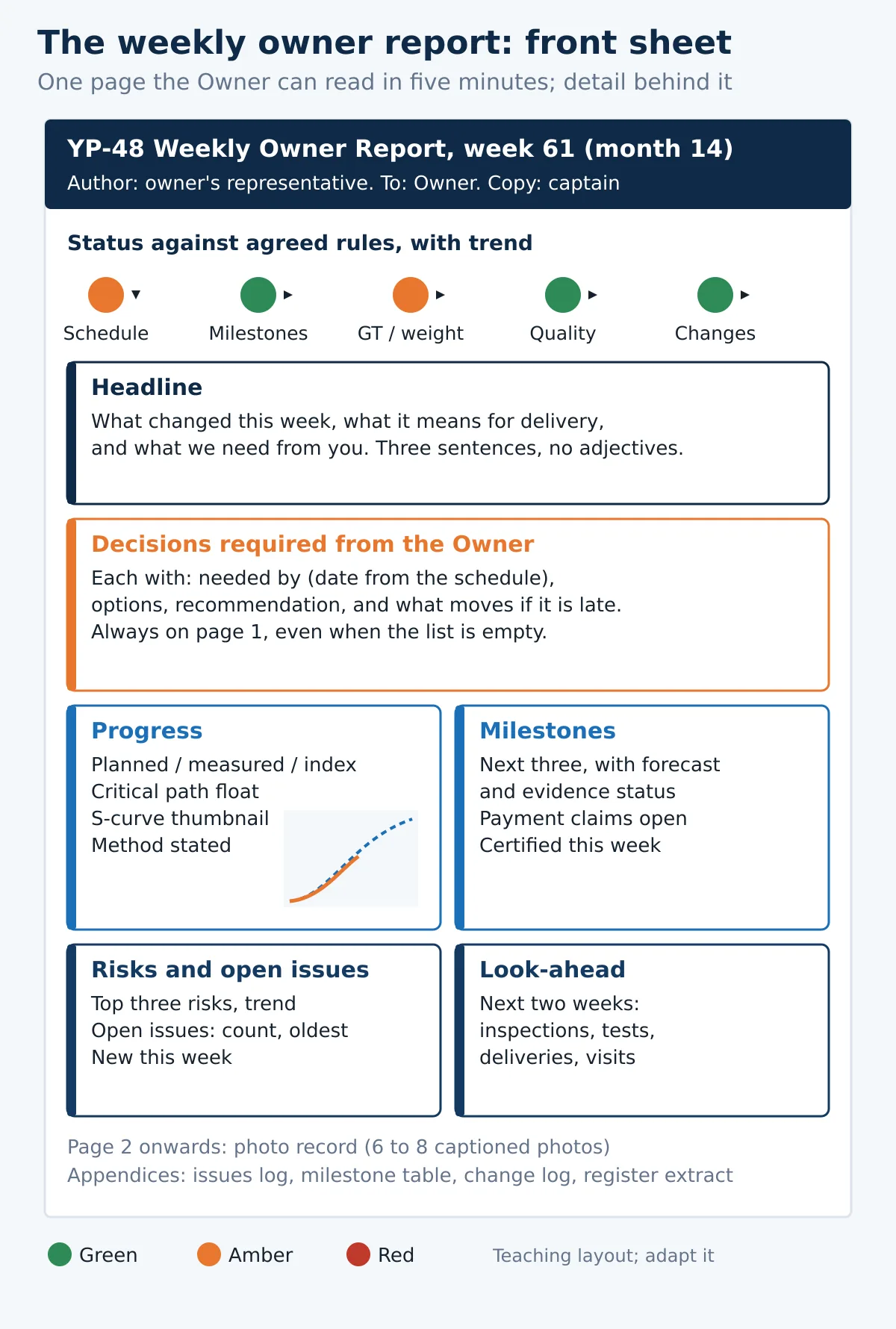
The headline is the hardest part to write. Three sentences: what changed, what it means for delivery, and what the Owner needs to do. No adjectives, no reassurance. For week 61:
Superstructure welding is about two weeks behind plan and sits on the critical path; the Yard started a second shift this week and still forecasts joining in month 16, while on the current rate we forecast the second half of month 16. Milestone 3 (main engines) is claimed, with five of six evidence items accepted and the joint inspection booked for Tuesday. We need three decisions from you: the master bathroom stone by the end of week 62, and the AV/IT specification and the tender garage door change by the end of week 63.
Behind the front sheet come the photo record, the open issues log, the milestone and payment table, a summary of the change log and an extract from the drawing register. Owners read the front sheet. Their advisers, and later perhaps their lawyers, read the rest, which is why the detail has to agree with the headline.
The templates: T10 Weekly Owner Report and Progress Calculator
Two files go with this lesson.
- Weekly Owner Report (T10), docx. A blank report with the front sheet (status strip with written rules, headline, decisions required, progress, milestones, risks and issues, look-ahead), a photo record table and the appendix headings, followed by the full YP-48 example for week 61 and the traffic-light rules used in this lesson.
- Physical Progress Calculator (T10), xlsx. One line per activity: weight, rule of credit, planned %, measured %, evidence reference. Formulas give planned and measured values, the variance and the index for each line and in total, and flag lines on the critical path. A second table logs the monthly totals and draws the S-curve and the index. A Blank sheet, plus an Example sheet with the YP-48 month-14 figures used above.
Download: Weekly Owner Report (T10), docx
Download: Physical Progress Calculator (T10), xlsx
The calculator measures physical progress only. If you also run cost-based earned value on your side of the project, the EVM (Earned Value) Tracker Template covers that. The payment side stays in the Milestone Payment Plan and Evidence Tracker (T6), and the GT and weight margins in the Drawing Approval Register and Weight / GT Tracker (T7). The weekly report quotes all three rather than duplicating them.
Before you send the first report
Agree these with the Owner, and where relevant with the Yard, before week one:
- the weights and the rules of credit for every activity, and that the baseline curve uses the same rules;
- how the owner's side will sample-check the Yard's quantities each month;
- the traffic-light rules for each dimension, in writing, including what "realistic recovery plan" means;
- the distribution list, and what stays owner-side;
- the photo viewpoints, the reference format and where the originals are kept;
- the day the report goes out, and the day the Owner's decisions are expected back.
Then keep the format stable. An owner who knows where to look each Friday reads the report; one who has to search for the news every week stops reading it.