
Owner-side change control on a yacht: screen requests, test the Yard's price and days, respect authority limits, track the total. Free xlsx form and VO log.
Every yacht owner changes something during the build. That is normal. The trouble starts when a change is agreed on deck, priced after it has been built, or approved by someone who had no authority to approve it. This lesson sets up the owner's side of change control on a yacht: how a request is raised and screened, what the Yard's variation order has to state before anyone signs it, who may sign, how the design freeze changes the price of a change, and how to keep the running total visible. It ends with a request form and a change log you can use on your own project.
The yard-side mechanics are covered elsewhere and are not repeated here. The standard-form clauses (SAJ Article V, NEWBUILDCON Clauses 24 and 26), the types of variation, cost build-up, time impact analysis and disruption are in Change Order and Variation Order Processes and Cost Impact Calculation. The Yard's paperwork is the Variation Order Form and the Cost Impact Calculation Sheet. The contract questions about changes were raised in Reviewing a Yacht Yard House Contract; this lesson runs the answers.
This is not legal advice. The contract's change clause, its notice periods and its named signatories decide. The project manager's job is to make every change visible, priced and authorised before the Yard acts on it.
Illustrative project: Project YP-48 is fictional. Its parameters are chosen from publicly reported industry ranges so the numbers are realistic, but no real yard, owner or yacht is described.
YP-48 at month 15
YP-48 is a 48 m full custom motor yacht with a design target of 499 GT, for private use and charter with 12 guests, built to the Red Ensign Group Yacht Code Part A (July 2024 edition). The contract runs 30 months, the flag is the Cayman Islands and the class society is Lloyd's Register, both illustrative choices explained in Rules Before Lines, and money is an index where the contract price is 100. The parties are introduced in Anatomy of a Superyacht Newbuild.
Three earlier lessons set the rules this one works with:
- Who Does What on a Yacht Build gives the owner's representative a delegation letter: owner change requests up to 0.25 per request and 1.5 in total, no effect on the delivery date, and nothing that touches the GT budget, class notation or exterior profile. Everything else goes to the Owner.
- Specification, General Arrangement and the Design Freeze freezes the GA and interior layout at month 7 and logs every change with its GT and weight effect.
- The Master Schedule for a Yacht Build puts hot work complete at month 16, launch at month 24 and delivery at month 30, with the paint window on the critical path.
By month 15 the owner's side has logged eight change requests. Three of them carry the lesson: CR-01, raised before the freeze; CR-02, which became VO-02 after it; and CR-05, rejected before the Yard priced it. The others show the authority limits, the time question and a disagreement.
Change request, variation order, change log
Three terms, used the same way throughout the series.
A change request (CR) is the owner's side asking for something different from the contract: the specification, the drawings, the makers list or the dates. It has no price yet and binds nobody.
A variation order (VO) is the priced, signed amendment. It states what changes, the price, the effect on the delivery date and on anything else the contract guarantees, and it is signed by the named persons on both sides. Until it is signed, the Yard has no instruction and the Owner has no price.
The change log is the owner's record of every request, including the ones that were rejected or withdrawn. In YP-48 the number carries through: CR-02 becomes VO-02 when it is signed, so anyone reading a drawing revision or an invoice can trace it back to the request.
The PMBOK Guide describes the same discipline in general project terms: every documented change request is approved, deferred or rejected by a responsible individual named in advance, changes that start verbally are recorded in writing, and a change log keeps the status of all of them. The yacht version adds two things the general guide cannot: a tonnage line that a small change can cross, and an owner who is rarely on site.
Writing is not a formality. Many yacht build contracts are governed by English law, as the arbitration article explains, and in 2018 the UK Supreme Court held in Rock Advertising v MWB Business Exchange Centres that a clause requiring variations to be made in writing and signed is effective, so an oral agreement to vary the contract was not binding. On a build site the practical reading is simple: an agreement on deck between the captain and the Yard's foreman changes nothing in the contract, but it may still change the yacht. The change log exists so that the two never drift apart.
Where requests come from
On YP-48 requests come from five places: the Owner, often through a family office; the captain, who will run the yacht; the Design Studio, still refining the interior; the owner's representative, who sees problems on site; and outside the owner's side, the Yard, class and the flag. Changes in class rules or flag requirements after signing, and the Yard's own substitutions, follow the contract's specific clauses; the variation order article covers them. This lesson deals with the owner's side.
The cheapest change is the one that never has to be made. Legal commentary on yacht build contracts makes the point that an inadequate specification or design phase leads to variations later, which is why From Design Brief to Yard Shortlist puts so much weight on the outline specification before the tender.
The one rule that matters most is the one set in the second lesson: every request reaches the Yard through the owner's representative. A designer who sends a revised detail straight to a joinery subcontractor, or a captain who asks a foreman to move a panel, has created a change without a number. The Yard will build it, and later price it.
Screening before the Yard prices anything
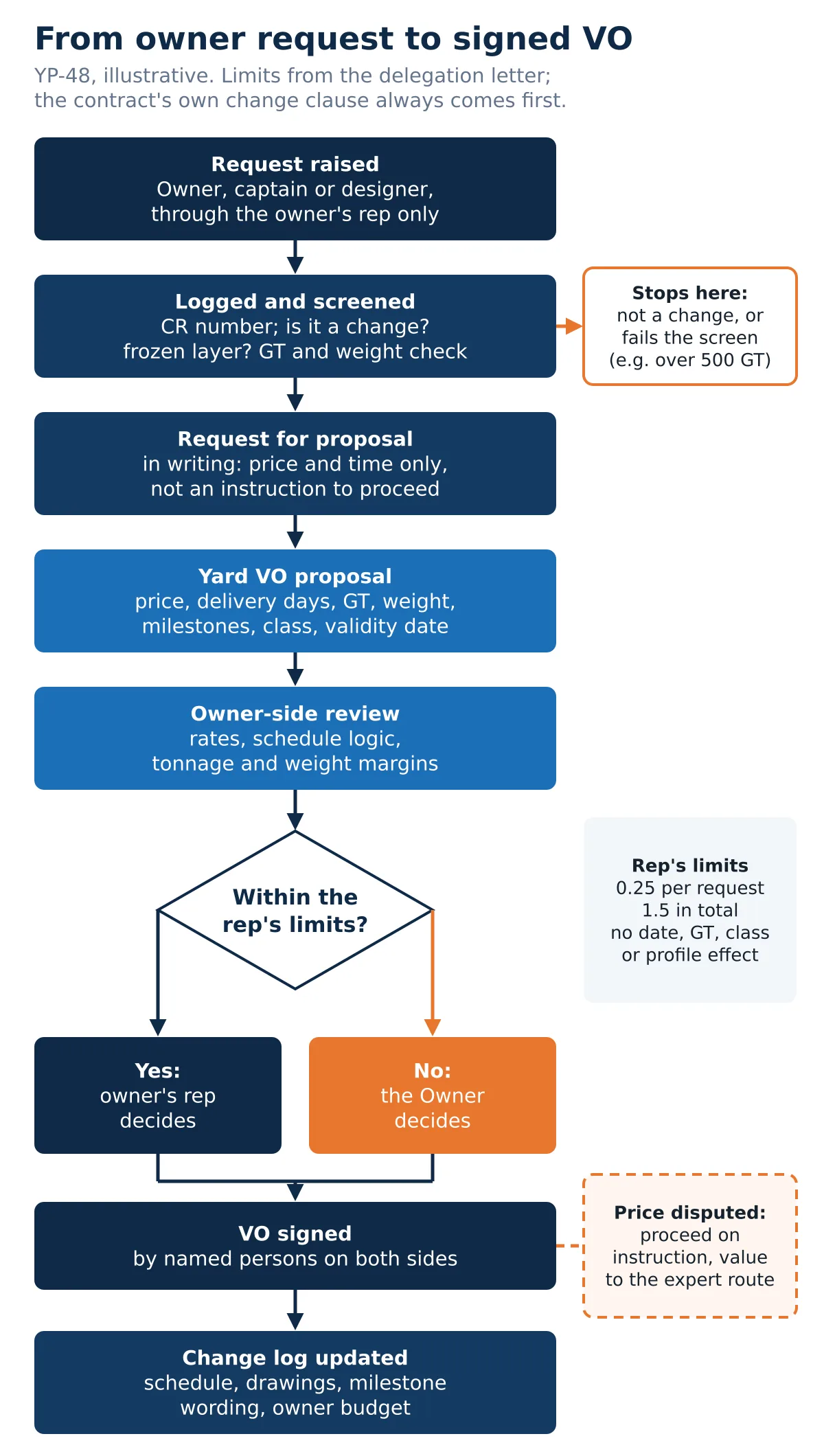
Asking the Yard to price a change costs the Yard's estimators and engineers time, and a steady stream of requests gives the Yard a reason to say that the owner's side is disrupting the build. Screen first. On YP-48 the owner's representative answers five questions within a few days of a request being logged:
- Is it a change at all? If the specification already requires it, it is the Yard's obligation, not a variation. If it develops the design inside the specification before the relevant freeze, it belongs in the drawing approval route. If it is a defect, it goes on the punch list. Only a departure from the contract documents is a change. The order of precedence in the design freeze lesson settles which document says what.
- Which frozen layer does it touch? Hull structure is fixed at the start of steel cutting (month 4), the GA and interior layout at the design freeze (month 7), interior details at month 14.
- What does it do to tonnage and weight? The naval architect gives a first estimate. On YP-48 the naval architect works for the Yard, so the rule-of-thumb column in the T7 tracker is used for the first check and the Yard's proposal carries the formal figure.
- What does it touch in the schedule? A long-lead order already placed, the hot-work cut-off at month 16, the paint window, or a payment milestone definition.
- When is a decision needed? The date after which the change costs more or can no longer be made without moving something else.
CR-05 shows why the screen matters. At month 14 the Owner asks for an enclosed bar on the sun deck, 4.0 by 2.5 m and 2.3 m high. That is 23 m³ of enclosed volume, about 6.3 GT near the 499 GT line, and it would take the estimate from 496.3 to about 502.6 GT, over 500. The representative takes the tonnage arithmetic to the Owner two days after the request, the Owner rejects it, and the Yard is never asked for a price. The request stays in the log as rejected, with the reason.
The request for proposal and the Yard's variation order
A request that passes the screen goes to the Yard as a written request for proposal. Its first line says what it is: a request for price and time, not an instruction to proceed. Without that line, a Yard that starts work "to save time" has an argument that it was instructed.
On YP-48 the owner's side asks for every proposal to state:
- the price as a lump sum, with the build-up on the contract's agreed rates where the contract has them;
- the effect on the contractual delivery date in days, with the schedule activities it touches, and zero written as zero;
- the GT and weight effect from the naval architect;
- any effect on performance guarantees, class or flag approval, and payment milestone wording;
- how long the offer is valid.
Two outside sources support that list. The Society of Construction Law's Delay and Disruption Protocol was written for construction contracts, not yachts, but its principle is general: it recommends that where practicable the total likely effect of a variation, including time-related and disruption costs and the extension of time, is agreed in advance so the variation has a fixed price. And legal commentary on yacht build contracts advises that the contract should set transparent benchmarks for how the cost and extra time of a variation are calculated. How to build up and audit the price itself is in the variation order article and the Cost Impact Calculation Sheet; the owner's side uses the same structure to check it.
Before and after the design freeze
The freeze does not stop changes. It changes what they cost, because after it the Yard has ordered, drawn or built against the frozen layer. The three YP-48 examples show the difference.
| Request | Raised | What it touched | Yard proposal | Signed | GT effect | Decided by |
|---|---|---|---|---|---|---|
| CR-01, enclosed gym on the bridge deck aft, reduced to 3.0 by 2.5 m | Month 3, before the freeze | Drawings only; superstructure steel not started | 0.45, 0 days | VO-01: 0.40, 0 days | +4.7 | Owner (GT, exterior profile) |
| CR-02, wheelhouse deckhead raised 150 mm over 38 m² | Month 8 to 9, after the freeze | Glazing already ordered; aluminium superstructure in build | 0.62, 15 days | VO-02: 0.55, 0 days | +1.6 | Owner (GT, exterior profile) |
| CR-05, enclosed sun-deck bar | Month 14 | Would cross the 500 GT line | Not requested | Rejected | +6.3 (not added) | Owner |
CR-01 was a larger change in volume than CR-02, and it cost less. Before the freeze and before any superstructure material was cut, it changed drawings and the tonnage estimate, nothing else. The Owner still had to sign it, because it used 4.7 of the 11 GT margin the naval architect had at signing and changed the exterior profile.
CR-02 came after the freeze. The wheelhouse windows were part of the glazing package ordered at month 7, so the order had to be revised, and the aluminium superstructure was already in production. The Yard's first proposal asked for 15 days on the delivery date. The owner's side checked it against the schedule: the superstructure is on the critical path, but the wheelhouse modules are among the last to be built, and the Yard could resequence them. The signed VO-02 has 0 days and a slightly lower price. The lesson is not that yards overstate time; it is that a time claim is tested against the current schedule, activity by activity, before anyone signs.
CR-05 never reached the Yard, for the reasons above.
The same pattern applies to every later layer. A change to interior details before month 14 is usually a drawing change; after it, joinery is in production. A change needing welding on the exterior after hot work complete can reopen fairing and paint in that area, as the master schedule lesson warns. The variation order article explains why the same change priced later carries more disruption; the owner-side point is to put a decision date on every request so the Owner decides while the change is still cheap.
Time: the figure to check hardest
The price of a change is visible on the invoice. Its time effect is not, until the delivery date moves. Three rules on YP-48:
Every VO states its delivery effect, and zero is written as zero. A VO signed with "time impact to be advised" or "time reserved" leaves the question open. Several of them become a single claim for an extension near the end of the build, when the causes are hard to separate. The T9 log flags any signed VO without a days figure.
Time goes through the contract's own extension mechanism. The contract review lesson flagged legal commentary warning that extra time granted outside that mechanism can reopen the whole delay regime. The VO should refer to the extension clause, and counsel should see any VO that moves the date.
Only the Owner can move the date. The delegation letter gives the representative no authority over the delivery date, however small the change.
CR-06 is the live example. At month 14 the Owner asks for a larger hydraulic tender garage door, to fit a bigger tender chosen after signing. The Yard proposes 0.70 and 21 days. The door has no GT effect but adds about 0.3 to the weight index, half of the remaining weight margin shown in the design freeze lesson. The new opening needs welding in the hull, which must finish before hot work complete on 2028-05-10, and the offer is valid until 2028-04-10. So the Owner has a fixed decision date, and the owner's side has two weeks to test the 21 days against the schedule: whether the extra hull work really moves hot work complete, and with it the paint window and launch, or whether it fits inside float. The payment plan is affected too, because the launch milestone's pre-launch list includes the garage door and its test, so the VO must state the new wording, as the payment plan lesson requires.
Who signs
The delegation letter from the second lesson decides who may approve, and the T9 log applies it with a formula:
- the Owner decides any change with a delivery date effect, a GT effect, a class, flag or exterior profile effect, or a credit for deleted scope;
- otherwise the representative may decide if the price is within 0.25 and the representative's signed total stays within 1.5;
- anything else goes to the Owner.
CR-03 is the ordinary case: the captain asks for the engine room switch panel to be moved to the forward bulkhead, the request comes through the representative, the Yard prices it at 0.06 with no time or tonnage effect, and the representative signs it.
CR-04 is the case the rule is written for. The Owner asks for a cinema system in the sky lounge. The Yard offers it as two VOs of 0.21 each, one for the screen and projector lift, one for the speakers, which would put both inside the representative's per-request limit. The owner's side merges them: one change, one VO. The Owner signs it at 0.40. Splitting is not always done in bad faith, since two trades may price separately, but a per-request limit that can be met by splitting is not a limit.
Named signatories. The contract review lesson asked who on the owner's side may sign a variation and up to what value. The answer goes into the delegation letter, a copy goes to the Yard, and the Yard's VO form carries those names. A VO signed by someone not on the list goes back.
The cumulative picture
No single YP-48 change is large. The log is what shows the total.
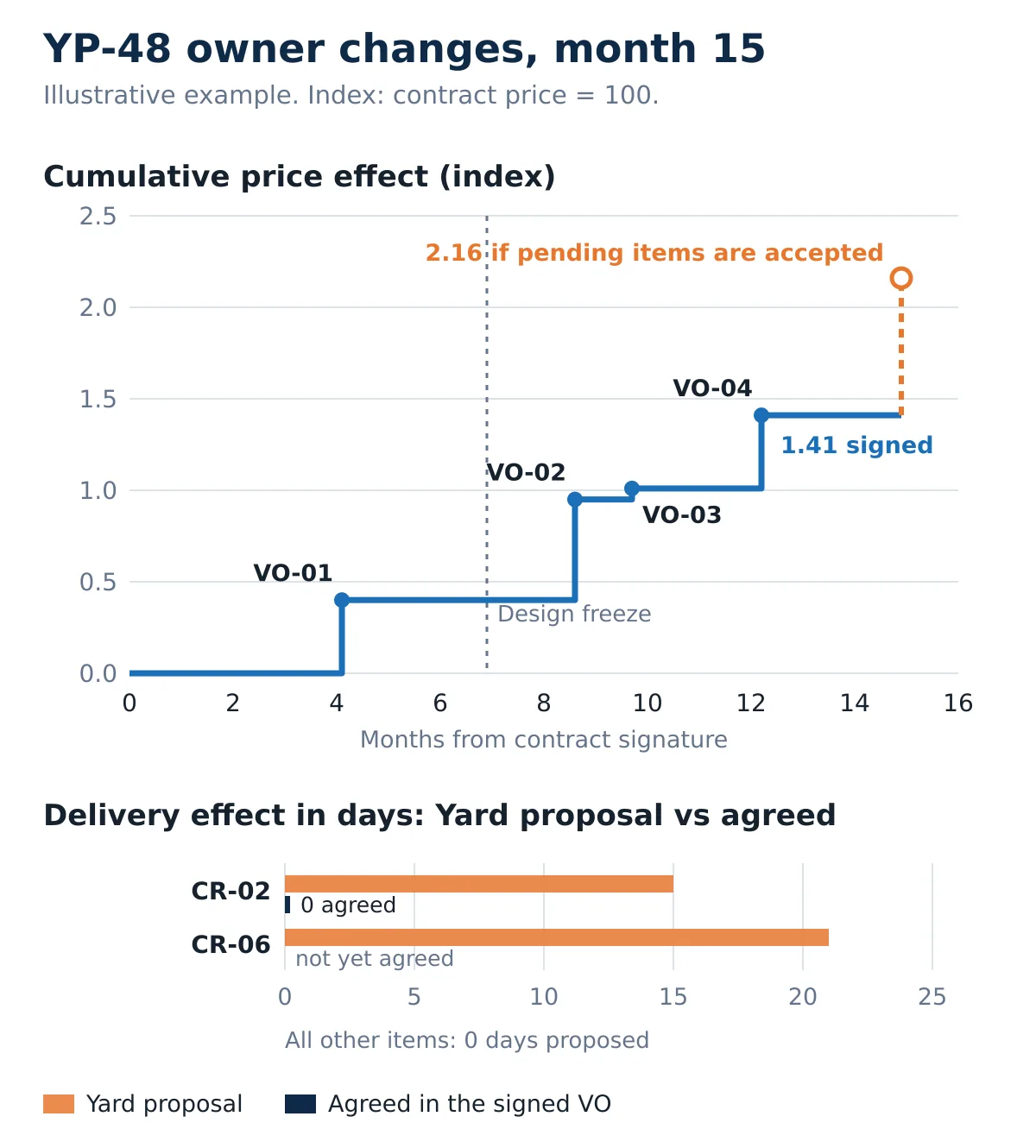
At month 15 the YP-48 log reads:
- Price. Four signed VOs total 1.41. Pending exposure is 0.75: CR-06 at 0.70, CR-08 at 0.15 and the disputed credit CR-07 at the Yard's figure of minus 0.10. If all are accepted as proposed, the total is 2.16.
- Time. 0 days agreed; 21 days claimed and not yet agreed.
- Tonnage and weight. Owner changes account for 6.3 GT of the tonnage used since signing; the rest came from design development. The GT margin is 2.7 and the weight margin 0.6, both in the warning band of the T7 tracker.
- Authority. The representative has signed 0.06 of the 1.5 cumulative limit. Most of the value went to the Owner because it touched tonnage, the profile or the date, which is what the letter intended.
The total matters for three reasons beyond the price. The Owner's budget for changes has to be tracked against it; the owner-side budget is a later lesson in this series. Several changes in the same area interact, and the Yard's disruption argument is built on exactly that. And changes that are not recorded as they happen are the raw material of a global claim. The Delay and Disruption Protocol discourages composite or global claims made without trying to show cause and effect; the owner's side's best protection against one is a log in which every change has its own price, its own days and its own date.
The log goes into the monthly report as a short table: signed total, pending exposure, days agreed and claimed, and any request older than its decision date.
When the Owner and the Yard disagree
Disagreements over changes come in four kinds, and it helps to name which one you have:
- Whether it is a change at all. The Yard says the specification did not include it; the owner's side says it did. The order of precedence and the approved drawings decide, not the price.
- The price. Usually the rates, the hours or the mark-up. The cost sheet structure makes the argument item by item.
- The time. Whether the change is on the critical path, and whether float absorbs it.
- The value of a credit. Deleted scope is often valued lower by the Yard than by the owner's side.
CR-07 is the credit case. The Owner deletes the sauna in the owner's suite. The Yard offers a credit of 0.10; the owner's side, adding the specified equipment and the joinery around it, values it at 0.22. Neither side wants the build to wait. After the contract review, YP-48's contract lets the Owner instruct the Yard to proceed with a change while its value is settled later through the expert route, which was the proposed fix for finding F-07 in the contract review lesson. The Owner instructs the deletion in writing, the log shows the item as disputed and proceeding, and the pending exposure counts it at the Yard's figure until it is settled.
Legal commentary on yacht build contracts notes that an independent technical expert can resolve a dispute over the impact of a change faster than arbitration or litigation while the project carries on. Where a dispute does go further, yacht contracts usually send it to arbitration, as explained in Why Yacht Disputes Go to London Arbitration. The project manager's part is the record: the request, the screen, the proposal, the owner-side check and the instruction, each dated.
The template: T9 Owner Change Request Form and Change / VO Log
The workbook has a request form and a log, each in a blank and an example version.
- Change log. One row per request: number, date, who raised it, description, area, the Yard's VO reference, proposed and agreed price, proposed and agreed delivery days, GT and weight effect, class or profile effect, payment milestone effect, who approved it, decision date and status. Formulas give before or after the GA freeze, the required approval level from the delegation limits, cumulative signed price and days, the representative's signed total, an authority check (approver above their limit, approver missing, agreed price or days missing) and days open. The summary at the top shows signed total, pending exposure, the total if pending items are accepted, agreed and claimed days, forecast delivery date, the representative's limit left and the number of flags.
- Request form. One page per request, in four parts: the request, the owner-side screen, the Yard's proposal in summary, and the decision with signatures. It is the owner's record; the priced change itself stays on the Yard's VO form.
The example log is YP-48 at month 15 with the eight requests from this lesson. The example form is CR-06, still open.
Download: Owner Change Request Form and Change / VO Log (T9), xlsx
The GT and weight effects in the log match the Weight & GT sheet of the Drawing Approval Register and Weight / GT Tracker (T7), which carries the running margins.
Before you sign a variation order
Check that:
- the request has a CR number and came through the owner's representative;
- it is a real change, not specification scope, design development or a defect;
- the proposal states price, delivery days (zero written as zero), GT, weight, milestone wording, class or flag approval and validity;
- the days have been tested against the current schedule, including the hot-work cut-off and the paint window;
- the approval level in the log matches who is about to sign, and the signatory is named in the delegation letter;
- a VO that moves the date goes through the contract's extension clause and past counsel;
- one change is one VO, not two halves under a limit;
- the log, the schedule, the drawing register and the owner budget are updated on the day it is signed.
The next lesson in this series, Measuring Progress and Writing the Weekly Owner Report, puts the change log alongside physical progress and the milestone plan in the report the Owner reads each week.