
A practical checklist for reviewing a yacht yard house contract: what to check, typical risks and PM questions per clause, with a worked illustrative example.
A superyacht newbuild is almost always signed on the yard's own contract, not on a published standard form. That changes the owner's side of the job: nobody hands you a balanced baseline, so the review has to find the gaps itself. This lesson gives you a working checklist for that review. For each clause area it covers what to check, where the risk usually sits and the questions a project manager should put to the yard and to the owner's lawyer. At the end we run the checklist over the draft contract for our illustrative project and show what the findings log looks like.
The lesson builds on four articles and does not repeat them. Why there is no NEWBUILDCON for superyachts explains why yards use house contracts. How a shipbuilding contract works walks through each mechanism on a commercial newbuild. Standard contracts in ship newbuilding and repair compares SAJ, NEWBUILDCON and the other forms. Milestone payments in superyacht contracts deals with milestone definitions in depth. If a term here is unfamiliar, the explanation is in one of those four.
This is not legal advice. A project manager's review does not replace specialist maritime counsel. The PM's job is to make sure the contract can actually be run as a project: that every date, notice, test and payment trigger is clear enough to plan, measure and prove. Anything with legal consequences goes to counsel. Where this lesson mentions a typical range, it says where the range comes from. Real numbers are always negotiated.
Illustrative project: Project YP-48 is fictional. Its parameters are chosen from publicly reported industry ranges so the numbers are realistic, but no real yard, owner or yacht is described.
The project behind the contract
YP-48 is a 48 m full-custom motor yacht, designed to stay under 500 GT, for private use and charter with up to 12 guests, built to the Red Ensign Group Yacht Code Part A (July 2024 edition). The contract runs 30 months from signing to delivery, with seven payments including the signing instalment and a 12-month warranty. The project and its parties are introduced in Anatomy of a Superyacht Newbuild. All money in this lesson is an index where the contract price equals 100. The draft contract names the Cayman Islands as flag and Lloyd's Register as class society, both illustrative choices explained in Rules Before Lines.
The Owner has received the Yard's draft contract, technical specification, general arrangement and makers list, and has asked the owner's side to report within three weeks which clauses are acceptable, which need changes and which must not be signed as drafted.
How to run the review
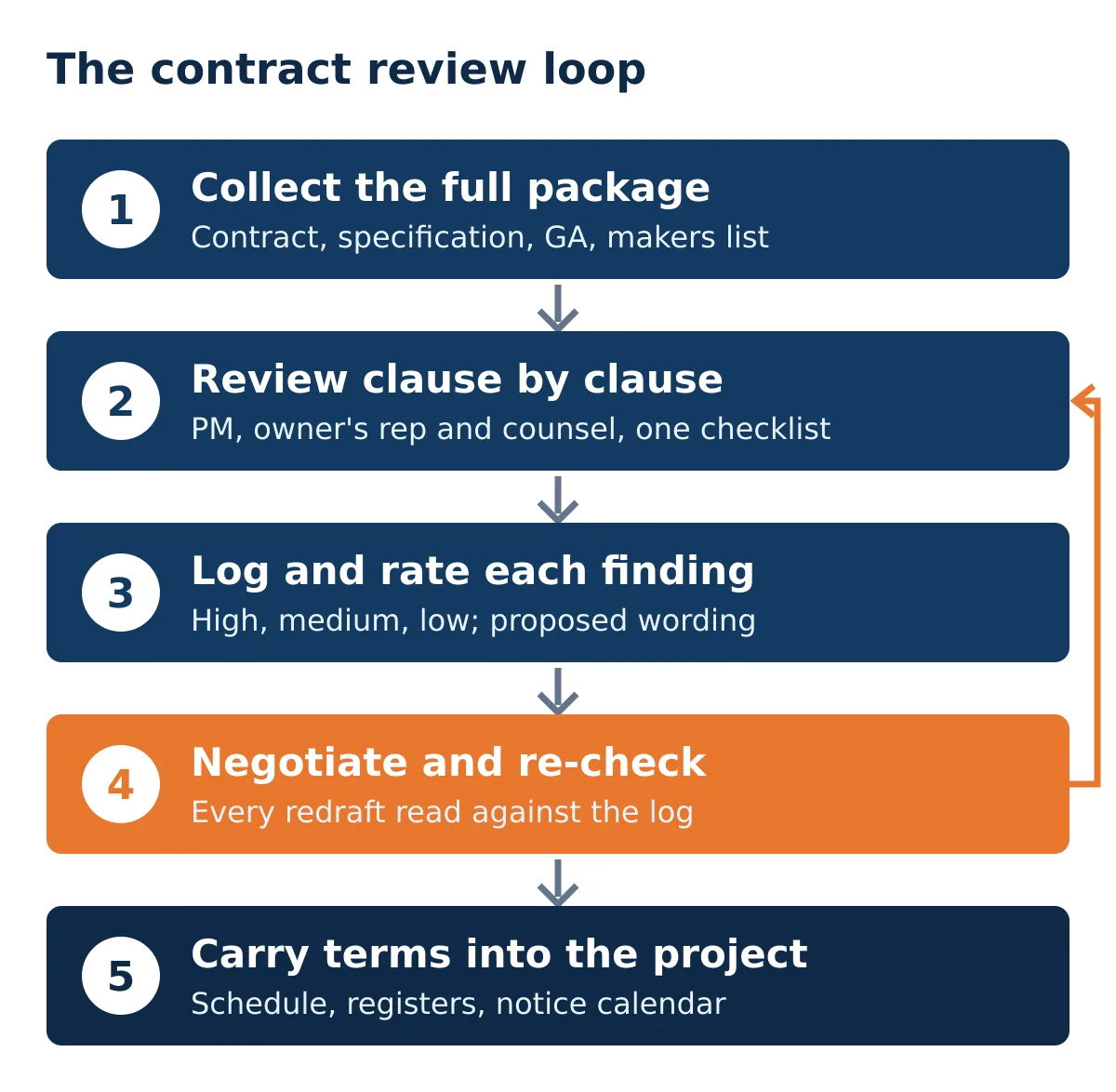
Collect the whole package first. A contract clause often reads well until you open the specification it points to. Review the contract, the specification, the GA, the makers list and every annex together, and check the order of precedence early, because it decides which document wins when they disagree.
Split the work, keep one log. The project manager reads for plannability: dates, durations, notice periods, test criteria, evidence. The owner's representative or build captain reads the specification and the acceptance terms. Counsel reads the legal mechanics: title, guarantees, termination, governing law. All three write into the same findings log, so nothing is agreed in one channel and lost in another.
Rate each finding. Three levels are enough. High: do not sign as drafted. Medium: change is needed but a fallback is acceptable. Low: clarification or wording. Each finding gets a proposed change, not only a complaint, because the yard's team will answer faster to a drafted alternative.
Re-check every redraft. Yards often return a revised draft with changes beyond the points you raised. Compare each new version against the previous one and against the log, clause by clause. A tracked-changes comparison is the minimum.
Carry the result into the project. A signed contract that lives only in a legal folder is how notice periods get missed. Every date, notice window and test criterion becomes a schedule activity, a register line or a calendar entry. The last section of this lesson lists where each one goes.
The accompanying template, T5 Yacht Build Contract Review Checklist, holds the questions below in a table with columns for the draft's position, risk rating and proposed change, and a second part with the YP-48 example filled in. Download: Yacht Build Contract Review Checklist (T5), docx
Where the exposure sits
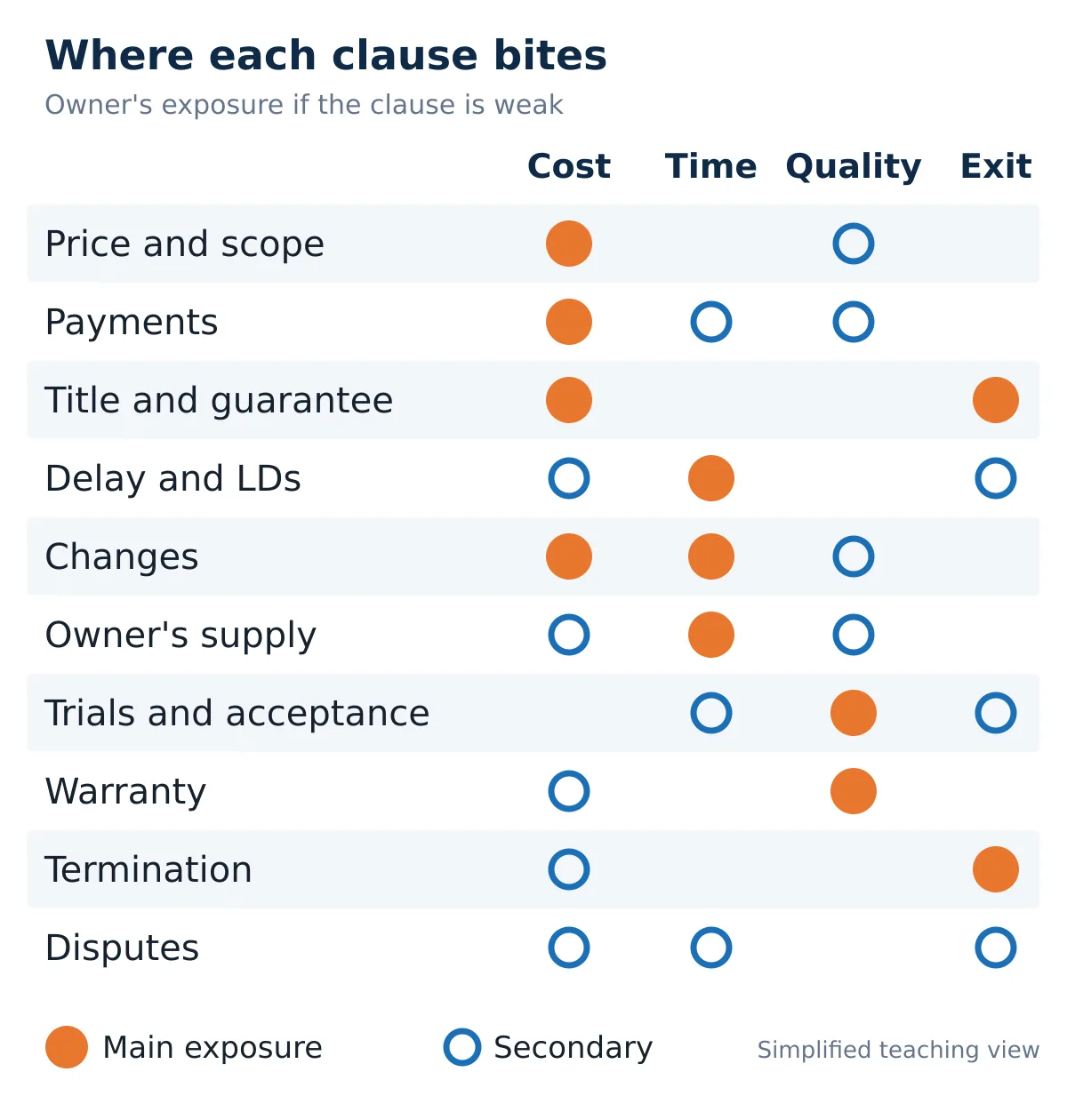
Not every clause matters equally for every risk. The map below is a simplified teaching view of where a weak clause usually hurts the owner. Use it to decide who reviews what first, not as a substitute for reading the whole contract.
Price, scope and what the price includes
The contract price is only meaningful against a scope. On a custom yacht much of the scope is still being designed at signing, so the specification carries more risk than the price figure itself.
What to check:
- What the price includes and excludes: design and engineering, class and flag approval fees, trials, delivery location, crew training, spare parts, consumables, loose items, the tender outfit.
- Allowances or provisional sums for items not yet specified, such as loose furniture, AV/IT or art installation. Check how each allowance is spent, who approves, and what happens to over- and underspend.
- Whether the price is fixed or can move through escalation, currency or tax clauses. Taxes and duties depend on where the yard is and where delivery takes place. Treat tax and customs wording as a specialist review item for counsel and a tax adviser.
- Whether the specification is detailed enough to price and test. Industry commentary on yacht contracts stresses that a thoroughly developed specification before signing reduces later variations and their knock-on schedule effects.
Typical risks: vague finish standards ("to superyacht standard") that cannot be measured, allowances set low to make the price attractive, and exclusions buried in the specification rather than the contract.
Questions to ask:
- Which specification items are still "to be agreed", and by what date?
- For each allowance, what is the basis of the figure and who holds the unspent balance?
- Which finish and comfort standards will be measured at acceptance, and how?
Payments and milestone definitions
The payment clause is where the owner's cash exposure is set. Industry guidance commonly describes six to eight payment stages on a yacht newbuild, tied to construction milestones, with more frequent percentage-based payments verified by an independent party as an alternative. There is no standard split; the milestone article covers the definitions in detail.
What to check:
- Each milestone is defined by a completed, provable event, not by a date or the start of a phase.
- Who certifies completion (the owner's representative, class, or both) and what evidence is attached.
- What happens when the owner disputes a milestone claim: is part of the payment released, is there an expert route, does the yard get time?
- Whether payment is made by transfer, into escrow, or under a letter of credit, and what documents trigger it.
- Interest on late payment and the yard's right to suspend work after non-payment.
Typical risks: front-loaded instalments that leave the owner with little leverage late in the build, and milestone wording loose enough for the yard to claim early.
Questions to ask:
- Is the cumulative amount paid at each milestone roughly in line with the value built by then?
- For each milestone, what exactly will the owner's representative inspect before signing?
- If a variation changes the scope of a milestone, how is its completion re-defined?
A later lesson in this series, "Building the Milestone Payment Plan and Its Evidence Pack", turns the agreed milestones into a payment plan and an evidence tracker.
Title, security and the refund guarantee
On most international shipbuilding contracts, title stays with the builder until delivery, and the buyer's pre-delivery money is protected by a refund guarantee from a bank or other surety. Yacht contracts sometimes do it differently: legal commentary notes that the owner taking title during construction is common where the yard cannot obtain credit lines for refund guarantees. That gives security but makes termination harder, because moving a half-built yacht to another yard is a major logistical exercise and a new yard may not warrant work it did not do.
What to check:
- Which security the owner gets: refund guarantee, title during build, a registered interest in the hull, or a combination.
- For a refund guarantee: the issuer, the amount (does it grow with each instalment?), interest, expiry date, governing law, and above all whether it is payable on demand or only after an arbitration award or judgment. From the buyer's side an unconditional, irrevocable, on-demand guarantee is preferable.
- That the guarantee does not expire before a dispute about the cancellation can be resolved, and which events allow a call.
- That later contract amendments do not weaken the guarantee. Counsel should confirm whether the guarantor must consent to amendments.
- For title during build: how title passes, how it is registered, what happens to materials and equipment not yet installed, and whether the owner can remove the hull and its components if the contract ends.
- The yard's builder's risk insurance: amount, named insured, loss payee, and what happens after a total loss before delivery.
Typical risks: a guarantee that pays only at the end of an arbitration, a guarantee that expires on the contractual delivery date while the yacht is still late, and title clauses that do not cover owner-furnished equipment already on site.
Questions to ask:
- Can the draft guarantee wording be seen before signing, and is issuing it a condition of the first payment?
- What does the guarantee not cover? Legal commentary is clear that refund guarantees do not compensate for inflation or for side costs such as the site team or financing.
- If the owner holds title during construction, what is the realistic plan for completing the yacht elsewhere?
Delivery date, delay and liquidated damages
The delivery clause decides what a late yacht costs the yard and when the owner can walk away. The mechanics (permissible delay, grace period, daily rate, cap, cancellation right) are described in the contract pillar. On a yacht the questions are the same, but the owner's loss is rarely lost earnings in the commercial sense, so the rate and the cap need a different rationale.
What to check:
- A single, unambiguous contractual delivery date and delivery place.
- The list of permissible delays, especially how force majeure is defined and whether subcontractor or supplier failure is included.
- The notice procedure for delay claims: who notifies, within how many days, with what evidence of the effect on delivery. Time-barred notice clauses cut both ways.
- The liquidated damages rate, any grace period, the cap, and the delay after which the owner may cancel.
- Whether the LDs are the owner's exclusive remedy for delay.
Legal commentary on yacht contracts makes a point worth remembering: liquidated damages motivate the yard, but they also limit its liability. A low cap can be cheaper for the yard than finishing on time. Under English law a liquidated damages clause is enforceable unless it is out of all proportion to the innocent party's legitimate interest, the test restated by the UK Supreme Court in 2015. Whether a specific rate passes that test is a question for counsel, not for the project team.
Questions to ask:
- How is a permissible delay's effect on delivery demonstrated? Is a critical path analysis on the agreed schedule required?
- Does the yard have to submit and update a programme, and is it a contract document?
- Is there an early-warning obligation before a delay becomes a formal claim?
Specification, approvals and the owner's site team
Much of a yacht's quality is decided in drawing and sample approvals during the build. The contract sets the rules for that process.
What to check:
- Order of precedence between contract, specification, drawings and makers list.
- Drawing approval turnaround: how many days the owner has to comment, and whether silence counts as approval.
- Access for the owner's representative, build captain and consultants to the yard, workshops and major subcontractors.
- How comments and rejections are recorded and answered.
- Whether owner approval of a drawing or sample shifts responsibility away from the yard.
Typical risk: short approval periods with deemed approval, which turn a busy owner's late reply into a permissible delay for the yard.
Questions to ask:
- What is the turnaround for interior samples and mock-ups, which usually need the owner in person?
- Which decisions does the owner have to make personally, and which can the owner's representative make?
Changes and variation orders
Variations are widely flagged as the highest-risk area of a yacht contract, because the owner keeps designing while the yard builds. The yard-side procedure and cost calculation are covered in the variation order article and the variation order form. Here the check is on the contract wording.
What to check:
- That no change is binding unless it is written and signed by named persons on both sides.
- How the yard prices a change: itemised hours, agreed labour rates, material at an agreed margin.
- How the time effect is calculated and whether it must be shown on the schedule.
- Whether the yard can refuse or delay work until price and time are agreed, and whether there is a route to proceed while the price is disputed.
- How changes in class rules or flag requirements after signing are treated.
- Whether amendments that give the yard more time are drafted through the contract's own extension mechanism. Legal commentary warns that an amendment granting extra time outside that mechanism can reopen arguments about the whole delay regime, so counsel should draft any extension.
Questions to ask:
- What rates will the yard use for variations, and can they be fixed in an annex now?
- Who on the owner's side may sign a variation, and up to what value?
- How are credit variations (deleted scope) valued?
A later lesson, "Owner Change Requests and Variation Orders on a Yacht", builds the owner-side change log.
Owner-furnished equipment
Owners of custom yachts often buy some items themselves: AV/IT systems, art, loose furniture, tenders and toys, sometimes specialist equipment. Legal commentary notes that yards usually prefer to contract directly with owner-preferred suppliers named in the specification, because bringing in outside vendors dilutes the yard's responsibility.
What to check:
- A list of owner-furnished items with delivery dates, delivery condition and the documents that must come with them.
- Who installs, integrates, commissions and warrants each item, and who is responsible for the interfaces.
- Whether late or defective owner-furnished items count as a permissible delay, and how the delay is measured.
- Storage, insurance and title for owner items on the yard's premises.
Questions to ask:
- Which owner items are on the critical path, and what are their latest delivery dates?
- Will the yard accept warranty responsibility for installation even when it does not warrant the item?
Trials, acceptance and delivery
On a commercial ship, trials mostly prove speed, consumption and capacity. On a yacht, noise, vibration, comfort and finish carry just as much weight, and they are harder to measure. The sea trials and delivery article covers the phase from the project side; the contract has to make it measurable.
What to check:
- The trial programme: who drafts it, when it is agreed, who attends, and which conditions apply.
- Guaranteed values (speed, range, noise and vibration levels in named spaces) with measurement method, tolerance, damages and rejection threshold for each.
- The definition of "ready for delivery", and how open items are classified at delivery.
- Whether a retention from the final payment secures minor items finished after delivery.
- The delivery documents: certificates, class and flag documents, bill of sale, manuals, as-built drawings, spare parts lists.
Typical risk: comfort and finish criteria written as adjectives. Anything the owner will reject at delivery must be describable and measurable in the contract.
Questions to ask:
- Which noise and vibration criteria apply, in which spaces, measured how?
- Who decides whether an open item is minor or blocks delivery?
Warranty
A 12-month guarantee period is common in shipbuilding. For yachts, industry guides quote 12 to 24 months, and some commentary mentions longer terms for structure or paint; treat those as negotiable, not standard.
What to check:
- Start date, length, and any extended guarantee for repaired items with an overall limit.
- How and when claims must be notified. An English court case summarised by Clifford Chance held that claims not notified within the contractual window after the guarantee period were barred.
- Where repairs are done, who pays for travel and moving the yacht, and what happens when the yacht is cruising far from the yard.
- Whether the yard passes on suppliers' warranties and who manages them.
- Exclusions and the cap on the yard's liability.
- Whether a guarantee engineer is provided, and for how long.
Questions to ask:
- If the yacht is in another region when a defect appears, who repairs it and at whose cost?
- For owner-furnished and yard-supplied equipment, which warranty applies and who is the owner's point of contact?
Termination
The termination clause is read in the worst week of the project, so read it now.
What to check:
- The owner's grounds to terminate: excessive delay, performance below rejection levels, insolvency, failure to proceed, total loss.
- The yard's grounds: non-payment after notice, refusal to accept delivery.
- The notice procedure, step by step. A buyer that terminates without following the contract's procedure can end up in breach itself.
- What happens to money paid, the hull, equipment, owner-furnished items, drawings and design rights after termination.
- Termination for convenience, if the owner wants it, and what it costs.
Questions to ask:
- Can the owner take the design and drawings to another yard to finish the build?
- How does termination interact with the refund guarantee or with title during build?
Disputes and governing law
Most yacht build contracts choose English law and London arbitration, for the reasons explained in why yacht disputes go to London arbitration. The useful project question is what happens before arbitration.
What to check:
- A fast route for technical disputes: referral to class or to an independent expert, whose decision lets the work continue. Legal commentary describes expert determination as faster and cheaper for technical disagreements and says yards are generally willing to accept it.
- Whether the expert's decision is final or can be reopened in arbitration.
- That governing law and seat are the same in the contract, the refund guarantee and any parent company guarantee.
- The obligation to keep building during a dispute.
Question to ask: which disputes go to class, which to an expert, and which go straight to arbitration?
Running the checklist on the YP-48 draft
The table below is an extract of the findings log for the YP-48 draft. The clause references and draft wording are fictional; they illustrate the kind of gap a review typically finds. Ratings follow the High / Medium / Low scale above.

| Ref | Clause area | Draft position (fictional) | Rating | Proposed change |
|---|---|---|---|---|
| F-01 | Title and guarantee | Refund guarantee "in a form acceptable to the Builder's bank", payable after an arbitration award | High | Guarantee wording annexed; irrevocable and on demand; issued before the first instalment |
| F-02 | Title and guarantee | Guarantee expires on the contractual delivery date | High | Expiry after the latest possible cancellation date plus time to resolve a dispute |
| F-03 | Payments | Launch milestone defined as "yacht in the water" | Medium | Launch defined with listed systems complete and class survey records attached |
| F-04 | Delay | Force majeure includes "delays of suppliers and subcontractors" without limit | High | Supplier delay permissible only if the supplier itself is hit by a defined force majeure event |
| F-05 | Delay | No obligation to keep a programme; delay notices "as soon as practicable" | Medium | Agreed programme as annex, monthly update, notices within a fixed number of days with schedule evidence |
| F-06 | Approvals | Owner comments within a short period, silence counts as approval | Medium | Longer turnaround for interior samples; no deemed approval for finish and colour items |
| F-07 | Changes | Yard may stop affected work until a variation price is agreed | Medium | Proceed on instruction with the price settled later through the expert route |
| F-08 | Owner's supply | Owner items "to be delivered when required by the Builder" | Medium | Dated list of owner items as annex, linked to the programme |
| F-09 | Trials | Noise and vibration "to superyacht standards" | High | Named spaces, limits, measurement method and tolerance in the specification |
| F-10 | Warranty | Repairs at the yard only; travel and transit at owner's cost | Medium | Repairs at the yacht's location by agreed contractors when a return to the yard is impractical |
| F-11 | Disputes | All disputes to arbitration, no technical expert route | Low | Expert determination for technical disputes, with the obligation to continue work |
Four findings are rated High. The owner's side would not recommend signing until F-01, F-02, F-04 and F-09 have been resolved or explicitly accepted by the Owner with counsel's advice. The remaining items go into the negotiation list, each with its fallback position.
From signed contract to running project
Once the contract is signed, every clause the checklist touched needs a home in the project. This is the part a planner owns.
| Contract term | Where it goes | Who keeps it |
|---|---|---|
| Delivery date, grace period, LD cap, cancellation threshold | Top-level milestones in the master schedule, float measured against the contractual date | Planner |
| Milestone definitions and evidence | Payment plan and evidence tracker | Owner's representative |
| Drawing and sample approval periods | Approval register with due dates | Design coordinator |
| Delay and change notices | Notice log and calendar with contractual deadlines | Project manager |
| Owner-furnished items | Procurement tracker, linked to schedule activities | Owner's procurement lead |
| Refund guarantee expiry, insurance renewal | Contract calendar with reminders well before expiry | Project manager, counsel |
| Trial criteria | Trial programme and test procedures | Build captain, owner's representative |
| Warranty notice periods | Warranty claim log | Owner's technical manager |
The same terms belong in the project risk register: the LD cap, the refund guarantee expiry and the cancellation threshold are exactly the limits a monthly risk review should watch.
Before you sign off the review
A checklist review is only as good as its last pass. Before the owner's side signs off, confirm that every High finding is closed or accepted in writing, that the final draft was compared against the version the review was based on, and that all annexes named in the contract are attached. The contract is the rulebook for the next 30 months of YP-48, and the rest of this series refers back to it, starting with the payment plan and the master schedule.