
Charter or private, 12 guests or more, under or over 500 GT, which flag and class: the early rule decisions on a yacht build. Free applicability matrix, xlsx.
A commercial ship's rules follow from its type and size. A yacht's rules also follow from how the owner means to use it, how many guests it will carry and how much enclosed volume the designer draws. Four early answers (charter or private, how many guests, which side of 500 GT, which flag and class society) fix a large part of the design envelope, the certificates the yacht must hold at delivery, the plan approval route for hundreds of drawings and some of the cost. Get them late and the lines on the general arrangement have to be redrawn.
This lesson sets out those decisions for a project manager: which part of the Red Ensign Group Yacht Code applies and why, what changes at the tonnage lines of 300, 400 and 500 GT, how the flag, its Recognised Organisations and the class society share the approval work, and how the choice of class society shows up in the schedule and the budget. It closes the two choices the earlier lessons left open for the example project: YP-48 is now flagged in the Cayman Islands and classed by Lloyd's Register.
It builds on Anatomy of a Superyacht Newbuild, which introduced the example project and the reported cost of crossing 500 GT, and on Who Does What on a Yacht Build, which set out what class and flag do. The rulebooks of the four main yacht class societies are compared in Four Classification Societies, Four Yacht Rulebooks; this lesson does not repeat that comparison.
This is not legal or regulatory advice. Codes, flag requirements and class rules change, and the flag administration and the class society are the authorities on what applies to a given yacht. Every reference below is to the edition named, and a real project confirms each point in writing with the flag and the class society.
Illustrative project: Project YP-48 is fictional. Its parameters are chosen from publicly reported industry ranges so the numbers are realistic, but no real yard, owner or yacht is described.
YP-48 so far, and what this lesson settles
YP-48 is a 48 m full custom motor yacht with a design target of 499 GT, for private use and charter with 12 guests, built to the REG Yacht Code Part A (July 2024 edition). The contract runs 30 months and the contract price is an index of 100. At contract signature the naval architect's tonnage estimate was 488.0 GT, a margin of 11 GT to the target, as tracked in Specification, General Arrangement and the Design Freeze.
Until now the lessons used "a Red Ensign Category 1 register" and "an IACS class society" so their methods would fit any choice. From this lesson on, YP-48 uses:
- Flag: the Cayman Islands, through the Cayman Islands Shipping Registry (CISR), part of the Maritime Authority of the Cayman Islands.
- Class: Lloyd's Register (LR).
Both are illustrative choices for teaching. They are not a recommendation, and nothing below says that another Category 1 register or another society would be worse. The section on the choice explains the criteria a real project would weigh.
Use decides the code
The REG Yacht Code has two parts, and the choice between them is made by use and guest numbers, not by length.
- Part A applies to motor or sailing yachts of 24 m load line length and over that are in commercial use for sport or pleasure, carry no cargo and carry no more than 12 passengers (Part A, 1.2).
- Part B applies to pleasure yachts on international voyages carrying more than 12 but not more than 36 passengers, with no more than 200 persons on board in total, and no cargo (Part B, 1.2). Part B yachts are held to passenger ship standards in several areas and receive a Passenger (Yacht) Ship Safety Certificate.
Three details catch people out.
The 24 m line is load line length, not length overall. The code measures length on a waterline, as a percentage of the waterline length at a set fraction of the moulded depth. For a 48 m yacht that makes no difference. For a yacht near 24 m it can decide whether Part A applies at all.
"Passengers" has a definition. Crew are not passengers, and nor are certain occasional workers such as a nanny or a masseuse who normally work ashore and have no emergency duties, provided they meet the conditions in the code's common annexes. A child under one year old is not counted either. The 12-passenger limit is a count of guests as the code defines them, not of beds.
Private use is outside Part A. Part A applies to yachts in commercial use. The Cayman registry's own guidance describes code compliance for a privately operated yacht as voluntary, and lists resale value and risk reduction among the reasons owners adopt it anyway. For YP-48, which the Owner intends to charter, the question does not arise: charter is commercial use, so Part A applies from the start.
The edition matters too. Part A (1.6) says that a yacht whose building contract is placed on or after 1 July 2024 complies with the July 2024 edition in its entirety. YP-48's contract falls after that date, so the July 2024 edition is the one written into the specification.
| Question | YP-48 answer | Consequence |
|---|---|---|
| Commercial use (charter)? | Yes | Code applies by law, not by choice |
| Load line length 24 m or more? | Yes (48 m LOA) | Inside Part A scope |
| Passengers | 12 | Part A; a 13th guest would move the yacht to Part B |
| Cargo | None | Inside scope |
| Building contract date | After 1 July 2024 | July 2024 edition in full |
The guest number deserves a separate sign-off from the Owner. The difference between 12 and 13 guests is not one more cabin; it is a different part of the code with passenger ship standards behind it.
The tonnage lines: 300, 400 and 500 GT
Inside Part A, a second set of requirements scales with gross tonnage. Gross tonnage is a measure of enclosed volume, not weight; how it is calculated and tracked through design is covered in the design freeze lesson. What matters here is which requirements switch on at which line. The code's certificate list (Common Annex M) and its chapters give a clear ladder.
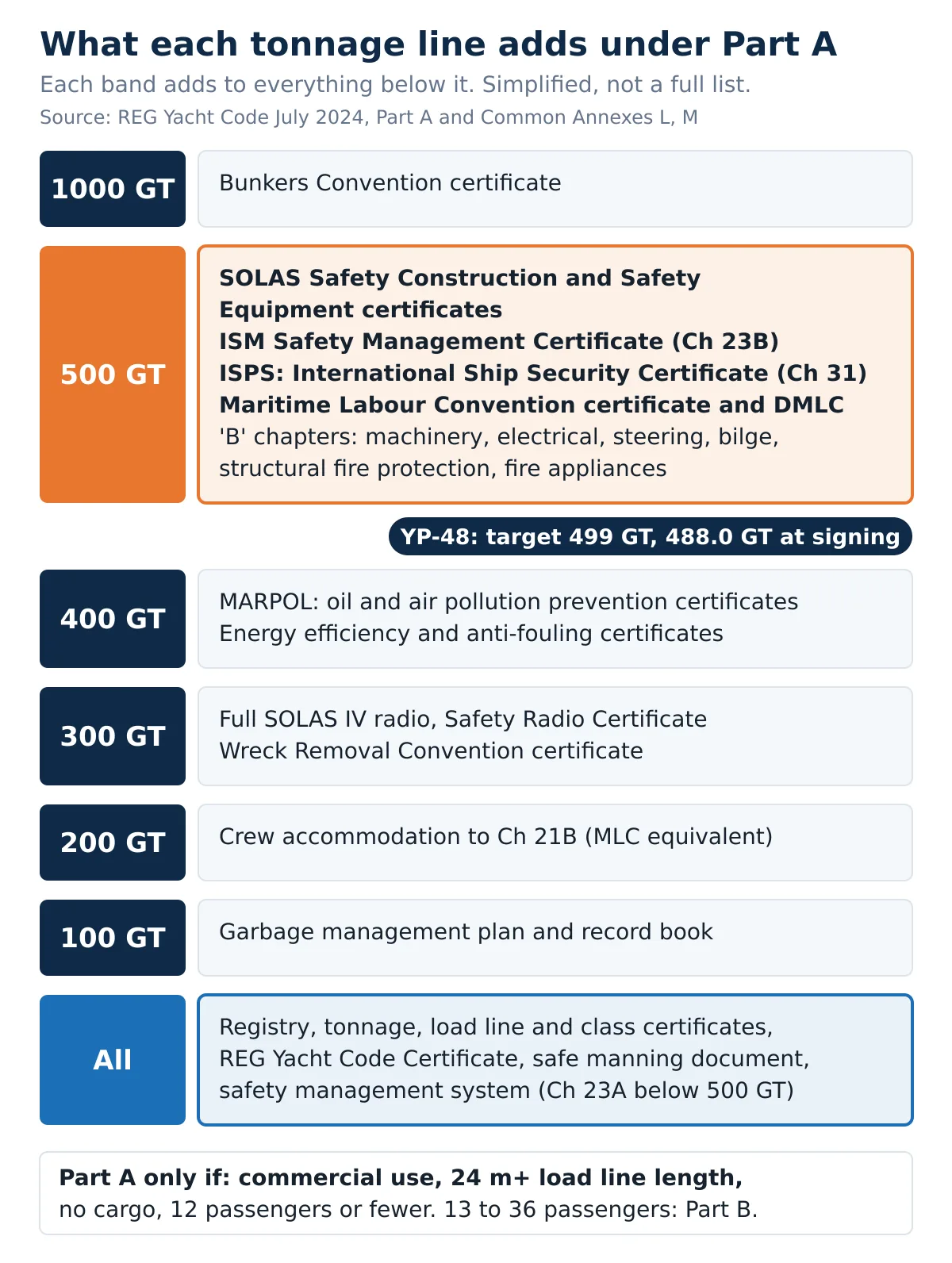
Every Part A yacht, whatever its tonnage, needs among other things a certificate of registry, an International Tonnage Certificate, the REG Yacht Code Certificate, a Certificate of Classification, an International Load Line Certificate, a minimum safe manning document and a safety management system under Chapter 23A. Then the ladder:
- 100 GT: a garbage management plan and garbage record book (also required at 15 persons or more, whatever the tonnage).
- 200 GT: crew accommodation to Chapter 21B, the code's equivalent of the Maritime Labour Convention accommodation standard, instead of the lighter Chapter 21A.
- 300 GT: radio installations to the full cargo ship requirements of SOLAS Chapter IV, a Safety Radio Certificate, and a Wreck Removal Convention certificate backed by insurance.
- 400 GT: the MARPOL certificates (International Oil Pollution Prevention, International Air Pollution Prevention), an energy efficiency certificate and an anti-fouling systems certificate. Below 400 GT the code leaves oily bilge water handling to local and port state rules.
- 500 GT: covered in the next section.
- 1000 GT: a Bunkers Convention certificate for oil pollution liability insurance.
The point many owners miss: a 499 GT yacht is already well up the ladder. YP-48 needs the 300 GT and 400 GT certificates and the 21B accommodation standard. The 499 GT target avoids one line, not all of them.
What crossing 500 GT changes
At 500 GT the code changes character. Several technical chapters of Part A exist in two versions, "A" for yachts under 500 GT and "B" for 500 GT and over: machinery (7A/7B), electrical installations (8A/8B), steering gear (9A/9B), bilge pumping (10A/10B), structural fire protection (14A/14B), fire appliances (15A/15B) and safety management (23A/23B). The "B" chapters point more directly to SOLAS: Chapter 7B, for example, asks for machinery to meet the relevant SOLAS parts so far as reasonable and practicable, with at least an equivalent standard of safety. Structural fire protection is the clearest example: Chapter 14B brings main vertical zones, fire integrity tables for bulkheads and decks and restrictions on combustible materials, all of which reach into the interior design.
The certificates change as well. From 500 GT, Annex M adds a Safety Construction Certificate and a Safety Equipment Certificate, an ISM Safety Management Certificate (Chapter 23B applies SOLAS Chapter IX, the International Safety Management Code), an International Ship Security Certificate (Chapter 31 applies the ISPS Code to yachts of 500 GT and over), a Continuous Synopsis Record, and a Maritime Labour Convention certificate with its declaration of compliance. For yachts operating in EU waters, an Inventory of Hazardous Materials certificate is added, and the EU Ship Recycling Regulation applies to yachts of 500 GT and over under an EU flag or calling at EU ports.
Some of these obligations cannot be delivered by the Yard at all. ISM and ISPS need a company ashore, procedures, drills and trained crew. The UK Ship Register's guidance to large yacht builders, discussed in Who Does What on a Yacht Build, makes the same point: ISM and crew qualifications sit with the owner, and the contract should say so.
Then there is the money. A naval architect quoted by Boat International put the cost of crossing 500 GT at around USD 5 million on the build, plus higher running costs every year. That is one reported estimate, not a benchmark, but it explains why so many yachts are designed to 499 GT. The same article reports the price of staying under: compromises on headroom, storage, crew areas and deck arrangements that the design team has to accept to keep enclosed volume down.
For YP-48 the decision is recorded like this:
- Decision: design to a maximum of 499 GT; the naval architect's tonnage estimate is a controlled budget line.
- Why: crossing 500 GT would bring in the "B" chapters, ISM, ISPS and the 500 GT certificate set, with a reported build cost in the millions and permanent operating obligations.
- What it costs: volume. Every change that encloses space is checked against the margin before it is approved.
- Who holds it: the Owner is accountable for the target; the naval architect reports the estimate monthly, and the owner's representative puts it in the weekly owner report.
- Trigger: once the margin to the target falls below 3 GT (the warning level in the YP-48 weight and GT tracker), any change that adds volume goes to the Owner with its tonnage effect before it is priced.
The 3 GT warning level is the example's own rule, chosen to leave room for the difference between the design estimate and the final measurement. Treat it as illustrative. How the margin is used month by month, including a rejected change that would have taken YP-48 to about 502.6 GT, is worked through in the design freeze lesson.
Flag, Recognised Organisation and class
Three bodies are easy to blur: the flag, the Recognised Organisation and the class society. On most yachts the second and third are the same company, wearing two hats.
- The flag administration is the government of the state whose flag the yacht flies. It issues the code certificate and the statutory certificates and remains responsible for them, whoever does the survey work.
- A Recognised Organisation (RO) is, in the code's words, a classification society or other body authorised by the administration under a written agreement to carry out statutory surveys and issue statutory certificates on its behalf. The code's definition of "Administration" includes an RO to the extent that responsibilities have been delegated to it.
- The class society applies its own rules to the hull, machinery and essential systems and issues the Certificate of Classification. Part A requires new yachts to be built to the requirements of a Recognised Organisation and to hold a commercial Certificate of Classification (Chapter 4).
So LR on YP-48 has two roles. As class society it approves plans and surveys against its own rules. As an RO for the Cayman Islands, it may carry out statutory work that CISR has delegated to it. The two roles have different authorities behind them, and the owner's side needs to know which hat LR is wearing on each drawing and each survey.
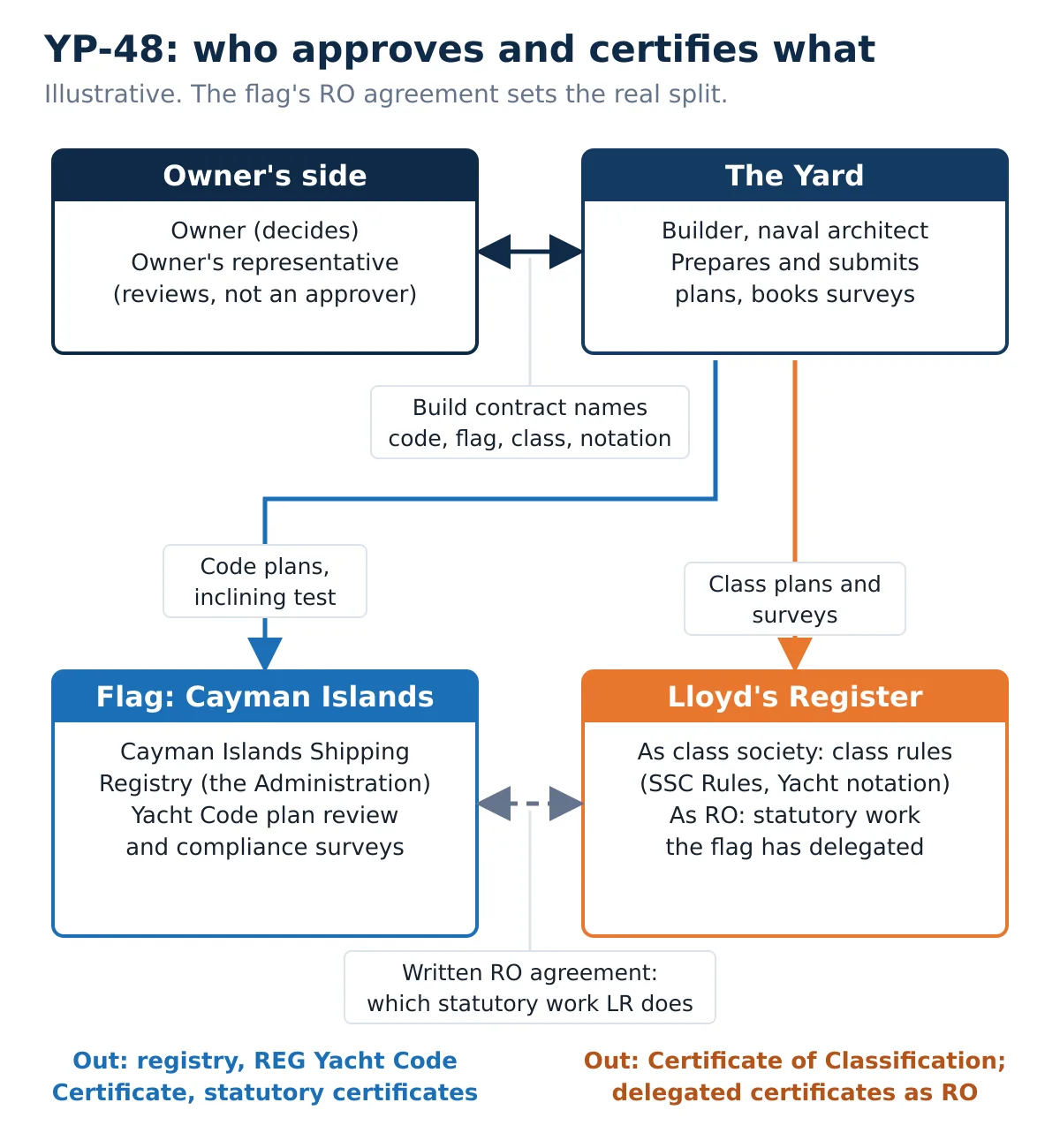
For the Cayman Islands the public picture is this. The registry is a member of the Red Ensign Group with Category 1 status, which allows it to register vessels of any size and type. It lists six classification societies as Recognised Organisations: ABS, Bureau Veritas, DNV, Lloyd's Register, ClassNK and RINA. It says that many statutory surveys under the international conventions, for yachts and merchant ships, are delegated to those six, while Yacht Code compliance surveys are generally carried out by the registry's own network of exclusive surveyors. It also offers plan approval and construction supervision for new builds, attending at key stages to check the build against the approved plans.
That general picture is not enough for a project. The split for YP-48 is confirmed in writing with CISR at the start of detail engineering, certificate by certificate and drawing group by drawing group, and recorded in the T3 matrix below.
Who approves which plans
For a project manager, the flag and RO arrangement turns into a routing question: for each drawing, who has to approve it, and in what order?
- Class items. Hull structure, machinery, piping, electrical systems and the other items within the class rules go to LR as class society, under the LR rules.
- Code items. Fire protection and means of escape, life-saving appliances, radio, navigation equipment, crew accommodation and the other code chapters go either to CISR's surveyors or to LR acting as RO, depending on what CISR has delegated.
- Stability. Under Part A (11.9) the lightship weight and centres of gravity come from an inclining experiment carried out in the presence of the Administration, and the results are approved before they are used in the stability calculations. LR's rules add a link of their own: in the July 2020 text of its yacht rules, the "Yacht" notation for a yacht of 24 m load line length and over is assigned only once stability has been shown to meet the flag's requirements.
Many drawings go to both. A tender garage door is a class item for its structure and a code item for watertight integrity and stability. The practical rule, already used in the design freeze lesson, is to put the approval route on every line of the drawing register at kick-off, so a code comment does not appear when the class-approved steel is already cut. The general approach to scheduling class and flag survey points is covered in Managing Classification and Regulatory Milestones.
Why YP-48 uses the Cayman Islands and Lloyd's Register
The teaching reasons are simple and sourced:
- The Cayman Islands is a Red Ensign Category 1 register that applies the REG Yacht Code, so the code references in this series stay valid. The registry announced in 2016 that it would lead the secretariat work for the consolidated REG Yacht Code.
- The registry offers plan approval and construction supervision for new builds, which lets the lessons show a flag that is active during the build rather than only at delivery.
- Lloyd's Register is on the registry's list of Recognised Organisations, so the dual role described above is possible.
- LR classes yachts of 24 m and over under a published rule set with a yacht notation that can be quoted from a primary text (next section).
A real owner weighs different things, and the owner's representative's job is to put the questions to the Owner early, with evidence:
- Where will the yacht charter and cruise? The flag and the charter licensing, tax and crew rules of the cruising area have to fit together; that is specialist advice, not a project management call.
- Is the RO authorised by the flag? Check the flag's current list, not a list from a previous project.
- Where are the surveyors? Class and flag surveyors near the Yard, and their availability for short-notice inspections, drive the pace of approvals.
- What does the Yard know? A Yard that has built recent yachts to the same society's rules and the same flag's code has drawings, details and approved solutions it can reuse.
- What do the fees and approval times look like? Ask both the flag and the society for their plan approval process and fee basis in writing, and ask each yard whether its price depends on the choice. The yard shortlist lesson put exactly that question in the YP-48 tender package.
- What will a buyer or charterer expect later? Resale is one of the reasons the Cayman registry itself gives for adopting the code on private yachts.
Record the decision with the options considered and the reasons, in the same log as the other early decisions. A flag or class decision that nobody can explain two years later is hard to defend when a cost is disputed.
The LR class notation for YP-48
LR has no rulebook titled for yachts alone. It classes yachts of 24 m length overall and above under its Rules and Regulations for the Classification of Special Service Craft (the SSC Rules), which include a part with additional requirements for yachts and separate periodical survey regulations for yachts. The current edition is dated July 2026 and is published through LR's Regs4ships platform.
The class notation is built from standard elements. Using the July 2020 text of the SSC Rules (Part 1, Chapter 2, Section 3), the elements that fit a steel monohull motor yacht with unrestricted service are:
✠100A1 SSC Yacht Mono G6, ✠LMC, UMS
| Element | Meaning in the July 2020 SSC Rules |
|---|---|
| ✠ | Built under LR special survey in accordance with the rules |
| 100A1 | 100: fit for seagoing service; A: built or accepted into class under LR rules and maintained in good condition; 1: anchoring and mooring equipment in accordance with the rules |
| SSC | Classed under the Special Service Craft Rules |
| Yacht | Service type notation for yachts |
| Mono | Craft type: monohull |
| G6 | Service group: unrestricted service (for yachts) |
| ✠LMC | Main and auxiliary machinery built, installed and tested under LR special survey |
| UMS | Machinery space may be left unattended |
Two notes before this line goes into a specification.
First, the example uses the 2020 wording because that full text is publicly available. Whether the July 2026 edition writes each element the same way could not be checked for this lesson. Check the current edition, and ask LR to confirm the exact notation in writing before the specification is frozen. LR also publishes Guidance Notes for Notations and Descriptive Notes for Yachts, which is where optional notations are explained.
Second, ✠LMC and UMS are choices, not defaults. UMS in particular describes how the machinery space will be run, and the rules attach their own requirements to it. YP-48 includes it as an illustrative choice; a real Owner decides it with the future chief engineer and the Yard. If the guest count ever rose above 12, LR's rules have a separate Passenger Yacht notation linked to Part B of the code, which is another reason to settle the guest number first.
The notation, the class society, the flag and the code edition all belong in the specification's general section and in the contract. That is where the contract review checklist looks for them.
How the class choice shows up in the schedule and the budget
A class society does not appear as a line on the budget in the way an engine does, but its choice moves both time and money.
- Plan approval turnaround. Every class drawing sits in the approval loop for the society's review period. The Yard's schedule assumes a period, and the drawing register tracks each item against it. A late class answer delays the same work as a late owner answer.
- Survey attendance. Hold points need a surveyor on the day. Where the society has few surveyors near the Yard, inspections are booked further ahead and a missed slot costs days.
- Payment milestones. Where the contract defines a milestone by reference to a class survey or certificate, the milestone and the payment move with the surveyor. The milestone payment lesson puts the class sign-off in the evidence pack for that reason.
- Fees. Class and flag fees are either in the contract price or added to it. In the YP-48 bid comparison, one yard excluded them and the evaluation added 0.5 index points to its price to compare like with like.
- Changing course. Once the contract names the society and the flag, changing either is an owner change with a price and a delay, and drawings already approved may have to be resubmitted. That is the practical meaning of "rules before lines".
- Rule editions. Codes and class rules are revised. The code edition for YP-48 is fixed by its contract date, as shown above. Ask the class society which edition of its rules applies to the project and write it into the specification.
When each decision is taken
The order is what makes this a project management lesson rather than a regulatory one. Each decision has a latest sensible point, after which it starts to redraw lines.
| Decision | Latest sensible point | Accountable (from the L2 RACI) | Evidence to file |
|---|---|---|---|
| Intended use: private, charter or both | Before the design brief is issued | Owner | Signed brief |
| Maximum guest number | Before the design brief is issued | Owner | Signed brief |
| Code and edition | Before the outline specification | Owner, advised by the representative | Rules statement in the outline specification |
| GT target and margin rules | Before the outline specification | Owner, with the naval architect | Tonnage estimate and budget |
| Flag and class society | Before contract signature, after yard bids are compared | Owner | Decision log entry, contract clause |
| Class notation | Before contract signature | Owner, with the Yard | Society's written confirmation |
| RO split and approval routes | At kick-off, before the drawing register is issued | Owner's representative and Yard | Registry's written confirmation, register routes |
On YP-48, use, guests, code and the 499 GT target were fixed in the design brief. Flag and class were left open in the tender package on purpose, so each yard could say whether its price depended on them, and were settled before signature. The RO split is the one item still open at the start of detail engineering, and it is marked that way in the matrix.
The template: T3 Regulatory Applicability Matrix
The workbook turns this lesson into a working sheet.
- Project inputs. Use, load line length, passengers, persons on board, gross tonnage target and current estimate, building contract date, flag, class society and notation. Formulas show which part of the code applies, the margin to 500 GT and which tonnage lines have been crossed.
- Applicability matrix. One row per requirement or certificate, with its threshold and code reference. A formula marks each row "Yes", "No" or "Near" (within a set margin of a tonnage line), and "Check" where an input is missing. For each row you record who approves or issues it (flag, RO, class), whether the work is delegated, who on the owner's side is responsible, the date it was confirmed and its status.
- Decision log. The early decisions with options, reasons, who decided, the date and the evidence reference.
The Blank sheet is ready to fill. The Example sheet holds YP-48 at contract signature (488.0 GT estimate against the 499 GT target): Cayman Islands flag, LR class with the notation above, the 500 GT rows marked "Near", the crew number still open, and the RO split marked for written confirmation.
Download: Regulatory Applicability Matrix (T3), xlsx
The matrix is a planning tool. It does not replace the flag's or the society's own lists, and the rows are a simplified extract from the July 2024 code; add the flag's national requirements and anything your cruising area adds.
Before the brief goes out
- The Owner has signed off intended use and the maximum guest number, knowing that 13 guests means Part B.
- The code and edition are named in the outline specification.
- The GT target, the margin and the trigger for referring changes to the Owner are written down, and the naval architect owns the estimate.
- The certificates the yacht must hold at delivery are listed, including the 300 GT and 400 GT items a 499 GT yacht still needs.
- The obligations that sit with the Owner, not the Yard (safety management, manning, crew qualifications), have a named person on the owner's side.
- The flag and class questions have gone to the yards with the tender package, and the decision is recorded with its reasons.
- The notation is confirmed in writing by the society against its current rules.
- The RO split is confirmed in writing by the flag before the drawing register is issued.
The next step is turning the brief into an outline specification and a tender package, covered in From Design Brief to Yard Shortlist.