

From design brief to yard shortlist: outline spec, GA, tender package, like-for-like bids, weighted scoring and the LOI, with a free bid comparison matrix.
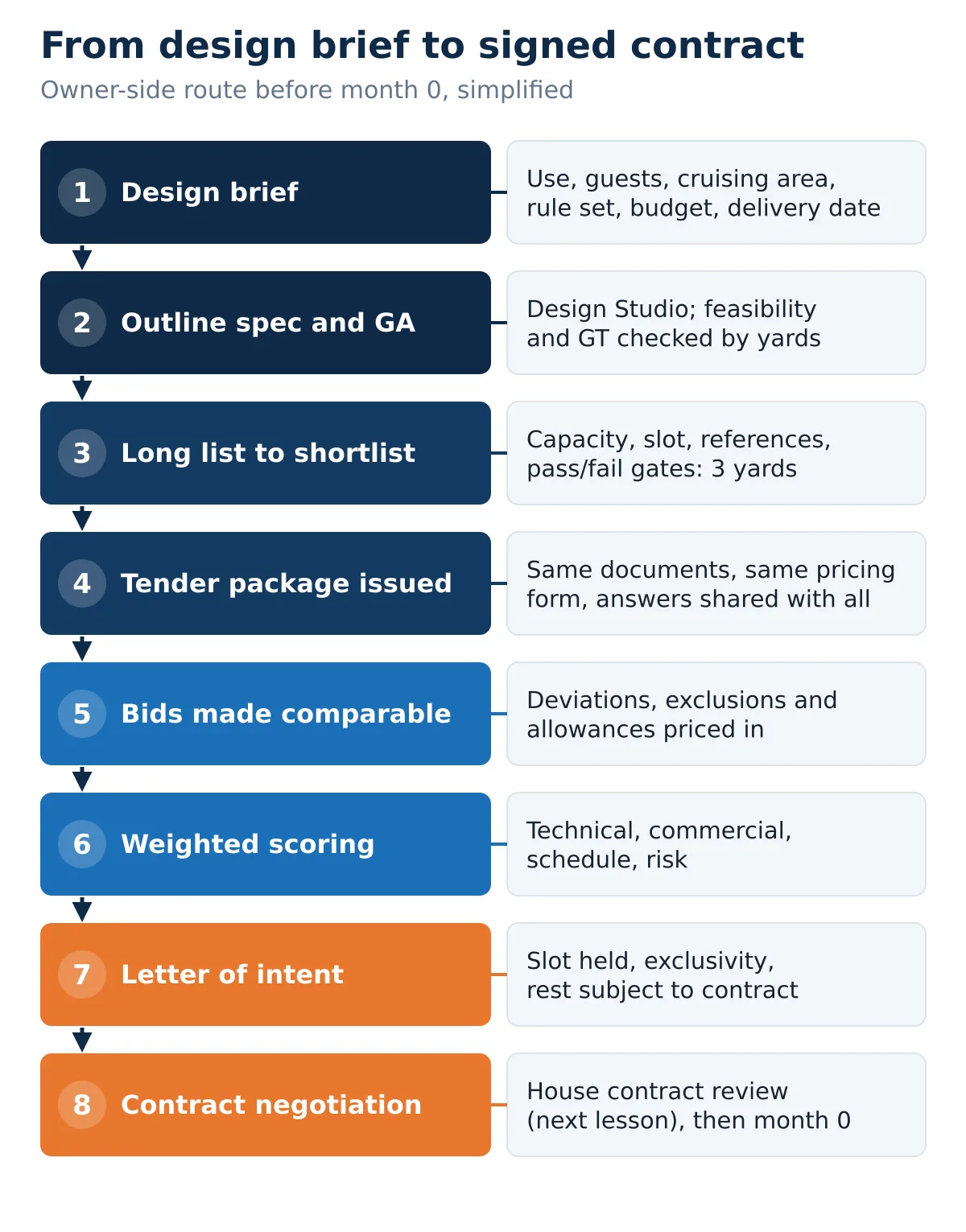
Most of the risk in a yacht newbuild is priced in before anyone signs. By the time the contract reaches the lawyers, the Owner has already chosen a yard, accepted a delivery slot and agreed a price against a specification that may still be thin. This lesson covers the work that leads up to that point: writing the design brief, turning it into an outline specification and general arrangement, finding yards with real capacity, issuing a tender package that makes bids comparable, scoring them, and holding the chosen yard with a letter of intent while the contract is negotiated.
The lesson builds on earlier ones and does not repeat them. Anatomy of a Superyacht Newbuild places this phase in the life of the project. Who Does What on a Yacht Build sets out who holds the pen on the brief and the yard selection. Why yacht contracts are drafted by the yard, and not taken from a standard form, is explained in Why There's No NEWBUILDCON for Superyachts. The contract review that follows the shortlist is the subject of Reviewing a Yacht Yard House Contract.
Illustrative project: Project YP-48 is fictional. Its parameters are chosen from publicly reported industry ranges so the numbers are realistic, but no real yard, owner or yacht is described.
Where YP-48 stands before the tender
YP-48 is a 48 m full-custom motor yacht with a design target of 499 GT, for private use and charter with up to 12 guests, to be built to the Red Ensign Group Yacht Code Part A (July 2024 edition). The target is 30 months from contract signature to delivery, seven stage payments including the one at signing, and a 12-month warranty. All money is an index where the eventual contract price is 100. The flag (the Cayman Islands) and the class society (Lloyd's Register) are fixed before the tender goes out, so every bid prices the same rules; both are illustrative choices explained in Rules Before Lines.
Before the tender the Owner's side consists of the Owner, the owner's representative, the Design Studio (exterior and interior) and a broker who helps with the shortlist and the negotiation. In YP-48 the naval architect is engaged by the Yard, as fixed in Lesson 2. That has a consequence for this phase: until a yard is chosen, nobody on the Owner's side owns the tonnage and stability numbers. The tender has to ask each yard to take a position on them.
The design brief
The design brief is the Owner's statement of what the yacht is for. Buyer guidance describes it as the stage that shapes the outline design, the build cost and the choice of yard, which is a fair summary of its weight. It is also the document everyone comes back to when a later decision is disputed, so it should be written down and signed off by the Owner, not left in meeting notes.
A brief that is useful to a project manager answers five groups of questions:
- Use. Private, charter or both; number of guests and how they will live on board; cruising areas and seasons; how long the yacht must stay away from port. On YP-48, charter use and 12 guests already fix the rule set.
- Rules and limits. The target code, the tonnage line, any size limit set by marinas or berths the Owner has in mind. These are constraints for the designer, not preferences.
- Performance. Cruising and maximum speed, range, comfort at anchor, noise targets in guest areas. Anything the Owner will judge at sea trials should appear here as an intent, so it can become a measurable requirement in the specification.
- Look and experience. The styling direction, the spaces that matter most, the tender and toy programme, the balance between guest and crew space.
- Budget and date. The funds available and the season by which the yacht must be delivered. A brief without a date lets the tender drift; a brief without a budget lets the design grow until no yard can price it.
On YP-48 the Owner is accountable for the brief and the owner's representative writes it, with the build captain, the Design Studio and the naval architecture view consulted, which is the first row of the responsibility matrix in Lesson 2. The brief's key values also go straight into the first lines of the Yacht Project Parameter Sheet (T1).
Outline specification and general arrangement
The Design Studio turns the brief into two documents that a yard can price: the general arrangement (GA) and the outline specification. For a full-custom yacht, this design work is commissioned and paid for by the Owner before any yard has signed anything.
The GA shows the profile and the deck plans: where the guest cabins, saloons, galley, crew mess, tender garage and technical spaces sit. At tender stage it does not need to be a construction drawing, but it has to be complete enough for a yard to estimate structure, volume and systems. If you are new to reading one, Reading a Ship's General Arrangement for Planners covers the basics; the same logic applies to a yacht, with far more of the drawing given over to accommodation.
The outline specification describes what is to be built in words. A workable structure follows the way the yacht will be priced and later tested:
- General: rules, code, class and flag assumptions, principal dimensions, tonnage target, design standards, delivery place.
- Hull and superstructure: materials, structural principles, insulation, noise and vibration targets.
- Machinery and propulsion: engines, gearboxes, generators, stabilisers, thrusters, with performance stated as requirements rather than brand names where possible.
- Systems: electrical, HVAC, fuel, fresh water, black and grey water, fire, navigation and communication, AV/IT.
- Deck equipment and exterior: anchoring and mooring, tender handling, exterior furniture, paint system and finish standard.
- Interior: zones, the finish level for each, and the allowances the yard should include for items not yet designed, such as loose furniture and AV/IT.
- Owner-furnished items: what the Owner will buy directly, so yards can exclude it and price the interfaces.
- Trials and acceptance: what will be measured, in which conditions, and how results will be judged.
Two habits make the outline specification do its job. First, write requirements that can be measured at acceptance. Owner's-side advisers stress that quality can only be enforced if the specification is detailed and measurable in the first place, and the contract review lesson shows what happens when finish and comfort are left as adjectives. Second, mark every open point as open, with a date by which it must be closed. An outline specification is allowed to be incomplete; it is not allowed to hide where it is incomplete.
On YP-48 one open point stands above the rest: will the GA fit under 500 GT? The Design Studio's concept keeps the volume in view, but the check that matters is done by a naval architect with the hull form and the arrangement in hand. Because YP-48's naval architect will sit in the Yard, the tender asks each bidding yard to confirm, with its own naval architecture team, that the arrangement can be built below 500 GT and to state the margin. Some owners commission an independent feasibility check before the tender instead; either way, the answer has to exist before a yard is chosen, because Lesson 1 has already shown what crossing the line costs.
Finding yards with a slot
A yard's price is only half of its offer. The other half is a slot: a period in which the yard has the shed, the people and the management attention to build your yacht. Yachts over 24 m are built in a limited number of countries and yards, as the country breakdown in Where Superyachts and Offshore Wind Vessels Are Actually Built shows, and a yard with a strong order book may simply not have room for a 48 m hull when you need it.
Start with a long list of yards that have built yachts of similar size, material and rule set, then narrow it with evidence rather than impressions:
- Capacity and slot. Which shed or hall would the hull be built in, what else is in it during your months, and when did the yard last deliver a yacht of this size on time? Ask for the yard's production plan for your period, not only a delivery date.
- Where the hull is built. Some yards build hulls at another site or at a subcontractor and outfit at home. That is a legitimate model, but it adds a transport step and a second quality regime to your schedule.
- Experience with the rules. Delivered yachts under the same code and near the same tonnage band are worth more than larger yachts under a different regime.
- Financial strength. Buyer guidance lists financial stability among the first criteria. For the Owner it decides whether the yard can obtain a refund guarantee, which is the Owner's main protection before delivery.
- References. Talk to owners, captains and owner's representatives of recent deliveries. Ask how the yard handled changes and bad news, not only whether the yacht is good.
A shortlist of three is common. Sponsored builder guidance describes owners typically narrowing to three yards before going further, and three is also a practical number for the Owner's side to evaluate properly. Fewer and there is little competition; more and the owner's team cannot review each bid in depth.
Before the tender, fix a few pass/fail gates: conditions a yard must meet to be scored at all. For YP-48 they are: the yard can build and certify to REG Yacht Code Part A below 500 GT; it can offer a refund guarantee from a bank acceptable to the Owner, or a security the Owner's counsel accepts; it can deliver no later than month 36; and it accepts site access for the owner's representative and build captain. A gate is a yes or no, and one "no" ends the yard's participation, however good the rest of its bid looks.
Custom is not the only route. A yard's speculative build, started without a buyer, can be delivered much sooner but leaves limited room for customisation depending on how far it has progressed; a semi-custom platform sits in between. If the Owner's date matters more than a full-custom GA, the brief should say so before the tender goes out, because it changes which yards belong on the list.
What goes in the tender package
The tender package is the set of documents each shortlisted yard receives. Its purpose is simple: every yard prices the same yacht, on the same terms, in the same format, so the bids can be compared line by line. Buyer guidance recommends that experienced members of the build team, ideally including legal advisers, prepare and present it.
For YP-48 the package contains:
- Invitation letter. Scope of the invitation, the bid deadline, the bid validity period required, the clarification procedure, the contact person, and a confidentiality undertaking.
- Design brief summary and the outline specification with its list of open points.
- GA and profile, plus any preliminary drawings the Design Studio has produced.
- Rules statement. REG Yacht Code Part A, charter use, 12 guests, the 499 GT target, and the statement that class and flag are open. Each yard is asked whether its price changes with the class society or register chosen.
- Owner-furnished items list, so every yard excludes the same items and prices the same interfaces.
- Key commercial terms. The Owner's position on payment stages, security, delivery date, delay damages, warranty and dispute resolution, as a short term sheet. The yard answers each point: accepted, accepted with changes, or rejected.
- Pricing form. A breakdown by specification section, with each allowance shown separately, and a list of options priced individually. This form is what makes normalisation possible.
And it asks each yard to return:
- the price on the pricing form, with bid validity;
- a list of deviations from, and exclusions to, the outline specification;
- a delivery date and a summary schedule showing the slot, the hull building site and the main milestones;
- a proposed makers list for major equipment;
- the GT confirmation and margin from its naval architect;
- its response to the key commercial terms, and its draft house contract;
- evidence of financial standing and the name of the bank that would issue the refund guarantee;
- references for comparable deliveries.
The draft house contract is requested now for a reason. It will be the starting document of the negotiation, and its distance from the Owner's term sheet is itself a scoring criterion.
Running the tender
Three rules keep a yacht tender fair and useful.
Same information for every yard. Questions arrive in writing by a cut-off date, and answers go to all bidders, with the question anonymised. A clarification given to one yard alone makes its bid incomparable with the others. The equipment tender process in International Procurement of Major Ship Equipment uses the same discipline; it works the same way one level up.
Criteria before bids. Decide the gates, the criteria, their weights and the scoring guide before any bid is opened, and write them down. Public procurement guidance puts this at the centre of fair evaluation, and the reason applies equally to a private owner: weights chosen after seeing the prices tend to justify a preference instead of testing it.
Enough time to read. An owner's representative quoted by SuperyachtNews has warned that owners' teams are sometimes given only a few weeks for a full specification review on very large projects, and that yards want to fill slots quickly. Plan the evaluation as a task with a duration and named reviewers, the same way the contract review is planned in Lesson 5.
Making the bids comparable
No two yacht bids price the same scope. One yard sets a low allowance for loose furniture, another quotes a cheaper stabiliser that does not meet the zero-speed requirement, a third includes tenders the Owner intends to buy directly. Comparing headline prices rewards whoever left the most out.
Normalisation fixes this. For each bid, go through the deviations and exclusions list and the pricing form, and for every difference from the tender scope add or remove a value:
- Missing scope is added at a fair estimate: the owner's-side estimate, or the price another yard quoted for the same item.
- Extra scope that was not asked for is removed.
- Low allowances are raised to the Owner's figure, so that every bid carries the same allowance.
- Terms with a cost, such as a material escalation clause, are recorded as risks rather than priced, unless you can value them honestly.
The adjustments are estimates, and every one should be traceable to a line of the bid, so the yard can see why its price was moved and answer if it disagrees. The result is a like-for-like price for each yard.
For YP-48 the three bids look like this (index, contract price = 100; all values illustrative):
| Item | Yard A | Yard B | Yard C |
|---|---|---|---|
| Headline price | 92.0 | 97.0 | 103.5 |
| AV/IT allowance raised to the Owner's figure | +2.5 | 0.0 | 0.0 |
| Loose furniture allowance raised to the Owner's figure | 0.0 | +1.5 | 0.0 |
| Stabilisers with zero-speed function, as specified | +1.5 | 0.0 | 0.0 |
| Tender garage crane quoted as an option, added | 0.0 | +1.0 | 0.0 |
| Class and flag approval fees excluded, added | +0.5 | 0.0 | 0.0 |
| Trial costs and crew familiarisation excluded, added | +1.0 | +0.5 | 0.0 |
| Two tenders the Owner buys directly, removed | 0.0 | 0.0 | -2.0 |
| Like-for-like price | 97.5 | 100.0 | 101.5 |
| Delivery offered (months from signature) | 34 | 30 | 36 |
| First instalment at signature | 20% | 10% | 15% |
A spread of 11.5 points between the headline prices shrinks to 4 once the scope is the same. Yard A is still the cheapest, but by 2.5 points, not 5. Yard B's like-for-like price is 100, which is where the contract price of the YP-48 series comes from.
Scoring: technical, commercial, schedule and risk
With comparable prices in hand, score each yard against criteria in four groups. The weights below are YP-48's; yours should reflect what the brief says matters most.
| Ref | Group | Criterion | Weight |
|---|---|---|---|
| T1 | Technical | Compliance with the outline specification (deviations list) | 15% |
| T2 | Technical | Comparable yachts delivered (size, GT, code) | 10% |
| T3 | Technical | Engineering capacity and proposed makers list | 5% |
| C1 | Commercial | Like-for-like price | 20% |
| C2 | Commercial | Payment schedule and security offered | 10% |
| S1 | Schedule | Delivery date against the Owner's target | 10% |
| S2 | Schedule | Slot credibility (order book, hull source, concurrent builds) | 10% |
| R1 | Risk | Financial strength and refund guarantee capacity | 10% |
| R2 | Risk | Mark-up of the Owner's key contract terms | 5% |
| R3 | Risk | Reference checks with owners and captains | 5% |
Each criterion is scored from 0 to 10 against a written scoring guide, and the weighted score is the score times the weight, so the total is out of 100. Three points of method are worth keeping.
Score the price on a fixed scale. YP-48 sets, before bids are opened, a like-for-like price that scores 10 (index 90) and one that scores 0 (index 110), with a straight line between. A common alternative gives the cheapest bid full marks and scores the others relative to it. UK public procurement guidance has advised caution with that relative method since 2020, because a bid's score then depends on the other bids and the ranking can move in ways that do not reflect value. A fixed scale avoids the problem.
Define the scores in words. "7 out of 10 for experience" means nothing unless the guide says what 10 and 0 look like. Government guidance on bid evaluation makes the same point: replace vague labels with descriptions of the evidence that earns each score. The template carries a scoring guide column for exactly this.
Score as a panel, then compare. Let the owner's representative, the build captain and the Owner's counsel score their own criteria independently, then meet to agree the final score and record the reason in one line. The record matters later, when a yard asks why it lost or when the Owner asks why the cheapest bid was not chosen.
The YP-48 comparison
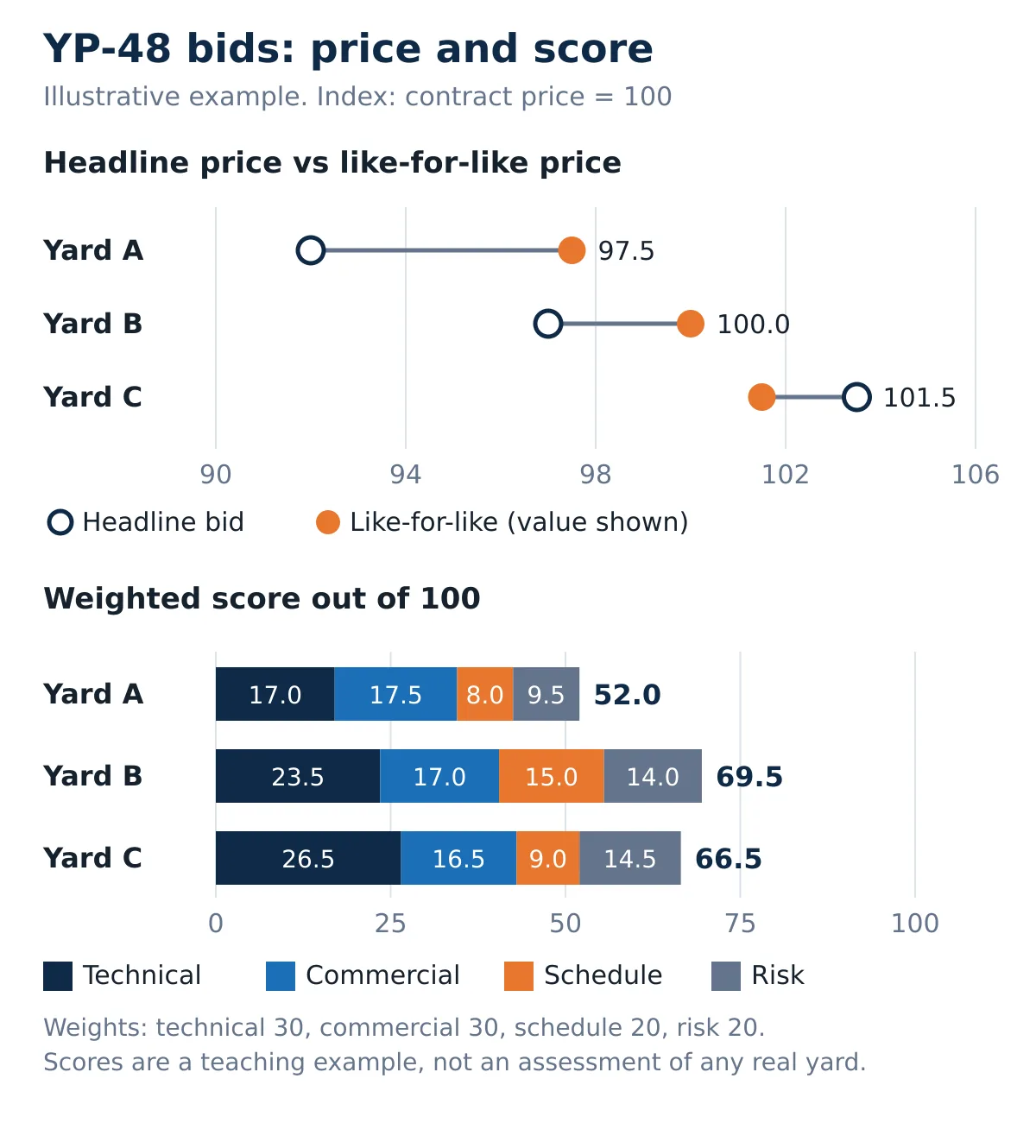
All three yards pass the gates. The weighted totals are:
| Group | Weight | Yard A | Yard B | Yard C |
|---|---|---|---|---|
| Technical | 30% | 17.0 | 23.5 | 26.5 |
| Commercial | 30% | 17.5 | 17.0 | 16.5 |
| Schedule | 20% | 8.0 | 15.0 | 9.0 |
| Risk | 20% | 9.5 | 14.0 | 14.5 |
| Total out of 100 | 52.0 | 69.5 | 66.5 |
Reading the result:
- Yard A has the best price score and the weakest everything else. Its hull would be built at a subcontract yard, its slot depends on a current build finishing, the bank for the refund guarantee is not yet named, and it asks for 20% at signature. The price advantage of 2.5 points does not buy back that exposure.
- Yard C has the strongest technical offer and good financial standing, and it offers a 24-month warranty. Its next free slot gives delivery at month 36, six months after the Owner's target, and its bid carries a material escalation clause.
- Yard B is not the best in any single group except schedule, but it has no weak group. It delivers on the target date, has built comparable yachts, and its main issue, a low loose furniture allowance, has already been priced in.
Before accepting a ranking, test it. Move ten points of weight from schedule to technical (delivery date and slot credibility at 5% each, specification compliance at 20% and experience at 15%) and Yard C edges ahead, 71.0 against 70.0. The matrix is not wrong; it is telling you that the choice between B and C is really a question about how much a six-month later delivery is worth to the Owner. That question goes to the Owner, in those words, before the letter of intent is signed. On YP-48 the Owner confirms that the season matters, and Yard B is selected, with Yard C kept informed as the reserve.
The letter of intent
Once a preferred yard is chosen, the parties usually sign a letter of intent (LOI) to hold the slot while the contract is negotiated. Legal commentary on superyacht LOIs describes it as the first stage of the construction process: a record of the intention to enter a building contract and some of its key terms, without fully committing either side.
What makes an LOI tricky is that it is neither clearly binding nor clearly not. Lawyers writing in The Superyacht Report agree on the main points:
- Under English law an agreement to negotiate in good faith is generally not enforceable, but parts of an LOI can be binding where the usual elements of a contract are present. A court has described the phrase "letter of intent" as having no fixed meaning; its effect depends on the circumstances.
- Terms that are commonly made binding include the yard's commitment to reserve capacity for a set period, a deposit paid for exclusivity, confidentiality, and a "lock-out" that stops either side negotiating with others for a period. Lock-out undertakings are often enforceable.
- Terms about the construction itself, such as price, specification and delivery, are usually stated to be "subject to contract".
- An LOI that names a price, a detailed specification and terms can come close to a contract, and a yard that starts building on an LOI can create claims nobody intended. If the LOI does not state a governing law and is signed at the yard, it is likely to be governed by the yard's law.
The practical advice from the same commentary is plain: say in the LOI which parts are binding and which are not, and take legal advice before signing. For the project manager, the LOI is also a schedule document. Industry commentary reports LOI periods of a couple of weeks to a couple of months, and warns that this is often too short for a proper specification and contract review. Plan the LOI period backwards from the work it has to contain: specification development with the yard, the contract review, the refund guarantee wording and the Owner's decisions.
For YP-48 the LOI with Yard B contains, as binding terms: the slot held for eight weeks, exclusivity for both sides for the same period, confidentiality, the deposit amount with the conditions under which it is refunded or credited to the first instalment, and English law. Price, specification, delivery date and payment terms are recorded as subject to contract. The Owner's counsel drafts or reviews every binding term. Anything that commits the Owner beyond that is a question for counsel, not for the project team.
The template: T4 Yard Bid Comparison Matrix
The template holds the whole comparison on one sheet, in the order this lesson follows:
- Parameters. The price scale floor and ceiling and the Owner's target delivery, all set before bids are opened.
- Bid register. Up to five yards: headline price, up to eight like-for-like adjustments, the like-for-like price (formula), delivery offered and its difference from the target (formula), first instalment and bid validity.
- Pass/fail gates. Up to six gates with a Pass/Fail drop-down; one Fail marks the yard Excluded.
- Weighted scoring. The price row scores itself from the like-for-like price; the other criteria take a 0 to 10 score against the scoring guide. Weighted scores, totals, group subtotals and the rank are formulas.
- Checks. Weights must total 100%. The check cell turns orange if they do not, and the rank stays blank until they do. Excluded yards are not ranked.
- Notes per yard. Strengths, red flags, open clarifications and the conditions for an LOI.
The "Example (YP-48, illustrative)" sheet holds the three bids from this lesson. The "Blank" sheet has the same layout, empty, for your own tender.
Download: Yard Bid Comparison Matrix (T4), xlsx
Two habits make the sheet worth keeping after the decision. Save a copy of the scored version with the date, and do not edit it again; it is the record of why this yard was chosen. And move every red flag from the notes of the chosen yard into the project risk register, with an owner and a date. The Shipyard Risk Register Template and Risk Management in Shipyard New-Build Projects cover how.
Before you sign the letter of intent
Before the Owner signs, the owner's side should be able to confirm that:
- the design brief is written and signed off, and its key values are in the parameter sheet;
- the outline specification lists its open points, each with a closing date;
- the preferred yard's naval architect has confirmed the GT margin in writing;
- every bid was normalised against the same scope, and each adjustment is traceable to the bid;
- the criteria and weights were fixed before bids were opened, and the ranking has been tested by changing the weights;
- the question the ranking could not answer, such as the value of an earlier delivery, has been put to the Owner and answered;
- the refund guarantee bank is named and has confirmed capacity;
- the LOI states which terms are binding, its period fits the work planned inside it, and counsel has reviewed it;
- the red flags of the chosen yard are in the risk register.
The yard's draft house contract is now on the table. The next lesson, Reviewing a Yacht Yard House Contract, works through it clause by clause, and Building the Milestone Payment Plan and Its Evidence Pack and The Master Schedule for a Yacht Build pick up the payment stages and the slot once the contract is signed.