MYBA has no new-build contract, and there is no BIMCO-style standard form for superyachts. Every yard uses its own bespoke house contract, usually modeled on builder-favoring commercial forms, which changes how a project manager has to approach negotiation, milestones, and risk.
Project managers and contract administrators transitioning from the commercial maritime sector into the superyacht industry frequently expect to find a familiar contractual architecture. In commercial shipbuilding, project parameters are governed by widely adopted, industry-standard forms. BIMCO's NEWBUILDCON is a fixture in commercial yards across the globe, providing a balanced, predictable framework for risk allocation, delivery schedules, and dispute resolution. It allows project teams to begin negotiations from a neutral baseline. However, professionals entering the luxury yacht sector quickly discover a completely different contracting environment. There is no NEWBUILDCON equivalent for superyachts.
The absence of a universal standard form is not a historical oversight. It is a fundamental reflection of the custom yacht building market, where every vessel is a unique prototype and every contract is heavily individualized. Understanding why this contractual vacuum exists, and how yards fill it, is the first critical requirement for any project manager tasked with overseeing a superyacht new build.
The MYBA Misconception
The most common assumption made by newcomers to yacht project management is that a standard construction contract must already exist and is likely published by a recognized industry body. This assumption almost always points to MYBA, the Mediterranean Yacht Brokers Association. It is crucial to correct this misconception explicitly and clearly. MYBA has no new-build or construction contract in its portfolio.
The organization is highly influential in the yachting sector, but its standardized contractual forms are strictly limited to other phases of a yacht's lifecycle. Specifically, MYBA publishes a universally recognized Memorandum of Agreement for the sale and purchase of existing yachts, alongside a highly standardized Charter Agreement. Because these documents are ubiquitous in yacht brokerage and chartering operations, professionals naturally, but incorrectly, assume a MYBA construction form exists to govern new builds.
The practical consequence of this absence is immediate and significant for a project manager or an owner's representative. In a commercial project utilizing NEWBUILDCON, the project team benefits from a relatively neutral baseline. The standard form allocates risks fairly between the buyer and the shipyard, meaning negotiations can focus on specific commercial terms or technical deviations rather than foundational legal mechanics. In the superyacht sector, without a MYBA equivalent for construction, there is no neutral starting point. The buyer and their project management team are entirely reliant on the yard's proprietary documentation, which shifts the initial balance of power heavily toward the builder.
The Reality of Yard House Contracts
In practice, every yacht-building yard relies on its own bespoke house contract. The major full-custom builders, including Feadship, Lürssen, Oceanco, Amels/Damen, Benetti, Sanlorenzo, and Heesen, each utilize their own proprietary contractual frameworks. These agreements are not off-the-shelf industry standards. They are individually negotiated and bilaterally amended between the yard and the buyer for every single project. There is no single dominant standard form in this space.
However, these bespoke house contracts do not emerge from a vacuum. Industry sources consistently note that superyacht construction contracts are commonly modeled on, or adapted from, legacy commercial shipbuilding forms. The SAJ form, published by the Shipbuilders' Association of Japan, is specifically cited as a foundational influence for many custom yacht builders. The SAJ form is historically recognized in the commercial sector as a builder-favoring form, drafted by a shipbuilders' trade association, in contrast to NEWBUILDCON, which is generally regarded as more buyer-friendly precisely because shipbuilders did not actively participate in drafting it. When a custom yacht builder's house contract carries that same builder-favoring lineage, the resulting document tends to protect the yard's interests: its schedule, its liability exposure for supply chain delays, and its control over the buyer's inspection and rejection rights.
For the project manager, this means the contract negotiation phase is extensive and resource-intensive. The buyer's legal counsel and the technical representative must meticulously deconstruct the yard's house contract to reallocate risk more equitably. Every clause regarding permissible delays, force majeure, liquidated damages, and default mechanisms must be heavily scrutinized. Unlike a commercial scenario where the boilerplate is largely accepted, a superyacht contract requires the project team to actively engineer their own protection into the document before any physical construction begins.
Milestone Payments and Technical Representation
The structural core of any shipbuilding contract is the payment schedule. Similar to commercial shipbuilding, superyacht projects rely on milestone payments to fund the build. However, the exact structure requires rigorous project management oversight because there is no standardized schedule. Typical payment structures in superyacht contracts are strictly staged against completed construction milestones, rather than merely started phases or arbitrary calendar dates.
While there is no fixed universal count of milestones, they generally follow the physical progression of the build. The number of payment stages is negotiated individually per project, and common milestones typically include the following key phases:
- Design Approval: payment is tied to the finalization and sign-off of the naval architecture and general arrangement drawings.
- Keel Laying: often the first major physical milestone, marking the formal commencement of structural fabrication.
- Hull Completion: reached when the steel or aluminum hull structure is fully fabricated and welded.
- Hull and Superstructure Joining: a critical engineering milestone where the upper superstructure is mated to the lower hull.
- Machinery Installation: triggered by the installation of the main engines and primary generator sets into the engine room.
- Launch: the milestone marking the vessel's first movement into the water, allowing for initial static testing.
- Sea Trials: payment is released upon the successful completion of dynamic testing at sea, verifying speed, vibration, and maneuvering parameters.
- Delivery: the final payment, exchanged for the physical handover of the vessel and the transfer of the builder's certificate.
The project management mechanism governing these payments is the inspection and approval process. A payment is never released simply because the shipyard issues an invoice claiming a milestone has been achieved. The buyer's own technical representative must physically inspect the work, verify that the milestone meets the strict contractual definition of completion, and confirm that the execution adheres to the agreed technical specifications. Only after the owner's representative issues a formal certification of completion is the financial transaction authorized. This creates a high-stakes verification environment requiring constant vigilance from the project team.
The High-Risk Area of Variation Orders
In any major construction project, scope changes are inevitable. However, in the bespoke superyacht sector, variation orders represent a unique and severe vulnerability. Variation orders are widely flagged by industry sources and maritime legal practitioners as the highest-risk area in superyacht contracts. A fully custom yacht is effectively a prototype, and owners frequently request layout changes, material upgrades, or the integration of emerging technologies long after the initial design has been frozen.
Without the disciplined framework of a standard form contract, variation orders can quickly derail both the project budget and the delivery schedule. House contracts often stipulate that any change request automatically entitles the yard to claim a schedule extension and broadly re-price the associated work. If this process is left to ad hoc negotiation during the build, the yard holds significant leverage: the owner is heavily invested, the vessel is mid-construction, and the yard can largely dictate the cost and time impact of the requested change.
To mitigate this exposure, a robust project manager must ensure the bespoke contract establishes a transparent, evidence-based change-pricing process. The contract must dictate exactly how a variation is quoted. This requires demanding itemized breakdowns of additional labor hours, specifying material costs at agreed cost-plus margins, and establishing a strict mathematical methodology for calculating any associated delay to the final delivery date. The contract must also define a clear process for the owner's representative to audit and challenge the yard's variation quotes. Without these bespoke contractual controls written into the house document, the project management team loses much of its ability to control cost overruns.
Warranties and Defect Liability
Warranty provisions further highlight the bespoke nature of superyacht contracts and the resulting burden on the project management team. In commercial shipping, warranties are relatively standardized and focus primarily on keeping a revenue-generating asset operational. Superyacht warranties involve a much higher degree of aesthetic perfection and subjective performance criteria. Typically, the baseline warranty terms dictate a period of 12 to 24 months post-delivery for general defects.
Industry commentary often describes a bifurcated warranty structure for these highly complex vessels. Sources frequently suggest that major structural elements, such as the hull integrity and primary paint systems, may carry longer coverage periods spanning five to six years. Conversely, highly sensitive mechanical systems and rapidly evolving electronic integrations are generally restricted to the shorter standard window. It is important for project managers to understand that this longer structural coverage figure is treated here as indicative, sourced to consumer-facing yacht industry commentary rather than a verified universal contract standard.
Therefore, the project manager must view the warranty clause not as an industry given, but as another heavily negotiated variable. The owner's team must define exactly what constitutes a defect, how formal notice is given to the yard, and the logistical realities of how the yard will resolve issues when the yacht is cruising in remote locations far from the original build facility.
Regulatory Compliance and Dispute Resolution
While the commercial contract is bespoke, the technical baseline of the build remains strictly governed by classification societies. Organizations with dedicated yacht rule sets, such as Lloyd's Register, DNV, ABS, and RINA, dictate the structural integrity, safety standards, and essential machinery requirements. Compliance with these classification rules forms the non-negotiable technical floor of the construction contract. The intricacies of classification society interaction represent a vital discipline in yacht construction, which is detailed extensively in our companion piece, Four Classification Societies, Four Yacht Rulebooks.
Similarly, if the contractual mechanisms fail and a dispute arises, the resolution pathways are firmly established within the sector. The superyacht industry is dominated by English law and London arbitration. This jurisdiction is highly valued by both yards and buyers due to its mature maritime case law and the confidentiality afforded by arbitration proceedings, a genuinely important consideration for the high-net-worth individuals commissioning these vessels. As with classification rules, the specific mechanics and strategic advantages of London maritime arbitration are covered in depth in our companion article, Why Yacht Disputes Go to London Arbitration.
The Project Management Takeaway
The absence of a standard NEWBUILDCON equivalent for superyachts fundamentally shapes the project management approach required for these unique builds. Superficial similarities certainly exist between commercial shipbuilding and custom yacht building. Both endeavors involve a shipyard, a buyer, a complex technical specification, staged milestone payments, and the eventual delivery of a large vessel. However, the underlying contractual environment is entirely different, demanding a much higher level of vigilance.
In the commercial realm, standard forms provide a safety net of established risk allocation and procedural predictability. In the superyacht sector, the reliance on heavily customized, bilaterally negotiated yard house contracts creates a higher-friction administrative environment: more legal negotiation overhead per project, and much less standardized risk allocation, which can leave a buyer exposed to real financial and schedule risks if the contract is poorly drafted or poorly administered.
Consequently, the success of a superyacht new build relies heavily on the deployment of a strong owner's representative and specialized maritime legal counsel. The project management team cannot rely on the contract to protect them by default, as they might with a BIMCO form. They must actively negotiate, draft, and enforce their own operational protections into the yard's proprietary document. Acknowledging this reality, and preparing for the intensive bespoke negotiations it requires, is one of the most important steps for any project professional operating in the superyacht sector.
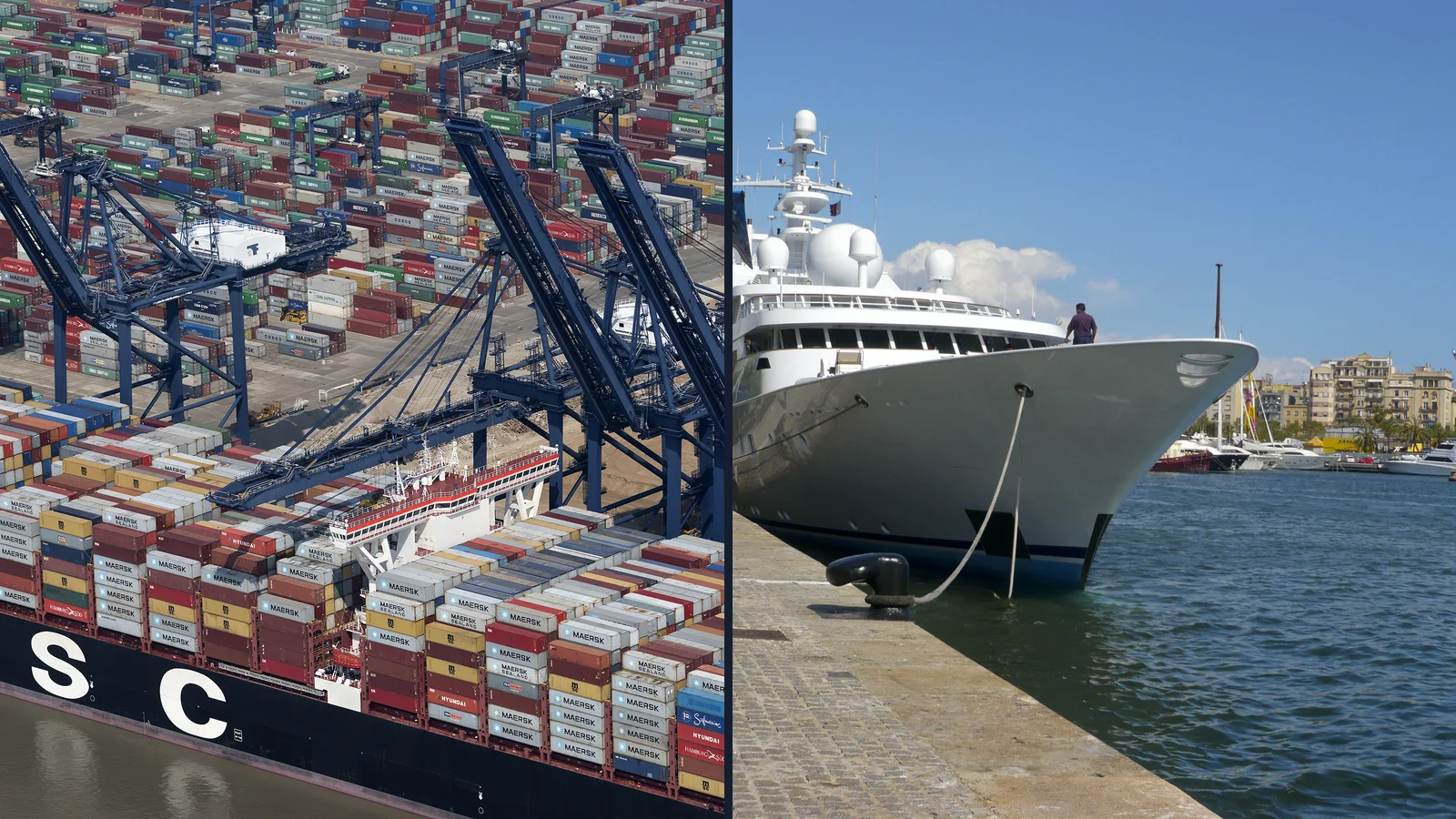
Cover photo: container ship photo by John Fielding, via Wikimedia Commons, licensed CC BY 2.0; yacht "Golden Odyssey" photo by Andy Mitchell, licensed CC BY-SA 2.0.