Set a meeting rhythm for a yacht build, keep a decision log with dates from the schedule, get remote owner approvals and manage expectations. Free xlsx.
A yacht build rarely stops because the Yard cannot build. It stops because a question is waiting for an answer: which stone, which AV/IT specification, whether to accept a change. On a commercial newbuild, most of those answers sit inside the specification. On a custom yacht, many of them are left open at signature on purpose, and only the Owner can give them. This lesson is about getting those answers on time: a fixed rhythm of meetings, a decision log with dates taken from the schedule, a way of getting approvals from an Owner who is rarely on site, and the habits that stop the Owner's expectations drifting away from what is being built.
The weekly owner report, with its front sheet, traffic lights and "decisions required" box, was covered in Measuring Progress and Writing the Weekly Owner Report and is not repeated here. That lesson showed the decisions on page one. This one covers where they come from, how their dates are set and what happens around them. The roles and authority limits come from Who Does What on a Yacht Build, and the dates from The Master Schedule for a Yacht Build.
Illustrative project: Project YP-48 is fictional. Its parameters are chosen from publicly reported industry ranges so the numbers are realistic, but no real yard, owner or yacht is described.
YP-48 in week 62
YP-48 is a 48 m full custom motor yacht with a 499 GT design target, for private use and charter with 12 guests, built to the REG Yacht Code Part A (July 2024 edition). The contract runs 30 months and the contract price is an index of 100. The flag is the Cayman Islands and the class society is Lloyd's Register, both illustrative choices explained in Rules Before Lines. The parties are the Yard, the Owner, the Design Studio and the owner's representative, as introduced in Anatomy of a Superyacht Newbuild.
We join the project at the start of week 62, just after the month-14 report. The superstructure is about two weeks behind on the critical path and the Yard has started a second shift. Three decisions are on page one of the report: the master bathroom stone (D-14), the AV/IT specification (D-15) and the larger tender garage door, CR-06 (D-16). The month-14 owner review is on Wednesday.
The people who have to answer are spread out. The Owner lives abroad and travels often, and has told the family office that they will be away from 13 to 24 March, in weeks 63 and 64. The family office handles money and legal matters. The build captain is on site. The Design Studio works from another country and visits the Yard about once a month. The owner's representative is at the Yard every day. Two of the three open decisions are due while the Owner is travelling. That is the situation the rest of this lesson is built around.
The meeting rhythm
A meeting rhythm is a set of fixed slots where each kind of question gets answered. Without it, questions go to whoever is easiest to reach, and decisions happen in corridors, on calls and in messages that nobody records.
The rhythm also fixes a weakness of reports. The PMBOK Guide separates interactive communication, such as meetings and calls, from push communication, such as reports and e-mails, and notes that pushing information to someone makes sure it was sent, not that it reached the person or was understood. A weekly report on its own is push. A decision needs a conversation, so every report on YP-48 is followed by a short call in which the decisions are actually taken.
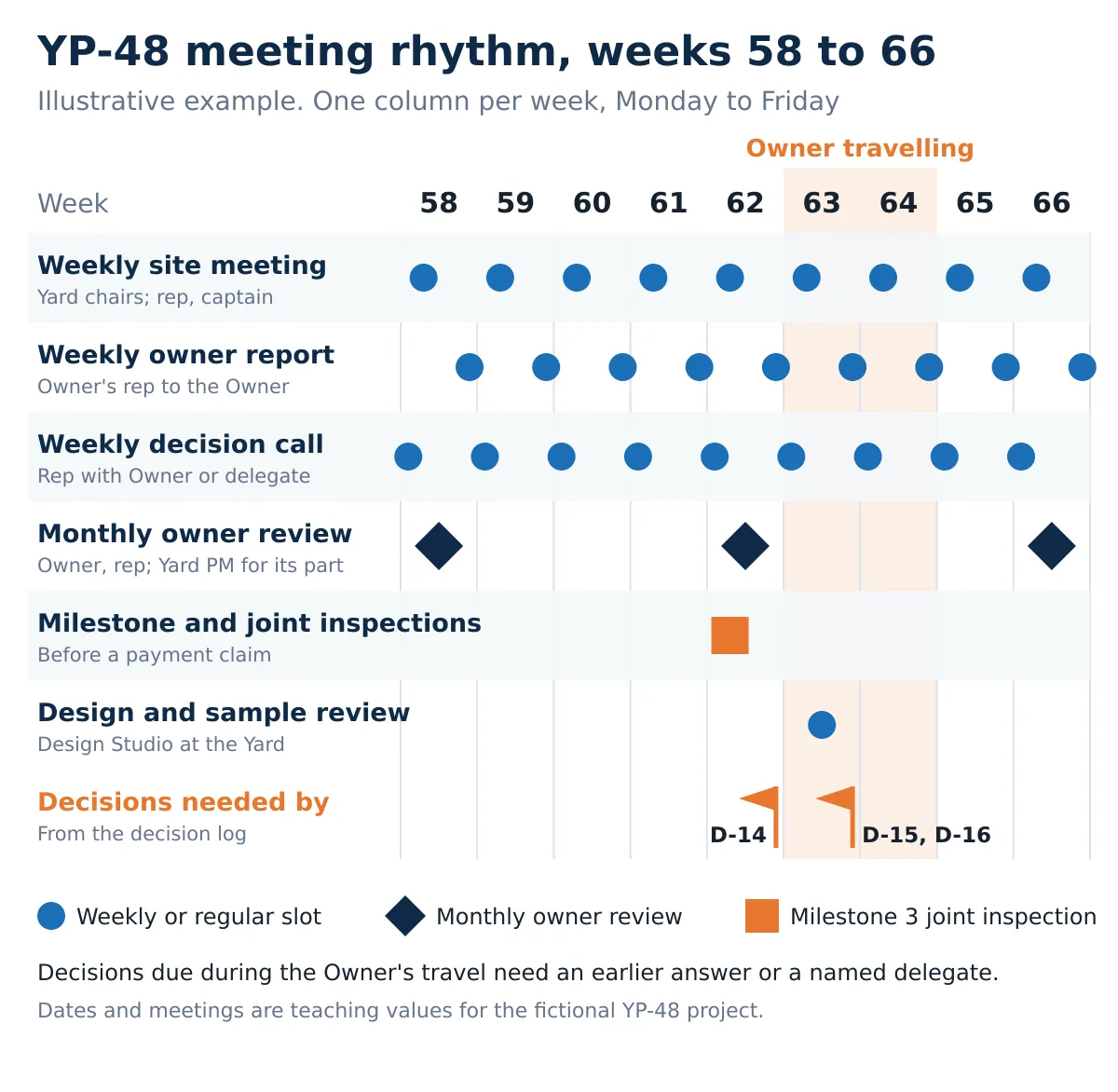
The YP-48 rhythm, agreed at kick-off (illustrative):
| Meeting | Chair | Attends | When | Purpose | Output |
|---|---|---|---|---|---|
| Weekly site meeting | Yard project manager | Owner's rep, build captain, Yard leads | Tuesday | Progress facts, look-ahead, issues, inspections | Yard minutes, reviewed by the rep |
| Weekly decision call | Owner's rep | Owner or the named delegate; captain and Design Studio when their item is on | Monday, 30 minutes | Only the decisions in the report | Decisions confirmed in writing the same day |
| Monthly owner review | Owner's rep | Owner, family office; Yard PM for the second part; Design Studio as needed | Wednesday after the month-end measurement | Forecast, decisions for the next 90 days, changes, risks | Minutes within two working days; decision and action logs updated |
| Milestone meetings | Yard PM | Owner's rep, captain; class where its sign-off is part of the evidence | Before each payment claim, the design freeze, launch, sea trials and delivery | Agree that the milestone is met, or what is missing | Signed record for the evidence pack |
| Design and sample review | Design Studio | Owner's rep, captain; Owner for look and feel | Monthly while the interior is being designed and built | Samples, mock-ups, drawings with the Yard present | Sample register entries, questions for the decision log |
| Escalation meeting | Owner's rep | Owner and the Yard's management | When a status turns red or a change is disputed | Settle what the project level could not | Written outcome |
A few rules make the rhythm work:
- One place for each kind of question. Facts go to the site meeting, decisions to the decision call or the monthly review, look and feel to the sample review. A question raised in the wrong meeting is written down and moved, not answered on the spot.
- The Owner's part and the Yard's part are separate. The first part of the monthly review is owner-side only: assessment, negotiating positions, budget. The Yard joins for the second part. As the weekly report lesson put it, the facts are shared; the assessment stays with the Owner.
- Minutes are the record, and only one set. The Yard minutes the site meeting and the rep checks them before the next one. Disagreements with the minutes are raised in writing within a fixed period, otherwise the minutes stand. Why three parties leaving one meeting with three versions of it causes disputes is covered in Stakeholder Management Between Owner, Yard and Class.
- Class and flag are not in the owner's meetings. Their surveys run through the Yard. The rep attends where the RACI says so. Who reports what to whom, and through which channel, is in the Owner-Yard-Class Communication Matrix.
- The calendar knows the Owner's diary. Known absences go into the schedule like any other constraint, so decisions due in those weeks are moved forward or given a named delegate before the Owner leaves.
The decision log
The decision log is the owner's side's list of every question that needs an answer from the Owner, or from the rep under the delegation letter, with the date by which it is needed. It is not the change log, the drawing register or the minutes. Each of those has a job:
- Change log (T9): requests to depart from the contract, with price, time and tonnage. A change that waits for an Owner decision appears in the decision log as well, with a cross-reference, so the Owner sees one list of questions.
- Drawing register (T7): replies to the Yard's submissions within the contractual review period. Routine drawing comments stay there.
- Decision log (T11): choices the contract leaves open or that come up during the build: selections, samples, specifications, owner-supplied items, and changes waiting for the Owner.
- Action list: things someone has to do, often so that a decision can be made. An action has an owner and a due date; it is not a decision.
Some yacht building agreements plan for this list from the start. One yard's owner guide lists, among the documents that make up its building agreement, a list of decisions to be made during the build. If your contract has one, it is the first version of the decision log. If it does not, build one from the specification in the first month: every item described as "to Owner's choice", "to be selected" or "allowance" is a future decision.
Each line in the YP-48 log carries:
- The question, phrased so that it can be answered: "sample A or sample B", not "stone".
- The options, with what each does to price, weight or tonnage and schedule, and the recommendation with one line of reasoning.
- Who decides, taken from the delegation letter, and who must be consulted first.
- The consuming activity in the master schedule, and two dates: the needed-by date and the last responsible date (the next section explains both).
- Whether it affects the schedule if it goes past the last responsible date.
- Status and record: open, decided or closed; the decision, its date and where the written confirmation is filed.
Four rules keep the log honest. A decision is logged as decided only when the authorised person has confirmed it in writing. A decision is closed only when the Yard has received the instruction through the rep. Nothing is deleted: a decision that is later reversed stays in the log, and the reversal gets a new line that points back to it. And every decision taken in a meeting or a call goes into the log the same day.
The YP-48 log going into the month-14 review, open items and recent entries (illustrative):
| Ref | Question | Decides | Needed by | Last responsible | Status on 8 March |
|---|---|---|---|---|---|
| D-08 | Limousine tender: model and size | Owner | 30 Nov 2027 | 31 Dec 2027 | Decided 19 Nov: largest of three. Garage interface not checked; led to CR-06 |
| D-12 | Guest cabin mock-up comments: accept the Yard's revised joinery details | Owner's rep | 3 Mar 2028 | 7 Apr 2028 | Open, 5 days overdue, waiting for the captain's comment |
| D-13 | CR-05, enclosed sun-deck bar | Owner | 3 Mar 2028 | 3 Mar 2028 | Decided 1 Mar: rejected, would pass 500 GT |
| D-14 | Master bathroom stone: sample A or B | Owner | 10 Mar 2028 | 7 Apr 2028 | Open, due this week |
| D-15 | AV/IT specification rev C: sign so the order can be placed | Owner | 17 Mar 2028 | 14 Apr 2028 | Open, due during the Owner's travel |
| D-16 | CR-06, larger tender garage door | Owner | 17 Mar 2028 | 10 Apr 2028 | Open, Yard price expected this week |
| D-17 | Hull colour and topcoat: approve sample panels | Owner | 30 Jun 2028 | 28 Jul 2028 | New |
| D-18 | Loose furniture, guest areas: final selection | Owner | 31 Aug 2028 | 29 Sep 2028 | New |
Two lines deserve a second look. D-12 is overdue, and it is the owner's side that is late, not the Owner: the rep is waiting for the captain. The log shows it anyway, because a log that only records other people's delays is not believed. D-08 is closed and still teaches something: the tender was chosen without anyone checking the garage, and five months later that choice came back as a change request with a price, a weight penalty and a date. When a decision touches an interface, the consulted column should include whoever owns the other side of it.
Needed-by dates come from the schedule
"As soon as possible" is not a date, and neither is the date the Yard would like. A needed-by date is worked out backwards from the schedule activity that consumes the answer.
Start from the planned start of the consuming activity and subtract everything that has to happen after the decision: the Yard's instruction and drawing revision, ordering, fabrication, delivery. That gives the needed-by date: decide by then and no float is used. Do the same from the activity's late start, its planned start plus its float, and you get the last responsible date: decide later than that, and delivery moves. The master schedule lesson put owner decisions into the schedule logic for exactly this purpose; the decision log is where those dates are read and chased.
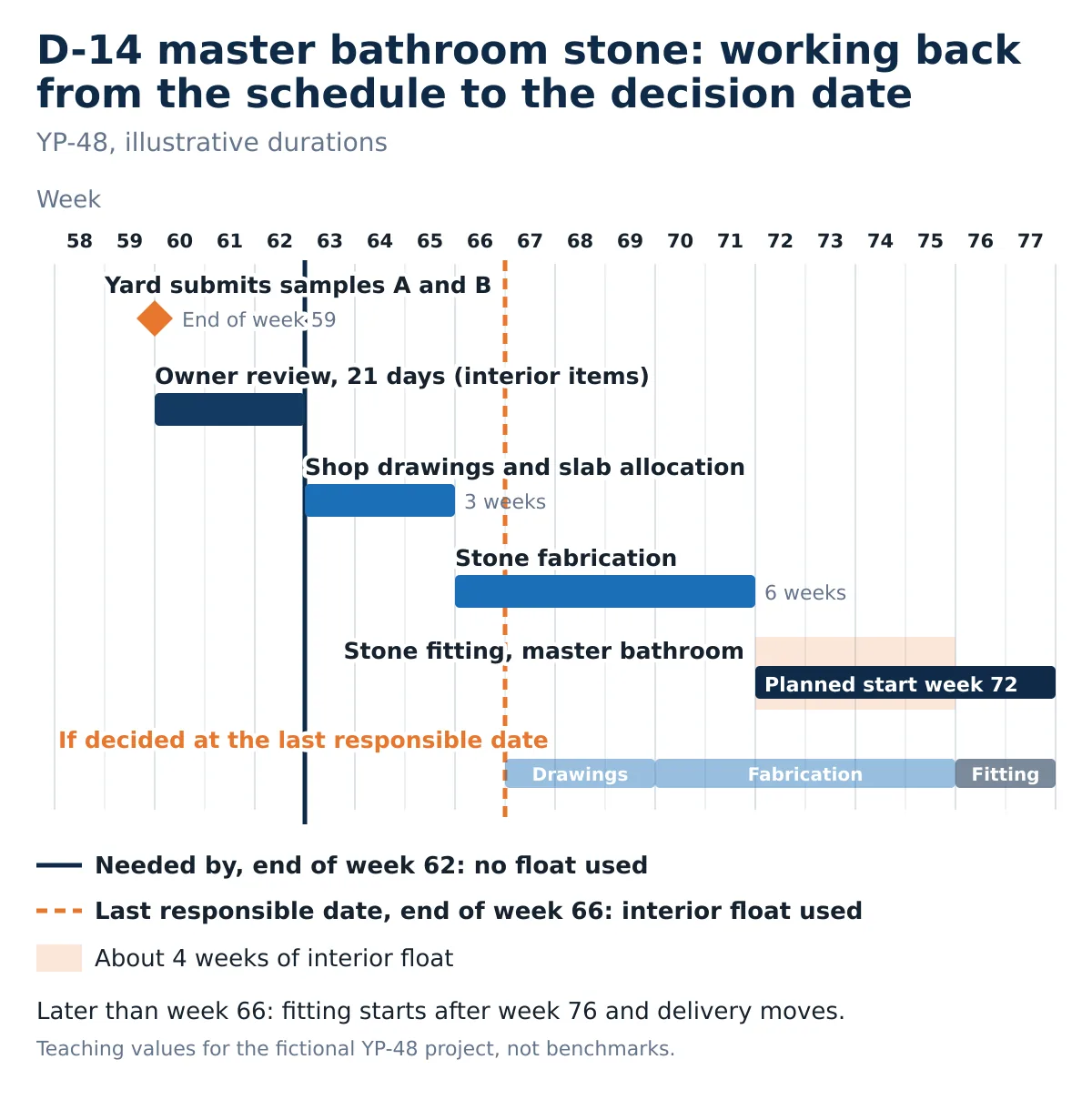
For D-14, the master bathroom stone, the chain reads like this (illustrative durations):
- Stone fitting in the master bathroom is planned to start in week 72, inside interior outfitting.
- Before that, the stone has to be fabricated (six weeks) and, before that, the slabs allocated and shop drawings made (three weeks).
- So the choice is needed by the end of week 62. The Yard submitted the two samples at the end of week 59, and YP-48's contract gives the owner's side 21 days for interior items, as set in Specification, General Arrangement and the Design Freeze, which also ends in week 62. The contract period and the schedule date agree here. When they do not, the earlier date governs.
- Interior outfitting has about one month of float. The last responsible date is therefore the end of week 66. A decision in week 64 uses two weeks of float and delivery does not move; a decision in week 68 moves delivery by about two weeks.
Three practical points follow:
- Decisions on the same path share the same float. D-12 (guest cabin joinery) and D-14 (master bathroom stone) both draw on the interior outfitting float. If each is two weeks late, together they use all of it. The log should show the path, not only the date, so that the rep can see when several small delays add up.
- Other limits can come first. D-16's schedule date comes from the hot-work cut-off, but the Yard's offer for CR-06 expires on 10 April. The last responsible date is the earlier of the two.
- Aim at the needed-by date, not the last responsible date. Float belongs to the project and it is used up by problems nobody has had yet. The monthly review reports decisions made after their needed-by date as float consumed, even when delivery has not moved.
Remote approval and the Owner's advisers
On YP-48 the Owner holds the A on eleven of the 18 rows in the RACI, and the Owner is rarely in the same country as the yacht. Around the Owner sits a circle of people who all have views: the family office, the captain, the Design Studio, sometimes family members and friends who will use the yacht. None of them can decide for the Owner unless the Owner says so in writing (why the owner's side needs one professional channel at all is argued in The Owner's Representative), and all of them can slow a decision down if they are consulted in the wrong order.
What works on YP-48:
- A named route for answers. The delegation letter from the roles lesson says what the rep may decide. For remote approval it gets a companion: a short list, signed by the Owner and copied to the Yard, of who may confirm an Owner decision and for what. On YP-48 the Owner may name the family office director to confirm decisions during absences, within limits the Owner sets. The captain and the Design Studio are consulted; they do not confirm.
- Consult first, then ask. The rep collects the captain's and the Design Studio's views before the question goes to the Owner and puts them in the decision paper. The Owner should not have to reconcile three separate message threads.
- One page per decision. The question, the options with photos or drawings, what each does to price, weight, tonnage and time, the recommendation, the needed-by date and what happens if it is missed. The Owner replies with an option, not an essay.
- Show the real thing where possible. Photos of samples in daylight and under the yacht's planned lighting; samples shipped to the Owner's office when the decision is about look and feel; a video walk-through of a mock-up. Remote approval of a sample the Owner has only seen on a screen is where many later disputes start.
- Confirm in the channel the contract recognises. A message on a phone is a good way to get an answer quickly. The confirmation then goes into the channel that the contract's notice clause and the delegation letter name, and into the log. Under English law, which governs many yacht build contracts, the Law Commission concluded in 2019 that an electronic signature can be used to execute a document where the signer intends to authenticate it and the contract or the law does not require something else. Whether a given e-mail or e-signature counts as "writing" for your contract is a question for counsel, and Reviewing a Yacht Yard House Contract lists the notice clauses to check.
- Silence is not approval. YP-48's contract has no deemed approval for finish and colour items, so an unanswered question simply stays open. The rep sends a reminder a week before the needed-by date, calls on the date, and on the last responsible date writes to the Owner stating what will move and by how much.
In the week 62 example, this plays out as follows. The family office has not yet confirmed who may decide during the Owner's travel (action A-33, due on the day of the review). D-15 and D-16 are both due on 17 March, while the Owner is away. The review therefore has two jobs: take D-14 and D-15 while the Owner is present, and either get the Yard's CR-06 price in time for a decision before 13 March or have the named delegate in place, with the Owner's instruction, before the Owner leaves.
Managing expectations: samples, mock-ups and the first sight
Most owners form their picture of the yacht from renders and the general arrangement. The yacht they see at the Yard, months later, is bare aluminium, temporary lighting and protective covers, and eventually a finished space that can look different from the render in ways nobody wrote down. The risk is the first sight: the moment the Owner sees a space for the first time, reacts, and turns that reaction into a change request when changes are most expensive.
The answer is to move the first sight forward, to a point where the reaction is still cheap.
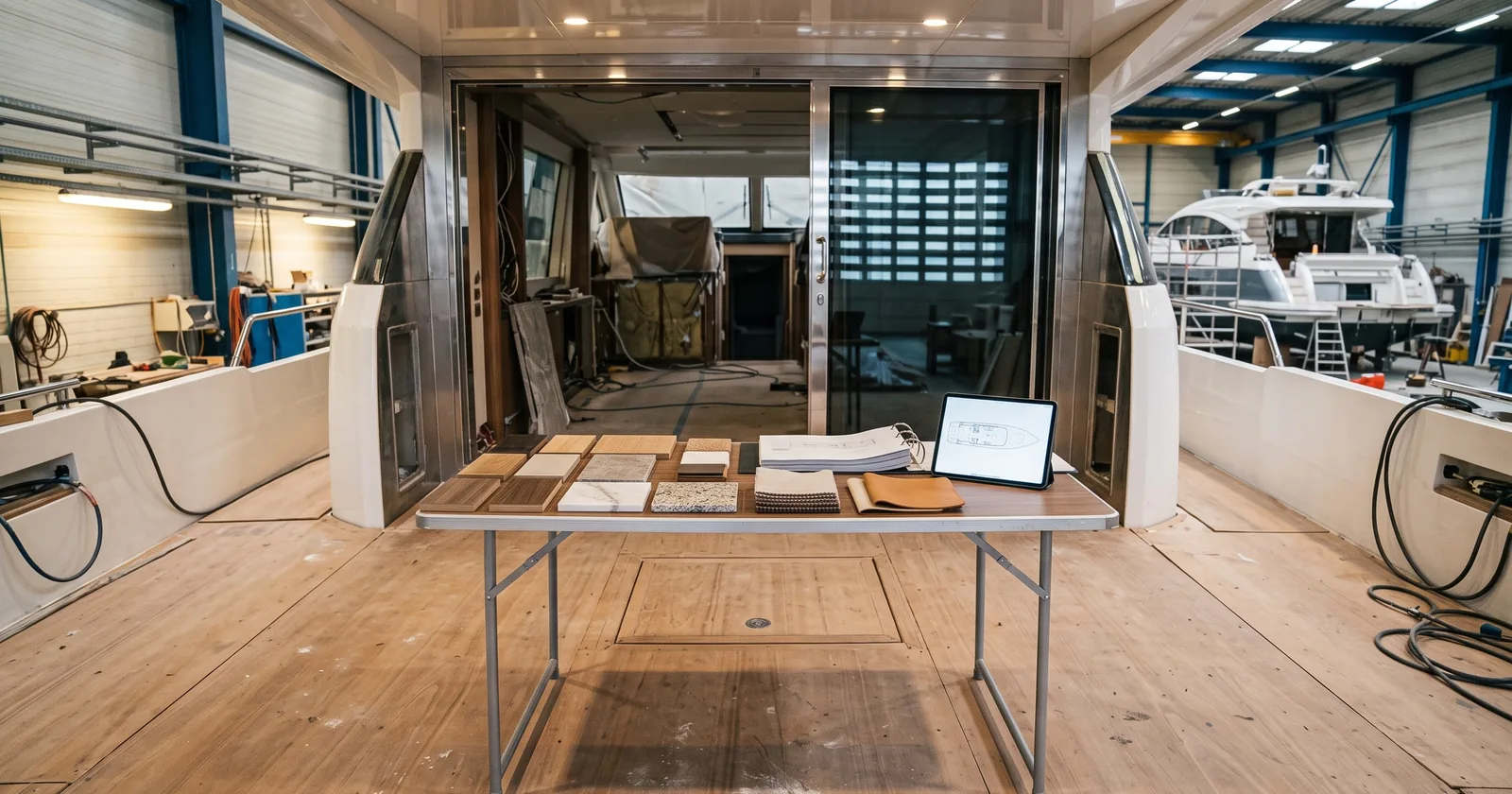
- Samples at a useful size. Stone and timber are natural materials, so a sample shows a range, not the exact piece that will be fitted. Approve a set of samples that shows the range, sign and label them, and keep a signed set at the Yard and one at the owner's side. The signed set becomes the reference when the finished surface is inspected later.
- Full-scale mock-ups before production. A mock-up of a guest cabin or a bathroom lets the Owner stand in the space, open the lockers and see the lighting. Build updates in the yacht press mention full-scale mock-up evaluations running alongside interior production. On YP-48 the guest cabin mock-up (D-10) was reviewed in month 12, before the joinery went into production, and its three comments are in D-12.
- Brief before every visit. Before an Owner visit, the rep sends a short note: what the Owner will see, what is unfinished and why, what is deliberately temporary, and which decisions are prepared for the visit. A visit without a briefing turns every unfinished area into a worry.
- No instructions on deck. An Owner visit produces comments, which the rep writes down and routes. A request made on deck to a foreman becomes a change without a number, the case the change request lesson is built to prevent.
- Mark the render. Where a render shows something that is not in the specification, such as loose furniture, art or a different light level, say so on the render. An Owner who was shown a render and never told what it did not include has been set an expectation the contract will not meet.
Bad news, early
The Owner should hear bad news from the owner's representative first: before the Yard's letter, before the captain mentions it on a call and before an invoice shows it. Bad news that arrives late costs more than the problem itself, because the Owner then wonders what else they have not been told.
Three habits help:
- Agree the triggers in advance. On YP-48 the rep calls the Owner within one working day of any status turning red under the traffic-light rules from the weekly report lesson, without waiting for the Friday report. The superstructure checkpoint at the end of week 63 is such a trigger: if the last two sections are not welded and inspected by then, the Owner hears it on Monday of week 64, not on Friday.
- Say what is known, what is not, and when you will know. "The superstructure checkpoint was missed by four days. The Yard's view is that the joining date holds; ours is that it moves into the second half of month 16. We will know after next Tuesday's section count. Nothing is needed from you yet." That message can be sent before the analysis is finished, and it should be.
- Bring a decision with the problem where there is one. If the bad news creates a choice, such as accepting a later date or paying for recovery, it goes into the decision log with options and a date, like any other question.
Escalation thresholds and how to present schedule variances to senior people are covered in general terms in PMI-SP Domain 5: Stakeholder Communications Management. The yacht version is shorter: tell the Owner early, in plain words, and put anything they have to decide in the log.
The monthly owner review: YP-48 agenda for month 14
The monthly review is where the decision log, the change log and the forecast meet the Owner in person or on video. It is not a second reading of the weekly report; the Owner has read that. The agenda below is for Wednesday of week 62 (illustrative).
| Time | Item | Lead | Input | What should come out |
|---|---|---|---|---|
| 5 min | Actions from the month-13 review | Owner's rep | Action list | Open actions with new dates, or closed |
| 10 min | Where we stand: forecast against the contract dates | Owner's rep | Week 61 report, month-14 measurement | Owner agrees the forecast and the red trigger at week 63 |
| 25 min | Decisions due now: D-14, D-15, D-16 | Owner's rep | Decision papers, samples, CR-06 status | D-14 and D-15 decided; for D-16, a decision date before 13 March or a named delegate |
| 10 min | Decisions due in the next 90 days: D-17, D-18 and anything new | Owner's rep, Design Studio | Decision log | Dates agreed; sample panels for D-17 booked |
| 10 min | Changes and money | Owner's rep | Change log summary (T9) | Owner sees signed total and pending exposure |
| 5 min | Owner's diary: travel on 13 to 24 March | Family office | Action A-33 | Written confirmation of who confirms decisions during the travel |
| 15 min | Yard session: recovery plan and AV/IT order timing | Yard PM | Recovery plan, section count | Yard's commitments recorded as actions |
| 5 min | Read back decisions and actions | Owner's rep | Notes | Everyone hears the same list before leaving |
Two details are worth copying. The read-back at the end costs five minutes and prevents most disputes about what was agreed. And the decision papers go out before the meeting, not in it: the Owner of YP-48 had the photos of both stone samples, and the samples themselves, a week before the review (actions A-32 and A-39).
The review produces two updates the same day: the decision log, with the decisions and their written confirmations, and the action list. The minutes follow within two working days.
The template: T11 Decision and Action Log
The workbook puts this lesson into a form you can use.
- Decision Log. One line per decision: reference, date raised, question, options and recommendation, who decides, who is consulted, the consuming schedule activity, needed-by date, last responsible date, whether it affects the schedule, status, decision date, the decision and where it is recorded, cross-reference and notes. Formulas give days to the needed-by date, days late for decisions made after it, a flag for open decisions past their needed-by date and a stronger flag once the last responsible date has passed. Counters at the top show open decisions, overdue decisions, open decisions that affect the schedule, decisions past their last responsible date and decisions made late.
- Review and Actions. A monthly review agenda (time, item, lead, input, expected outcome, decision references) and an action list with owner, due date, status and a days-overdue formula, with counters for open and overdue actions.
Each has a Blank sheet and an Example sheet with the YP-48 logs as they stood on the morning of the month-14 review.
Download: Decision and Action Log (T11), xlsx
The log refers to the other YP-48 templates rather than repeating them: changes to the Owner Change Request Form and Change / VO Log (T9), drawing replies to the Drawing Approval Register and Weight / GT Tracker (T7), authority to the Yacht Build RACI Matrix (T2) and the weekly front sheet to the Weekly Owner Report (T10).
Before the first owner meeting
Agree these at kick-off, with the Owner and, where it concerns them, with the Yard:
- the meeting rhythm: which meeting takes which questions, on which day, who chairs and who writes the minutes;
- the list of decisions the contract leaves open, entered in the log with needed-by and last responsible dates from the baseline schedule;
- who may confirm Owner decisions, in which channel, and who confirms them when the Owner is away;
- how samples are approved, signed and kept, and which mock-ups will be built and when;
- the triggers for calling the Owner between reports;
- where the logs live and who may see them.
Then keep to the rhythm when nothing much is happening. An Owner who is used to a Monday call and a monthly review will still be there when a hard decision comes.