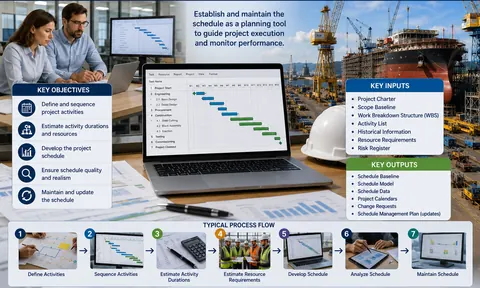

Domain 5 is the final section of the PMI-SP exam (14% of the total): developing stakeholder relationships, maintaining schedule visibility, reporting to senior management, and escalating schedule issues before they become irreversible delays.
While technical scheduling competencies such as critical path method (CPM) modeling, schedule compression techniques, and quantitative risk analysis are fundamental to schedule development, a mathematically sound schedule holds little value if it is developed in isolation or poorly communicated. Domain 5 of the PMI Scheduling Professional (PMI-SP)® Examination Content Outline focuses on Stakeholder Communications Management. Project schedulers often encounter high-pressure environments where technical schedule analysis must be translated into clear, actionable intelligence for diverse project participants. Effective schedule communication bridges the gap between complex network logic and strategic decision-making, ensuring that project sponsors, executives, functional leaders, and operational teams remain aligned on project objectives, current performance, and emerging risks.
Domain Overview
Domain 5 accounts for 14% of the PMI-SP examination. The official definition of this domain is:
Domain 5: Stakeholder Communications Management (14% of examination) — "Activities related to developing and fostering relationships with stakeholders, and supporting project schedule-related communication over the course of the project."
This domain addresses how a scheduling professional establishes trust, maintains transparency, tailors time-management information to target audiences, and systematically elevates schedule variances and corrective actions. Schedule communication is not merely a passive distribution of Gantt charts; it is an active, iterative process of stakeholder engagement that protects the integrity of the baseline and fosters proactive problem-solving across the project lifecycle.
Task 1: Develop and Foster Relationships with Project Stakeholders
Task Definition: Develop and foster relationships with project stakeholders, consistent with the communication management plan, in order to enhance support for the project schedule.
A project schedule relies heavily on accurate input from the individuals executing the work. Developing and fostering strong relationships with project stakeholders ensures that schedule data collection is based on trust, transparency, and accurate ground-level intelligence rather than overly optimistic reporting or defensive withholding of information. The scheduling professional must work continuously with project managers, functional leads, subcontractors, and client representatives to establish a shared understanding of schedule constraints, logic dependencies, and critical path priorities.
Fostering these relationships requires the scheduler to act as a collaborative advisor rather than an auditor. When functional teams view the scheduler as a partner who helps them forecast resource bottlenecks and resolve logic conflicts, they are far more likely to provide honest status updates, realistic duration estimates, and early warnings regarding potential delays. Relationship management must strictly follow the governance frameworks defined in the Communication Management Plan, respecting organizational protocols while maintaining open lines of communication.
Shipbuilding Industry Context
In large-scale marine vessel construction, stakeholder networks are exceptionally complex, comprising shipyard executives, naval architects, classification society surveyors (e.g., American Bureau of Shipping or Lloyd's Register), trade superintendents (pipefitting, electrical, structural welding), equipment original equipment manufacturers (OEMs), and shipowner representatives. A scheduler working in a shipyard must build direct trust with shop-floor foremen and trade superintendents. If a trade foreman believes the schedule is an impractical management tool imposed from above, status updates will be superficial or inaccurate. By walking the slipway, drydock, and outfitting berths, and listening to the practical workflow constraints of the trades, the scheduler fosters relationships that yield reliable actual start/finish dates, accurate remaining duration updates, and early identification of space-congestion conflicts within vessel compartments.
Exam Tip: On the PMI-SP exam, questions related to stakeholder relationships emphasize alignment with the Communication Management Plan and proactive engagement. Always select answers that promote open communication, collaboration, and structured transparency over authoritative enforcement or isolated schedule updating.
Task 2: Generate and Maintain Visibility of Project Schedule
Task Definition: Generate and maintain visibility of project schedule, by working with the project manager and/or stakeholders, in order to maintain stakeholder support.
Schedule visibility refers to the degree to which current schedule performance, logical paths, upcoming milestones, and critical constraints are clear and accessible to all relevant project participants. Maintaining visibility requires translating detailed, highly technical scheduling software outputs into intuitive, tailored visual formats that meet the specific needs of different stakeholder tiers. Raw network diagrams and thousand-activity bar charts are rarely effective for broad stakeholder engagement; high-level executive dashboards, milestone trend charts, line-of-balance diagrams, and departmental look-ahead schedules are far more compelling.
Generating visibility is a continuous joint effort between the scheduling professional, the project manager, and key operational stakeholders. The schedule must be treated as a living management baseline. When changes occur—such as scope modifications, logic adjustments, or variance realizations—the visual representations of the schedule must be updated promptly and made accessible through centralized project management information systems (PMIS), visual management boards, or formal reporting packages. High schedule visibility prevents surprises, reinforces accountability, and maintains institutional support for the project's time objectives.
Shipbuilding Industry Context
Maintaining schedule visibility in a shipyard involves bridging macro-level vessel delivery dates with micro-level shop floor operations. Schedulers deploy visual management tools tailored to specific shipyard zones. For executive management and shipowners, high-level Milestone Trend Analysis (MTA) diagrams and Earned Schedule S-curves visually track macro milestones such as first steel cutting, keel laying, hull launching, main engine installation, dock trials, and sea trials. On the shipyard floor, digital display boards or physical visual boards in grand-block assembly halls display three-week look-ahead schedules and compartment-by-compartment outfitting matrices. This ensures that trade supervisors, quality inspectors, and rigging teams visually understand how their daily progress directly drives downstream compartment completion and eventual vessel launch.
Task 3: Executive and Stakeholder Reporting
Task Definition: Provide senior management and other stakeholders with verbal and written schedule status updates and impact on schedule of corrective actions, as defined by the communication management plan, in order to maintain stakeholder awareness.
Senior management and key external stakeholders require regular, structured updates regarding schedule health, performance trends, and baseline variance. This task highlights the scheduler's responsibility to deliver concise, accurate, and actionable verbal briefings and written reports in direct compliance with the frequency, format, and protocol standards established in the Communication Management Plan.
Crucially, reporting must go beyond stating current status; it must evaluate and explain the net time impact of recommended or implemented corrective actions. When a schedule variance occurs, stakeholders need to know not only that a critical activity is delayed, but also how management proposes to recover the slippage—such as through schedule crashing, fast-tracking, or resource re-allocation—and what residual schedule risks remain after executing the recovery plan. Effective updates present what-if scenario analysis that demonstrates the comparative schedule impact of alternative decision paths, allowing executives to make informed governance decisions.
Shipbuilding Industry Context
During the construction of a commercial cargo vessel or naval surface combatant, senior shipyard leadership and shipowner representatives require structured monthly baseline variance briefings. If the structural integration of a hull super-block falls fifteen days behind schedule due to steel plate delivery delays, the written and verbal status updates provided by the scheduler must detail the exact downstream ripple effects on outfitting, piping, and electrical cabling activities. The scheduler presents the calculated impact of proposed corrective actions—such as shifting non-structural outfitting activities earlier via fast-tracking, or authorizing double-shift overtime for welding crews (crashing). The report details both the schedule time recovered and any secondary schedule risks introduced, such as potential trade interference or increased safety hazards in confined spaces.
Task 4: Elevating Schedule Issues and Variances
Task Definition: Communicate schedule issues that could impact delivery of project scope or adherence to the schedule management plan, in order to elevate awareness to relevant stakeholders.
Schedule performance rarely deviates catastrophically without preliminary warning signs. This task focuses on the proactive detection and formal escalation of emerging schedule issues, scope creep impacts, and logic anomalies that threaten project delivery or violate performance thresholds defined in the Schedule Management Plan. A primary duty of the scheduling professional is to identify early variance signals—such as persistent consumption of total float on near-critical paths, declining Duration Performance Index (DPI) trends, or unmitigated resource over-allocations—and elevate them immediately to relevant decision-makers.
Communicating schedule issues requires clarity, objectivity, and context. The scheduler must clearly articulate the root cause of the schedule issue, the affected scope packages, the potential impact on project completion dates or major contract milestones, and the urgency of required intervention. Escalation must adhere strictly to established variance thresholds (for example, escalating any float erosion exceeding ten working days on driving paths) to ensure that decision-makers are notified before negative variances become irreversible delays.
Shipbuilding Industry Context
Consider a scenario where an equipment supplier delays the delivery of a vessel's main propulsion shaft line by four weeks. In a complex shipyard schedule, this delay creates an immediate bottleneck for stern tube alignment, propeller fitting, shaft coupling, and subsequent compartment closure. A proactive scheduling professional does not wait for the formal monthly reporting cycle to report this issue. Recognizing that the shaft line installation is on the primary critical path driving the drydock evacuation milestone, the scheduler elevates this issue immediately to the shipyard project director, commercial manager, and procurement lead. The formal variance notification quantifies the exact delay to drydock floatation and prompts immediate commercial and technical countermeasures, such as adjusting drydock blocking arrangements or re-negotiating the supplier's factory acceptance testing sequence.
Knowledge and Skills
Per the official PMI-SP Examination Content Outline, this domain draws on:
Targeting Communications to Senior Management
Senior executives operate under severe time constraints and require targeted, high-level schedule intelligence rather than granular operational details. Communicating effectively with senior management requires distinct techniques:
- Executive Summaries and Exception Reporting: Executive communications should lead with key findings, strategic milestone forecasts, primary critical path health, and significant exceptions. Routine, on-track activities are summarized briefly, while activities experiencing critical path variance or severe float erosion are highlighted for decision-making.
- Metric-Driven Dashboards: Senior stakeholders rely on consolidated performance indicators, such as Earned Schedule metrics (time-based Schedule Variance and Schedule Performance Index), Milestone Trend Analysis indicators, and critical path float consumption trends.
- Impact and Decision Focus: Presentations to leadership should connect technical schedule variances to business outcomes—contractual liquidated damages, cash flow impacts, and resource commitments—presenting decision options alongside their schedule implications.
- Signal vs. Noise Filtering: The scheduling professional must filter out routine operational noise, such as minor non-critical float adjustments, so that executive attention remains focused on issues that genuinely threaten overall project parameters or contract delivery obligations.
Methods and Techniques Used to Maintain Visibility of Project Schedule
Maintaining broad schedule visibility across diverse project teams requires a combination of analytical presentation techniques, software reporting capabilities, and visual management practices:
- Milestone Trend Analysis (MTA): A graphical method where forecasted completion dates for key milestones are plotted over time against successive status dates. Downward trends visually indicate systemic productivity issues long before a final milestone date is formally missed.
- Earned Schedule Charts: Earned Schedule extends Earned Value Management by translating earned value horizontally into time units, producing intuitive graphical time-based metrics that clearly show whether the project is ahead of or behind schedule in months or weeks.
- Line of Balance and Time-Location Diagrams: Highly visual scheduling formats used particularly in linear or repetitive construction environments, plotting physical locations or repeated units along one axis and time along the other. Points where activity lines intersect highlight spatial and temporal congestion immediately.
- Visual Management Boards and Digital Dashboards: Integrating current schedule information into physical boards, interactive dashboards, or model-integrated visual sequences allows shop-floor supervisors, engineering leads, and project managers to interactively explore schedule sequences and current status.
- Critical Path and Float Mapping: Simplified, color-coded network-path diagrams that display the primary critical path, secondary critical paths, and near-critical paths, making clear to non-schedulers which chains of work carry zero or low float.
Elements of the Communication Management Plan
The Communication Management Plan is a foundational project management artifact that establishes the rules, channels, and architecture for schedule data distribution. Schedulers must deeply understand its core elements to ensure compliant schedule reporting:
- Stakeholder Communication Requirements: Detailed mapping of each stakeholder group (executives, project managers, contractors, clients, regulatory bodies) to their specific schedule information needs, preferred detail level, and formats.
- Information Distribution Architecture: Definitions of the media, tools, and systems used to disseminate schedule reports—such as PMIS access protocols, automated distributions, executive briefings, and visual floor displays.
- Reporting Cycles and Frequencies: Clear schedules defining when daily look-aheads, weekly operational updates, monthly baseline variance reports, and periodic leadership reviews are published.
- Roles and Responsibilities: Explicit definitions of who creates, reviews, approves, and distributes specific schedule reports—for example, the scheduler authors the baseline update report, the project controls manager reviews it, and the project manager formally releases it to external clients.
- Variance Thresholds and Escalation Pathways: Pre-defined trigger conditions (such as a specific number of days of float reduction, or a schedule performance index falling below a defined value) that dictate when an emerging issue must be elevated, along with specific reporting protocols and timeframes.
- Feedback Loops: Structured mechanisms allowing stakeholders to request schedule presentation adjustments, clarify data assumptions, and confirm that delivered schedule reports effectively support operational decision-making.
Final Exam Preparation Focus
When preparing for Domain 5 questions, remember that the scheduler is presented as a proactive, transparent, and structured communicator. Focus on recognizing how schedule data must be adapted for different stakeholder audiences without compromising accuracy or integrity. Expect scenario questions that test your response when schedule variances occur: the correct answer almost always involves analyzing the schedule impact, following the protocols of the Communication Management Plan, presenting transparent corrective options to the project manager and senior leadership, and ensuring early, targeted notification to affected stakeholders—rather than unilaterally altering schedule logic or delaying bad news.
This concludes the five-domain PMI-SP series on this site. Together, Domain 1, Domain 2, Domain 3, Domain 4, and this domain cover the full PMI-SP Examination Content Outline.