
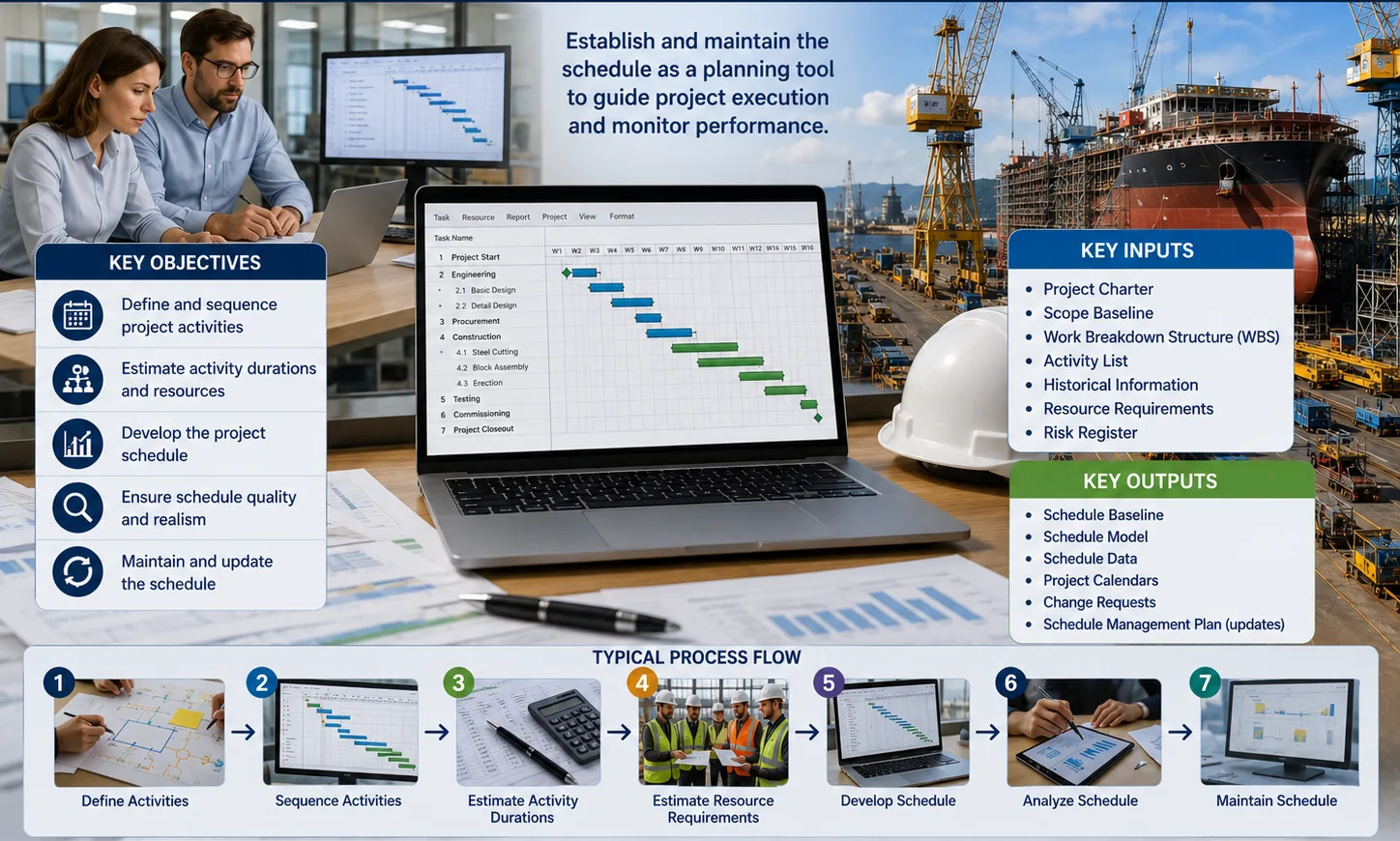
The most heavily weighted areas in the PMI-SP examination. It focuses on the creation and development of a realistic, achievable schedule model. This domain covers the full lifecycle of building the schedule, from defining what work must be done, through logical sequencing, resource and duration estimating, to applying advanced scheduling techniques and establishing the approved baseline.
The primary reference is the Practice Standard for Scheduling (PMI), particularly Chapters 2, 3, and 4. The goal is to produce a schedule model that is:
- Complete and logically sound
- Resource-loaded where appropriate
- Risk-informed
- Usable for performance measurement (links to EVM)
Schedule Model Management & Creation Planning
Before creating activities, establish the governance framework.
Key Elements (from Practice Standard):
- Schedule Data Management Plan: How schedule data will be collected, stored, versioned, and controlled.
- Schedule Model Management Plan includes:
- Selection of scheduling method (Critical Path Method is most common; also Precedence Diagramming Method, Critical Chain).
- Selection of scheduling tool (Primavera P6, MS Project, etc.).
- Schedule Model Creation Plan: Level of detail, rolling wave approach, WBS alignment.
- Schedule Model ID and Version control.
- Calendars and Work Periods (project, resource, and activity calendars).
- Project update cycle frequency and change control process.
Good Practice Tip: Document all assumptions and constraints clearly. The schedule model must support the project’s complexity (e.g., long-lead equipment in shipbuilding projects).
Define Activities
Transform the WBS deliverables into manageable activities.
Good Practices:
- Activities should be verb-noun format and unique (e.g., “Weld deck plating, Frame 45-52” not “Welding”).
- Each activity must have a clear, unambiguous description that leaves no room for interpretation.
- Include activity attributes: Activity ID, WBS ID, responsible party, location, etc.
- Avoid activities that are too long (> 2 reporting periods) or too granular unless justified.
- Use rolling wave planning for progressive elaboration, detail near-term work fully, keep future work at higher level.
Key Components (Chapter 4):
- Activity Name (Required)
- Activity Description (Required)
- Activity Identifier (Required)
- WBS Identifier (Required)
- Activity Calendar (Optional but recommended)
Sequence Activities
Build the logical network.
Dependency Types (Precedence Diagramming Method, PDM):
- Finish-to-Start (FS), most common
- Start-to-Start (SS)
- Finish-to-Finish (FF)
- Start-to-Finish (SF), rarely used
Leads and Lags:
- Lag = positive delay (e.g., concrete curing)
- Lead = negative lag / overlap (use with caution, increases risk)
Good Practices:
- Eliminate dangling activities (no predecessor or no successor).
- Avoid logic loops.
- Prefer mandatory (hard) logic over discretionary (soft) logic.
- Use milestones to mark key events (contractual, external, or summary).
- Document rationale for all leads/lags and constraints.
Common Constraints:
- Start Not Earlier Than (SNET)
- Finish Not Later Than (FNLT)
- Must Start On, Must Finish On, etc.
Estimate Activity Durations & Resources
Duration Estimating Techniques:
- Analogous (top-down, historical)
- Parametric (e.g., m² of welding × productivity rate)
- Three-point (PERT):
- tE = (tO + 4tM + tP) / 6
- (Optimistic, Most Likely, Pessimistic)
- Bottom-up, expert judgment, historical data.
Resource Estimating:
- Identify required resources (labor, equipment, materials).
- Consider availability, skills, and calendars.
- Resource Breakdown Structure (RBS) helps organize.
Good Practice: Duration estimates should reflect realistic productivity and include appropriate contingency for identified risks (but do not pad excessively).
Develop the Schedule (Core Technical Process)
This is the heart of Domain 2.
Critical Path Method (CPM) Calculations:
Forward Pass:
ES = max(EF of all predecessors)
EF = ES + Duration
Backward Pass:
LF = min(LS of all successors)
LS = LF − Duration
Float Calculations:
Total Float = LS − ES = LF − EF
Free Float = ESsuccessor − EF
Critical Path = longest path with zero total float (or lowest float in some cases).
Additional Development Techniques:
- Resource Leveling: resolve overallocations while trying to minimize project duration increase.
- Resource Smoothing: keep resource usage within limits without changing critical path.
- Schedule Compression:
- Crashing (add resources, increases cost)
- Fast Tracking (perform activities in parallel, increases risk)
- What-If Analysis and Monte Carlo Simulation for risk-informed schedules.
- Critical Chain considerations (buffer management).
Schedule Presentation Levels (good practice):
- Level 1: Executive / Milestone
- Level 2: Management / Summary
- Level 3: Detailed / Control account
- Level 4+: Working / Activity level
Establish the Schedule Baseline
The approved version of the schedule model becomes the baseline.
Requirements:
- Formally approved by project sponsor / key stakeholders.
- Used as the comparison point for all future performance measurement (SV, SPI, etc.).
- Any changes after baseline require formal change control (Domain 3 topic).
Documentation to Include:
- Basis of estimates
- Assumptions log
- Constraints
- Risk register linkage
- Resource histograms and S-curves (where applicable)
Key Exam Focus Areas & Common Pitfalls
- Understand the difference between Total Float and Free Float.
- Know when to use leads vs. lags and the risk implications.
- Recognize that resource leveling can change the critical path.
- Be able to identify near-critical activities.
- Understand how calendars affect calculations (especially in shipyard projects with weather, shift, and holiday calendars).
- Know the difference between mandatory, discretionary, and external dependencies.
Quick Reference, Most Important Components (Domain 2)
- Activity Name — Required, manual, must be unique & clear.
- Predecessors / Successors — Required, manual, logical relationships.
- Duration — Required, manual, estimated or calculated.
- Early Start / Early Finish — Required, calculated, forward pass.
- Late Start / Late Finish — Required, calculated, backward pass.
- Total Float — Required, calculated, key for criticality.
- Constraints — Optional, manual, use sparingly.
- Calendars — Recommended, manual, project + resource.
Study Recommendations
- Master the forward and backward pass calculations manually.
- Practice identifying the critical path on small networks.
- Review all “Required” components in Chapter 4 of the Practice Standard.
- Understand how rolling wave planning and agile techniques integrate with traditional CPM.
- Link scheduling to EVM concepts (Planned Value, Earned Value) for integrated performance management.
These notes cover the core knowledge required for PMI-SP Domain 2. Focus on understanding why each good practice exists, not just memorizing lists.