Yard scope, allowances or owner-furnished equipment: map who buys what, read the makers list and 'or equal', track latest safe order dates. Free xlsx tracker.
Every item on a yacht reaches it by one of three routes. The Yard buys it inside the contract price, the Yard buys it against an allowance the Owner's choices will spend, or the Owner buys it directly and hands it to the Yard to install. Most procurement trouble on a yacht build starts where nobody wrote down which route an item takes, or where the route was agreed but the dates and interfaces that go with it were not.
This lesson draws that map for the example project. It sorts the packages by who buys them, explains how the makers list and its "or equal" wording work in practice, sets out what the Owner's side has to manage when it supplies equipment itself, and turns the latest safe order date into a column you can track. It ends with a procurement matrix template.
Earlier lessons in the series did part of this work and are not repeated. From Design Brief to Yard Shortlist asked every bidding yard to exclude the same owner-furnished items and to price the same allowances. Reviewing a Yacht Yard House Contract listed the questions to ask about the owner-furnished equipment clause and the warranty clause. The Master Schedule for a Yacht Build set up six long-lead lines and their float. The commercial side of equipment supply, including where the bottlenecks sit and how to expedite an order, is covered in Procurement and Supply Chain for Major Ship Equipment; the full purchasing process, from pre-qualification to factory acceptance, is in International Procurement of Major Ship Equipment.
Illustrative project: Project YP-48 is fictional. Its parameters are chosen from publicly reported industry ranges so the numbers are realistic, but no real yard, owner or yacht is described.
YP-48 at month 15
YP-48 is a 48 m full custom motor yacht with a design target of 499 GT, for private use and charter with 12 guests, built to the Red Ensign Group Yacht Code Part A (July 2024 edition). The contract runs 30 months, the flag is the Cayman Islands and the class society is Lloyd's Register, both illustrative choices explained in Rules Before Lines, and money is an index where the contract price is 100. The parties are introduced in Anatomy of a Superyacht Newbuild.
At the end of month 15 procurement stands roughly here. The main engines, generator sets and stabilizers are at the Yard and being installed. Glazing and the joinery package were ordered after the design freeze at month 7. The AV/IT order has just been placed, a little later than planned, because the specification waited for the Owner. And the Owner has chosen a larger limo tender than the one assumed at signing, which is where Owner Change Requests and Variation Orders on a Yacht found CR-06, the larger tender garage door. That tender turns out to be the most urgent line on the map.
Three routes onto the yacht
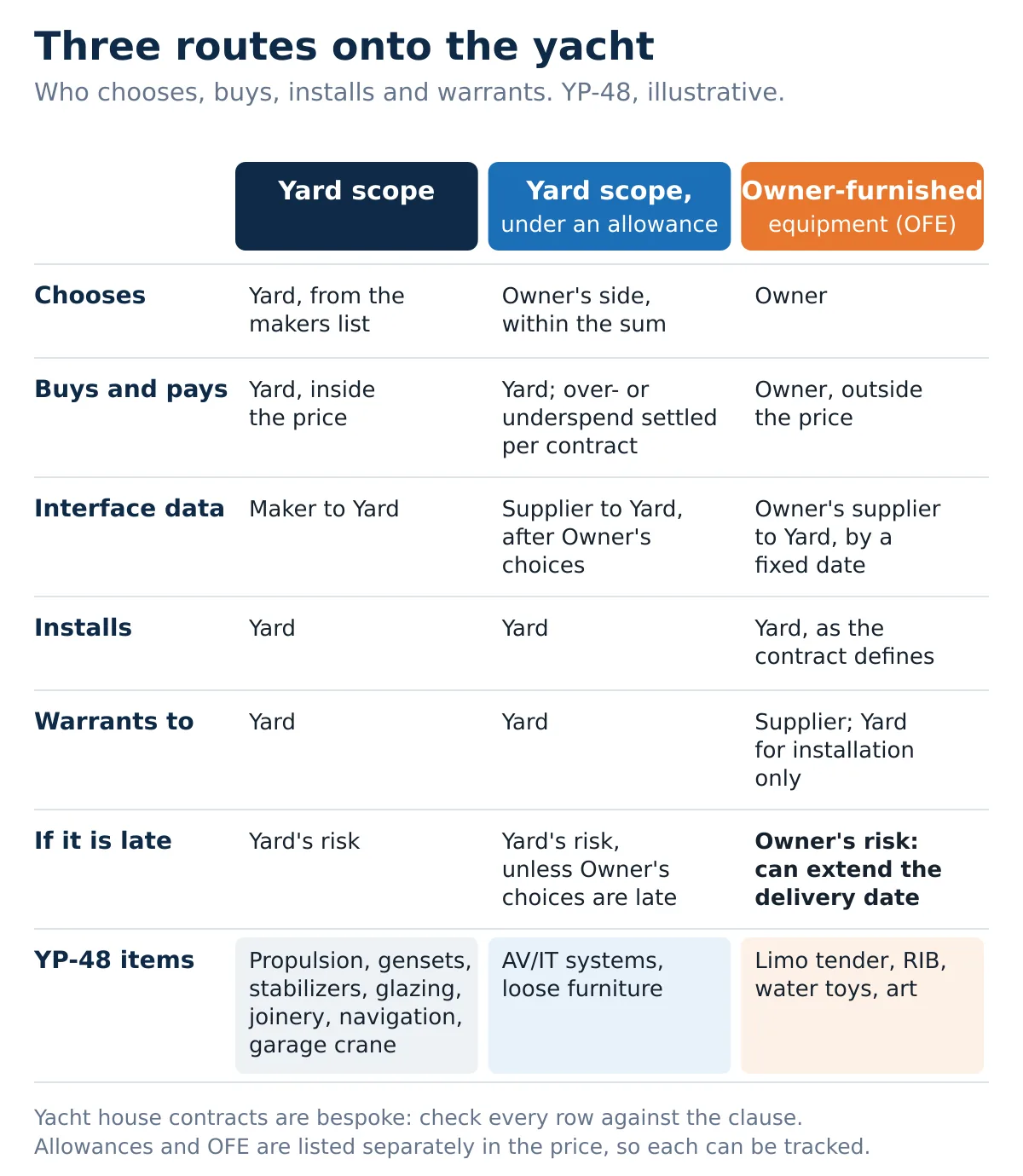
Yard scope. The item is in the specification and in the price. The Yard selects the maker from the makers list, places the order, installs, commissions and warrants the result to the Owner. If the maker is late, that is the Yard's problem under the contract, although, as the next section shows, the way the makers list was written can move part of it back.
Yard scope under an allowance. The item is in the price as a sum, not as a design, because the Owner has not chosen it yet: loose furniture, AV/IT, sometimes lighting or soft furnishings. The Yard still buys and installs it, but the Owner's side makes the choices, and the choices carry dates. An allowance item behaves like yard scope once the choice is made and like an owner item until then. How the sum is spent, who approves and what happens to over- and underspend were questions in the contract review lesson; the running total belongs in the owner-side budget, which a later lesson in this series covers.
Owner-furnished equipment (OFE). The Owner buys the item under its own contract and delivers it to the Yard for installation. Tenders, water toys, art and specialist systems are the usual candidates on a yacht. The price of the item sits outside the build contract, but the interfaces sit inside it.
Deciding which route an item takes is the Owner's version of what the PMBOK Guide calls a make-or-buy analysis: whether a deliverable is better produced inside the project or bought from outside, weighing skills, the need for specialist expertise and the risk each option carries. For a yacht owner the question is narrower. It is whether the Owner's side should hold a supply contract itself, or leave it with the Yard and influence it through the specification and the makers list.
Legal commentary on superyacht build contracts leans towards the second answer. A partner at a shipping law firm, interviewed by Boat International in 2025, advised that the best arrangement is for the builder to contract directly with the owner's preferred suppliers, named in the makers list, and noted that an individual owner is seldom better placed than an established builder to get good terms from those suppliers. Bringing in outside suppliers risks diluting the builder's responsibility for the whole. That does not make OFE wrong. It makes it a decision to take item by item, with the costs listed further down in view.
On YP-48 the split was fixed at tender. Two tenders, water toys and art are owner-furnished. AV/IT and loose furniture are allowances. Everything else, including the tender garage crane that the tender comparison added as an option, is yard scope.
The makers list and "or equal"
The makers list names the approved manufacturers for each major item. Procurement and Supply Chain for Major Ship Equipment explains why it is also a supply chain decision, and Specification, General Arrangement and the Design Freeze placed it in the YP-48 order of precedence after the contract, the specification and the contract drawings. What matters here is how each entry is worded, because the wording decides who carries the risk when a maker is late or a substitute is offered.
Entries usually take one of three forms:
- A single named maker. Clear, but it removes the Yard's alternative. If the Owner asked for that maker, the contract should say who carries the delay if the maker cannot deliver on time. On YP-48 the stabilizer maker is listed alone at the Owner's request.
- Two or three named makers. The Yard chooses among them. This keeps a real alternative only while the design is still compatible with all of them. Once foundations and connections are drawn around one maker's equipment, the others are alternatives on paper.
- A named maker "or equal" (sometimes "or equivalent", "or approved equal"). The Yard may propose something else, provided it is equal.
"Or equal" needs a test, or it becomes an argument. Yacht house contracts rarely define one, so it is worth borrowing the structure from a place where the term is defined. The US Federal Acquisition Regulation clause on "brand name or equal" products is a public example. An equal product has to meet the salient physical, functional or performance characteristics stated by the buyer. The party offering the substitute has to identify it and supply the descriptive literature to show it meets them. The buyer evaluates on the information provided, and where a substitute is not clearly declared, the named brand is what must be supplied. A yacht contract is a different legal setting, but the same three points make a workable owner-side rule:
- Before signing, write down the characteristics that make each "or equal" entry equal: performance, class certificate, weight and footprint, power and data interfaces, service network, spares commonality with the rest of the yacht, and warranty terms.
- Any substitution comes as a written proposal from the Yard with the evidence, not as a purchase order the Owner learns about later.
- The owner's side answers in writing, and the answer goes in the change log even when there is no cost.
YP-48 has already used this route once. The Yard proposed a navigation package from a different maker as equivalent to the listed one; the owner's side checked it against the specification, accepted it in writing at month 9, and logged it as a no-cost change, as the design freeze lesson showed.
Where an owner item meets the Yard's yacht
An owner-furnished item is not finished when it is delivered. It has to fit, be connected, be commissioned, be certified where the rules require it and be warranted. Each of those steps crosses the line between two contracts, the Owner's contract with its supplier and the Owner's contract with the Yard.
Commercial shipbuilding forms show how that line is usually drawn. A shipbuilding contract form filed publicly with the US Securities and Exchange Commission, based on a Japanese builder's standard terms, has a clause on "the Buyer's supplies" that sets out the typical bargain:
- the buyer delivers its items at its own risk and cost, in the condition ready for installation, to the time schedule designated by the builder, with the specifications, drawings, manuals, test reports and certificates they need;
- the builder stores and handles them with reasonable care and installs them at its own cost, but is not responsible for their quality, efficiency or performance;
- if the buyer's items are late, the delivery date is extended by the delay, and if they are more than 30 days late the builder may carry on and deliver the vessel without them.
The shipbuilding contract pillar adds that late or defective owner-furnished equipment is one of the most common grounds for a yard's claim for extra time and money. A yacht house contract is bespoke, so its clause may be kinder or harsher, and the contract review lesson has the questions to ask. But the commercial default is worth knowing, because it is where a Yard's lawyer will start: late owner items move the delivery date, and the Yard is not answerable for how they perform.
For the project manager, that bargain turns into a short list per OFE item:
- Interface data date. When the Yard needs the weight, centre of gravity, dimensions, lifting points, foundation loads, power, cooling and data connections. This is usually the Owner's first real deadline, and it comes long before the item itself.
- Delivery date and condition. The date agreed with the Yard's schedule, the state the item arrives in, and the documents that come with it.
- Terminal points. Where the supplier's responsibility ends and the Yard's begins, connection by connection. The idea is set out in International Procurement of Major Ship Equipment.
- Storage, insurance and title while the item is on the Yard's premises.
- Commissioning. Who starts it up, who attends, and which test proves it works on board.
- Warranty. Who the Owner calls when it fails in the first year.
The YP-48 limo tender shows why the interface date matters more than the delivery date. The tender's size and weight were needed at the design freeze, month 7, because they fix the garage, the door and the crane. The Owner chose a larger tender after signing, and the new data reached the Yard at month 14. The consequences were already visible in the change log: a larger hydraulic garage door (CR-06), a crane whose capacity has to be re-checked, and half of the remaining weight margin. None of that was caused by the tender arriving late. It was caused by its data arriving late.
Class certificates travel with the equipment
Class does not only look at the yacht. According to the IACS paper on the role of classification, the class process during construction includes attending the production of key components such as steel, engines and generators, as Who Does What on a Yacht Build noted. Some products are covered by type approval instead: Lloyd's Register, for example, runs a type approval scheme in which a product type is assessed against class requirements and recognised standards and then listed as approved.
Whether each item needs type approval, an individual certificate with a surveyor at the factory, or nothing from class at all should be settled when the specification is written, and the purchase order should say so, so that the maker plans the survey into its production. The procurement article makes the same point for commercial ships. The series does not quote the Lloyd's Register rules for YP-48, so the template leaves the requirement as a text field to be confirmed with class for your own project.
For the tracker, the certificate is part of the delivery. An item that arrives without the certificate class expects has not really arrived, because the installation cannot be offered to class for acceptance until the paperwork is complete. On YP-48 that is the stabilizer line: the units are at the Yard and being installed, but the maker's certificate was not in the delivery documents, and the factory acceptance test left an open point on the control software. Both are flagged until they are closed. For owner-furnished items the same logic applies with one difference: the Owner, not the Yard, has to get the certificate out of its supplier.
The latest safe order date on the map
The method is not new. Procurement and Supply Chain for Major Ship Equipment works backwards from the date the equipment is needed on board, through receipt, transport, factory acceptance, manufacture and approvals, to the latest safe order date, with a worked example for a main engine. The master schedule lesson applied it to six yacht packages. What the procurement map adds is that every line gets the same arithmetic, including the owner-furnished ones and the allowance items, and that the answer is kept as a date in a column, not as a line in a meeting note.
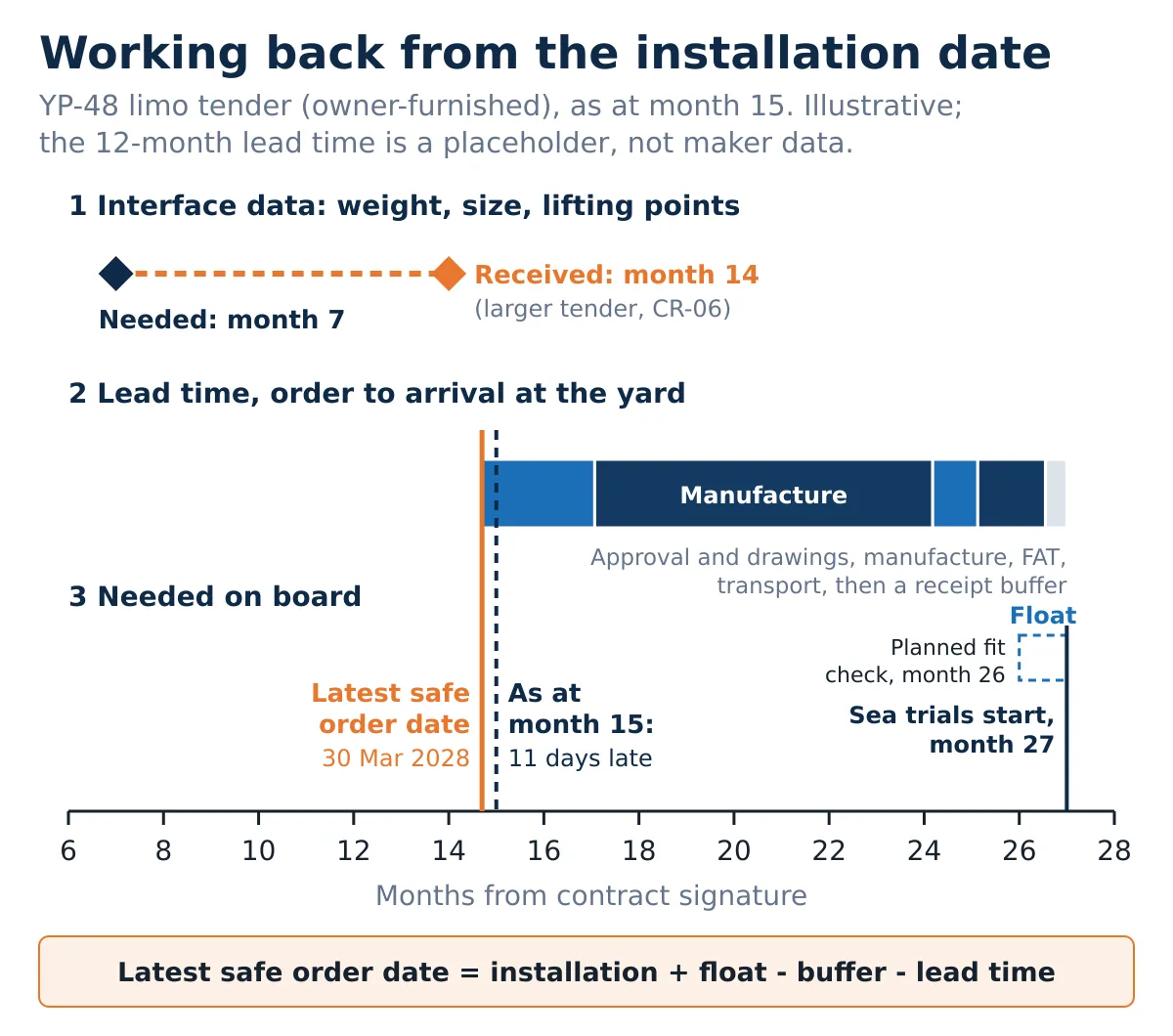
The formula in the template is:
latest safe order date = planned installation start + schedule float at installation − receipt buffer − lead time
Three definitions keep it honest:
- Planned installation start and float come from the master schedule: the early start of the task that needs the item, and that task's total float. Ordering on the latest safe order date uses all of the float, which is why it is the latest date, not the target.
- Lead time is the time from order to arrival at the Yard, taken from the maker's confirmed quotation or production slot. It includes the maker's drawings and approvals, manufacture, factory acceptance and transport.
- Receipt buffer covers unloading, receipt inspection and preservation. YP-48 uses 14 days for every line, as an illustrative figure.
Two things follow for a yacht in particular. Some orders cannot be placed until a decision is made: glazing and joinery wait for the design freeze, AV/IT waits for the interior specification. For those lines the latest safe order date is also a decision deadline for the Owner, and it should appear in the schedule as one. And for owner-furnished items the whole chain is the Owner's. The Yard's schedule may show the date the tender must arrive; nobody at the Yard will chase the tender builder.
The lead times behind the YP-48 figures are placeholders, as they were in the master schedule lesson. They were chosen to make the logic readable and are not taken from any maker. Replace each one with the maker's own confirmed figure.
The YP-48 procurement matrix
Here is the map for YP-48 at the end of month 15, one line per package. Months are counted from contract signature. The latest safe order date is rounded to the half month; the template carries exact dates.
| Package | Scope | Makers list entry | Latest safe order (month) | Ordered (month) | Status at month 15 |
|---|---|---|---|---|---|
| Propulsion package | Yard | Two approved makers | 2 | 1 | Installed |
| Generator sets | Yard | Two approved makers, or equal | 3 | 2 | Installing; maker warranty ends before the yacht warranty |
| Stabilizers (zero-speed) | Yard | One maker, at Owner's request | 3 | 2 | Installing; certificate missing, FAT open point |
| Glazing and exterior doors | Yard | Specialist named, or equal | 16 | 7 | On order (revised for VO-02) |
| Interior joinery package | Yard | Outfitter named | 9 | 7 | Behind plan, within float |
| Navigation package | Yard | Listed maker, or equal | 15 | 13 | On order (accepted equivalent) |
| AV/IT systems | Yard, allowance | Owner's specification | 15 | 14.7 | Ordered with 9 days of float left |
| Tender garage crane | Yard | Two approved makers | 16.5 | not yet | Capacity re-check for the larger tender |
| Limo tender | OFE | Owner's own contract | 14.5 | not yet | Order 11 days overdue |
| RIB tender | OFE | Owner's own contract | 20.5 | not yet | Not yet due |
| Loose furniture | Yard, allowance | Design Studio selections | 21.5 | not yet | Selections needed by month 20 |
| Water toys and dive equipment | OFE | Owner's purchase | 23.5 | not yet | Stowage sizes due month 20 |
| Art | OFE | Owner's collection | no order | n/a | Fixing data overdue since month 14 |
Illustrative. Makers are not named; lead times behind the dates are placeholders.
Read it the way the owner's representative would at the monthly review. Most lines are fine, and the table makes that visible quickly. Four lines need action, and three of them belong to the Owner.
The limo tender is the urgent one. It is needed for the tender launch and recovery tests in the sea trials, and on the placeholder lead time its latest safe order date passed eleven days ago. The order is waiting for the decision on CR-06. Every further day now pushes the tender's arrival past the start of sea trials, unless the tender builder can shorten its lead time. Under a clause like the commercial one above, that would also give the Yard an argument for extra time. The decision on CR-06 and the tender order belong in the next weekly report as a decision required, with its date.
The art line has no order date at all, because the pieces already exist, but it has an interface date that has passed. The joinery around the pieces needs their fixing points and weights, and joinery is in production. That is a request to the Owner's art adviser this week, not in month 29.
AV/IT was ordered with nine days of float left, the price of the specification waiting for the Owner, as the weekly owner report at month 14 predicted. It is on order and not late, but it is now a line to watch every week.
The stabilizer certificate and the software open point are the Yard's to close, and the owner's representative's job is to make sure they are closed before the installation is offered to class, not at delivery.
Warranty: when does the maker's clock start?
YP-48 has a 12-month warranty from delivery. Industry guides quote 12 to 24 months for yachts and describe defects in third-party equipment such as engines, generators and electronics as being handled under the makers' own warranties, with the yard coordinating. The contract pillar lists owner-furnished equipment among the usual exclusions from the builder's guarantee: the buyer pursues its own supplier.
The practical problem is the start date. Makers' warranties often run from shipment, installation or commissioning, not from the yacht's delivery. One HVAC equipment maker's published warranty policy, for example, covers 12 months from start-up but no later than 18 months from shipment, whichever comes first. Equipment that reaches a yacht yard at month 12 of a 30-month build can use up most of such a warranty before the Owner ever takes the yacht to sea.
For yard-scope items this is the Yard's problem under the contract: the Yard warrants the yacht to the Owner, whatever its makers give it. The owner's side should still ask how the Yard covers the gap, because a yard that cannot recover a repair cost from its maker will argue harder about whether a defect is covered. On YP-48 the Yard negotiated the propulsion warranty to start at yacht delivery. The generator sets are on the maker's standard terms, and the matrix shows the maker's cover ending almost a year before the yacht warranty does.
For owner-furnished items there is no Yard behind the maker. The Owner's supplier contract has to carry the warranty terms, including a start date that makes sense for an item that will sit at a yard for months, and the Yard's warranty covers only its installation, if the contract says so. The contract review lesson had the question to put to the Yard; the procurement matrix records the answer, line by line, with the start and end dates.
When owner-furnished is worth it, and when it is not
OFE carries two risks the Owner does not carry for yard scope: delay and warranty. On the delay side, a late owner item can extend the delivery date, and the Yard may be entitled to deliver without it. On the warranty side, the Owner has a separate supplier to pursue for every item it bought itself.
Against those risks, the reasons to furnish an item are specific: the Owner already owns it (art), the item is personal and chosen late (water toys), the Owner wants a direct relationship with a specialist builder (tenders), or the Owner can genuinely buy better than the Yard. Before leaving an item as OFE, the owner's side should be able to answer yes to four questions:
- Is it off the critical path, with its interface data date and delivery date in the master schedule?
- Can the supplier give complete interface data by the date the Yard needs it?
- Does it need class or flag certificates, and can the supplier provide them?
- Does the supplier's warranty start late enough, and reach far enough, to cover the yacht's first year?
An item that fails on two of these is usually better moved into yard scope, either as a named maker on the makers list or as an allowance, through a variation. On YP-48 that question will come up for the limo tender if CR-06 is not decided this month.
Running the matrix
The RACI in the second lesson makes the owner's representative, with the build captain, responsible for owner-furnished equipment supply, so the representative owns the matrix. The Yard's procurement team supplies its lines: order dates, factory acceptance dates, forecast deliveries, certificates. A few habits keep it useful:
- Update it monthly, and weekly for any line with less than 30 days of order float or delivery margin.
- Take planned installation dates and float from the current master schedule, not from the baseline, and refresh them after every schedule update.
- Carry every "or equal" acceptance and every scope move between routes to the change log with its number.
- Put the overdue and nearly due lines, and whose action they need, in the weekly owner report. Owner-furnished lines go under decisions required.
- Record warranty start and end dates when the item arrives, not when the first claim does.
A short review list for the matrix itself, whether you built it or the Yard did:
- Every item in the specification, every allowance and every owner item has one line and one scope owner.
- Every makers list entry says whether "or equal" is allowed, and who approves a substitute.
- Every line has an interface data date, and owner-furnished lines have one agreed with the Yard in writing.
- Every latest safe order date is derived from the current schedule, and every lead time has a source.
- Every delivered item has its certificate status and its warranty dates.
Download the template
Yacht Procurement Matrix and Long-Lead Tracker (T13), xlsx. One line per package or item, with scope owner (Yard, Yard allowance, Owner OFE), makers list entry and "or equal", supplier, certificate requirement, who warrants the item, interface data dates, planned installation and float from the schedule, lead time and receipt buffer, order, factory acceptance, delivery, certificate status, installation and the maker's warranty. Formulas give the latest safe order date, order float in days, delivery margin, maker warranty end and its cover against the yacht warranty, an interface flag and a status for each line, and counters for overdue orders, orders due soon, late interface data, missing certificates, FAT open points and warranty gaps. It has a Blank sheet and an Example sheet with the 13 YP-48 lines above, as at month 15.
The schedule dates come from the YP-48 master schedule; you can build your own in the Yacht Master Schedule Template (Excel), or for a commercial newbuild in the Newbuild Master Schedule Template (Gantt). Everything in the example is illustrative. Replace every lead time with a maker's confirmed figure, and every certificate requirement with what class and the flag confirm for your yacht.