
Ship lifecycle management from design to recycling: the five-year survey cycle, drydocking, retrofits and the Hong Kong Convention and EU recycling rules.
A newbuild project ends at delivery. The ship's life does not. For the ships they cover, the IMO's goal-based construction standards assume a design life of at least 25 years, and at the other end the vessel will be dismantled at a recycling facility that, since June 2025, may need authorisation under an international convention. Ship lifecycle management is the work of running a vessel as an asset across that whole span: keeping it in class and certificated, maintaining it, upgrading it when rules or trades change, and planning how it leaves the fleet.
This guide follows the ship stage by stage and gives most of its space to the part that build-focused material leaves out: the survey cycle, drydocking, retrofits and recycling. The build itself is covered elsewhere on the site. Our lesson on the shipbuilding project lifecycle walks through the seven phases from concept to delivery, and the ship project management guide covers the roles, key dates and controls of the build. How a yard plans several hulls at once is the subject of our shipyard planning article.
What "ship lifecycle management" means
The phrase turns up with three different meanings, and search results mix them.
The asset view. The owner's or ship manager's view of one ship, or a fleet, from design to recycling. It is about certificates, surveys, maintenance, upgrades, operating cost and the exit decision. This is the subject of this article.
The project view. Some writers use "lifecycle" for the stages of the newbuild project alone, which end with delivery and the guarantee period. That is the scope of our lifecycle lesson linked above.
The software view. Shipbuilding "product lifecycle management" (PLM) is a class of software for managing design, engineering and configuration data. Vendors describe it as a data backbone that can run from the first enquiry to decommissioning. Whatever tool is used, the underlying problem is real: information created during design and construction is needed decades later, often by an owner who was not involved in the build.
The main difference from a build project is the shape of the calendar. A build has a contract, a critical path and a delivery date. A ship in service has a repeating cycle of survey windows and certificate expiry dates, regulatory deadlines that arrive from outside, and an end date that the owner chooses.
The lifecycle at a glance
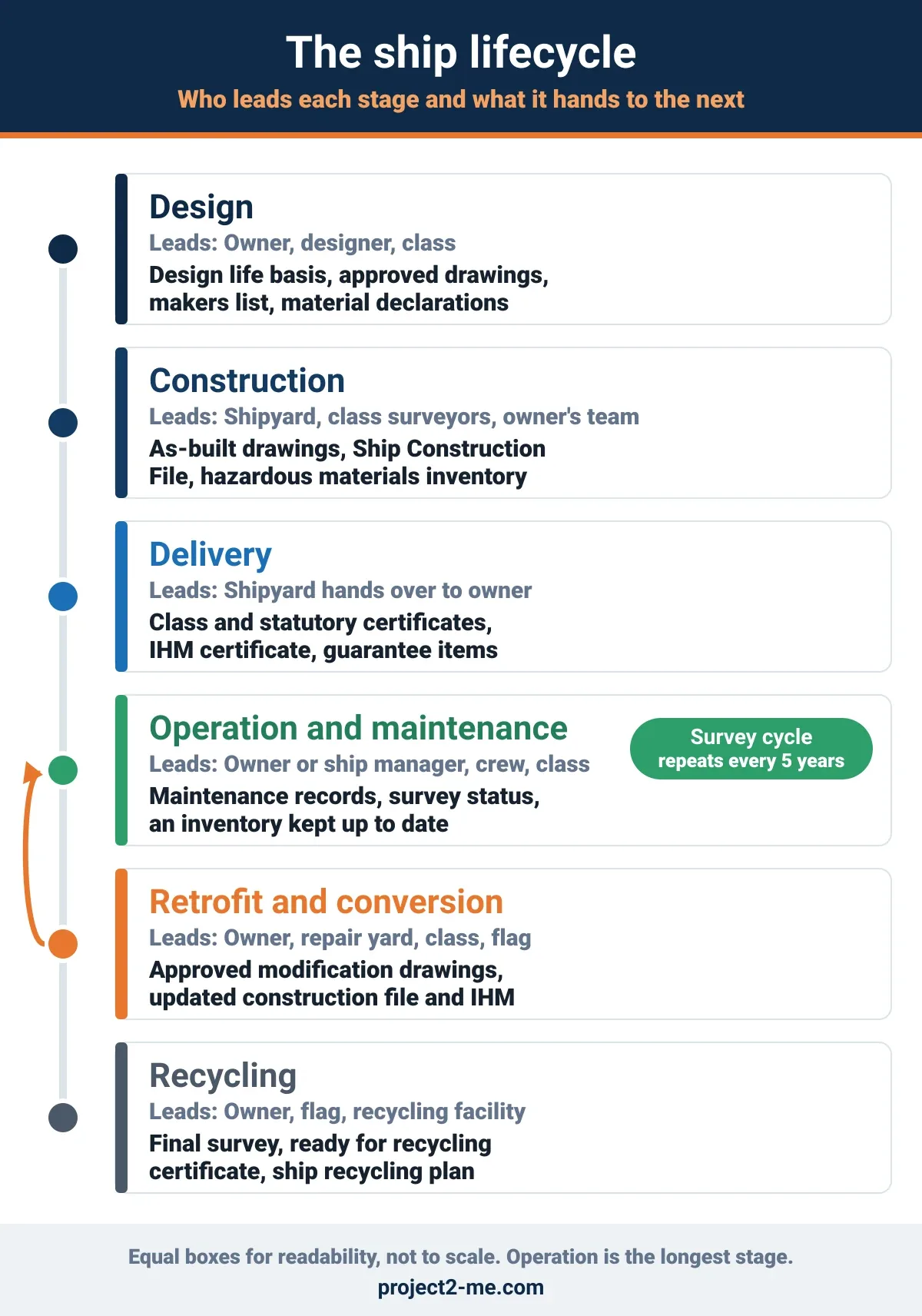
| Stage | Who leads | What sets the timing | What it must hand on |
|---|---|---|---|
| Design | Owner, designer, classification society | Owner's business case; the contract date fixes the class rule edition | Design life basis, approved drawings, makers list, suppliers' material declarations |
| Construction | Shipyard, class surveyors, owner's site team | Contract schedule and the class survey plan | As-built drawings, Ship Construction File, hazardous materials inventory |
| Delivery | Shipyard to owner | Protocol of delivery and acceptance | Class and statutory certificates, inventory certificate, guarantee items |
| Operation and maintenance | Owner or ship manager, crew, class | Survey windows, certificate expiry dates, charter commitments | Maintenance records, survey status, an inventory kept up to date |
| Retrofit and conversion | Owner, repair yard, class, flag | Regulatory deadlines and docking slots | Approved modification drawings, updated construction file and inventory |
| Recycling | Owner, flag administration, recycling facility | The owner's decision; certificate validity | Final survey, ready for recycling certificate, ship recycling plan |
Design: where much of the life is fixed
The IMO goal-based standards for bulk carriers and oil tankers (made mandatory through SOLAS regulation II-1/3-10 for ships of 150 m and above contracted from 1 July 2016) read like a lifecycle brief. They require ships to be designed for a specified design life, not less than 25 years, so that they stay safe when properly operated and maintained. The same standard notes that the actual service life may be longer or shorter, depending on how the ship is operated and maintained. It also asks for designs that make survey and maintenance easy, avoid spaces too confined to inspect, give access for close-up inspection and thickness measurement, and use materials that can be recycled in an environmentally acceptable way. Operation and recycling are written into the design requirements.
Coatings show how a design choice becomes a running cost. The IMO performance standard for protective coatings in dedicated seawater ballast tanks targets a useful coating life of 15 years in "good" condition, and requires a Coating Technical File that stays on board and is maintained for the life of the ship. The link to the survey calendar is direct: under the IACS hull survey requirement (UR Z7), ballast tanks found with poor coating, or with only soft or semi-hard coating, are examined internally every year unless the coating is renewed (for double bottom tanks this is at the surveyor's discretion).
Hazardous materials start at the design stage too. The IMO guidelines for the Inventory of Hazardous Materials (IHM) say that Part I of the inventory for a new ship should be developed during design and construction, based on Material Declarations from suppliers in the shipbuilding supply chain. That puts a requirement into every equipment purchase order, which is one more reason to manage makers closely (see our article on procurement and supply chain for major ship equipment).
Finally, the dates of the build decide which rules the ship carries for life. The contract date fixes the class rule edition and keel laying fixes most IMO construction requirements, as explained in our article on regulatory trigger dates. Later rules reach the ship only where they apply to existing ships, and those are the ones that turn into retrofits.
Construction and delivery: handing over the information
The management of the build is covered in the ship project management guide and the lifecycle lesson. From a lifecycle point of view, what matters is what the yard hands over, because the owner will depend on it for the next few decades.
- Ship Construction File (SCF). The IACS requirement for hull surveys of new construction (UR Z23) has the shipbuilder deliver documents for the SCF, including as-built structural drawings, which stays on board to support later survey, repair and maintenance. For ships under the goal-based standards, SOLAS II-1/3-10 also requires the SCF to be provided at delivery, kept on board and/or ashore, and updated as appropriate throughout the ship's service.
- Inventory of Hazardous Materials. Since the Hong Kong Convention entered into force on 26 June 2025, new ships flying the flag of a Party need an International Certificate on Inventory of Hazardous Materials.
- Certificates and the survey anchor date. The class certificate and the statutory certificates are issued at delivery. Class annual surveys are then timed from the anniversary of the initial classification survey, so delivery also starts the survey clock.
- Guarantee items. Defects found during the guarantee period are claimed against the yard under the contract. Our article on sea trials and delivery covers the punch list and handover.
The handover is only useful if the owner can find the documents later. A drawing list, a document register and a clear rule on which revision is current are the basics; our article on document control and technical data packages sets out how yards and owners organise them.
Operation and maintenance: the longest stage
Once in service, the ship is run either by the owner's own technical department or by a third-party ship manager under a management agreement. BIMCO's standard form for this is SHIPMAN, now in its 2024 edition, which can cover crew, technical and commercial management and insurance arrangements. Whoever holds the role, the obligations are the same.
The ISM Code sets the baseline for maintenance. Clause 10 requires the company to have procedures that keep the ship maintained in line with the rules and regulations and any additional company requirements, with inspections at appropriate intervals, non-conformities reported with their possible cause, corrective action taken and records kept. It also requires the company to identify equipment and technical systems whose sudden failure could create a hazardous situation, and to take specific measures for their reliability, including regular testing of standby equipment and of systems that are not in continuous use. In practice this is run through a planned maintenance system, where every job has an interval, a responsible person and a record.
Two other things keep running in the background throughout operation:
- The hazardous materials inventory. The IMO guidelines ask the shipowner to designate a person responsible for keeping the inventory up to date, to update it whenever something new is installed, and to provide the related documents for survey or sale. An additional survey can be requested after a change, replacement or significant repair.
- Operational carbon intensity. Since 1 January 2023, ships of 5,000 GT and above receive an annual Carbon Intensity Indicator (CII) rating from A to E. A ship rated D for three consecutive years, or E in a single year, must submit a corrective action plan. Operating data can therefore start a retrofit discussion years before any physical work.
The survey cycle that sets the calendar
Two parallel systems decide when a ship must be surveyed. The classification society keeps the ship in class. The flag administration, often acting through a recognised organisation that is in practice a classification society, issues the statutory certificates under the IMO conventions. For cargo ships, both are built around a five-year cycle.
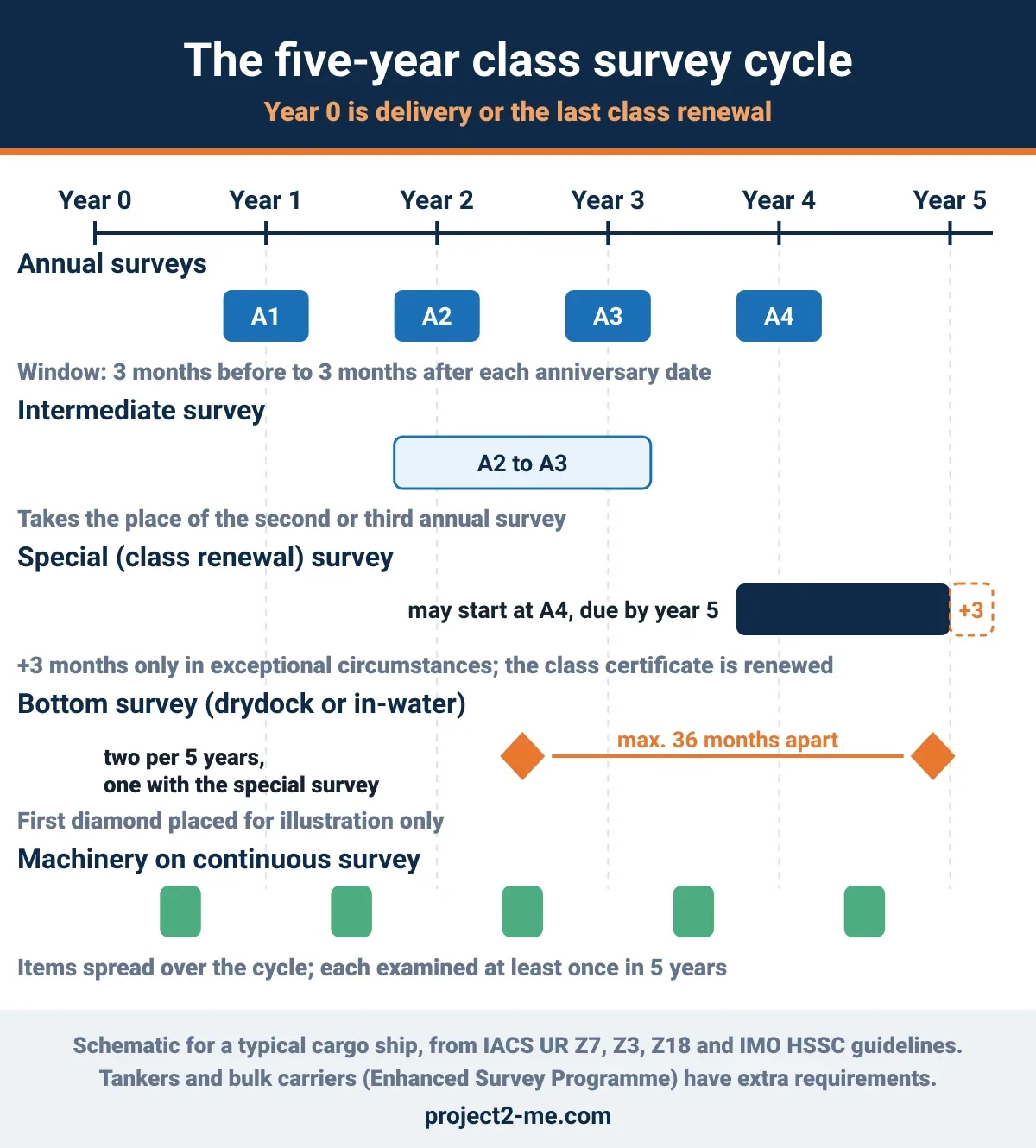
Class surveys of the hull follow IACS Unified Requirement Z7:
- Annual surveys are held within three months before or after each anniversary date.
- The intermediate survey is carried out at or between the second and third annual surveys.
- The special survey, also called the class renewal survey, is carried out every five years to renew the class certificate. It may be started at the fourth annual survey and progressed to completion by the fifth anniversary. A three-month extension beyond the fifth year can be granted only in exceptional circumstances, and a survey planning meeting is held before it starts.
The work grows with age. For the first special survey, Z7 calls for thickness measurements of suspect areas only. From the fourth special survey onward, the minimum list includes, among other items, the full length of the exposed main deck plating and of all keel plates, all hatch covers and coamings, and three transverse sections in way of cargo spaces. At intermediate surveys, ships between 5 and 10 years old get a general internal examination of representative ballast tanks, and ships over 10 years old of all ballast spaces. A survey plan that treats every renewal as the same job underestimates the later ones.
Bottom surveys follow UR Z3. There must be at least two examinations of the outside of the bottom in each five-year period, one of them together with the special survey, and never more than 36 months between two of them. They are normally done in drydock. An in-water survey can be accepted instead for some ships, but ships under the Enhanced Survey Programme (bulk carriers and tankers) aged 15 years and over must be examined in drydock.
Machinery can be surveyed on a continuous basis under UR Z18, with items spread across the cycle so that the interval between consecutive examinations of each item does not exceed five years.
Statutory surveys follow the IMO's Harmonized System of Survey and Certification. Its 2025 survey guidelines (resolution A.1207(34)) set a maximum validity of five years for cargo ship certificates, a six-month window around each anniversary date for annual, intermediate and periodical surveys, a 12-month validity for the Passenger Ship Safety Certificate, and at least two inspections of the outside of the bottom in each five-year period with no more than 36 months between them.
For lifecycle planning, the result is a fixed set of windows that every other plan has to fit around. Our lesson on managing classification and regulatory milestones looks at the build-phase side of the same relationship with class, and the quality assurance and classification society surveys article explains how class surveyors work.
Drydocking: the project that keeps coming back
The bottom survey rule turns into a docking plan. For a typical cargo ship it means two dockings in every five years, unless an in-water survey is accepted for one of them, and one of the two is tied to the special survey. That is the docking where survey work, steel renewal, coating, overhauls and any retrofit compete for the same days in dock.
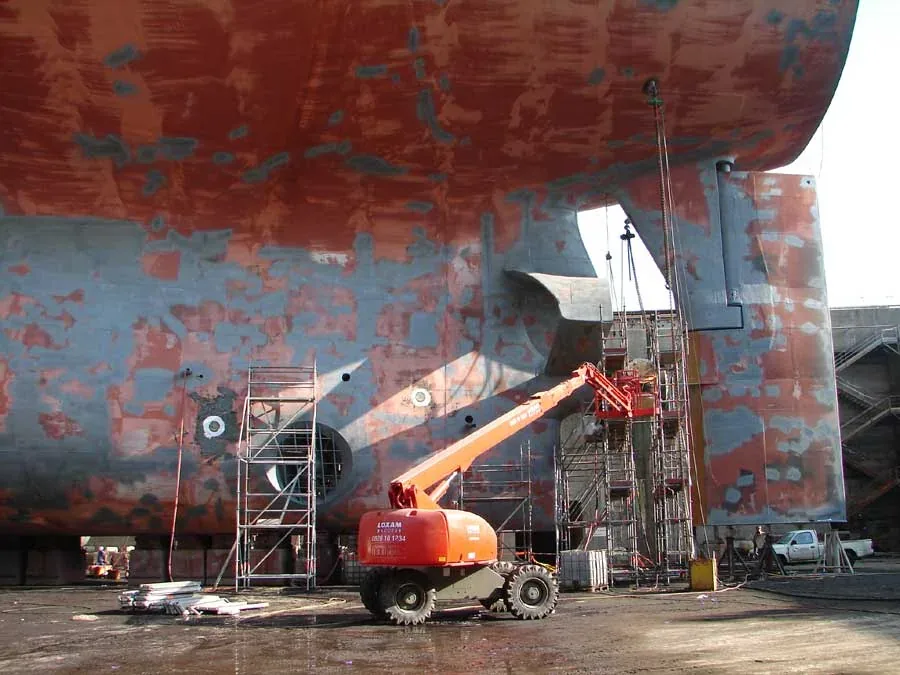
Each docking is a short project of its own, with a repair specification, a yard tender, a contract and a docking schedule. Our article on planning a ship repair drydocking works through that sequence, including how the critical path moves when steel renewal found at survey grows. The drydock and berth planning basics lesson shows the same constraint from the yard's side, and the ship repair agreement template gives a starting point for the contract.
The lifecycle view adds one thing the single docking cannot see: what is coming in the next one. If a regulatory deadline, a major overhaul or a coating renewal falls within the next survey period, a docking that is already planned is often the cheapest place for it. A rolling plan per ship, at least one full survey cycle ahead, is what makes that visible.
Retrofit, modernisation and conversion
Retrofits come from three directions: new rules for existing ships, commercial needs such as a new trade or a charterer's requirement, and the wish to extend a ship's life. Three recent IMO requirements for existing ships show how regulation drives the work:
- Ballast water. The Ballast Water Management Convention entered into force on 8 September 2017. Existing ships had to meet the D-2 discharge standard by their International Oil Pollution Prevention Certificate renewal survey, and no later than 8 September 2024 for ships without such a survey date, which in practice meant fitting an approved treatment system.
- Sulphur. Since 1 January 2020 the global limit for sulphur in fuel oil has been 0.50%. Exhaust gas cleaning systems (scrubbers) are accepted as an equivalent method, so some owners retrofitted scrubbers rather than switching fuel.
- Energy efficiency. Since 1 January 2023, ships of 400 GT and above must meet the Energy Efficiency Existing Ship Index (EEXI). The IMO has issued guidelines on shaft or engine power limitation as one way of meeting it.
The rules for the work itself are set in SOLAS. Ships under repair, alteration or modification must continue to meet at least the requirements that applied to them before. Repairs, alterations and modifications "of a major character" must meet the requirements for ships constructed on or after the date of the relevant amendments, "in so far as the Administration deems reasonable and practicable". The IMO's interpretation lists examples: lengthening a ship by adding a new midbody, changing ship type such as converting a tanker to a bulk carrier, and converting a single-hull tanker to double hull. Whether a given job counts as major is decided by the flag administration, so ask early.
Managed well, a retrofit runs like a small newbuild project:
- Define the scope and the performance the owner needs, and check what the rules require of the modified ship.
- Get the engineering done and the drawings approved by class before the ship arrives.
- Order long-lead equipment against the docking date, since a late treatment system or scrubber means a second docking.
- Plan the work inside the docking schedule, with interfaces to survey and repair items.
- Close out the paperwork: class approval of the modification, an updated Ship Construction File where one is required, and an additional survey to update the hazardous materials inventory.
The tools are the ones used on a newbuild at a smaller scale: CPM scheduling, a cost estimate built the same way as for a newbuild budget, and a risk register such as our shipyard risk register template. Changes after the contract are handled like variation orders on a newbuild.
End of life: recycling under the Hong Kong Convention and the EU rules
The decision to sell a ship for recycling is commercial, but the survey calendar shapes it. A ship approaching its special survey faces a known docking, a growing thickness measurement programme and possible steel renewal, all of which have to be weighed against its remaining earning power.
The Hong Kong Convention
The Hong Kong International Convention for the Safe and Environmentally Sound Recycling of Ships was adopted in 2009 and entered into force on 26 June 2025. It applies to ships flying the flag of a Party, except ships under 500 GT, warships, naval auxiliaries and other government ships on non-commercial service, and ships that operate only in the Party's own waters throughout their lives. Its main requirements for shipowners:
- An inventory for every ship. The IHM has three parts: Part I covers hazardous materials in the ship's structure and equipment, Part II covers operationally generated waste and Part III covers stores. Parts II and III are prepared before the ship is recycled.
- Certification during service. New ships have needed an International Certificate on Inventory of Hazardous Materials since 26 June 2025. Existing ships need one by 26 June 2030, or before going for recycling if that is earlier. The certificate is renewed at intervals set by the flag administration of no more than five years.
- A final survey before recycling. The final survey checks the full inventory, the ship recycling plan and the facility's authorisation, and leads to an International Ready for Recycling Certificate valid for no more than three months.
- Authorised facilities only. Ships flying the flag of a Party may be recycled only at facilities authorised under the Convention, which must hold a Document of Authorization to conduct Ship Recycling. The facility prepares a ship-specific recycling plan from the inventory the owner provides.
Ships flying the flag of a non-Party cannot be issued the Convention's certificates, but port States that are Parties are expected to check equivalent documentation, so that non-Party ships receive no more favourable treatment.
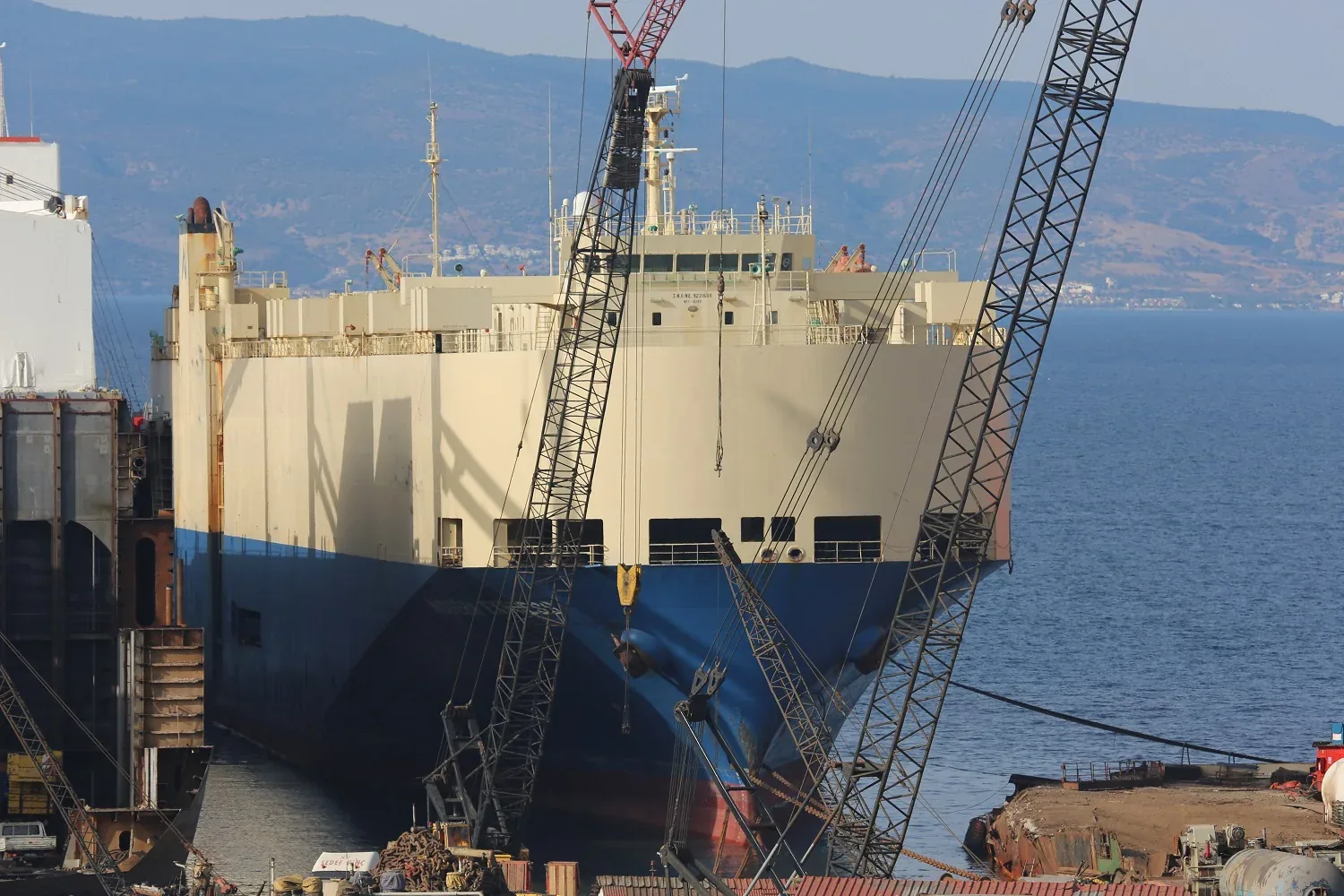
The EU Ship Recycling Regulation
The EU Ship Recycling Regulation (Regulation (EU) No 1257/2013) applies to ships flying the flag of an EU Member State, with the same kind of exclusions for small ships under 500 GT and government ships. One article reaches further: ships flying the flag of a third country must carry an inventory of hazardous materials when they call at a port or anchorage in the EU. The European Commission dates the full application to existing EU ships and to non-EU ships calling at EU ports from 31 December 2020.
For EU-flagged ships the regulation adds obligations beyond the inventory:
- They may only be recycled at facilities on the European List, which includes facilities both inside the EU and in third countries. Each listing is valid for no more than five years and can be renewed.
- Before recycling, the owner must notify the flag administration, with the inventory, of the intention to recycle at a named facility, keep cargo residues, remaining fuel and ship-generated waste to a minimum, and obtain a ready for recycling certificate after the recycling plan has been approved. Tankers must arrive with cargo tanks and pump rooms ready for certification as safe for hot work.
- The owner remains responsible for the ship until the facility accepts it, and the facility may decline the ship if its condition does not substantially match the inventory certificate, for example because Part I was not kept up to date.
That last point ties the end of the lifecycle back to the middle. An inventory that was not maintained through decades of repairs and retrofits can hold up the final sale at the last step.
Who carries the lifecycle
| Party | Design and build | Operation | Retrofit | End of life |
|---|---|---|---|---|
| Owner | Defines the ship, signs the contract, accepts delivery | Holds the certificates, decides budgets and dockings | Decides scope and timing, pays | Decides to recycle, chooses the facility, obtains the certificates |
| Ship manager (if appointed) | May supervise the build for the owner | Runs technical management, crewing and maintenance under the agreement | Specifies and supervises the work | Supports the owner with documents and preparation, as the agreement provides |
| Classification society | Approves drawings, surveys the build | Annual, intermediate and special surveys | Approves modification drawings, surveys the work | Often surveys for the inventory and recycling certificates as recognised organisation |
| Flag administration | Statutory requirements and certificates | Statutory surveys, often delegated | Decides whether a modification is of a major character | Issues or authorises the recycling certificates |
| Shipbuilder | Builds the ship, compiles the construction file and inventory Part I | Handles guarantee claims | Sometimes carries out conversions | None |
| Repair yard | None | Docking and repairs | Carries out most retrofits | None |
| Makers and suppliers | Supply equipment and material declarations | Service, spares, overhauls | Supply retrofit equipment | Material declarations support the inventory |
| Recycling facility | None | None | None | Prepares the ship recycling plan and dismantles the ship |
Records that should outlive every owner
A ship can change owner, manager and flag several times. Its records need to survive each change, because the next survey, the next retrofit and the final recycling all depend on them. The IMO's inventory guidelines put it plainly for hazardous materials information: it belongs to the ship, and continuity should be kept when the flag, owner or operator changes. The same logic applies to:
- the Ship Construction File and as-built drawings, plus approved drawings for every later modification;
- the Coating Technical File;
- the hazardous materials inventory and its certificate;
- class and statutory survey reports and the current survey status;
- the planned maintenance history and records of critical equipment;
- makers' manuals and the spare parts list as delivered and as modified.
The inventory guidelines already expect the owner to hand over the inventory documents when the ship is sold. Treating the rest of the list the same way saves the next owner from rebuilding it.
Planning tools for a ship's whole life
A lifecycle plan does not look like a newbuild schedule. It has few logic links and many fixed windows. In a scheduling tool such as MS Project, the survey windows become milestones with earliest and latest dates, dockings become summary tasks, regulatory deadlines become constraints, and major overhauls are placed by running hours or calendar intervals. Our article on getting started with MS Project for shipbuilding schedules covers the views and baselines that also work for this kind of plan.
Regulatory change is the input that most often moves the plan. Keeping a register of rules adopted but not yet in force, with the date each one applies to the ship, works in service just as it does during the build; our newbuild regulatory change register template can be adapted for an existing ship by tracking the existing-ship deadlines instead of construction dates.
Digital twins and model-based tools are extending the 3D model from production into maintenance planning, as noted in our article on lean and digital tools in the shipyard. They do not change the regulatory calendar. They make it easier to know the ship's condition when the next window arrives.
Frequently asked questions
What is ship lifecycle management?
It is the management of a ship as an asset from design to recycling: specifying it for a long life, taking over the right information at delivery, keeping it in class and certificated through the survey cycle, maintaining and upgrading it, and planning its sale or recycling. The newbuild project is the first part of that life.
How long does a ship last?
The IMO goal-based standards require a specified design life of at least 25 years for the bulk carriers and oil tankers they cover. The same standards state that the actual service life may be longer or shorter, depending on operating conditions and maintenance. In practice the end date is a commercial decision, made against the cost of keeping the ship in class.
What is the difference between ship lifecycle management and ship management?
Ship management usually means the day-to-day technical, crewing and sometimes commercial management of a ship in service, often by a third-party manager under an agreement such as BIMCO's SHIPMAN. Lifecycle management is wider. It covers the same operating years but also the design decisions before them and the recycling after them.
What is a special survey?
It is the class survey that renews the class certificate every five years, also called the class renewal survey. Under IACS UR Z7 it may start at the fourth annual survey and must be completed by the fifth anniversary, with a three-month extension only in exceptional circumstances. Its scope, especially the thickness measurements, grows as the ship ages.
Does a retrofit make a ship count as new under the rules?
Not automatically. Under SOLAS, repairs and modifications must keep at least the standard the ship already met. Only work "of a major character", such as adding a midbody or changing ship type, has to meet the newer requirements, and then as far as the flag administration finds reasonable and practicable.
What does the Hong Kong Convention require from shipowners?
For ships of 500 GT and above flying the flag of a Party: an Inventory of Hazardous Materials verified and certified (for new ships since 26 June 2025, for existing ships by 26 June 2030 or before recycling), renewal surveys of the inventory at intervals of no more than five years, and before recycling a final survey, an International Ready for Recycling Certificate and recycling only at an authorised facility.
What is ship product lifecycle management (PLM)?
PLM is software that manages a ship's design and configuration data, such as models, drawings, bills of materials and changes, in one place. In shipbuilding it starts in design and engineering, and vendors extend it into operation and decommissioning. It supports lifecycle management but does not replace the survey, maintenance and certification work described above.
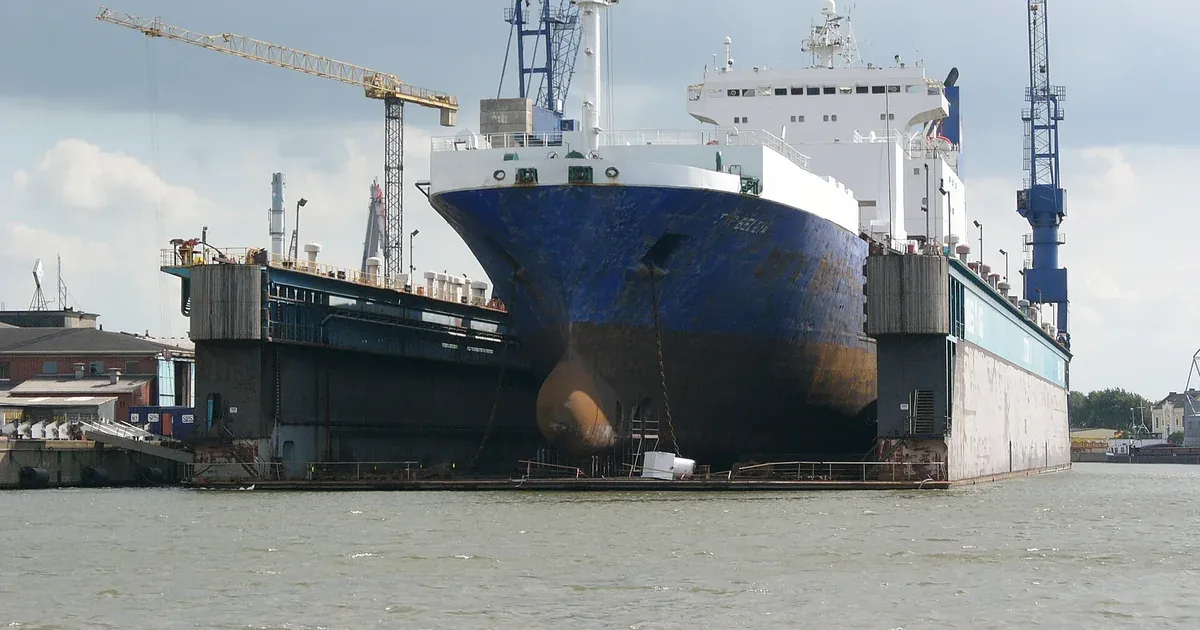
Cover photo: a cargo ship in a floating dock at Bremerhaven, Germany, in 2008. Photo: Hannes Grobe, via Wikimedia Commons, licensed CC BY 3.0.