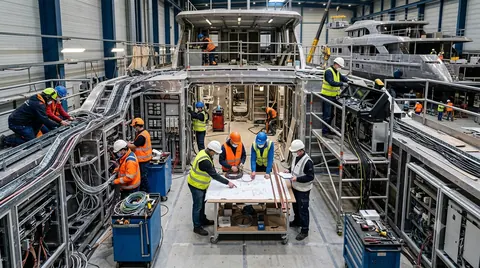

Shipyard planning explained: the four levels from yard load and dock slots to weekly work packages, and how they keep many ships on schedule at once.
A project manager looks at one ship. A shipyard planner looks at all of them. One hull may be on the building dock, another fitting out at the quay, the blocks of a third in the assembly halls and a fourth still at the tender stage, and all four want the same cranes, welders and dock floor. Shipyard planning fits those demands into one set of facilities without letting any ship miss its contract date.
This guide covers the planning levels yards use, what each decides, how they constrain each other, and what happens when one ship slips. The single-project side of the job (owner, yard and class, the key dates and the project controls) is covered in our guide to ship project management.
What "shipyard planning" means
The phrase is used for two quite different jobs.
Facility planning is about the yard itself: where the docks, halls, cranes and quays go, how big they are, and how a new or expanded site should be laid out for the ships it wants to build. Marine infrastructure consultancies sell it as "shipyard master planning". It is an engineering and investment exercise rather than a weekly routine.
Production planning is about the ships: which hull uses which dock and when, how much steel and how many man-hours the yard must process each week, and which crew works on which block next Monday. This is the everyday meaning inside a shipbuilding company, and it is the subject of this article.
What sets it apart from single-project planning is that the resources are shared. A dock, a gantry crane or a panel line serves every hull in the orderbook, so a decision on one ship is always partly a decision about the others.
Why yards plan in levels
No single schedule can show a multi-year orderbook and tomorrow's welding jobs at the same time. Yards therefore break planning into levels, each with its own horizon and level of detail, and each setting the limits for the level below.
The names differ from yard to yard, but the structure is consistent in the literature. A study of block assignment at a large Korean shipyard, published in the International Journal of Naval Architecture and Ocean Engineering, describes four steps: a production plan, a master production schedule, a midterm schedule and a short schedule. A TU Delft doctoral thesis on European yards building complex ships describes a similar cascade: a master plan, then an erection plan, then a section building plan, with outfitting handled through weekly coordination. A hierarchical framework reviewed in the Croatian journal Brodogradnja puts the same idea in one sentence: the planner at each layer sets limitations that lower layers must follow.
This guide uses four plain-English names for those levels.
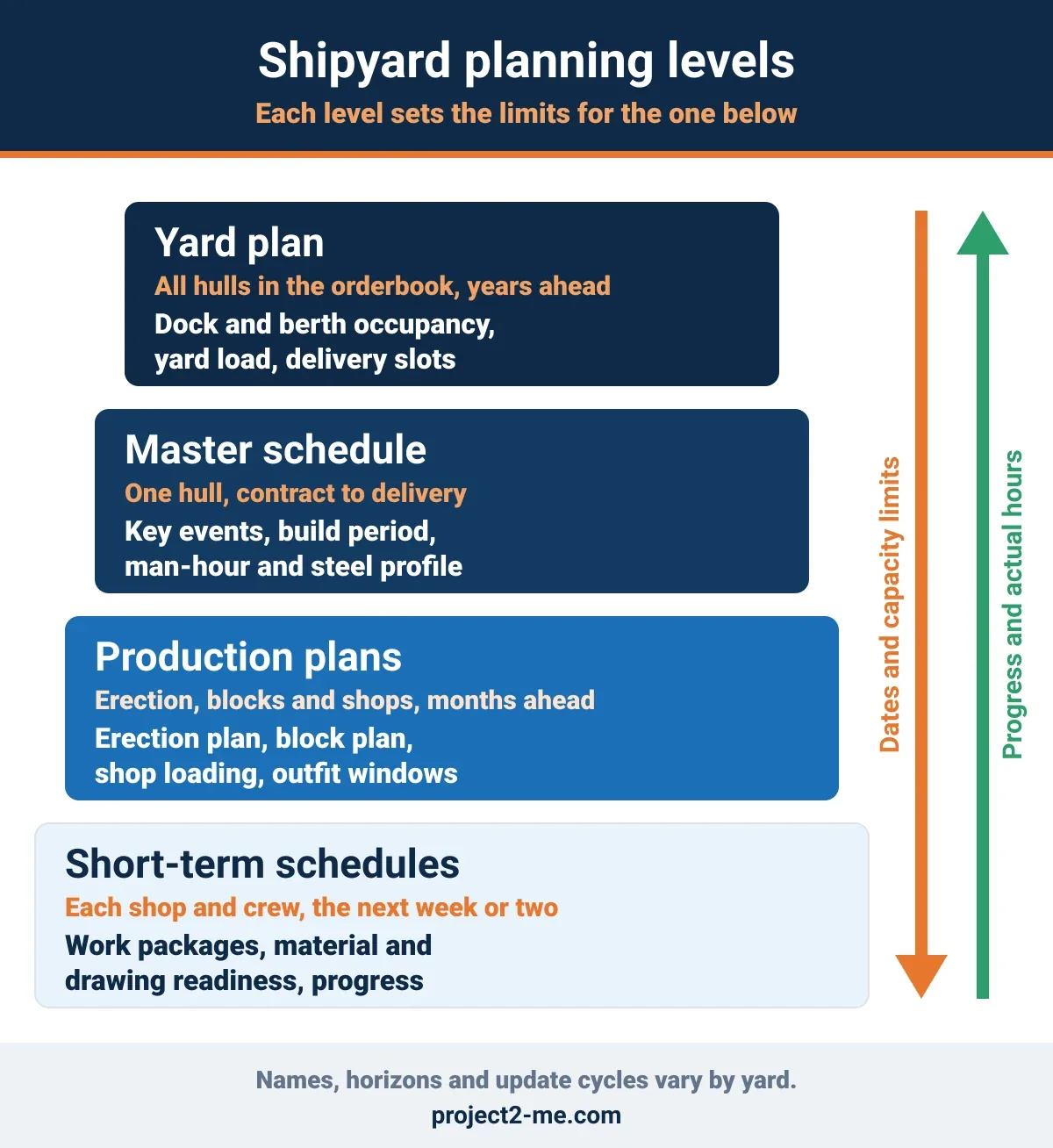
| Level | What it covers | Horizon | Usually owned by | Main outputs | Typical update |
|---|---|---|---|---|---|
| Yard plan | Every hull in the orderbook and every major facility | The orderbook, several years ahead | Central planning or production control, with sales and management | Dock and berth occupancy, yard load by trade and shop, free delivery slots | When orders are won, lost or re-dated, and at regular management reviews |
| Master schedule | One hull, from contract to delivery | The whole build | The project planner for that hull | Key events, build period, man-hour and steel profile over time | Baselined early, reforecast at project reviews |
| Production plans | Erection, block and section building, pre-outfitting, shop loading | The coming months | Production planning, by area and shop | Erection plan, block building plan, shop load plans, outfitting windows | Rolled forward as erection progresses |
| Short-term schedules | Each shop, crew and work station | The next week or two | Shop and area supervisors with production control | Work package lists, readiness checks, progress returns | Weekly |
Titles and horizons vary, and a small yard may run the top two levels in one spreadsheet. The direction of control does not change: dates and capacity limits flow down, progress and actual hours flow up.
The yard plan: orderbook, docks and load
The top level answers three questions. Can the yard build everything it has sold? Where are the gaps and overloads? And when could it deliver a new order?
Docks and berths come first
The dock (or slipway, or land-level erection area) is the resource the whole plan is built around. The Korean study is blunt about why: the dock is the least extendable resource in a shipyard, and overloading it is difficult to resolve. Halls can run extra shifts and blocks can be bought from subcontractors, but a yard cannot buy a second building dock for a few months. The TU Delft thesis makes the same point about European yards, where the slipway typically limits throughput and, unlike section building, cannot be outsourced.
At this level the planner decides which ship type goes into which dock, how long each hull occupies it, and the key events for each ship. The Korean study lists dock turnover, the ship-type mix for each dock and the feasibility of that mix among the main decisions of the production plan. The result is usually drawn as a dock and berth occupancy chart: one row per dock or quay, one bar per hull, with time running across. Double bookings and idle gaps show up immediately. Our free dock and berth occupancy planner is a 52-week Excel version of that chart, and the lesson on drydock and berth planning basics explains what the planner has to check before a ship goes into a dock or alongside a quay.
In yards that also repair ships, docking work competes for the same docks; our guide to planning a ship repair drydocking covers that side.
Load: steel, man-hours and work content
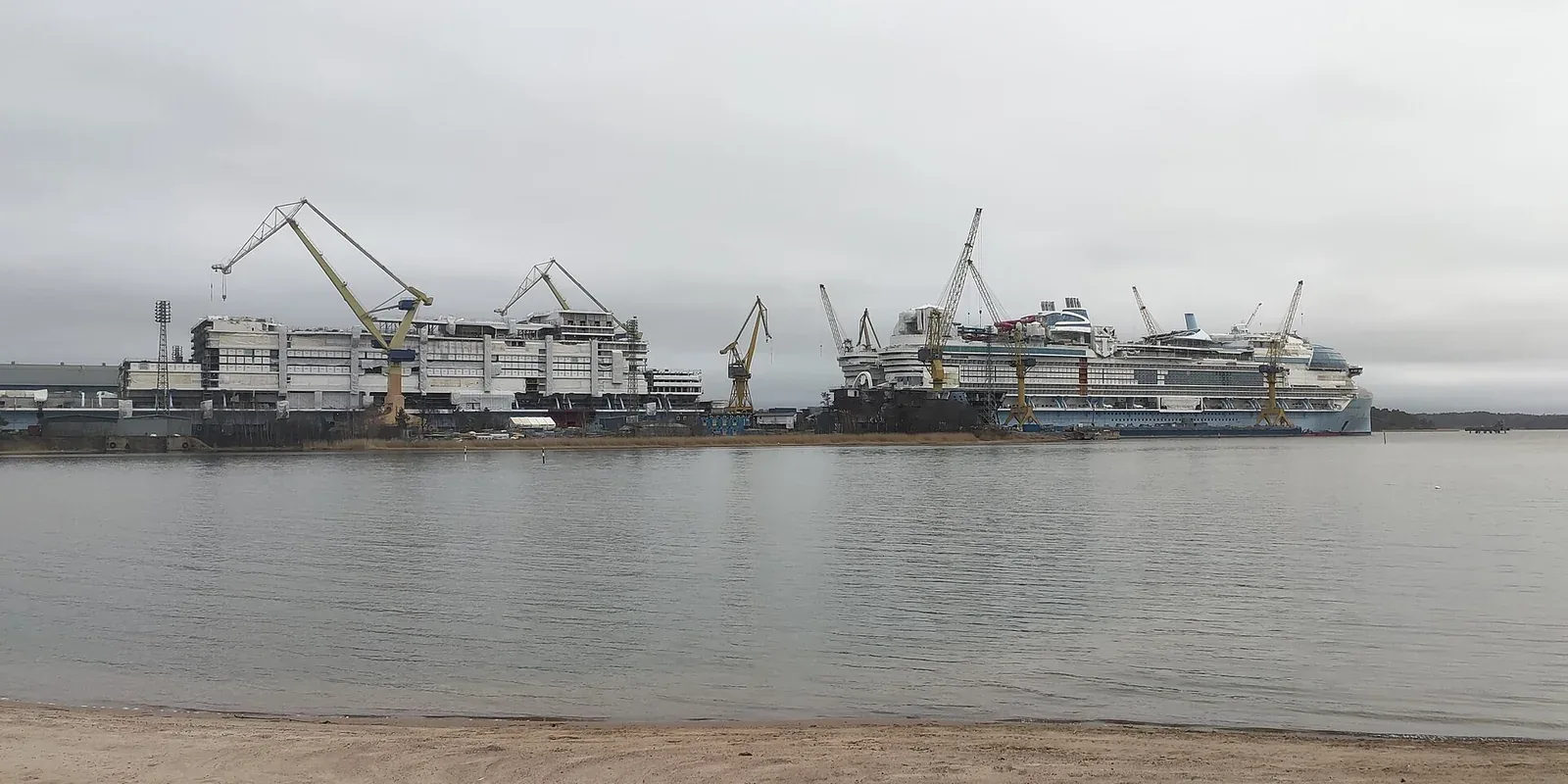
Behind the docks sit the steel shops (cutting, panel line, sub-assembly, block assembly, blasting and painting), the outfitting shops and the labour pool in each trade. The yard plan adds up the demand of every hull, week by week, and compares it with capacity.
Two units are common. Steel throughput is commonly tracked in tonnes processed per period, because steel shop work scales with weight and weld length. Labour is tracked in man-hours by trade. Each hull's man-hour estimate, spread over its build period, gives a curve; stacking the curves for all hulls gives the yard load profile, usually drawn as a histogram by trade or by shop. Our article on estimation and resource planning in shipbuilding shows where those estimates come from, and the lesson on how to estimate man-hours and load resources walks through spreading them over a schedule.
Across very different ship types, raw gross tonnage misleads, because ships of the same tonnage can contain very different amounts of work. The common yardstick is the OECD's compensated gross tonnage (CGT), which adjusts gross tonnage with factors set for each ship type. CGT suits comparisons between yards and long-range capacity statements; inside one yard, man-hours and steel tonnes by shop are more practical.
Offering a delivery date
Before a contract is signed, the yard needs a credible answer to "when can you deliver?" The planner looks for the first realistic dock slot, checks that the shops can absorb the extra load around it, and adds the build period for that ship type. The TU Delft thesis describes this first master plan as typically produced before contract signing, from the existing orders, the business forecast and historical production data, and showing how the new project interacts with the previous and following ones. A delivery date offered without this check is a sales promise, not a plan.
The master schedule for each hull
Once a ship is contracted, it gets its own master schedule, which must sit inside the slot the yard plan has reserved for it.
The master schedule carries the key events: contract, start of steel cutting, keel laying, launching (or float-out), first start of the main engines, sea trials and delivery. In the European practice described in the TU Delft thesis, these milestones are written into the contract and the owner's payments are tied to them, which is why the master schedule is watched closely by both sides. It also carries the profile of the work: how many man-hours and how many tonnes of steel the hull needs in each month, by trade. The Korean study lists exactly these items, the building period set against load and capacity and the distribution of hours by job type, among the decisions of the master production schedule.
That profile is the link back to the yard plan. Compress one hull's steelwork into fewer weeks and the yard's steel load rises in those weeks, so the next hull may have to start later.
For the structure of the schedule itself, see the lesson on critical path method scheduling for shipbuilding and our article on planning a new shipbuilding project from contract to keel laying. The newbuild master schedule template gives a one-sheet Gantt starting point with the main phases and milestones.
Series and sister ships
For a series of sister ships, the master schedules are planned together and staggered, so that each hull follows the one before it through the shops, the dock and the quay, and crews move from hull to hull. The second hull's schedule is then largely set by the first: if hull one leaves the dock late, hull two cannot enter on time.
Production plans: erection, blocks and shops
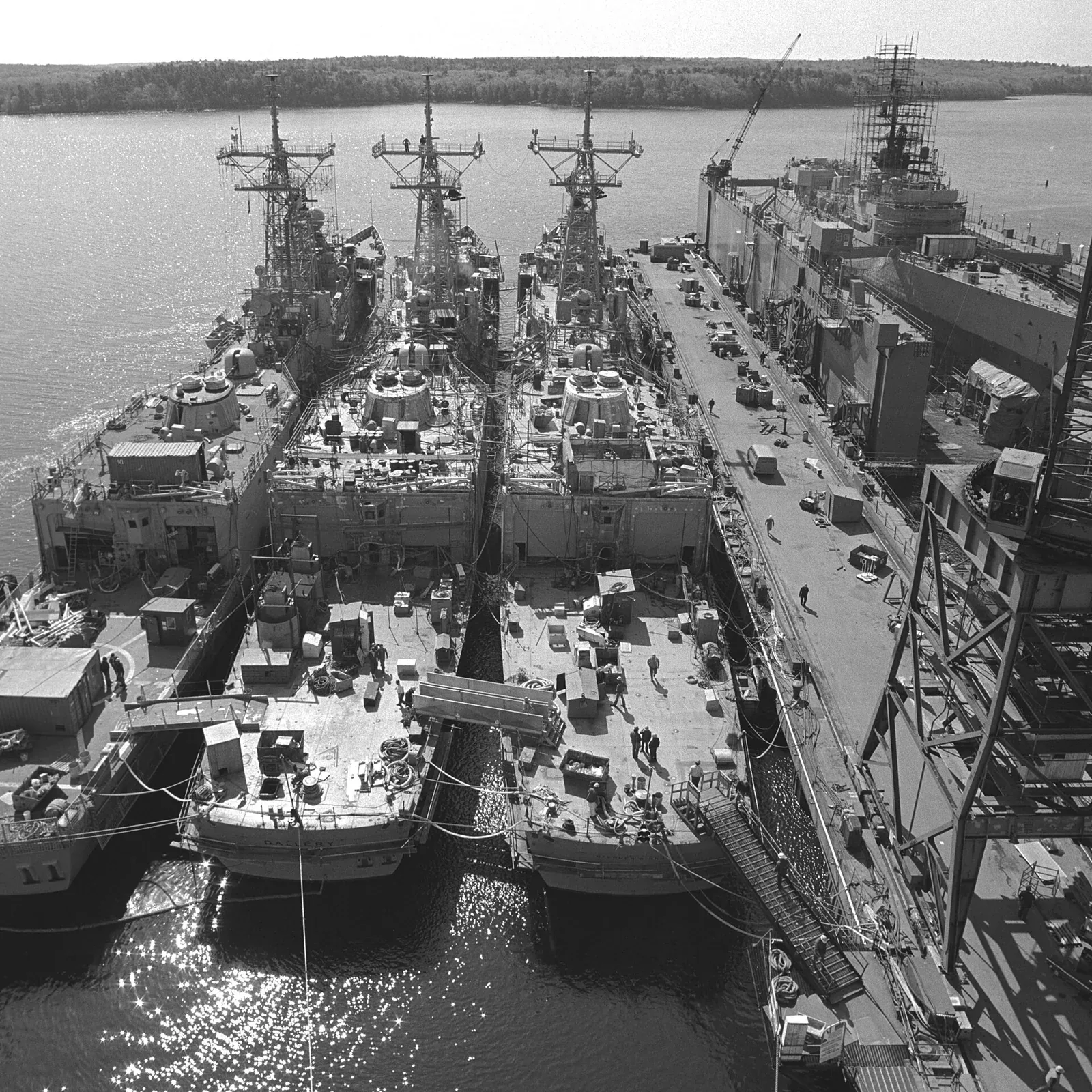
The middle level turns each master schedule into dates that production can act on. It works backwards from the dock.
The erection plan sets the pace
The erection plan fixes when each block or section is lifted into the dock or onto the slipway. According to the TU Delft thesis, its inputs are the production milestones (keel laying and launching), the ship's block division with the size and weight of each block, and the yard's characteristics: dock or slipway capacity, gantry crane capability and the erection crew available. The yard avoids delaying the erection plan whenever possible, because a late erection pushes back the launch and, with it, the next project waiting for the dock.
The sequencing logic itself is covered in the lesson on block construction and erection sequencing, and the block erection sequence plan is a worked two-page example with weights, dependencies and cranes.
Block building plans work backwards
From the erection date of each block, the planner counts back through block outfitting, painting, block assembly, sub-assembly, panel production and cutting to find when each step must start. The TU Delft thesis describes the section building plan as extrapolated backwards from the erection plan, so that every section is ready on time. It also notes the main limit at this stage: the floor area of the assembly halls caps how many sections can be built at once, and when demand exceeds that, whole sections are outsourced. Our article on building the hull block construction schedule follows a block through each of these stages.
Pre-outfitting windows are set here too. The thesis observes that yards often treat pre-outfitting crudely at this level, for example giving every section the same fixed allowance regardless of its outfitting content. The more outfitting a block can take before erection, the less work is left for the cramped, slower conditions on board, which is the argument of the lesson on pre-outfitting strategy. How the on-unit, on-block and on-board stages fit together, zone by zone, is explained in our article on ship outfitting and coordinating the trades.
Product-oriented work breakdown
Production plans only work if the work is broken down the way it is built: a ship designed by system has to be built by place and by stage. The product work breakdown structure (PWBS), documented by the US National Shipbuilding Research Program from practice at the Japanese shipbuilder IHI, does this. It groups work into interim products such as parts, sub-assemblies, blocks and outfit units, and classifies them by zone and stage, so that hull construction, outfitting and painting can be planned together.
The SNAME ship production literature names three integrated methods that follow from it: the hull block construction method, the zone outfitting method (with its on-unit, on-block and on-board stages) and the zone painting method. For the planner, every work package then belongs to a zone, a stage and a work station, which is what makes shop loading possible. The project WBS used for cost reporting can still be system-based; the lesson on building the newbuild WBS discusses how the two views coexist.
Shop loading and space
With the block dates set, each shop's load can be calculated: plates through cutting, panels through the panel line, blocks in each assembly bay. Where several halls can build the same block, the planner also decides which one builds it. The Korean study calls this block assignment, one of the most heavily loaded midterm planning tasks, still done by hand by experienced staff at the yard it studied. When the yard's own shops are full, blocks can be bought in.
Floor space is itself a resource. Research in the Journal of Ship Production describes a tool for reserving space in a yard's most valuable areas for large units across the erection period, because existing planning software made space hard to track.
When the load exceeds capacity, the options are the familiar ones: use float, re-sequence, add a shift, subcontract, or move a start date. When work is subcontracted, the scope, interfaces and delay pass-through should be written down; the Shipyard Subcontract Agreement Template is a Word starting draft. The lesson on resource leveling and crane and dock capacity planning works through those choices with an example.
Short-term schedules: the week on the shop floor
The lowest level is where plans become jobs. Each shop or area receives a list of work packages for the coming week or two, sized so that a crew can finish each one in a known number of shifts.
Before a package is released, the planner or supervisor checks that it can actually be done: drawings or model-based work instructions issued, material and equipment on hand, preceding work complete, access and crane time available. Releasing a package without them only moves the waiting from the office to the shop floor.
Materials are typically collected per work package and delivered to the work station as a set, and how that set is organised matters. A study of European outfitting cited in the TU Delft thesis observed two workers spending 35 minutes digging a single pipe spool out of the bottom of a pallet delivered to the work site, time that sorting the pallet in installation order would have saved. Our article on lean and digital tools in the modern shipyard covers takt-based flow and what a model-based work package should contain.
Progress goes back up from here. Completed packages and hours booked update the block dates, the erection forecast, the hull's earned value and finally the yard load. The TU Delft thesis notes that European yard planners issue weekly updates to absorb delays and last-minute changes, and that outfitting subcontractors and the yard meet weekly to agree the coming week's work. For how that progress turns into cost and schedule indicators, see our article on earned value management in shipbuilding and the free EVM tracker template.
How the levels push on each other
The levels are not a one-way cascade. Two links matter most in practice.
Engineering and procurement are scheduled from production need
Drawings and equipment have to arrive in the order production needs them, so their dates are worked back from the erection and block plans. An NSRP report from Newport News Shipbuilding describes a program built for exactly this, generating integrated schedules for drawing development and equipment ordering tied to the block erection schedule. Our article on procurement and supply chain for major ship equipment explains how latest order dates are set for long-lead items. When a drawing or a pump arrives late, the block it belongs to slips, and the slip travels upwards.
One ship's delay moves the next ship
Because the dock is shared, a delay on one hull is rarely contained. If hull A's launch moves by three weeks, hull B cannot start erection in that dock until A has left. B's blocks, built to the old dates, wait in storage, while the halls carry A's late work and B's on-time work at once. The TU Delft thesis describes the chain directly: delaying the erection plan implies that the following project will also be delayed, and delays in a previous project may force adjustments to the section building plan.
So the yard plan is re-run whenever a master schedule changes materially, and the planner decides where the delay is absorbed: in float, extra shifts, outsourced blocks, a later start for another hull or, as a last resort, a later delivery. Weighing one hull's delay exposure against another's is a yard-level decision that no single project schedule can make.
What planners produce and look at
Most of these outputs are familiar project tools. What changes is the level at which each one is used.
| Output | Level | Question it answers |
|---|---|---|
| Dock and berth occupancy chart | Yard plan | Which hull is in which dock or at which quay, and where are the clashes and gaps? |
| Load histogram by trade or shop | Yard plan, production plans | Where does demand exceed capacity, and by how much? |
| Master schedule (Gantt) with key events | Master schedule | Will this hull meet its contractual dates? |
| Precedence network and critical path | Master schedule, production plans | Which activities drive the dates? |
| Erection sequence and erection plan | Production plans | When does each block go into the dock, and with which crane? |
| Block and shop schedules | Production plans | When must each block start in each shop? |
| Work package lists and readiness checks | Short-term schedules | What can each crew actually do next week? |
| S-curves of planned and actual progress | All levels | Are we ahead or behind, and is the trend improving? |
The software ranges from spreadsheets to general scheduling tools and yard-specific systems. What matters is that the levels share one structure of hulls, blocks and work packages, so a change at one level can be traced to the others. If you build your hull schedules in Microsoft Project, our article on getting started with MS Project for shipbuilding schedules covers views, baselines and progress reporting.
Frequently asked questions
What is the difference between shipyard planning and ship project management?
Ship project management looks at one ship against its contract: scope, dates, cost, quality, changes and the owner, yard and class relationships. Shipyard planning looks across all ships and asks whether the docks, shops and people can carry the combined load. A hull's master schedule is where the two meet.
What does a shipyard planner do?
It depends on the level: maintaining dock occupancy and yard load and giving sales realistic delivery slots; building one hull's master schedule; turning those dates into erection, block and shop plans; or releasing weekly work packages and collecting progress. In smaller yards one person covers several of these roles.
Why is the dock usually the bottleneck?
Because it is the hardest resource to add. Shops can add shifts and blocks can be bought in, but dock or slipway capacity cannot be outsourced or extended at short notice, so yard plans are built around dock occupancy.
What is a product work breakdown structure (PWBS)?
It is a way of breaking a ship down into the interim products it is actually built from, such as parts, sub-assemblies, blocks and outfit units, classified by zone and stage rather than by system. It was documented by the US National Shipbuilding Research Program from Japanese practice and underlies the hull block construction, zone outfitting and zone painting methods.
How far ahead does a shipyard plan?
The yard plan covers the whole orderbook and the slots offered to new customers, usually several years. A master schedule covers one hull from contract to delivery, production plans a few months, short-term schedules a week or two. Exact horizons depend on the yard and its ship types.
How does a yard decide the delivery date it offers in a tender?
It finds the first realistic dock or slipway slot, checks that the shops and trades can absorb the extra load, and adds the build period for that ship type from its historical data. This first master plan is typically prepared before the contract is signed.
Cover photo: Halifax Shipyard, Nova Scotia, in January 2026, with the future Canadian Coast Guard ship Donjek under construction beside the assembly halls. Photo: Quintin Soloviev, via Wikimedia Commons, licensed CC BY 4.0.