Turn a repair spec into a docking schedule: WBS, yard tender, the in-dock critical path, MS Project setup and where REPAIRCON moves the dates.
A repair docking is a short project with an unforgiving clock. Docks are charged by the day (public tariffs such as Esquimalt Graving Dock's price dockage per day), the ship earns nothing on the blocks, and part of the scope stays unknown until the hull is washed and surveyed. This article is about the schedule: how the owner's superintendent and the repair yard's planner turn a specification into a network, find what sets the days in dock, and keep the network honest once extra work appears.
The lesson Drydock and Berth Planning Basics covers the yard side, allocating docks and berths across many vessels. Here the unit of planning is one ship's repair docking, run as a project.
The docking window is set by class
For most cargo ships the timing comes from the bottom survey. IACS Unified Requirement Z3 calls for at least two examinations of the outside of the bottom in each five-year special survey period, one of them with the special survey, and no more than 36 months between any two (IACS UR Z3 Rev.7). A three-month extension is allowed only in exceptional circumstances such as no available dock, repair facility or spares, or weather avoidance. An in-water survey can replace a docking for some ships, but ESP ships of 15 years and over must be examined in drydock.
So the window is fixed backwards from a survey due date. Specification, tender, yard selection, long-lead spares and the trading plan that brings the ship in on time all sit ahead of the docking.
From repair specification to a schedulable work list
The specification is a priced work list: each item has a description, location, quantity and unit (square metres to blast, kilograms of steel, number of valves). A public example is the Shipping Corporation of India's 2024-25 drydock and repair specification, which asks yards to quote general services as a lump sum based on the repair period they quote themselves, sets unit rates for labour and staging, and says dock work continues on weekends and holidays (SCI tender specification).
A specification is organised for pricing; a schedule has to be organised for time. So the first cut of the work breakdown is where the work can happen:
| WBS level 1 | What belongs here | Uses dock days? |
|---|---|---|
| Afloat, before docking | Tank cleaning, gas freeing, removals, deck items | No |
| In dock | Work that needs a dry hull: underwater hull, propeller and shaft, rudder, sea chests | Yes |
| Shop work | Overhaul of removed components, machining, valves | Only if it feeds an in-dock refit |
| Afloat, after undocking | Commissioning, tests, remaining items, sea trial | No |
Below that, split by area and system, and give each item a duration, crew and predecessor. Every "open, inspect and report" item needs two activities: the inspection, and a placeholder for the repair decision that follows. Those decision points are where extra work comes from; a schedule without them is only valid on day one.
Reading the yard tender as a schedule
Beyond price, the planning comparison of yard quotations asks:
- Days in dock and afloat. Compare quoted dock days with your own estimate of the longest in-dock chain. A shorter quote means more shifts than you assumed or a misread scope.
- Shift pattern. Under REPAIRCON 2018 the price is based on normal working hours, with overtime periods and rates in Box 11 (BIMCO explanatory notes). If a quoted dock period relies on overtime, that cost belongs in the comparison.
- Rates for extra work. Where no fixed price is agreed, work and additional works can be priced from a stated tariff (Clause 6(a)), and BIMCO describes the tariff annex (Annex C) as a basis for comparing yards. Equal lump sums can end far apart once growth is priced at each yard's rates.
- General services. Priced per day, they grow with every extra day; as a lump sum tied to the quoted period, as in the SCI specification, the yard carries its own overrun.
- Dock availability against the survey window, and any deviation to reach the yard.
To compare like with like, apply the same growth allowance to every quote at each yard's own tariff.
What actually sets the days in dock
Only work that needs a dry hull consumes dock days. Whatever can be done afloat, or in the shop while the ship is in dock, should be planned there. What remains forms a few chains, and the longest sets the undocking date.
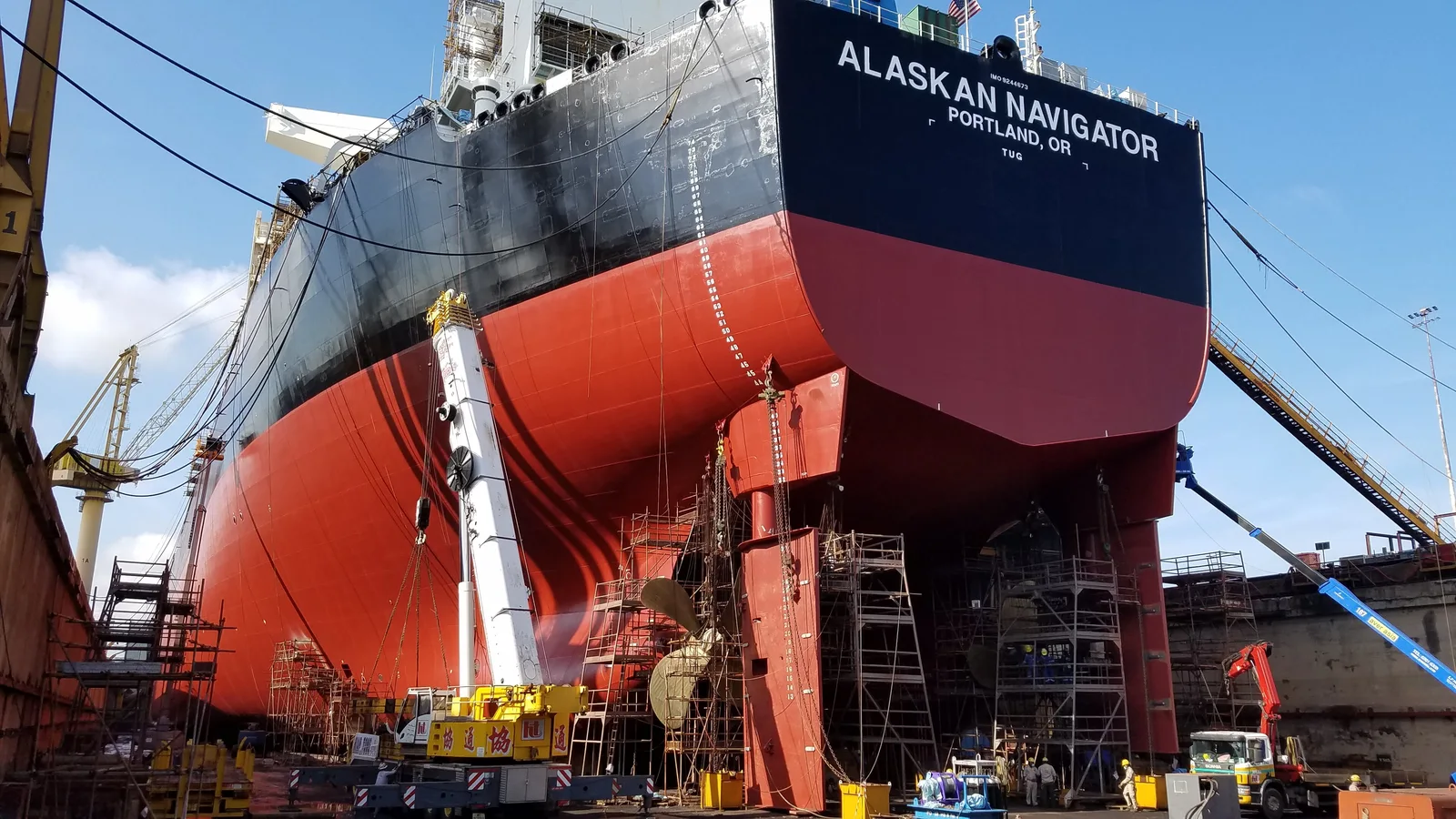
Propeller and shaft. When the tailshaft survey is due or stern seals are renewed: remove the propeller, withdraw the shaft, survey and measure with class, shop work, refit. If the stern arrangement drawings show the rudder must come off before the shaft can be drawn, it joins the same chain.
Hull coating. Wash, survey, blast, apply coats within their overcoat intervals, then wait out the minimum time before flooding. The chain is weather-gated. One antifouling data sheet requires the surface to be at least 3°C above the dew point during application and relative humidity below 85% during drying and curing, and gives a minimum time before immersion of 26 hours at 0°C, 13 at 10°C, 6.5 at 20°C and 4.5 at 30°C (Hempel Olympic Flex+ data sheet). IMO's ballast tank coating standard uses the same 85% and 3°C limits (IMO MSC.215(82)). A humid week stops this chain whatever the crew size.
Steel renewal found at survey. Unknown until the surveyor has seen the washed hull. Cropping, fitting, welding and testing must finish before coating closes in that area, so steel growth feeds the coating chain.
Sea chests and valves. Usually have float, since valve overhaul runs in the shop in parallel. A long-lead replacement valve can make them critical.
Class hold points. Bottom survey, tailshaft survey, rudder clearances and the final check before flooding need the surveyor on site. Schedule them as linked activities with booked dates.
An illustrative docking schedule
The example is hypothetical: durations were chosen to show the logic, not taken from a real docking. Day 0 is when the dock is dry and the ship sits on the blocks; in-dock work runs on a seven-day dock calendar.
| ID | Activity | Days | Predecessors | Float |
|---|---|---|---|---|
| D1 | Dock, land on blocks, pump dry | 1 | none | 0 |
| D2 | High-pressure wash of hull | 1 | D1 | 1 |
| D3 | Bottom survey with class | 1 | D2 | 1 |
| D4 | Staging and access | 1 | D2 | 2 |
| H1 | Shell plate renewal found at survey | 4 | D3 | 1 |
| H2 | Blasting and surface preparation | 3 | D3, D4 | 2 |
| H3 | Anticorrosive coats | 3 | H1, H2 | 1 |
| H4 | Anodes, transducers, draft marks | 2 | H3 | 2 |
| H5 | Antifouling coats | 2 | H3 | 1 |
| H6 | Minimum time before flooding (elapsed) | 1 | H5 | 1 |
| P1 | Remove propeller | 1 | D1 | 0 |
| P2 | Withdraw tailshaft | 2 | P1 | 0 |
| P3 | Tailshaft survey and clearances | 1 | P2 | 0 |
| P4 | Shaft and stern seal work in shop | 6 | P3 | 0 |
| P5 | Refit shaft, seals and propeller | 3 | P4 | 0 |
| S1 | Open and survey sea chests | 2 | D3 | 4 |
| S2 | Sea valve overhaul, sea chest coating | 5 | S1 | 4 |
| R1 | Rudder clearances and pintle check | 1 | D4 | 10 |
| U1 | Final class check, flood and undock | 1 | H4, H6, P5, S2, R1 | 0 |
Illustrative example, hypothetical durations. All links finish-to-start; float in days.
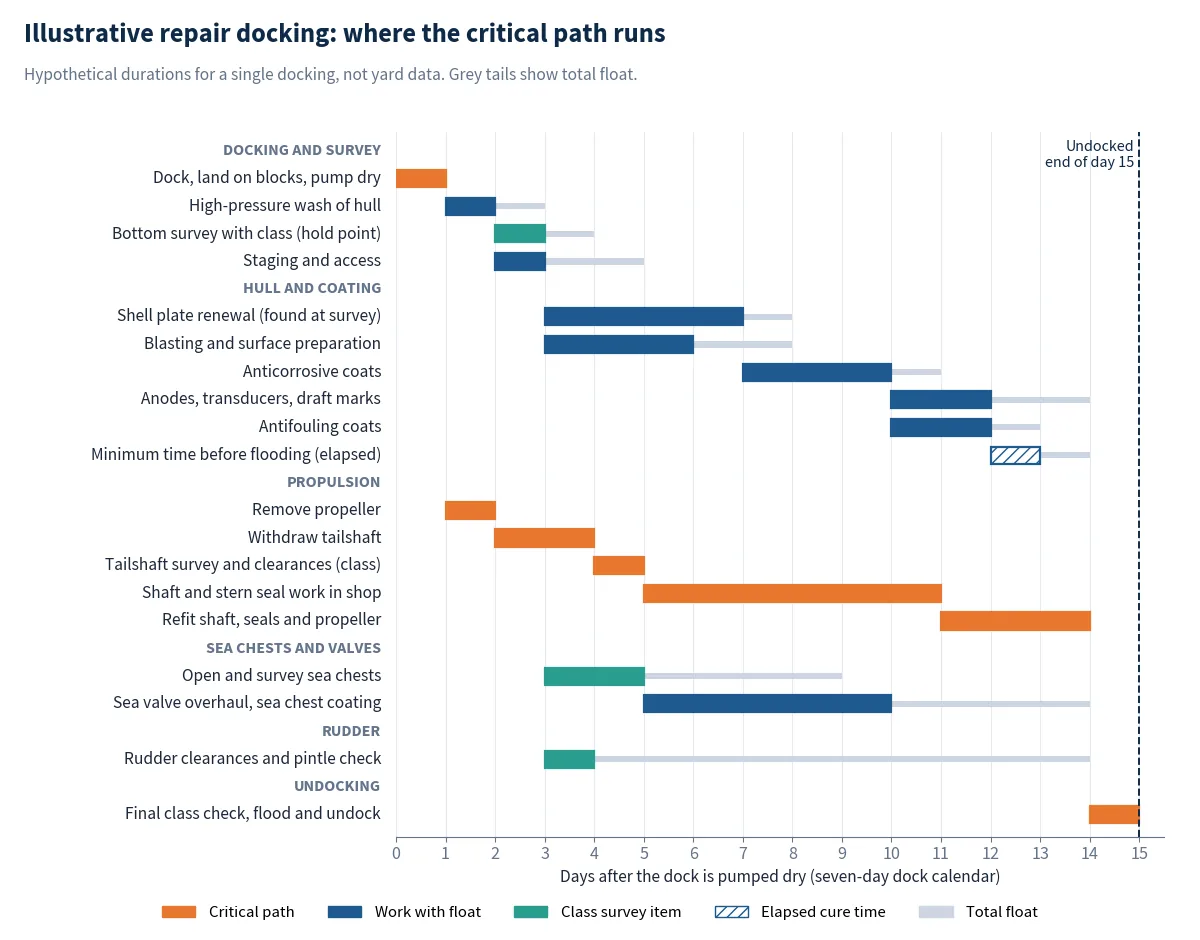
The propeller and shaft chain is critical and the ship undocks at the end of day 15. The coating chain has one day of float, and that is the buffer steel growth consumes. If shell renewal grows from four days to six, the coating chain becomes critical and undocking moves to day 16, while the shaft chain gains a day of float. Nothing changed on the shaft side, yet the dock date moved. That is why near-critical chains need the same attention as the critical one. The critical path method lesson covers the forward and backward pass behind these figures.
Building it in MS Project
Calendars. Project ships with three base calendars: Standard (8 AM to 5 PM), Night Shift, and 24 Hours, which is working time every day around the clock (Microsoft Support). Copy one into a dock calendar matching the yard's real shifts; use 24 Hours only if the yard truly works round the clock. Office work such as approvals and ordering stays on Standard. Assign the dock calendar as a task calendar to in-dock activities. It overrides the project calendar, but resource calendars still apply unless "Scheduling ignores resource calendars" is ticked on the task's Advanced tab (Microsoft Support: task calendars).
Elapsed durations. Cure and minimum time before immersion run whether anyone works or not. Type "e" before the unit (13eh, 1ed) and Project schedules the task 24 hours a day, seven days a week (MPUG on elapsed durations; see also Microsoft's duration format reference).
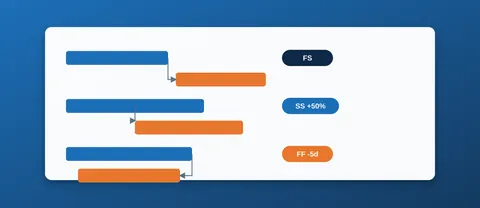
Links. Mostly finish-to-start. Zone-by-zone hull work suits start-to-start with lag: blasting zone 2 starts once zone 2 is washed, not the whole hull. See the task dependencies lesson.
Constraints and milestones. Constrain the docking date only and let logic drive the rest. Add milestones for dock dry, bottom survey complete (when steel scope can be priced), undocked and redelivery.
Baseline. Save it at contract signature and keep it; record approved extensions against it rather than re-baselining. See getting started with MS Project for shipbuilding schedules.
For the yard, this dock period is also one bar in its dock occupancy plan; the Dock / Berth Occupancy Planner template covers that view.
Where REPAIRCON meets the schedule
The form itself is covered in standard contracts in ship newbuilding and repair. The points below come from BIMCO's explanatory notes for REPAIRCON 2018 (archived August 2024; BIMCO now keeps the notes for members). Signed contracts are often amended, so check your own copy.
- Contract period (Box 6). The agreed repair time, running from the first working day after delivery to the yard, adjusted for additional work, reductions and delays under Clause 11 (Disruptions). This is the finish the schedule is measured against.
- Variations (Clause 2(a), Annex B). Changes are recorded on a Work Variation Form signed by both parties; if a change affects the redelivery date, the period is extended or shortened. Give each form a time impact from the network: insert and link the activity, then read the new undocking and redelivery dates before signing.
- Disruptions (Clause 11). Extensions for force majeure or owner's delays, lost if the yard does not follow the notice provisions. A daily delay log tied to activities is the evidence.
- Liquidated damages (Clause 7, Box 17). A daily rate for delay beyond the contract period, up to an agreed maximum, defaulting to 10% of the contract price. Since the period moves with every approved variation and extension, the time-impact record decides the LD days.
- Daily meetings (Clause 3(c)). The representatives must meet daily: the natural schedule update.
- Delivery (Clause 5(b)). The yard may cancel if the ship is not delivered by 15:00 local time on the cancellation date; the owner may cancel if work has not started within 48 hours of the delivery date.
Log extra work by type as well. US Navy maintenance reporting separates "growth work", issues found during the maintenance period, from "new work" added by the Navy, and GAO pointed to unplanned work needing contract changes as one cause of delays (Stars and Stripes on GAO-20-370; GAO-20-370). After a commercial docking, the same split shows whether the specification missed things or the owner added them.
Daily progress and the close-out report
Update at the daily meeting against a fixed status date. Ask for remaining duration on each open in-dock activity, not just a percentage. Then report four things: forecast undocking against the contract period as adjusted so far, critical and near-critical chains (float of one day or less), open Work Variation Forms with their time impact, and class items passed or pending. Keep a weather log beside the coating activities; a humidity stop not recorded on the day is hard to prove later.
The close-out report compares planned and actual days in dock and afloat, lists each variation with approved time and cost, classifies delays by cause (yard, owner, force majeure), records class items closed or outstanding, and notes when the agreed guarantee period starts. Its most useful part is usually the shortest: the "inspect and report" items that grew this time, so the next specification plans for them instead of finding them in the dock.
Cover photo: Alexgilmore85, via Wikimedia Commons, licensed CC BY-SA 4.0 (cropped).