Contract date fixes the class rules, keel laying most IMO rules, and a late delivery can pull a ship into new ones. 2026-2028 cut-offs and a free register.
Two ships of the same design, built at the same yard, can end up with different engines, towing gear and fire detection layouts because their contracts were signed a few weeks apart, or because one of them reached the berth a month later than planned. The rule books are the same for both. What differs is the date each rule looks at.
Every IMO regulation, class rule edition and regional measure decides its scope with a trigger: the building contract date, the keel-laying date, the delivery date, the date equipment was installed, or the date a ship starts operating in a regulated area. Since March 2026, the record of construction attached to the International Air Pollution Prevention Certificate has separate entries for the contract date, the keel-laying date and the delivery date (MEPC.392(82)).
This article is for contract staff, project managers and planners on the owner and yard side. It explains what each trigger date controls, lists the effective dates for 2026 to 2028 that land on ships being contracted now, and shows how the contract's "changes in rules" mechanism turns a regulatory date into a price and schedule question.
Three dates, three different questions
The contract date fixes the class rule edition
Classification societies apply the rules in force on the date of the contract for construction, defined by IACS in Procedural Requirement 29. It is the date the prospective owner and the builder sign the contract, declared to the society with the hull numbers. Ships in a series built to the same approved plans share that date, including optional ships if the option is exercised within one year of signing. Ships added later by an amendment get the amendment's date, as does a ship whose type is changed (IACS PR 29 as reproduced by ClassNK). The same ClassNK amendment shows the pattern in practice: it applies to ships "for which the date of contract for construction is on or after 1 January 2027". An option declared thirteen months after signing is not a sister ship for class purposes and may be built to a different rule edition.
Keel laying decides most IMO construction rules
When an IMO convention applies a rule to ships "constructed" on or after a date, it means ships whose keel is laid, or which are at a similar stage of construction, on or after that date. A similar stage means construction identifiable with the specific ship has begun and at least 50 tonnes or one percent of the estimated mass of all structural material, whichever is less, has been assembled (MARPOL Annex VI, regulation 2; the same wording appears in SOLAS-based national rules such as the UK Navigation Bridge Visibility Regulations 1998).
The milestone itself, and how to plan the run-up to it, is covered in planning a new shipbuilding project from contract to keel laying. The point here is narrower: the yard decides when 50 tonnes are on the berth, so it also decides which generation of keel-triggered rules the ship falls under, and a schedule slip can move that line.
Delivery, installation and operation dates catch the rest
SOLAS uses "installed on or after" for some equipment. For lifting appliances and anchor handling winches under regulation II-1/3-13, any installation date counts on a ship keel-laid on or after 1 January 2026, while on older ships the appliance's contractual delivery date decides (MSC.532(107)). Other rules ignore build dates and apply to every ship operating in an area from a given date, such as the 0.10% sulphur limit in an emission control area or the EU Emissions Trading System, which takes in offshore ships of 5,000 GT and above from the 2027 reporting period (European Commission FAQ).
The three-date test and why a delivery slip matters
Several recent IMO amendments define their scope with all three dates at once. NOx Tier III for the new North-East Atlantic emission control area, adopted on 1 May 2026, applies to a ship operating there:
- for which the building contract is placed on or after 1 January 2027; or
- in the absence of a building contract, whose keel is laid or which is at a similar stage of construction on or after 1 July 2027; or
- whose delivery is on or after 1 January 2031
(MEPC.407(84), MEPC 84/16/Add.1 Annex 3).
Two things follow. The keel branch only applies where there is no building contract, so for a contracted newbuild the contract and delivery dates are the ones that count. And signing before the contract cut-off is not a permanent exemption: a ship contracted in December 2026 stays outside Tier III for this area only if it is delivered before 1 January 2031. That delivery cut-off works as a regulatory long-stop date and belongs in the schedule next to the contractual delivery date, the end of the liquidated damages period and the buyer's cancellation date. The January 2026 IGF Code amendments use the same structure with earlier dates (MSC.551(108)).
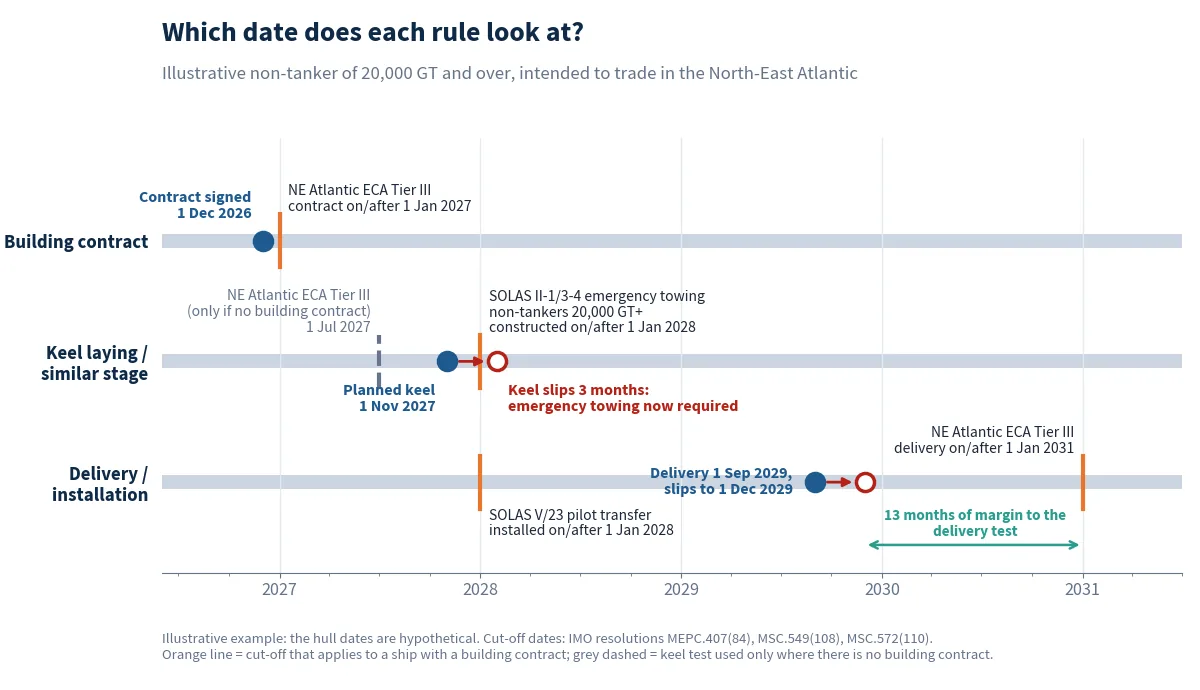
In this illustrative case the contract is signed a month before the Tier III contract cut-off and delivery stays well clear of 2031. The keel date is the weak point: a three-month slip from November 2027 to February 2028 puts the hull past the SOLAS emergency towing cut-off, so a ship not designed with emergency towing arrangements now needs them.
Effective dates 2026 to 2028 that affect newbuild specifications
Every date below was checked against the adopted text on 14 October 2026. The table is not a complete list of IMO amendments and does not replace a check with the flag Administration and the class society.
| Effective | Requirement | Who it applies to | Trigger | Source |
|---|---|---|---|---|
| 1 Jan 2026 | SOLAS II-1/3-13: lifting appliances and anchor handling winches | Equipment installed on or after 1 Jan 2026 (any date on ships keel-laid from then) | Installation | MSC.532(107) |
| 1 Jan 2026 | SOLAS II-2/7.5.5: fixed fire detection in all control stations and cargo control rooms | Cargo ships constructed on or after 1 Jan 2026 | Keel laying | MSC.550(108) |
| 1 Jan 2026 | SOLAS V/19: electronic inclinometer | Container ships and bulk carriers of 3,000 GT and upwards constructed on or after 1 Jan 2026 | Keel laying | MSC.532(107) |
| 1 Jan 2026 | IGF Code amendments (gas-fuelled ships) | Contract from 1 Jan 2026, or keel from 1 Jul 2026 without a contract, or delivery from 1 Jan 2030 | Three dates | MSC.551(108) |
| 1 Mar 2026 | NOx Tier III in the Norwegian Sea ECA | Contract from 1 Mar 2026, or keel from 1 Sep 2026 without a contract, or delivery from 1 Mar 2030 | Three dates | MEPC.392(82) |
| 1 Mar 2026 | NOx Tier III in the Canadian Arctic ECA | Ships constructed on or after 1 Jan 2025 | Keel laying | MEPC.392(82) |
| 1 Jan 2027 | EU ETS: offshore ships of 5,000 GT and above | All such ships, from the 2027 reporting period | Operation | European Commission |
| 1 Mar 2027 | 0.10% sulphur limit in the Norwegian Sea and Canadian Arctic ECAs | All ships operating there, after the 12-month exemption | Operation | ABS |
| 1 Sep 2027 | NOx Tier III in the North-East Atlantic ECA (entry into force) | Contract from 1 Jan 2027, or keel from 1 Jul 2027 without a contract, or delivery from 1 Jan 2031 | Three dates | MEPC.407(84) |
| 1 Jan 2028 | SOLAS II-1/3-4: emergency towing arrangements | Ships other than tankers of 20,000 GT and over, constructed on or after 1 Jan 2028 | Keel laying | MSC.549(108) |
| 1 Jan 2028 | SOLAS V/23: pilot transfer arrangements to the MSC.576(110) standards | Installed on or after 1 Jan 2028; earlier installations on SOLAS ships by the first survey on or after 1 Jan 2029 | Installation | MSC.572(110) |
| 1 Sep 2028 | 0.10% sulphur limit in the North-East Atlantic ECA | All ships operating there | Operation | IMO, DNV |
The IMO dates from September 2027 onward still depend on tacit acceptance: the amendments count as accepted unless enough governments object before 1 March 2027 (MEPC.407(84)) or 1 July 2027 (MSC.549(108) and MSC.572(110)). Two details are easy to miss. The emergency towing rule excludes tankers because they already have their own section in the same regulation. And the pilot transfer amendment reaches existing ships too, so a ship delivered in 2027 with an older arrangement would be upgraded at its first survey after 1 January 2029. Specifying the new standard from the start is usually simpler.
A wider EU ETS scope for some ship categories of 400 to 5,000 GT, from 2031, is only a Commission proposal, COM(2026) 616 (ABS Regulatory News 14/2026). It belongs on a watch list, not in the table.
Adopted before signing is not a change in rules
Most newbuilding contracts fix a regulatory baseline on the contract date and handle later changes in a separate clause, and the baseline wording matters more than the change clause. A wind turbine installation vessel contract based on an amended NEWBUILDCON, filed publicly with the US SEC, requires compliance with requirements in force on the contract date and with those already adopted by then that will be compulsory for the vessel by delivery (Cadeler and COSCO Shipping (Qidong), 2021).
Under wording like that, the emergency towing rule (adopted May 2024) and the North-East Atlantic ECA (adopted May 2026) are not changes in rules for a contract signed in late 2026. They are part of the price if they become compulsory for the vessel by delivery, and whether they do depends on the keel and delivery dates. If the specification assumed a keel date before 1 January 2028 and the yard's own delays push it later, the contract has to say who pays for the towing arrangements. Some wordings answer that clearly. Others leave a dispute.
Requirements adopted or changed after the contract date go through the change clause. The NEWBUILDCON-based contract above and a 2026 tanker contract on Guangzhou Shipyard International's form, also filed with the SEC (Hull 25110062), follow a similar pattern:
- Each party passes on notice of the change as soon as it receives it. The yard form gives the buyer a fixed number of days to instruct the builder.
- A compulsory change is carried out by the builder. The parties try to agree its effect on price, delivery date and other terms; the yard form also lists guaranteed deadweight, speed and consumption, and extra security for the builder.
- If they cannot agree, the builder still proceeds and the adjustment goes to the dispute procedure. The yard form puts the cost on the buyer and gives the builder a time extension.
- A non-compulsory change is the buyer's modification. Under the yard form, if price and time are not agreed, the builder may build to the original specification.
The main forms are compared in our overview of standard contracts in ship newbuilding and repair.
For the schedule, a rule change is a delay event like any other. Our pillar on how a shipbuilding contract works lists it among the usual permissible delays, with the same written-notice requirements. In the plan it becomes a short fragnet (engineering, class approval, procurement, installation) tied to the activities it disturbs, and its pricing works like a variation order, as described in variation order processes and cost impact calculation.
Checklist at contract stage
- Record the three dates the IAPP certificate will ask for, and agree what will prove each one: the signed contract, the class confirmation of keel laying or similar stage, the protocol of delivery.
- List every requirement adopted but not yet in force that will be compulsory by delivery, and agree whether each is in the price.
- Read the baseline wording closely: "in force", "adopted", "published" and "ratified and promulgated" draw the line in different places. Ask the same of class amendments published but not yet effective.
- For each three-date rule, compare the delivery cut-off with the contractual delivery date, the end of the liquidated damages period and the cancellation date.
- For option vessels, check that the option falls within one year of signing (IACS PR 29), and ask the flag or recognised organisation how statutory rules treat option dates.
- Write the intended trading areas into the specification. Emission control areas drive engine and exhaust choices.
- Note the notice and response periods of the change-in-rules clause, and name who monitors IMO, class, flag and EU changes.
Checklist before keel laying
- Compare the planned keel date with each keel-triggered cut-off and record the margin in days. Where it is small, decide on purpose: lay the keel with real readiness before the cut-off, or design for the new rule. See what has to be true before a keel-laying date is committed.
- Agree with class how the similar stage will be shown: estimated structural mass, the one percent figure, and the block weights erected on the day.
- Check the delivery forecast, not only the contractual date, against every delivery cut-off.
- Check planned installation dates for equipment with an "installed on or after" trigger.
- Update the register and open rule-change notices, and plan the survey gates that follow, as in the lesson on managing classification and regulatory milestones.
IMO Net-Zero Framework: status on 14 October 2026
The Net-Zero Framework is a set of draft amendments to MARPOL Annex VI combining a global fuel standard with a global GHG emissions pricing mechanism, approved in April 2025 as a new chapter of the draft revised annex. At an extraordinary session on 14 to 17 October 2025, the Marine Environment Protection Committee adjourned the adoption decision for 12 months (IMO, 17 October 2025). MEPC 84 (27 April to 1 May 2026) set up an intersessional working group, and the session is to resume on Friday 4 December 2026, subject to confirmation by MEPC 85 (IMO, MEPC 84).
Until then there is no adopted text and no application date. For a project signing now, the framework goes on the watch list, not the register. Two contract questions are worth asking today: would the change-in-rules clause treat an operational fuel standard as a change at all, and does the specification say what fuel readiness the owner expects? For a sense of lead time, the emergency towing amendment was adopted in May 2024 and enters into force in January 2028. This section will be updated after the December session.
Keeping the register
The Newbuild Regulatory Change Register, xlsx is a free workbook for this. You enter the contract date, planned keel date and delivery forecast once. Each requirement gets a row with its trigger type and cut-offs, and formulas show whether it applies, how many days the controlling date can still slip before a cut-off, and whether the rule was in force, adopted or not yet adopted on the contract date. A notice log tracks change-in-rules notices and a watch list holds measures not yet adopted. The table above comes pre-filled, with the hypothetical hull from the figure as the example. For yachts, where code, flag and the 500 GT line come first, the Regulatory Applicability Matrix (T3) does the same job.
Regulatory cut-offs rarely appear in the master schedule, yet they behave like contract milestones. With the contract, keel and delivery dates sitting next to the cut-offs they are measured against, a planner can see a regulatory slip coming months before it turns into a claim.
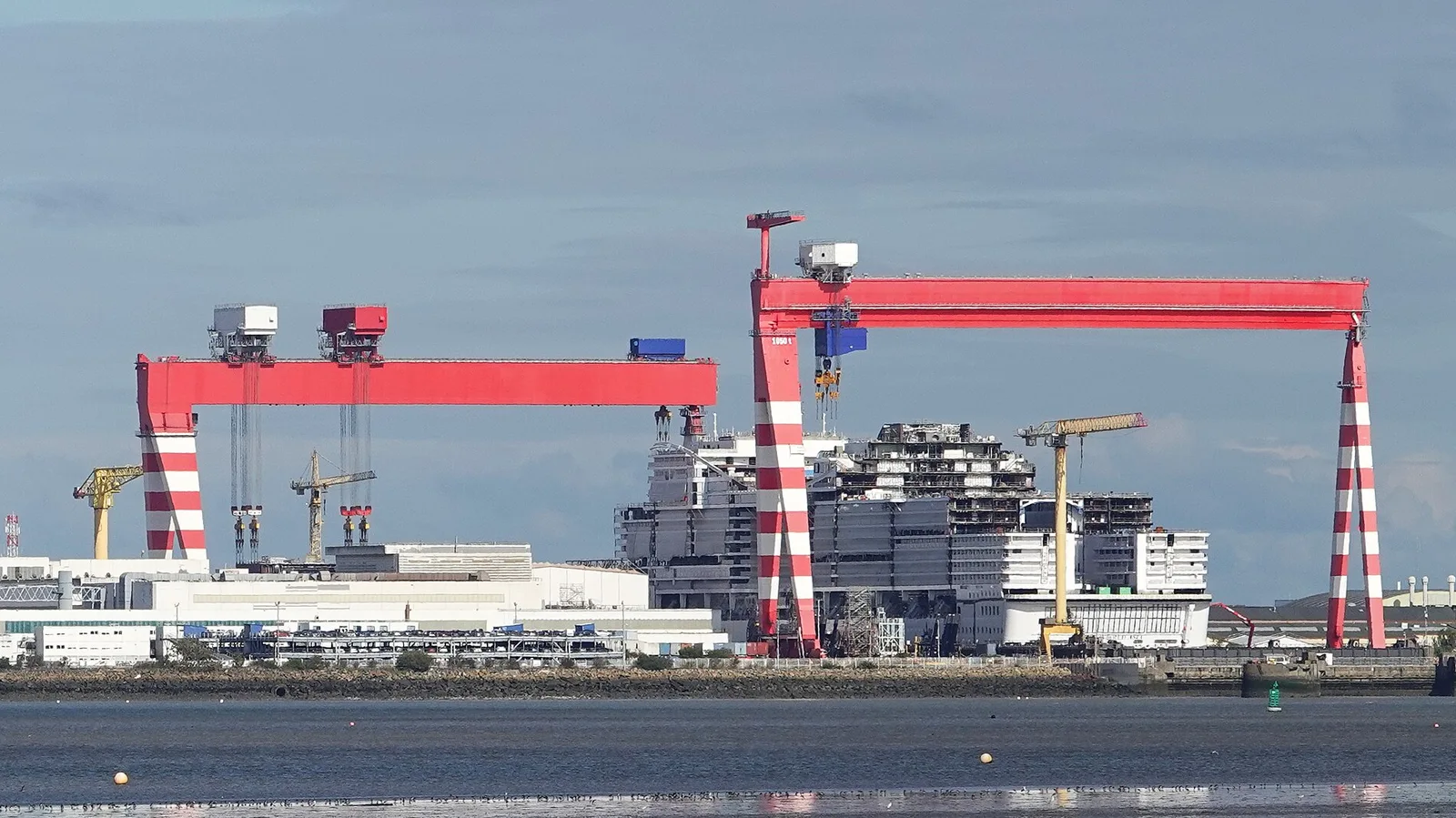
Cover photo: Ibex73, via Wikimedia Commons, licensed CC BY 4.0 (cropped).