
The global orderbook hit 226m CGT in October 2026. What full yards mean for a newbuild: 2029-2030 slots, prices, fuel choice, delay risk and a checklist.
In late October 2026 the world's shipyards had more work on their books than ever before. Clarksons Research put the global orderbook at 226 million CGT, with an estimated value of US$700 billion, in a report issued on 30 October. The previous peak was about 225 million CGT in September 2008 (Riviera, 3 November 2026; Caixin, quoting the same data as of 26 October, gives the 2008 record as 224 million). CGT, or compensated gross tonnage, is gross tonnage multiplied by a coefficient for ship type and size, so that it reflects the work needed to build a ship rather than its size alone. A passenger ship counts for much more than a bulk carrier of the same tonnage, which is why CGT, a system maintained by the OECD Working Party on Shipbuilding, is the usual unit for comparing yard workload (OECD; summary in Wikipedia).
One comparison keeps the record in proportion. Measured against the existing fleet, the orderbook is about 25% of fleet gross tonnage today, against 53% in 2008 (Clarksons, via Riviera). The fleet has grown, so this boom is smaller relative to the fleet even though the yards are fuller in absolute terms.
This article does not forecast the market. It is written for owner-side project managers, yard planners and procurement staff who need to sign a newbuild in this market, and it covers what the numbers mean for slot dates, price, fuel choice, equipment and the contract you put in front of the yard.
Who holds the work: new orders and the orderbook are different numbers
Two shares are quoted in almost every market report, and they measure different things. The share of new orders shows who signed the contracts in a period. The share of the orderbook shows who holds all the ships contracted and not yet delivered, including orders placed years ago.
In the first half of 2026, by Clarksons' count, the world ordered 42.95 million CGT in 1,481 ships. Chinese yards took 72% of it (31.00 million CGT, 1,131 ships) and South Korean yards 19% (7.97 million CGT, 195 ships). At the end of June, China held 65% of the orderbook (134.03 million CGT) and South Korea 19% (38.81 million CGT) of a total of 206.59 million CGT (PortNews, 6 July 2026, citing Clarksons Research).
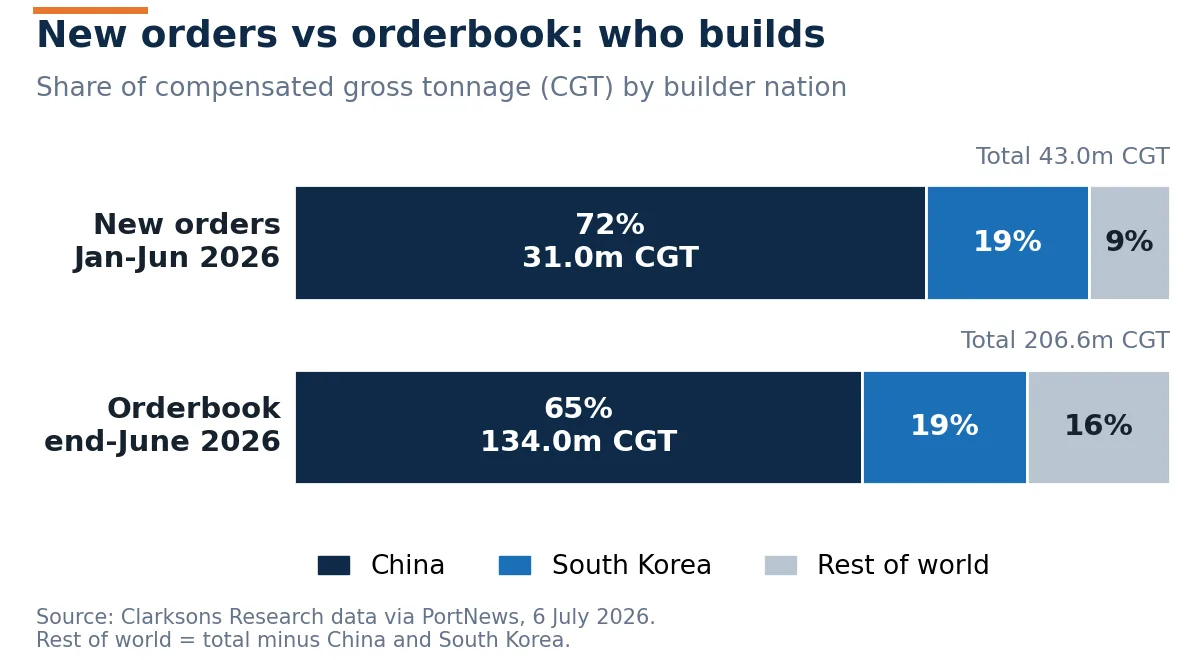 Source: Clarksons Research data reported by PortNews, 6 July 2026.
The gap kept widening through the year. From January to August, China's share of new contracting was 76% and South Korea's 15.7% (Clarksons, via Xinde Marine News, 7 September 2026). By the end of October, Chinese builders held 68% of the orderbook by tonnage, South Korea 17% and Japan 8% (Clarksons, via Riviera). Different trackers and national statistics count small yards and ship types differently, so expect a point or two of difference between sources.
For a project manager the distinction is practical. The new-order share tells you where slots are being sold now, and therefore where your shortlist is likely to end up. The orderbook share tells you where the work in progress sits for the next three to four years: that is where site teams, class surveyors and equipment deliveries will be competing for attention while your ship is being built.
Slot dates: when the earliest delivery is 2029 or 2030
At the large yards, the earliest open positions quoted during 2026 were in 2029 and 2030. In September, Yangzijiang's 2029 positions were close to fully committed and its 2030 slots were being opened gradually, Guangzhou Shipyard International's schedule ran into 2030, and Hengli had deliveries scheduled through 2030 (Xinde Marine News, 7 September 2026). On the Korean side, delivery in the first half of 2030 was being quoted by mid-2026 (Nathan Research Group, 14 August 2026, citing the Seoul Economic Daily). BIMCO found that 57% of the contracting in the first months of 2026 was due for delivery after 2028 (The Maritime Executive, 9 April 2026).
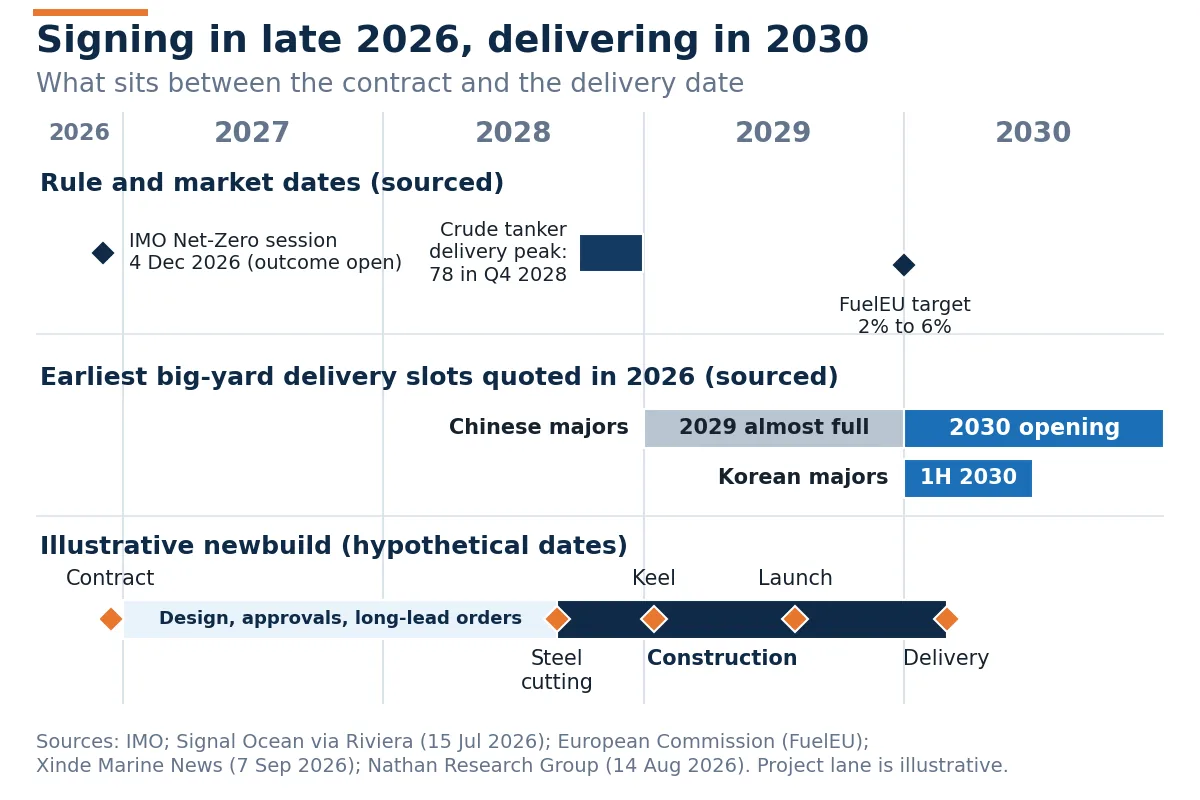 Illustrative example: the project lane uses hypothetical dates. Other dates from IMO, Signal Ocean via Riviera, the European Commission, Xinde Marine News and Nathan Research Group.
A three-year gap between signing and delivery changes how the project behaves:
- The specification ages before the ship is built. A specification fixed in 2026 describes a ship delivered in 2030. Equipment models, software versions and the owner's own commercial plans can all move in that time, and every change after signing goes through a variation order. The process and its cost logic are covered in change order and variation order processes.
- The rule picture moves with the dates. The contract date fixes the class rule edition, keel laying decides most IMO construction rules, and some recent amendments add a delivery cut-off as well. A 2029 keel and a 2030 delivery can fall on the other side of cut-offs that did not matter when the deal was signed. How each date works is explained in Which Rules Apply to Your Newbuild?, and the Newbuild Regulatory Change Register tracks the margins.
- The yard has no detailed schedule for your hull yet. Engineering, steel cutting and berth dates for a 2030 delivery depend on hulls that have not been built. Ask for the planned dates of the payment milestones (steel cutting, keel laying, launching) in the contract or its schedule, not only the delivery date, and ask which hulls occupy the berth or dock immediately before yours. A slip on those hulls is the first thing that will move your dates.
- Letters of intent and slot reservations need reading closely. A letter of intent or slot reservation can hold a position while the specification and price are agreed, but what it binds, how long it lasts and whether a deposit is refundable depend entirely on its wording. Until the building contract is signed and the refund guarantee issued, treat the slot as provisional in the project schedule.
- Options need dates as well as prices. Option ships let an owner extend a series at an agreed price, but each option has an exercise deadline and a delivery window that the yard may not hold open. There is also a rules point: under IACS Procedural Requirement 29, an optional ship shares the contract date of the series for class purposes only if the option is exercised within one year of signing (IACS PR 29 as reproduced by ClassNK).
Price: a high index, and resale above newbuild
The Clarksons Newbuilding Price Index stood at 185.15 at the end of June 2026, up from 185.01 a month earlier and about 33% above June 2021 (PortNews, citing Clarksons Research). It was 186.34 at the end of August, 28% higher than five years earlier (Xinde Marine News). The index is high but has moved slowly this year: one analysis found it rose by less than half a percent over the first seven months of 2026 while ordering volume rose by about 65% (Nathan Research Group).
The more telling number for some segments is the gap between building a ship and buying one that is ready now. In its mid-year report, Veson Nautical put a VLCC newbuild at around US$132 million and a resale at about US$172 million (Riviera, 8 July 2026). Other valuers publish different figures for the same months, and values have moved since. What matters for the project is that the market pays a premium for early delivery, which also tells you what a late delivery could cost the owner.
What this means for the contract and the budget:
- Fixed price, and what can still move it. Commercial newbuilding contracts are normally fixed-price, with adjustments only for listed events such as variation orders, rule changes and performance shortfalls. If a yard proposes a steel or equipment escalation clause, ask which published index it uses, the base date, any cap, and whether it can also reduce the price. Price mechanics are covered in How a Shipbuilding Contract Works.
- Instalments and security over a longer period. With delivery three or more years out, the pre-delivery instalments sit with the yard for longer. Check that the refund guarantee covers every instalment paid before delivery and stays valid until after the latest date on which the buyer could cancel, including the period during which delay liquidated damages run before the cancellation right starts.
- Currency. Newbuilding prices are usually quoted in US dollars. If the owner's budget or financing is in another currency, a payment schedule that runs to 2030 is a long open exposure, and the treasury function should decide early whether the instalments are hedged.
- Liquidated damages against the market. Delay liquidated damages are a fixed daily rate up to a cap. When resale values sit well above newbuild prices, a typical rate may cover only part of what the owner loses for each day of late delivery. Look at the grace period, the cap and the number of days after which the buyer may cancel, and decide whether those numbers still make sense in this market.
Segments with a scheduling story
Two segments stand out for their effect on planning.
VLCCs. Veson counted 183 VLCC orders in the first half of 2026, against 18 in the same period of 2025 (Riviera, 8 July 2026). Maritime Strategies International counted 177 VLCCs (54.5 million dwt) for the same half-year, and other trackers give different counts again, but all show a step change. MSI also found that about 83% of the VLCCs contracted in 2026 are due for delivery in 2028 and 2029, and Signal Ocean's data show the busiest quarter in the crude tanker orderbook in Q4 2028, with 78 deliveries (Riviera, 15 July 2026). When dozens of similar ships deliver in the same quarters, they need the same engine types, cargo pumps and trial windows at the same time. A tanker project delivering in 2028 or 2029 should plan its owner's site team, sea trials and crew handover with that crowding in mind.
Methanol. Clarksons data show only 4 methanol dual-fuel ships ordered in the first half of 2026, 0.37% of all orders by number. In the same period 85 ships were ordered as methanol-ready and 173 as LNG-fuelled (Xinde Marine News, 3 July 2026). For a project, the gap between "dual-fuel" and "ready" is the specification question discussed in the next section.
Fuel choice while the global rule is unsettled
The IMO Net-Zero Framework, approved in April 2025, would combine a global fuel standard with an emissions pricing mechanism for ships over 5,000 GT. At an extraordinary session in October 2025, the Marine Environment Protection Committee adjourned the adoption decision for a year (IMO, 17 October 2025); the vote to adjourn was 57 in favour, 49 against, with 21 abstentions (Hill Dickinson). The session is due to resume on 4 December 2026, subject to confirmation by MEPC 85 (IMO, MEPC 84), and the framework came out of September's technical talks largely intact (gCaptain, 4 September 2026). On the date of writing, 12 November 2026, the outcome is not known. Even if adopted, commentators do not expect entry into force before 2028 at the earliest (Hill Dickinson).
Regional rules already apply to ships trading to Europe. The EU Emissions Trading System has covered cargo and passenger ships of 5,000 GT and above since 2024. Shipping companies surrender allowances for 40% of their 2024 emissions and 70% of their 2025 emissions, and for 100% of emissions from 2026 onwards, surrendered from 2027; methane and nitrous oxide are included from 2026, and offshore ships of 5,000 GT and above join from 2027 (European Commission). FuelEU Maritime has applied since 1 January 2025 and requires the greenhouse gas intensity of energy used on board to fall against a 2020 baseline: by 2% from 2025, 6% from 2030, 14.5% from 2035, 31% from 2040, 62% from 2045 and 80% from 2050 (European Commission). A ship delivered in 2030 starts its EU trading life at the 6% step.
For the specification, three points follow:
- Define "ready" in writing. A "ready" notation can mean very different amounts of work: reserved space on the general arrangement, structural reinforcement for future tanks, an engine type that can be converted, or installed piping. The specification should say which items are installed at delivery, which are only designed and approved, and who pays for class approval of the future conversion. The class society's notation rules define the minimum; the contract can ask for more.
- Expect the yard to prefer its standard design. Suppliers at SMM in September 2026 reported that large yards with full orderbooks prefer serial, standard designs and may pass on custom orders that add engineering work (The Maritime Executive, 22 September 2026). A non-standard fuel system can cost you the slot, or come with a longer engineering period and a later delivery date.
- Check the changes-in-rules clause. If the Net-Zero Framework is adopted after signing, or the EU rules change, the contract decides who pays for any modification that becomes necessary. The clause and its trigger dates are covered in Which Rules Apply to Your Newbuild? and the lesson on managing classification and regulatory milestones.
Equipment and delivery risk in a full yard
A yard working at capacity has less room to absorb a late main engine, generator set or deck crane, because the berth or dock is already committed to the next hull. The usual tools for managing this sit in the contract and the procurement schedule.
The makers list names the approved suppliers for each major item. A longer list gives the yard room to switch when one maker's lead time grows; a shorter list gives the owner more control over what is fitted but leaves less room to manoeuvre. Agree the list before signing, together with how a maker can be added or changed later and who carries the delay if an owner-nominated or owner-furnished item arrives late. How lead times feed into the schedule, with a worked example of the latest safe order date for a main engine, is in procurement and supply chain for major ship equipment. The tender, factory acceptance test and logistics side is covered in international procurement of major ship equipment.
The delay clauses decide who carries a slip. The contract separates permissible delay, which extends the delivery date, from delay that triggers liquidated damages after a grace period, with a cancellation right once the delay passes an agreed number of days. Read the permissible delay list with the current market in mind: whether late supply by a subcontractor or maker counts as permissible delay, and whether it is limited to delays the yard could not have avoided, matters more in a busy market. The same clauses are explained in How a Shipbuilding Contract Works, and the standard forms behind them are compared in standard contracts in ship newbuilding and repair.
The owner's long-lead decisions come early. Anything the owner chooses, such as the main engine type, a scrubber or the cargo system, has to be decided in time for the yard to order it. In a market where the slot is three years away it is easy to treat those decisions as distant, but the yard's order dates for long-lead items often fall in the first months after signing. Put them in the owner's own schedule from the start, alongside the steps covered in planning a new shipbuilding project from contract to keel laying, and record the delivery risks in a register such as the Shipyard Risk Register Template.
Capacity also matters for owners who decide to keep an older ship running instead of replacing it. Planning a docking, from the specification to the yard tender and the docking schedule, is covered in planning a ship repair drydocking.
Checklist before you sign
Run through these points before the contract is signed. They are not a substitute for legal review of the contract itself.
- Delivery date, and the planned dates for steel cutting, keel laying and launching, written into the contract or its schedule
- Which hulls occupy the berth or dock before yours, and how the yard reports a slip on them
- What the letter of intent or slot reservation binds, until when, and whether any deposit is refundable
- Option ships: exercise deadline, delivery window, price, and whether exercise falls within one year of the contract date for class purposes
- Price basis: fixed, or with an escalation clause; if escalation, the index, base date, cap and whether it works in both directions
- Payment schedule against the refund guarantee: amount covered, expiry date relative to the latest possible cancellation date
- Currency of the price and the instalments, and the hedging decision
- Delay liquidated damages: grace period, daily rate, cap and cancellation threshold, compared with what a late delivery would cost the owner
- Permissible delay list, especially for late supply by makers and subcontractors
- Makers list for major equipment, the process for changes, and responsibility for owner-nominated or owner-furnished items
- Fuel and "ready" scope: what is installed at delivery, what is only designed and approved, and the class notation
- Changes-in-rules clause, and the regulatory cut-off dates between the contract date and the latest delivery date
- Owner's long-lead decisions and the dates by which the yard needs them
A note on the US Maritime Action Plan
The White House released America's Maritime Action Plan on 13 February 2026, as required by Executive Order 14269 of April 2025 (Seward & Kissel). It covers commercial and naval shipbuilding, the workforce and the maritime industrial base. For owners building abroad, the item to watch is a proposed fee on foreign-built commercial ships calling at US ports, assessed on the imported cargo tonnage. The plan does not set the rates, and much of it needs action by Congress before it takes effect (Holland & Knight). For a ship being contracted in Asia now, the plan affects trading costs if the ship will call at US ports, not the building contract itself. Projects with US trade in their business case should track the legislation.
Sources
Market figures are as of the dates given in the text; the article was written on 12 November 2026.
- Riviera Maritime Media, China emerges as dominant force behind record US$700bn global orderbook, 3 November 2026 (Clarksons Research data)
- Caixin Global, China dominates as global shipbuilding orderbook hits record, 3 November 2026
- PortNews, report on Clarksons Research data for H1 2026 orders, orderbook and newbuilding prices, 6 July 2026
- Xinde Marine News, report on Chinese yards' orderbooks, slots and the price index, 7 September 2026
- Xinde Marine News, New orders for methanol dual-fuel vessels almost stall in first half of 2026, 3 July 2026
- Nathan Research Group, Korea shipbuilding: a 65% surge, and a price that moved 0.45%, 14 August 2026
- The Maritime Executive, Shipbuilding orderbook hits 17-year high driven by tankers, reports BIMCO, 9 April 2026
- The Maritime Executive, With orderbooks full, big yards may pass on "green" custom newbuild orders, 22 September 2026
- Riviera Maritime Media, VLCC newbuilding orders on course for record-breaking year, 8 July 2026 (Veson Nautical data)
- Riviera Maritime Media, VLCC ordering hits all-time high with half the year still to go, 15 July 2026 (MSI and Signal Ocean data)
- IMO, IMO net-zero shipping talks to resume in 2026, 17 October 2025, and MEPC 84 meeting summary
- Hill Dickinson, IMO's Net-Zero Framework: adoption adjourned, and consensus building continues, 30 October 2025
- gCaptain, IMO Net-Zero Framework holds ground after latest round of climate talks, 4 September 2026
- European Commission, FAQ: maritime transport in the EU ETS and FuelEU Maritime
- ClassNK, rule amendments reproducing IACS PR 29
- OECD Working Party on Shipbuilding, paper on the CGT system
- Seward & Kissel, White House releases Maritime Action Plan, 19 February 2026
- Holland & Knight, White House releases America's Maritime Action Plan, 25 February 2026