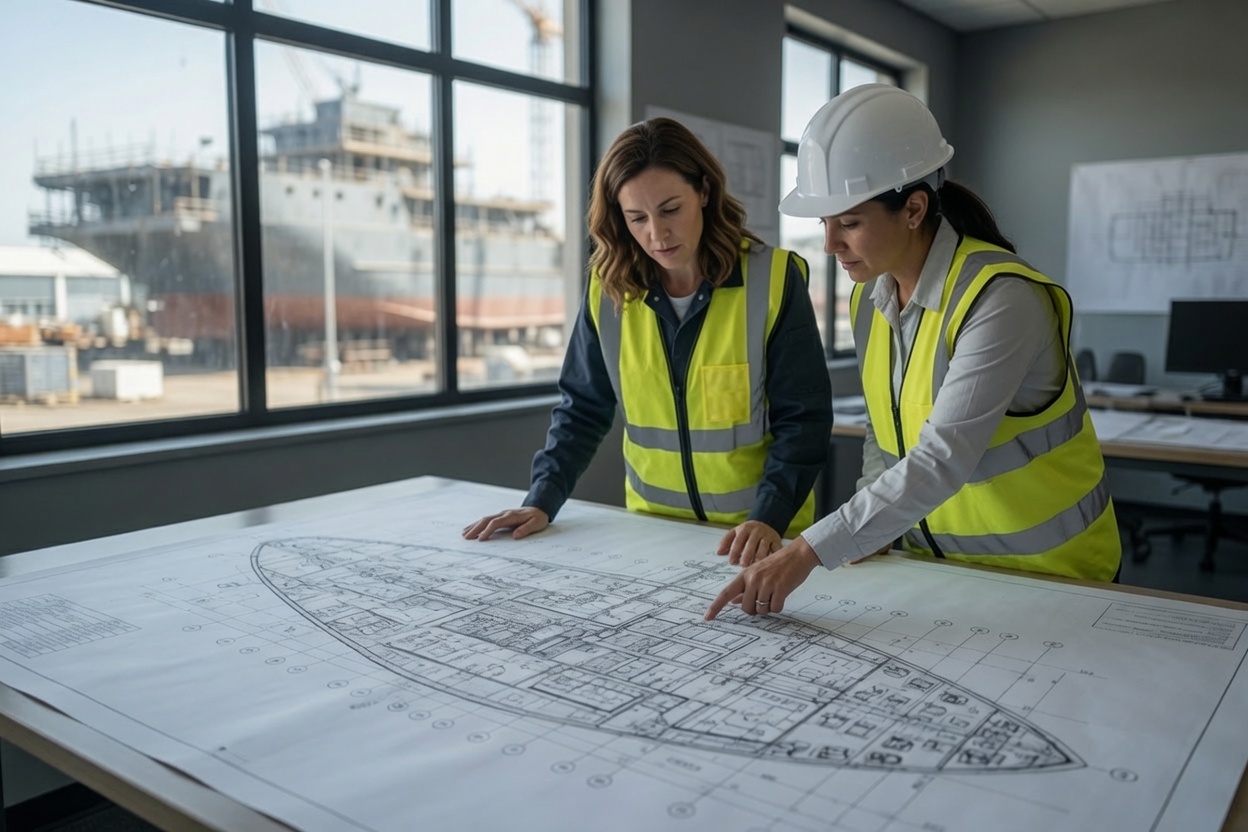
Master the skill of reading a Ship’s General Arrangement (GA) plan as a production planner or scheduler in the shipbuilding and ship repair industry. This practical guide explains how to interpret key sections of GA drawings, understand compartmentation, access routes, equipment layout, and extract critical information needed for work packaging, activity sequencing, and realistic schedule development. Designed specifically for planners working on newbuild and repair projects, this resource helps you bridge the gap between engineering drawings and executable production schedules.
What is a Ship’s General Arrangement Plan?
A General Arrangement (GA) plan is the most fundamental engineering drawing of a vessel. It shows the overall layout of the ship, including the location of compartments, equipment, tanks, accommodation areas, and access routes. Think of it as the “master map” of the entire vessel.
The GA drawing typically includes:
- Main dimensions and hull form
- Deck layouts, tank arrangements, and compartmentation
- Location of major equipment (engines, generators, cranes, etc.)
- Accommodation areas, galleys, and crew facilities
- Safety equipment, fire zones, and escape routes
For a planner, the GA is not just a drawing. It is the physical foundation upon which work packaging, sequencing, and scheduling decisions are built.
Why Planners Must Understand GA Drawings
Many planners treat the GA as “engineering work” and do not study it deeply. However, in real shipyard life, this creates serious problems:
- You cannot create realistic work packages without knowing where the work physically takes place.
- You cannot identify spatial conflicts between different trades.
- You cannot plan material flow and equipment access correctly.
- You cannot build an accurate logical sequence for activities.
A planner who cannot read a GA properly will either create overly conservative schedules or constantly receive feedback from the site saying “this cannot be done here.”
Main Views in a GA Drawing
A typical GA package contains several different views. Understanding each view is essential:
- Profile View (side view of the vessel): used for understanding deck levels and heights.
- Plan View (top-down view of each deck): most critical for work packaging.
- Section View (cross-section at specific points): used for understanding internal structure and tank depths.
Practical Tip: As a planner, you will spend most of your time working with the Plan View. This view shows you exactly where work will physically happen on each deck.
Key Areas and Compartments in a GA
When reviewing a GA, pay special attention to these critical areas:
Engine Room
The most equipment-dense and complex area of the ship. Work here usually involves multiple disciplines and takes longer than average. Access is often restricted.
Tanks and Double Bottom
These areas require gas-free certification, special permits, and strict safety procedures. Never schedule regular work here without checking requirements first.
Accommodation Areas
Cabins, galley, mess rooms. Work here is usually cleaner but requires coordination with the crew and hotel services.
Weather Decks and Superstructure
Cranes, masts, life-saving appliances. Access and lifting plans are critical here.
Understanding Symbols and Legends
GA drawings use many symbols. You do not need to memorize all of them, but you should know the most common ones:
- Dashed lines: Usually indicate boundaries or hidden structures.
- Hatched or shaded areas: Often represent tanks or hazardous zones.
- Arrows: Show flow direction (ventilation, piping) or escape routes.
- Stair symbols: Indicate vertical access between decks, very important for planning.
Important: Always check the Legend (usually located at the bottom right of the drawing) before starting work.
Extracting Information for Work Packaging (Step-by-Step)
Here is a simple process you can follow when using the GA to create work packages:
- Identify the correct deck using the Plan View.
- Locate major equipment and structures in that area.
- Check access routes (stairs, doors, hatches).
- Look for spatial conflicts with other ongoing work.
- Identify safety requirements (enclosed spaces, hot work permits, etc.).
- Estimate physical working space available for the team.
Using GA for Schedule Development
The GA drawing helps you make better scheduling decisions in several ways:
- Logical sequencing: You can see which activities must finish before others can start (e.g., insulation before painting in the engine room).
- Space management: You can avoid overloading one area with too many trades at the same time.
- Material handling: You can plan how large equipment will be brought into the vessel.
- Critical path identification: You can better understand physical dependencies between activities.
Common Mistakes Planners Make
- Relying only on the Profile View and ignoring Plan Views.
- Not checking the Legend before interpreting symbols.
- Ignoring access routes and vertical movement.
- Scheduling too many activities in the same confined space simultaneously.
- Treating tank and enclosed space work the same as normal deck work.
A Worked Example
Suppose a planner is packaging work for the engine room deck. The Plan View shows two access hatches and a single stair trunk serving that level, information the Profile View alone would never surface. If piping installation, electrical cable pulling and insulation are all scheduled for the same week in that space, the planner can see from the GA that all three trades would be competing for the same limited access points and floor space, before the conflict ever reaches the shop floor as a "we can't get in there" complaint. Sequencing insulation after the bulk of piping and cabling is done, rather than in parallel with it, is a decision the GA makes obvious once you know to look at access routes, not just equipment locations.
Practical Tips from the Shipyard
- Always work with an enlarged version of the GA (A3 print or tablet).
- Use colored markers (physical or digital) to highlight critical areas.
- If a 3D model is available, use it together with the GA, it makes understanding much easier.
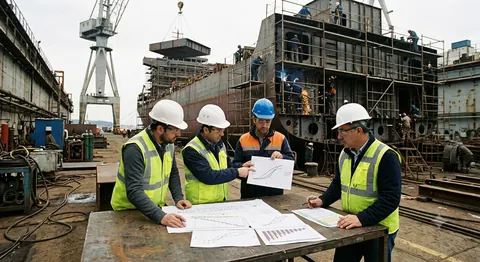
- Review the GA together with the foreman or supervisor before finalizing the schedule. This prevents many problems later.
Summary and Key Takeaways
The General Arrangement plan is much more than an engineering drawing. For a planner, it is the physical map of the project. Planners who can read GA drawings effectively will:
- Create more realistic work packages
- Build more accurate schedules
- Reduce surprises and conflicts on site
- Communicate more effectively with production teams
Final Thought: Learning to read a GA properly is one of the highest-return skills a shipbuilding planner can develop. It directly improves the quality of your schedules and reduces problems during execution.
See also: Shipbuilding Project Lifecycle: An Overview, and Drydock and Berth Planning Basics.