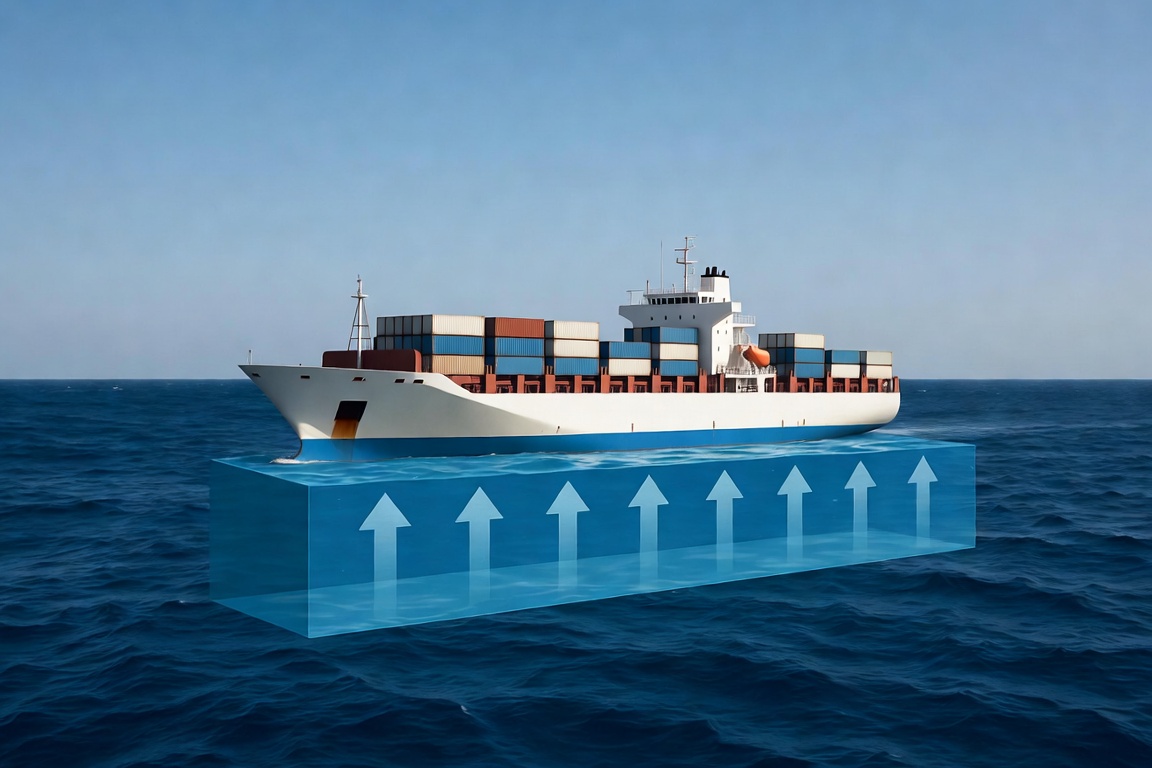
Have you ever looked at a massive cargo ship or a huge cruise liner and wondered: How on earth does something that heavy stay afloat? A modern container ship can weigh over 200,000 tons when fully loaded yet it glides across the ocean instead of sinking like a rock.
A container ship displacing over 200,000 tons of seawater floats for the same reason a nail sinks and a steel boat hull doesn't: not because of the material, but because of how much water the shape of the hull actually pushes out of the way. This isn't just physics trivia for a project team building the vessel, displacement and stability calculations are real, contractual deliverables that get approved by class before the ship is ever allowed to float, and they drive real decisions during construction, from the launch sequence to how ballast is managed while the vessel is still incomplete.
Archimedes' Principle, in the Terms a Planner Actually Uses
Archimedes' principle states that a floating object displaces a volume of water whose weight equals the object's own weight. In practice, this means a vessel's lightship weight (the finished hull, machinery and outfitting, with nothing loaded aboard) plus everything added afterward (cargo, fuel, crew, ballast) has to be balanced against the volume of water the hull displaces at a given draft. The buoyant force is expressed as Fb = ρ × V × g, where ρ is the density of the water (roughly 1000 kg/m³ for fresh water, 1025 kg/m³ for seawater), V is the displaced volume, and g is gravitational acceleration. A vessel floats in equilibrium exactly where its weight and this buoyant force are equal.
Why Average Density, Not Material, Is What Matters
Solid steel is roughly 7800 kg/m³, far denser than water, which is why a steel plate sinks. A ship's hull encloses a large volume of air and outfitted space, so the vessel's average density, steel plus air plus everything inside, ends up well below the density of the water it displaces, even though the ship's total weight can run into tens of thousands of tons. This is also exactly why flooding is dangerous: water entering a compartment doesn't just add weight, it replaces air with water and raises the vessel's average density, and if enough compartments flood, the hull can no longer displace enough water to stay in equilibrium.
Where This Shows Up in Actual Newbuild Planning
- The stability booklet is a contractual and class deliverable. Loading conditions, intact and damage stability calculations, and the vessel's load line are worked out during design and have to be approved by class before delivery, not just calculated informally.
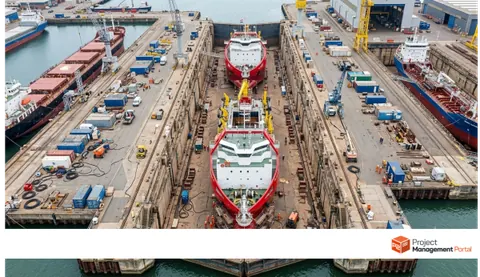
- Launch calculations are a real, scheduled engineering activity, not a formality. Whether a vessel launches by dry dock flooding, slipway, or ship lift, the yard has to confirm the hull's weight and center of gravity at that specific stage of construction, which is rarely the same as the finished vessel's condition, will actually float and trim correctly the moment it's waterborne.
- Ballast management during outfitting is a genuine operational task. A partially outfitted vessel afloat at the fitting-out berth has a different weight distribution than the design condition, and ballast has to be actively managed to keep the vessel at a safe, stable draft while work continues aboard.
- Compartmentalization (watertight bulkheads, double bottoms) is a design decision with direct schedule implications. The subdivision that keeps a damaged vessel afloat also defines structural boundaries that block/erection sequencing has to respect.
Load Lines and Why They're Not Arbitrary
The load line (Plimsoll mark) painted on a vessel's hull marks the maximum draft at which it can legally be loaded, set based on displacement calculations for the specific vessel and adjusted for the density of the water (a vessel floats higher in denser seawater than in fresh water, displacing less volume for the same buoyant force). It exists precisely because a vessel loaded beyond its calculated safe displacement doesn't have enough reserve buoyancy left to handle rough weather or an unexpected ingress of water.
None of this is abstract physics for the people actually building and delivering a vessel. Displacement, stability and load line calculations are approved documents that gate real milestones, launch, delivery, and the load conditions a vessel is certified to operate under, not background theory.