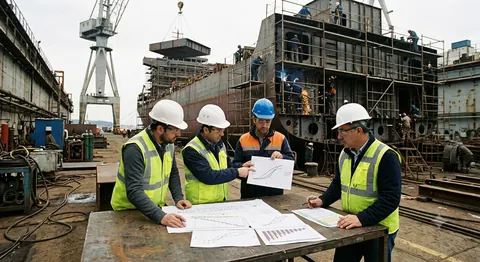
A guided tour of a newbuild from contract to delivery, and where the project manager adds value at each stage.
Every newbuild moves through roughly the same seven phases regardless of vessel type, but the project manager's actual job changes completely from one phase to the next. In feasibility, the job is mostly commercial judgment. By construction, it's resource and sequencing discipline. By sea trials, it's risk triage under real time pressure. Knowing which phase you're in tells you which skill actually matters right now.
Concept and Feasibility
The shipowner defines operational requirements (cargo capacity, speed, fuel efficiency, operating region), naval architects produce preliminary hull forms, and the economics get tested against estimated construction and operating cost. Early alignment with expected environmental regulation (IMO emission standards) and the intended classification society matters here specifically because a design assumption locked in now, before basic engineering starts, is comparatively cheap to change; the same assumption discovered wrong during detailed engineering is not. The PM's real job at this stage is pressure-testing the feasibility study's assumptions, not managing a schedule that doesn't exist yet.
Contract and Basic Design
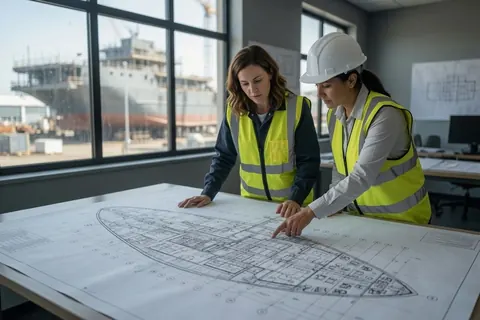
Basic engineering, structural drawings, piping diagrams, electrical load analysis, locks in the vessel's primary characteristics, and the basic design goes to the classification society (ABS, DNV, Lloyd's Register or similar) for approval before the contract is signed. This is where payment milestones, delivery timeline and technical specifications get fixed in writing. A vague or incomplete specification agreed here to keep the contract signing on schedule routinely becomes the source of variation-order disputes months later, once construction has started and there's no cheap way to resolve the ambiguity.
Detailed Engineering and Procurement
The engineering team turns the 3D model into actual production information, manufacturing blueprints for steel cutting, pipe bending, equipment installation, while procurement places orders for raw material and long-lead items (main engines, propulsion systems, custom switchboards). This is the phase where the project's real critical path usually gets set, not by construction activities, but by how early the longest-lead equipment orders actually go out, because production planning further downstream has to work around whatever delivery dates procurement locks in here.
Construction and Assembly
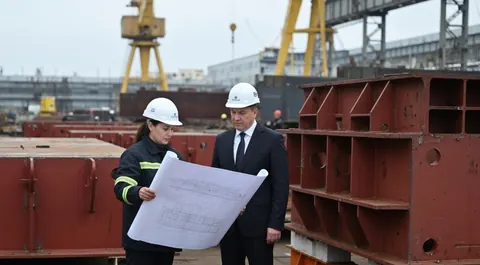
Blocks get fabricated, assembled and erected using the block construction method, prefabricated sections built separately then welded together, with steel cutting marking the formal start of physical construction and keel laying marking the point at which a defined mass of structure has been erected. This is the phase most visible to outside observers and least forgiving of planning mistakes made earlier, a sequencing or interface problem baked into the WBS during contract stage shows up here as a block that can't be erected on schedule, not as an abstract planning issue anymore.
Launching and Outfitting
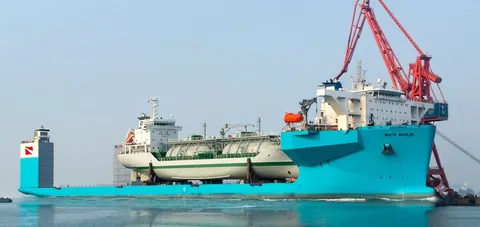
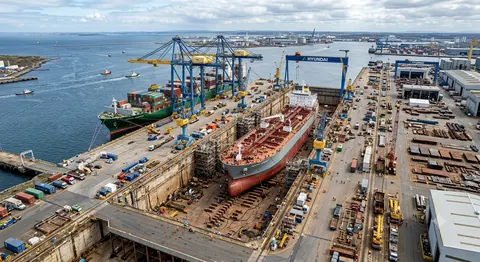
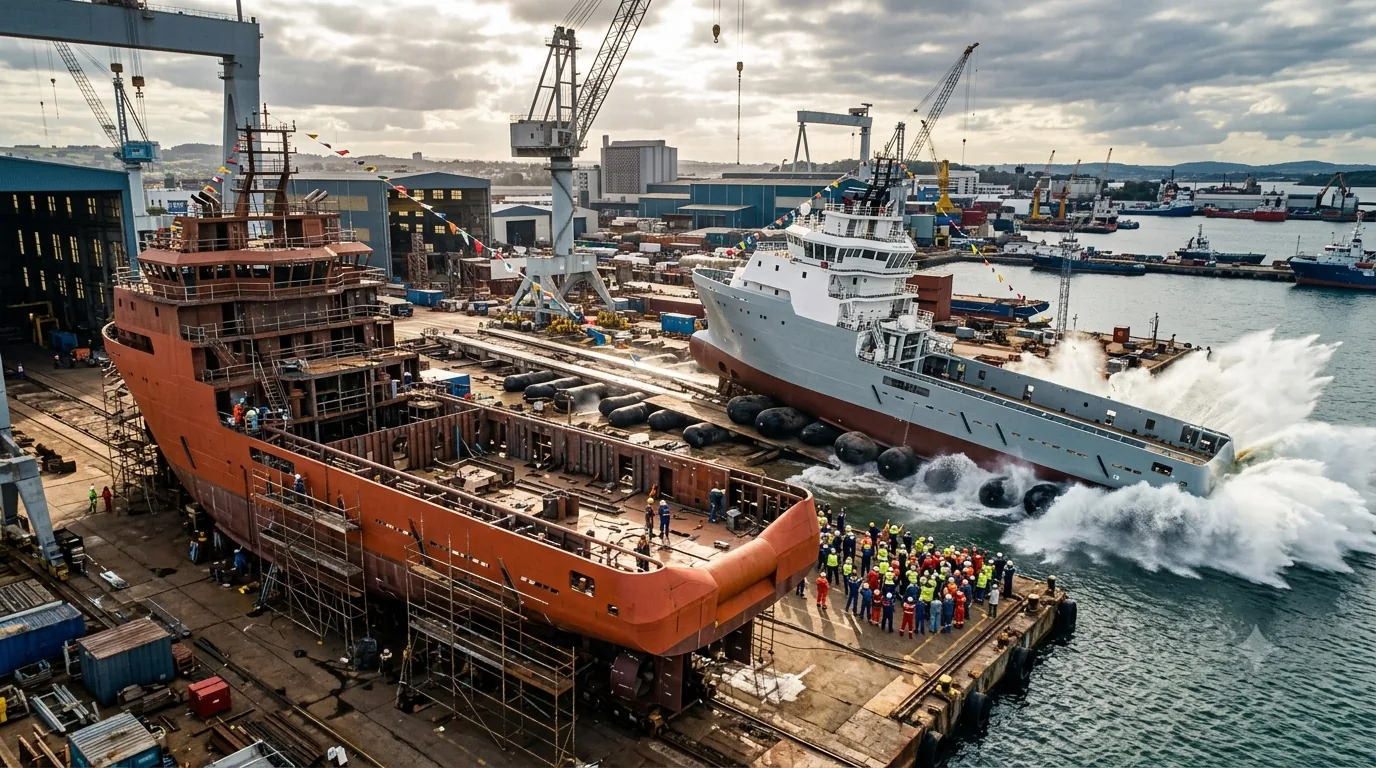
Launching, floating out of a dry dock, sliding down a slipway, or using a marine lift, moves the vessel from land-based construction to water, but the bulk of outfitting (cabling, piping, HVAC, navigation equipment, accommodation) typically runs concurrently with block construction rather than starting only after launch, since installing systems at the block stage is generally more efficient than installing them afterward. Progress here is where the gap between visual completeness and actual completeness is widest: a hull that looks nearly finished from outside can still have a large share of outfitting work remaining inside.
Testing, Commissioning and Sea Trials
Harbour Acceptance Tests (HAT), conducted moored at the yard, verify generators, pumps and software systems before the vessel ever leaves the berth. Sea Acceptance Tests (SAT), out in open water, push the vessel against its contractual performance guarantees, speed, maneuverability, crash-stop behavior, endurance. This is the highest-pressure phase for a PM specifically because any deficiency found here has almost no schedule slack left to absorb it, which is exactly why the preparation for these tests (agreed trial agenda, dock trials completed properly beforehand) matters more than the trials themselves.
Delivery and Post-Delivery Support
Formal handover, the protocol of delivery and acceptance signed by both parties, transfers ownership and risk from yard to owner. A warranty period (commonly in the range of 12 to 24 months, set by contract) follows, during which the yard remains responsible for defects traceable to construction. What actually determines how smooth this period is isn't the ceremony, it's whether the punch list and warranty obligations were documented precisely enough at delivery that a defect claim six months later can be resolved by referring to a record, not by relitigating what was agreed.
Where the Lifecycle Is Changing
Alternative fuel systems (LNG, methanol, battery-electric propulsion) are increasingly designed in from the concept phase rather than retrofitted later, and digital twins, virtual replicas of the physical vessel, are extending the same 3D model used for production information into post-delivery maintenance planning. Neither trend changes the seven-phase structure itself, but both push more technical decision-making earlier into the lifecycle, into concept and basic design, where changes are still comparatively cheap to make.
See also: Block Construction and Erection Sequencing, Critical Path Method (CPM) Scheduling for Shipbuilding, Drydock and Berth Planning Basics, Pre-Outfitting Strategy: Maximizing Block-Stage Work, and Reading a Ship's General Arrangement for Planners.