Why military shipbuilding programs keep starting construction before the design is finished, and what the Zumwalt and Constellation-class programs show about the cost of that gamble.
Defining Concurrency in Naval Acquisition
In military acquisition, "concurrency" refers to the deliberate overlap between the three foundational phases of a defense program: technology development, detail design, and ship construction. According to the Government Accountability Office (GAO), concurrency reflects the degree to which a program initiates physical construction while technology integration or structural design work remains incomplete. While overlapping these phases is often intended to compress procurement timelines, in warship construction it frequently introduces compounding technical, financial, and schedule risks.
For project managers transitioning from commercial shipbuilding to defense acquisition, the institutional tolerance for concurrency can be a major shock. In commercial shipyards, starting construction before a vessel's design is contractually frozen is considered an unacceptable risk. Commercial contracts rely on fixed design baselines before cutting steel to protect fixed-price margins and delivery schedules. In contrast, defense acquisition programs frequently initiate yard fabrication while major systems, spatial layouts, and structural calculations are still fluctuating.
The GAO's established best practice for naval acquisition is straightforward: a program must reach a full, verified understanding of the design and construction effort before signing a contract that fixes price, delivery dates, and performance parameters. Crucially, key design phases, culminating in a complete, fully integrated 3D product model, should be completed before physical construction begins. When programs violate this principle, design modifications inevitably ripple through active production lines, turning minor engineering revisions into costly physical rework.
The Structural Pressures That Drive Concurrency
If starting construction on an unfinished design routinely leads to negative program outcomes, why does defense acquisition repeatedly accept this risk? The decision to adopt high degrees of concurrency is rarely driven by technical preference. Instead, it is fueled by systemic acquisition pressures that prioritize immediate schedule milestones over long-term risk mitigation.
Primary drivers of concurrency include:
- Schedule Pressure and Threat Dynamics: Defense programs are often initiated in response to evolving strategic requirements. Program offices face intense pressure to deliver capability to the fleet as quickly as possible, leading leadership to overlap design and manufacturing schedules to meet aggressive deployment targets.
- Preserving Shipyard Capacity: Modern naval shipyards require a continuous flow of work to maintain active craft labor, engineering headcount, and specialized supply chains. Program leadership may authorize early construction start dates to prevent production line gaps between major shipbuilding programs, prioritizing workforce retention over design completion.
- Political and Industrial-Base Budgeting: Funding cycles in defense acquisition operate on strict fiscal timelines. Program managers often face "use-it-or-lose-it" budget constraints, where failing to transition from design to procurement within a specific fiscal year risks losing funding appropriations altogether.
These drivers create an environment where program leadership opts to begin construction with incomplete engineering data, accepting the risk of subsequent rework to keep project momentum going. However, warship construction is uniquely intolerant of mid-stream design revisions. Unlike software development or even land-based vehicle manufacturing, naval vessel construction involves dense spatial interdependencies. Structural bulkheads, high-voltage electrical distribution systems, heavy machinery spaces, and complex combat system cabling must be integrated precise millimeter by millimeter. Modifying a structural compartment or routing path mid-construction inevitably disrupts adjacent compartments, creating structural, weight, and center-of-gravity complications across the entire hull.
Case Study 1: The Zumwalt-Class Destroyer
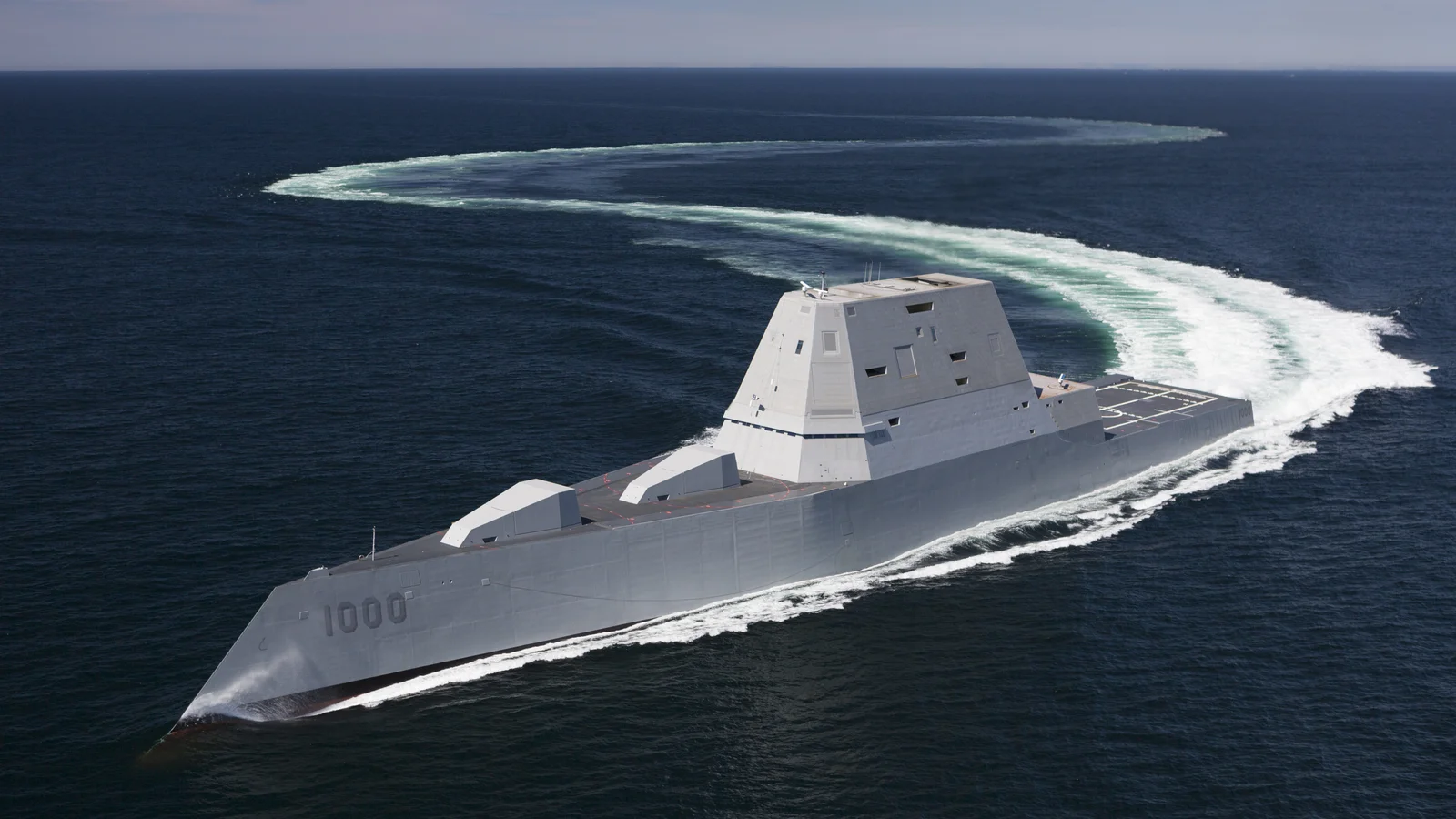
The Zumwalt-class destroyer (DDG-1000) serves as a classic modern example of high-concurrency acquisition risks. Conceived as a multi-mission surface combatant incorporating advanced stealth, automated systems, and clean-sheet gun systems, the program attempted to compress its development timeline by executing detail design concurrently with the integration of critical, unproven technologies.
Construction on the lead ship began before the ship's overall design was fully matured or integrated into a stable manufacturing baseline. Unproven deckhouse materials, novel power distribution architectures, and unresolved combat system requirements were continually modified while steel was actively being cut and assembled. This structural overlap created severe integration friction within the shipyard:
- Pervasive Physical Rework: Structural modifications required engineering teams to alter completed or in-progress ship modules, causing significant labor inefficiencies and schedule slip.
- Compounding Cost Growth: As design changes mounted, labor hours expanded rapidly beyond initial baselines, driving up unit costs and breaching projected acquisition budgets.
- Fleet Truncation: The compounding cost overruns stripped the program of its planned operational scale. Originally envisioned as a 32-ship class to replace existing surface combatants, the Navy was forced to progressively truncate procurement down to just 3 hulls.
The Zumwalt-class highlights a core reality of defense concurrency: attempting to compress schedule through simultaneous design and fabrication often yields the exact opposite outcome, resulting in dramatically higher unit costs and drastically smaller fleet numbers.
Case Study 2: The Constellation-Class Frigate (FFG-62)
While the Zumwalt-class demonstrated the danger of high concurrency paired with clean-sheet technology, the Constellation-class frigate (FFG-62) program illustrates how concurrency can undermine even an acquisition strategy designed specifically to avoid technical risk.
In April 2020, the Navy awarded prime contractor Fincantieri Marinette Marine a contract to build the lead Constellation-class frigate. To minimize design risk, schedule, and cost, the program was explicitly built around a "parent design" strategy: adapting the established, already-in-service Italian/French FREMM frigate baseline rather than engineering a hull from scratch. The initial acquisition strategy aimed for approximately 85 percent structural and subsystem commonality with the parent FREMM design.
However, the program pushed forward into construction before the engineering adaptations required for US Navy standards, combat systems, and survivability requirements were fully resolved and locked into a completed design model. The interplay of concurrent modification and premature fabrication quickly degraded the program's foundational assumptions:
- Collapse of Parent Design Commonality: As Navy-specific engineering changes, structural hardening, and system swaps were integrated into the incomplete design model, the initial target of ~85 percent commonality with the parent FREMM design collapsed to an actual figure of approximately 15 percent.
- Weight and Performance Degradation: Continuous structural redesign during active layout planning caused the vessel's projected displacement to grow significantly. The ship became approximately 13 percent overweight relative to early growth allowances, which directly degraded its targeted top speed and reduced operational weight growth margins reserved for future upgrades.
- Schedule Slippage and Cost Escalation: Managing physical construction alongside incomplete engineering models led to major shipyard delays. Delivery of the lead vessel slipped by approximately 3 years. Total unit procurement costs escalated rapidly, growing from an initial projection of ~$940 million per ship to ~$1.4 billion per ship. Across the planned fleet, the concurrency-driven redesign contributed to over $1 billion in added program costs.
The Constellation-class experience proved that invoking a "proven parent design" provides zero protection against concurrency risk if significant design alterations are allowed to overlap with early physical construction.
The Institutional Policy Response: The FF(X) Pivot
The systematic failure of the Constellation-class acquisition baseline eventually forced a direct structural policy intervention. Recognizing that the program's structural weight growth, design instability, and delivery delays had invalidated the initial business case, decision-makers made a clear break from the concurrent model.
On 25 November 2025, the Navy formally cancelled the Constellation-class frigate program beyond the first two hulls already under contract. Shortly thereafter, on 19 December 2025, the Navy announced its replacement program, designated FF(X), awarded to Huntington Ingalls Industries (HII) Ingalls Shipbuilding.
The architectural strategy behind the FF(X) selection represents a direct, documented institutional reaction to the concurrency lessons learned on FFG-62 and DDG-1000. Rather than attempting another extensive design adaptation of a foreign warship or starting a clean-sheet design, the Navy explicitly anchored the FF(X) program to an existing, fully proven, active hull design: the U.S. Coast Guard's Legend-class National Security Cutter.
By taking an active, hot-production hull baseline with mature supply chains and proven operational weight balances, the defense acquisition establishment sought to eliminate design-immaturity risk entirely before fabrication started. The choice of the Legend-class hull demonstrates a formal recognition that true risk reduction is achieved not through contractual assumptions of commonality, but by enforcing absolute design maturity and line readiness before committing to physical production.
Commercial vs. Defense Shipbuilding: Bridging the Mindset Gap
Project managers entering the defense shipbuilding sector from commercial marine construction often face a fundamental misalignment in risk management philosophy. To manage programs effectively in this domain, PMs must understand why this divide exists and how to navigate it.
In commercial shipbuilding, profit margins depend on predictable serial production. A commercial yard standardizes modular hull units, locks spatial arrangements early, and refuses steel cutting until functional and detailed drafting reaches virtually 100 percent completion. A commercial customer who requests a structural or layout modification after steel cutting is issued a formal variation order that adjusts both price and delivery date: often carrying steep financial penalties.
In defense acquisition, program management operates under an entirely different operational construct:
- FAR and DFARS Requirements: Defense acquisition is governed by complex Federal Acquisition Regulation (FAR) and Defense FAR Supplement (DFARS) frameworks that distribute risk differently than commercial BIMCO or standard shipbuilders' contracts. Fixed-Price Incentive Firm (FPIF) or Cost-Plus contracts are often structured to absorb or split early design rework costs between the government and contractor, blunting the immediate financial penalty that would otherwise deter a commercial yard from starting construction early.
- Evolving Threat Baselines: Unlike commercial vessels built for static trade routes, warships face evolving operational threats during multi-year build cycles. Program leadership is continually tempted to insert new radars, electronic warfare suites, or weapons modules into an active production line, assuming the capability gain outweighs the integration cost.
- Multi-Stakeholder Authority: A commercial PM typically answers to a single technical superintendent or client representative. A defense PM operates at the intersection of NAVSEA technical authorities, fleet operational requirements officers, shipyard manufacturing managers, and legislative oversight committees: each with distinct priorities regarding schedule, capability, and industrial capacity.
Leading Indicators of Design Maturity for Program Health
To prevent concurrency from quietly eroding schedule and cost baselines, project managers must monitor empirical indicators of design health. Assessing a program's readiness to cut steel requires looking past high-level schedule milestones and evaluating granular design artifacts.
When assessing whether a warship program is approaching critical concurrency risk, project managers should monitor three primary metrics:
1. 3D Product Model Completion and Spatial Integration
In modern naval architecture, a 3D product model is much more than a collection of structural drawings; it is a fully integrated spatial database containing structural, piping, electrical, HVAC, and combat system arrangements. A key leading indicator of design health is the percentage of zones within the 3D model that are fully modeled, spatially uncluttered, and locked against further routing changes.
Starting construction when overall 3D product model maturity is low virtually guarantees physical interference in the yard. PMs should look for complete spatial integration of complex machinery spaces and distributed system routings prior to block fabrication, rather than relying on high-level hull design completion metrics.
2. Detail Design Drawing Release Metrics
A reliable warning sign of high concurrency risk is a gap between scheduled work package releases and the actual percentage of approved detail design drawings available to production craft. Program managers should track:
- Functional Drawing Releases: System schematics and one-line diagrams detailing operational system logic.
- Structural and Production Drawing Releases: Exact physical cutting files, plate nesting configurations, and unit assembly instructions.
If physical construction begins while production drawing release curves remain flat or fall behind target, craft workers will inevitably work from incomplete engineering instructions. This dynamic triggers high levels of shipyard Engineering Change Requests (ECRs) and widespread physical rework.
3. Parent Baseline Variance and Growth Limits
When a program relies on a parent design strategy to compress development time, PMs must track the variance between the modified baseline and the original parent design. A rapidly declining commonality percentage, as seen in the Constellation-class frigate, is a definitive leading indicator that the program is shifting from a low-risk modification to an unannounced clean-sheet redesign.
PMs must closely monitor structural weight growth allowances, center-of-gravity shifts, and electrical capacity margins. When design revisions consume weight and power margins during detail design, the ship will require further structural redesign during construction to restore baseline stability and performance: bringing the severe penalties of high concurrency full circle.
Ultimately, managing concurrency requires the discipline to treat design maturity as an absolute prerequisite for physical production. As demonstrated across major naval programs, cutting steel on an unfinished warship design does not save time; it simply shifts the engineering effort into the shipyard, where design corrections are paid for in high-cost labor hours, lost structural margins, and compromised operational capacity.
This checkpoint system is exactly what a well-run acquisition milestone process is meant to enforce: see our field guide to Milestone B and Milestone C for how the gates themselves work.