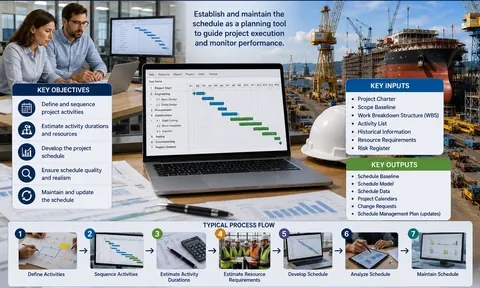


Master PMI-SP Domain 4: Schedule Closeout with this comprehensive study guide. Learn how to obtain final acceptance of contractual schedule components, evaluate project performance against the baseline, document lessons learned, distribute final reports including EVM analysis, and properly archive schedule files for forensic readiness. Specifically tailored for professionals working in shipbuilding and ship repair projects, this guide provides practical checklists, real-world examples, 20 practice questions with detailed explanations, and best practices to successfully close out complex project schedules. Strengthen your scheduling expertise and prepare effectively for the PMI Scheduling Professional (PMI-SP)® exam.
The Project Management Institute’s Scheduling Professional (PMI-SP)® certification is the premier credential for professionals who specialize in developing, maintaining, analyzing, and controlling project schedules. In industries where time is money (such as shipbuilding, offshore construction, oil & gas, infrastructure, and complex manufacturing) mastering scheduling is not just a skill; it is a strategic advantage that directly impacts project success, profitability, and organizational reputation.
The PMI-SP exam is built around a detailed Examination Content Outline (ECO) that divides the role of the scheduler into five performance domains. These domains reflect the full lifecycle of scheduling activities from initial strategy through planning, execution monitoring, and finally closeout.
Domain 4: Schedule Closeout represents only 6% of the exam questions. At first glance, this small percentage might suggest it is less critical than Domain 3 (Schedule Monitoring and Controlling at 35%) or Domain 2 (Schedule Planning and Development at 31%). However, experienced schedulers and project controls professionals understand that closeout is the capstone process. It is where all previous work is validated, knowledge is captured, contractual obligations are formally concluded, and the foundation for future project success is laid through lessons learned and archived data.
Poor schedule closeout can lead to: - Lost opportunities for defending against or pursuing delay claims - Incomplete historical data that handicaps future estimating and planning - Failure to obtain formal customer or sponsor acceptance, leaving contractual loose ends - Missed lessons that allow the same scheduling mistakes to repeat across projects - Reputational damage when final reports are incomplete or inaccurate
In contrast, organizations that excel at schedule closeout build a powerful knowledge asset. They improve their scheduling maturity, reduce risk on subsequent projects, and create defensible records that protect both the performing organization and the client.
This comprehensive study guide is designed specifically for PMI-SP candidates preparing for Domain 4, as well as practicing schedulers who want to elevate their closeout processes. We will explore every task in depth, provide real-world examples (with special relevance to shipbuilding and new-build planning environments), offer actionable checklists, examine Earned Value Management application at project end, discuss forensic readiness, and include practice questions with detailed explanations.
This applies directly whether the reader is a New Build Planning Chief working on offshore patrol vessels, a project controls lead in construction, or an independent scheduling consultant — mastering Schedule Closeout makes you more valuable to your organization and more confident going into the PMI-SP exam.
Let us begin by clearly defining what Schedule Closeout entails according to the PMI role delineation.
What is Schedule Closeout? Definitions, Scope, and Strategic Value
Schedule Closeout encompasses all activities required to formally conclude the scheduling aspects of a project. According to the PMI-SP Examination Content Outline, it involves:
“Activities related to finalizing all schedule activities, evaluating schedule performance against the original baseline, documenting lessons learned, and distributing final schedule information.”Photorealistic image of a modern shipyard at golden hour, large offshore patrol vessel under construction in the background, professional scheduler in high-visibility vest standing in the foreground reviewing a large printed Gantt chart and schedule documents on a table, calm focused atmosphere, detailed cranes and steel structures, soft warm lighting, cinematic composition, high detail, realistic, no text anywhere
This definition highlights four core pillars: 1. Finalization of schedule-related work and deliverables 2. Evaluation of performance against the approved baseline and chosen scheduling approach 3. Documentation and institutionalization of lessons and best practices 4. Distribution and Archiving of information for stakeholders and future reference
Schedule Closeout is not merely an administrative afterthought. It is a deliberate, value-adding process that occurs in parallel with overall project closeout activities described in the PMBOK Guide’s Integration Management knowledge area (Close Project or Phase process).
Why Schedule Closeout Matters Strategically
In traditional project management, the focus is often heavily weighted toward planning and execution. Closeout receives less attention because the “real work” appears finished. However, the scheduler’s perspective reveals why closeout is strategically vital:
- Contractual Closure: Many contracts require specific schedule deliverables at completion, final as-built schedule, final progress curves, delay analysis reports, or formal acceptance of the baseline and all approved updates. Failing to obtain sign-off can delay final payment, release of retainage, or trigger disputes.
- Knowledge Capture: Every project generates unique insights about activity durations, logic relationships, resource productivity, risk events, and mitigation effectiveness. Without structured closeout, this intellectual capital evaporates when the team disperses.
- Forensic Readiness: In industries prone to claims (construction, ship repair, engineering-procurement-construction), the archived schedule data, change logs, and contemporaneous records become the primary evidence in delay and disruption claims. Proper closeout preserves the “story” of the project in a defensible format.
- Organizational Learning: Updated organizational process assets (templates, historical databases, scheduling guidelines, risk checklists) directly improve the Schedule Strategy (Domain 1) and Schedule Planning and Development (Domain 2) of future projects. Closeout feeds the continuous improvement loop.
- Stakeholder Satisfaction: The final reports and formal acceptance meeting provide a structured opportunity to demonstrate professionalism, transparency, and control. This strengthens relationships for future work.
- Resource Release and Transition: Clear closeout allows schedulers and planners to be formally released to new assignments with documented handover of any ongoing schedule elements (warranty schedules, maintenance windows, etc.).
Schedule Closeout vs. General Project Closeout
While closely related, schedule closeout has a narrower but deeper focus than overall project closeout. Project closeout includes scope verification, contract closure, financial closure, resource release, and lessons learned across all knowledge areas. Schedule closeout zooms in on the schedule model, its performance data, supporting artifacts, and the specific contractual schedule obligations.
A well-run schedule closeout supports and accelerates the broader project closeout by providing clear evidence that scope was delivered on the agreed timeline (or documenting variances transparently).
The Scheduler’s Unique Role in Closeout
Unlike a general project manager who may view closeout as one of many closing activities, the scheduler often owns or heavily contributes to: - Final schedule model quality assurance - Baseline vs. actual comparison reports - EVM final calculations and narrative - Archiving of native schedule files and supporting data - Facilitating schedule-specific lessons learned sessions - Preparing documentation for potential forensic analysis
This specialized ownership makes Domain 4 knowledge essential for anyone aspiring to the PMI-SP credential.
Detailed Breakdown of the Five Tasks in Domain 4
The PMI-SP Examination Content Outline defines five specific tasks under Domain 4. Each task has a clear purpose statement (“in order to…”). Understanding not just what to do but why you are doing it is critical for both the exam and real-world application. We will examine each task in exhaustive detail.
Task 1: Obtain Final Acceptance of the Contractual Schedule Components
Task Statement (from ECO):
“Obtain final acceptance of the contractual schedule components, by working with sponsor and/or customer, in order to facilitate project closeout.”
What Are Contractual Schedule Components?
Contractual schedule components are the schedule-related deliverables, baselines, updates, and records that are either explicitly required by the contract or have become contractually binding through the change control process. They typically include:
- The original approved baseline schedule (and all approved baseline revisions)
- The schedule management plan (or relevant sections)
- All formally approved schedule updates and revisions
- Schedule change requests and their disposition (approved, rejected, deferred)
- Progress measurement methodology documentation
- Any schedule-related exhibits or attachments to the contract
- As-built or final schedule deliverables required at completion
- Supporting data such as daily/weekly progress records used for payment or milestone verification
In shipbuilding and heavy construction projects, these components often carry significant weight because milestones tied to schedule performance trigger stage payments, delivery bonuses, or liquidated damages.
How to Obtain Final Acceptance, Step-by-Step Process
- Preparation Phase (Internal)
- Compile a complete package of all contractual schedule components.
- Perform internal quality review: Are all updates properly baselined? Is the change log complete and consistent with schedule versions? Are there any open schedule-related issues?
- Prepare a summary “Schedule Closeout Dossier” that highlights key performance metrics, major changes, and resolutions.
- Brief internal stakeholders (project manager, contracts manager, commercial team) on any contentious points.
- Pre-Meeting Alignment with Sponsor/Customer
- Schedule a dedicated “Final Schedule Acceptance Meeting.”
- Share the dossier in advance with a clear agenda.
- Identify any known areas of disagreement early and prepare supporting evidence (contemporaneous records, correspondence, photos, daily reports).
- Conducting the Acceptance Meeting
- Walk through the final schedule model: baseline vs. actual completion dates for major milestones.
- Present variance analysis: explain major delays and accelerations with root causes.
- Review the change management trail: demonstrate that all scope changes and their schedule impacts were properly processed.
- Address any “punch list” items related to schedule deliverables.
- Use visual tools: comparison Gantt charts, progress S-curves, milestone achievement tables.
- Formal Sign-Off
- Use a pre-agreed Schedule Acceptance Form or incorporate into the overall Project Acceptance Certificate.
- Ensure signatories have proper authority (sponsor, customer representative, contracts/legal).
- Capture any conditional acceptance and the plan to resolve remaining items.
- Distribute signed copies to all parties and file in the project records.
Common Challenges and How to Overcome Them
- Disagreement on Delay Responsibility: Have the contemporaneous delay analysis ready. If the project used a prospective time impact analysis (TIA) process, the final position should be easier to defend.
- Incomplete Change Documentation: This is why Task 5 (archiving) and ongoing discipline throughout the project matter. Prevention is better than cure.
- Customer Wants More Detail: Be prepared to provide drill-down reports or native files (with appropriate controls).
- Internal Pressure to “Just Get Sign-Off”: Resist shortcuts that could expose the organization later. Proper acceptance protects everyone.
Real-World Example (Shipbuilding Context):
A shipyard is delivering an Offshore Patrol Vessel. The contract requires formal acceptance of the “Master Construction Schedule” and all approved revisions at delivery. The scheduler prepares a final as-built schedule showing that sea trials and delivery milestones were met despite a 3-week delay in hull fabrication caused by late steel delivery (excusable). The customer initially disputes the excusability. The scheduler presents the approved TIA, correspondence with the steel supplier, and updated schedule showing mitigation through parallel outfitting work. After review, the customer signs the Schedule Acceptance Form, releasing the final milestone payment and enabling smooth project financial closeout.
Task 2: Evaluate Final Schedule Performance Against Baseline Schedule, Scheduling Approach and the Implementation
Task Statement:
“Evaluate final schedule performance against baseline schedule, scheduling approach and the implementation, using standard scheduling tools and techniques, including solicitation of feedback from stakeholders, in order to identify lessons learned and develop best practices.”
This task is the analytical heart of schedule closeout. It transforms raw performance data into actionable organizational intelligence.
Key Evaluation Dimensions
- Performance Against Baseline
- Overall project duration variance (actual completion vs. baseline completion)
- Milestone achievement: On-time, early, or late?
- Critical path performance: Did the original critical path remain critical? How much float was consumed or created?
- Float analysis: Remaining total float and free float at key activities.
- Resource productivity: Actual vs. planned man-hours or equipment utilization on critical and near-critical activities.
- Evaluation of the Scheduling Approach
- Was the chosen methodology appropriate? (Critical Path Method, Critical Chain, resource leveling aggressiveness, rolling wave planning effectiveness, etc.)
- Did the level of detail in the schedule support effective control without becoming unmanageable?
- Were calendars, constraints, and leads/lags used correctly and consistently?
- How well did the schedule integrate with cost and risk management processes?
- Evaluation of Implementation
- Quality of schedule updates: timeliness, accuracy of progress data, proper reflection of change orders.
- Effectiveness of schedule control processes: early warning system, variance thresholds, corrective action planning.
- Stakeholder engagement with the schedule: Was it used as a living management tool or treated as a reporting artifact?
- Issue management: How quickly and effectively were schedule issues identified and resolved?
Tools and Techniques for Evaluation
- Schedule Comparison Reports: Baseline vs. current/final versions (many tools have “claim digger” or comparison features).
- Earned Value Analysis: Final SPI, CPI, SV, CV, and explanation of trends.
- Root Cause Analysis: 5 Whys, fishbone diagrams, or fault tree analysis applied to major variances.
- Stakeholder Feedback Mechanisms:
- Structured interviews with project team members, subcontractors, and client representatives.
- Anonymous surveys on schedule usability and communication effectiveness.
- Facilitated lessons learned workshops focused specifically on scheduling.
- Retrospectives at phase or work-package level.
Turning Evaluation into Lessons Learned and Best Practices
The output of Task 2 is not just a report. It is a set of documented lessons and recommended best practices that feed directly into Task 3.
Example Lessons from a Complex Shipbuilding Project: - “Rolling wave planning with 3-month detail windows worked well for outfitting but was insufficient for long-lead equipment procurement. Future projects should extend detailed planning to 6 months for procurement activities.” - “The decision to constrain the sea trial date as a ‘must finish on’ date created negative float that masked true critical path. Better to use soft constraints or buffers.” - “Weekly schedule review meetings with all major subcontractors improved update accuracy by 40% and reduced surprise delays.”
Each lesson should be specific, actionable, and include context so future teams can judge applicability.
Task 3: Update the Organizational Process Assets
Task Statement:
“Update the organizational process assets, through documentation of identified lessons learned and best practices, in order to improve business processes.”
Organizational Process Assets (OPAs) are the plans, processes, policies, procedures, and knowledge bases specific to and used by the performing organization. In the scheduling domain, key OPAs include:
- Schedule management plan templates and examples
- WBS and activity list libraries
- Standard calendars and resource pools
- Historical duration and productivity databases
- Scheduling software configuration standards and best practice guides
- Change control procedures specific to schedule
- Lessons learned repository (scheduling category)
- Risk checklist and response strategies with schedule impact
- Closeout checklists and acceptance templates
How to Effectively Update OPAs During Closeout
- Capture While Fresh: Conduct lessons learned sessions as close as possible to project end while memories are vivid. Do not wait until the team has dispersed.
- Structure the Documentation:
- Use a consistent template: Situation, Impact, Lesson, Recommendation, Applicable Project Types, Owner for Implementation.
- Tag lessons by domain (strategy, planning, monitoring, closeout) and by project phase or work type (e.g., hull construction, commissioning).
- Prioritize and Validate:
- Not every observation becomes an OPA update. Focus on high-impact, repeatable items.
- Have the scheduling community of practice or PMO review and approve additions.
- Implement and Communicate:
- Update the actual documents and databases.
- Announce changes through internal channels, training sessions, or updated onboarding materials for new schedulers.
- Track adoption on subsequent projects.
Shipbuilding-Specific Example:
After closing out a series of patrol boat projects, the planning department updates the standard WBS to include a new level for “Combat Systems Integration” based on lessons that this work package was consistently underestimated in duration and had complex interface dependencies. They also add a standard “Sea Trial Buffer” activity with recommended duration based on historical variance data. These updates are incorporated into the Arya ERP scheduling module and the corporate scheduling manual.
Task 4: Distribute Final Schedule Reports, Including Earned Value Management (EVM) Calculations and Variance Analysis
Task Statement:
“Distribute final schedule reports, including earned value management (EVM) calculations and variance analysis, to stakeholders in order to facilitate project closeout.”
Final reports serve multiple audiences and purposes: - Customer/Sponsor: Formal evidence of performance and basis for acceptance and final payment. - Senior Management: Strategic insights into scheduling capability and project outcome. - Project Team: Recognition of achievements and context for lessons learned. - Future Project Teams: Historical data and benchmarks. - Contracts/Legal: Supporting documentation for claims or disputes.
Essential Final Schedule Reports
- Final Schedule Performance Report
- Executive summary of baseline vs. actual completion
- Milestone achievement scorecard
- Critical path analysis narrative
- Major variance explanations with supporting data
- Earned Value Management Final Report
- Tabular summary of all EVM metrics at project completion (AC, EV, PV, BAC, EAC, VAC, SPI, CPI, etc.)
- S-curve graphs showing planned vs. earned vs. actual cost over time
- Narrative explaining final SPI and CPI values and trends
- Reconciliation of any forecast vs. actual differences
- As-Built Schedule and Comparison Analysis
- Final schedule model with actual start/finish dates
- Side-by-side or overlaid Gantt showing baseline vs. as-built
- Detailed variance report at activity or hammock level for key work packages
- Change Log Summary and Impact Analysis
- Total number of schedule change requests
- Breakdown by cause (owner-directed, contractor-initiated, external)
- Net schedule impact of all approved changes
- Lessons Learned Summary (Scheduling Focus)
- Top 5-10 lessons with actionable recommendations
- Best practices identified and proposed for standardization
Distribution Best Practices
- Tailor format and detail level to the audience (executive one-pager vs. detailed technical appendix).
- Use visual storytelling: charts, dashboards, before/after comparisons.
- Include both quantitative data and qualitative narrative.
- Provide native files (with read-only protection if needed) alongside PDF versions.
- Establish a formal distribution list and obtain confirmation of receipt where appropriate.
- Archive a complete set with the project records (links to Task 5).
Task 5: Archive Schedule Files
Task Statement:
“Archive schedule files (for example, final schedule model, schedule management plan, periodic status reports, schedule change log), as per defined procedures in order to satisfy contractual requirements and prepare for potential forensic schedule analysis.”
Archiving is the long-term memory of the project. In industries where disputes can arise years after completion, the quality of the archive can determine whether a claim is won, lost, or settled favorably.
What to Archive, Comprehensive Checklist
Core Schedule Artifacts: - Final native schedule model file(s), all versions from baseline through final update (with clear naming convention and version history) - Exported formats: PDF, XER (Primavera), MPP (MS Project), XML, etc. - Schedule management plan (final approved version) - All periodic status reports and progress narratives - Complete schedule change log with supporting documentation - Baseline change records and revision history
Supporting Data: - Daily/weekly progress reports, photos, and inspection records used for schedule updates - Resource loading and leveling reports - Risk register updates related to schedule - Correspondence, meeting minutes, and emails referencing schedule issues or changes - Time impact analyses (TIAs) and delay analysis reports - Subcontractor schedule submissions and approvals
Metadata and Indexing: - Project name, number, client, contract reference - Scheduler(s) of record and contact information - Software version and any custom configurations used - Date of archive and retention period - Index or manifest of all archived items
Archiving Procedures and Best Practices
- Follow the schedule management plan’s archiving section or the organization’s records management policy.
- Use a centralized, access-controlled repository (SharePoint, document management system, or dedicated project controls database).
- Apply consistent naming conventions and folder structures across all projects.
- Create both working copies and read-only archival copies.
- For forensic readiness: Preserve the ability to reconstruct the schedule state at any point in time. This often means keeping multiple versions rather than only the final file.
- Comply with contractual retention requirements (often 5–10 years or longer for certain project types).
- Consider legal hold procedures if disputes are anticipated.
Forensic Schedule Analysis Preparation
Forensic schedule analysis is the investigation of schedule delays and impacts after the fact, often in the context of litigation or arbitration. Proper closeout archiving dramatically reduces the cost and risk of such analysis by preserving: - Contemporaneous schedule updates (the “as-planned” vs. “as-built” story told in real time) - The logic and constraints that were actually used during the project - The change management history - Supporting progress data
Without good archives, forensic experts must reconstruct events from incomplete records, leading to higher costs, longer disputes, and less reliable conclusions.
Key Knowledge Areas and Skills for Schedule Closeout
The ECO lists specific knowledge and skills associated with Domain 4:
- Contractual schedule components: Understanding what the contract requires and how schedule deliverables become binding.
- Schedule closeout procedures: Standardized processes within the organization or dictated by contract.
- Feedback techniques: Methods to solicit honest, useful input from stakeholders (interviews, surveys, workshops, 360-degree feedback).
- Schedule review techniques: Systematic approaches to comparing planned vs. actual performance and diagnosing variances.
- Schedule issue management: Processes to identify, log, escalate, and resolve open schedule issues before formal closeout.
- Transition planning: Handover of schedule-related responsibilities, data, and tools to operations, maintenance, warranty teams, or subsequent projects.
Mastering these enables the scheduler to execute Domain 4 tasks professionally and defensibly.
Integrating Schedule Closeout with PMBOK Guide and Other PMI-SP Domains
Schedule Closeout does not exist in isolation. It is tightly integrated with:
PMBOK Guide Integration Management: - Close Project or Phase process relies on schedule closeout outputs for formal acceptance and lessons learned. - Final project report often includes schedule performance summary.
Domain 1: Schedule Strategy: - Closeout lessons directly inform future strategy choices (methodology selection, level of detail, software standards, etc.).
Domain 2: Schedule Planning and Development: - Updated OPAs improve WBS development, activity definition, duration estimating, and schedule model creation on future projects.
Domain 3: Schedule Monitoring and Controlling: - Closeout evaluation reveals the effectiveness of monitoring processes used during execution. Weaknesses identified here lead to improved control mechanisms.
Domain 5: Stakeholder Communications Management: - Final report distribution and acceptance meetings are key communication events. Stakeholder feedback collected here improves future communication planning.
Understanding these linkages helps candidates answer exam questions that cross domains and demonstrates holistic thinking in professional practice.
Earned Value Management (EVM) in Schedule Closeout: Deep Dive
EVM is a powerful technique for integrating scope, schedule, and cost performance. At project closeout, EVM provides objective, quantitative answers to the questions: “Did we deliver the planned scope on time and within budget?”
Final EVM Calculations and Interpretation
At project completion: - Budget at Completion (BAC) = Total authorized budget for the project - Actual Cost (AC) = Total costs actually incurred - Earned Value (EV) = BAC (because 100% of planned work is complete, assuming scope was fully delivered) - Planned Value (PV) at completion = BAC (by definition)
Therefore: - Schedule Variance (SV) = EV - PV = 0 at completion (mathematically) - Schedule Performance Index (SPI) = EV / PV = 1.0 at completion (mathematically)
This seems counter-intuitive at first. The final SPI is always 1.0 if the project is complete, regardless of whether it finished early, on time, or late.
The real value of EVM at closeout lies in: - Trend Analysis: Reviewing the SPI and CPI curves over the life of the project to understand when and why performance deviated. - Variance at Completion (VAC) = BAC - AC : Shows final cost overrun or underrun. - Estimate at Completion (EAC) reconciliation: Compare the various EAC formulas used during the project to the actual final cost. - Narrative Explanation: The scheduler must explain why the project finished when it did, using EVM data as supporting evidence alongside schedule-specific analysis.
Best Practice: Present final EVM data alongside traditional schedule metrics (milestone achievement, critical path completion, total float consumption). EVM alone does not tell the full schedule story.
Best Practices for Effective Schedule Closeout
Drawing from industry experience and PMI guidance, here are proven best practices:
- Plan for Closeout from Day One: Include closeout activities, acceptance criteria, and archiving requirements in the schedule management plan and project management plan.
- Maintain Discipline Throughout Execution: Good closeout starts with clean, contemporaneous records. Avoid “catch-up” updates at the end.
- Conduct Phased Closeout: For long projects, close out completed phases or work packages progressively rather than waiting until the very end.
- Use Checklists: Develop and use comprehensive schedule closeout checklists tailored to your organization and project type.
- Involve Stakeholders Early: Do not surprise the customer with final acceptance requests. Keep them engaged throughout.
- Protect the Narrative: Ensure the schedule change log and supporting documentation tell a coherent, defensible story of what happened and why.
- Prioritize Forensic Readiness: Assume disputes may arise. Archive in a way that allows reconstruction of events.
- Capture Lessons While Fresh: Schedule dedicated sessions immediately after major milestones or at project end.
- Standardize and Automate Where Possible: Use templates, macros, and scheduling software features to reduce manual effort and errors in reporting and archiving.
- Treat Closeout as a Project in Itself: Assign clear ownership, schedule the activities, and track progress to completion.
Common Pitfalls and How to Avoid Them
- Rushing Closeout: Pressure to release resources or finalize accounts leads to incomplete acceptance or poor archiving. Solution: Build closeout duration and resources into the baseline schedule.
- Incomplete Change Documentation: Gaps in the change log create disputes. Solution: Enforce change control discipline from day one.
- Losing Institutional Knowledge: Team members leave before lessons are captured. Solution: Conduct lessons learned in phases and document immediately.
- Poor Version Control: Multiple conflicting schedule versions cause confusion. Solution: Strict naming conventions and a single source of truth.
- Ignoring Contractual Requirements: Assuming “the schedule is done” without formal acceptance. Solution: Map contract deliverables to closeout tasks early.
- Weak Stakeholder Communication: Final reports are too technical or too high-level. Solution: Tailor communication and seek feedback on format.
Real-World Applications and Case Studies
Case Study 1: Offshore Patrol Boat New Build (Shipbuilding)
A 85m OPV project experienced a 6-week delay on the critical path due to a combination of late engine delivery and subsequent integration issues. The scheduler maintained rigorous contemporaneous updates and TIAs. At closeout: - Task 1: Customer accepted the final schedule package after a 2-hour walkthrough demonstrating that mitigation actions recovered 4 weeks. - Task 2: Evaluation revealed that the rolling wave approach needed refinement for complex systems integration. Lessons documented. - Task 3: Updated corporate WBS library and added new standard activities for engine integration testing. - Task 4: Final EVM report showed SPI trending to 0.92 but finishing at 1.0 (complete). Narrative explained recovery actions. VAC was positive due to efficient resource use. - Task 5: Full archive included 47 schedule versions, daily progress photos, and all TIA files. Two years later, when a subcontractor claim arose, the archived data allowed quick defense.
Case Study 2: Lessons from a Failed Closeout
A commercial building project rushed closeout to meet year-end reporting. The scheduler archived only the final P6 file. Two years later, a major delay claim emerged. Without intermediate updates and supporting progress data, the organization could not effectively rebut the claimant’s retrospective analysis. Settlement was unfavorable. This case reinforced the need for comprehensive archiving (Task 5) and became a lessons learned item that changed company policy.
Tools and Techniques for Schedule Closeout
Popular scheduling tools offer specific features that support closeout: - Oracle Primavera P6: Claim Digger for schedule comparison, powerful reporting, export to multiple formats, baseline management. - Microsoft Project: Compare Projects feature, visual reports, export to Excel/PDF, custom fields for closeout tracking. - Other Tools: Asta Powerproject, Phoenix Project Manager, Spider Project, each has strengths in comparison, archiving, and reporting.
General techniques include: - Schedule health checks and audits at closeout - Automated report generation from integrated project controls systems - Dashboarding tools (Power BI, Tableau) for final performance visualization - Document management systems for structured archiving
Transition Planning and Handover Considerations
Schedule closeout often includes transitioning schedule ownership or data to: - Operations and maintenance teams (warranty schedules, maintenance windows) - Subsequent projects or programs (if part of a larger portfolio) - Asset management systems
Transition planning ensures continuity and prevents loss of schedule knowledge when the project team disbands.
Legal, Contractual, and Claims Implications
In many jurisdictions and contract forms (FIDIC, NEC, AIA, shipbuilding contracts), the project schedule and its updates have contractual status. Proper closeout: - Provides evidence of compliance with notice provisions for delays - Supports or defends extension of time (EOT) claims - Protects against allegations of concurrent delay or failure to mitigate - Creates a clear record for any post-completion disputes
Schedulers should coordinate closely with contracts and legal teams during closeout.
Exam Preparation Strategy, Mnemonics, and Practice Questions
Mnemonics for the Five Tasks: - “A-E-U-D-A” → Acceptance, Evaluate, Update OPA, Distribute reports, Archive - “Always Evaluate Updates Daily, Archive” (rough memory aid)
Study Tips: - Focus on the “in order to” purpose of each task. - Understand why archiving supports forensic analysis. - Know how EVM metrics behave at project completion. - Be able to distinguish schedule closeout from general project closeout. - Practice explaining lessons learned in a structured, actionable format.
Practice Questions with Detailed Explanations
The following 20 original practice questions are designed to test your understanding of PMI-SP Domain 4 concepts, tasks, and their application in real-world scenarios, particularly relevant to complex projects like shipbuilding and construction. Each question includes four options and a detailed explanation of the correct answer and why others are incorrect. Use these to prepare for the exam and to deepen your professional practice.
Question 1: During schedule closeout on a large shipbuilding project, the scheduler is preparing to obtain final acceptance of the contractual schedule components from the customer. Which of the following actions is MOST critical to facilitate smooth and timely acceptance?
A. Submitting only the final native schedule file (e.g., P6 .XER) without additional documentation
B. Preparing and presenting a comprehensive Schedule Closeout Dossier that includes baseline vs. actual comparisons, the complete change log summary, and key variance narratives
C. Waiting for the project manager or contracts department to initiate the acceptance meeting
D. Immediately archiving all schedule files before obtaining any formal sign-off
Correct Answer: B
Explanation: A well-prepared Schedule Closeout Dossier provides the customer with clear, organized evidence of performance, changes, and resolutions. This builds confidence and reduces the likelihood of disputes or requests for additional information that could delay acceptance. Option A lacks context and narrative, making it difficult for the customer to understand the “why” behind variances. Option C abdicates the scheduler’s proactive role in driving closure. Option D reverses the logical order, acceptance should generally precede or occur in parallel with final archiving to ensure all parties agree on the record being preserved.
Question 2: A scheduler is evaluating final schedule performance as part of Task 2 in Domain 4. The project finished 4 weeks later than the approved baseline. The critical path shifted twice during execution due to owner-directed changes and a supplier delay. What is the PRIMARY purpose of soliciting structured feedback from stakeholders during this evaluation?
A. To assign blame for the delays to specific subcontractors or team members
B. To identify lessons learned about the effectiveness of the scheduling approach, update processes, and mitigation strategies in order to develop actionable best practices
C. To justify an extension of time claim against the customer
D. To complete the administrative requirement for the project management plan
Correct Answer: B
Explanation: Task 2 explicitly states the purpose of evaluation is “to identify lessons learned and develop best practices.” Structured feedback from stakeholders (team members, subcontractors, customer representatives) provides diverse perspectives on what worked, what did not, and why. This directly feeds Task 3 (updating OPAs). Option A is counterproductive and not the purpose of closeout evaluation. Option C may be a secondary commercial activity but is not the primary scheduling purpose. Option D understates the strategic value of the evaluation.
Question 3: Which of the following items should be included in the update to Organizational Process Assets (OPAs) during schedule closeout on a series of new-build vessel projects?
A. Only the final as-built schedule file for the most recent vessel
B. Documented lessons learned about activity duration estimating accuracy for long-lead equipment and recommendations for improved WBS structures for combat systems integration, along with updated templates
C. A list of all team members who worked on the project for HR records
D. The customer’s final acceptance certificate only
Correct Answer: B
Explanation: OPA updates focus on reusable organizational knowledge, lessons about estimating, WBS effectiveness, and process improvements that will benefit future similar projects. This aligns directly with Task 3’s purpose “to improve business processes.” Option A is too narrow (one file, not knowledge). Option C is HR-related, not a scheduling OPA. Option D is a project record but not an OPA improvement.
Question 4: At project completion, the Earned Value Management (EVM) metrics show SPI = 1.0 and CPI = 0.95. The project finished exactly on the baseline completion date. Which statement BEST explains these results to stakeholders in the final schedule report?
A. The project was perfectly on schedule throughout and slightly over budget.
B. Although the project finished on time, the SPI of 1.0 is a mathematical result at completion; the team should review the SPI trend curve over the project life to understand when and how schedule performance recovered from earlier delays. The CPI indicates a 5% cost overrun.
C. The scheduler must have made an error in the final update because SPI cannot be 1.0 if any delays occurred.
D. The customer should be invoiced for the cost variance because the schedule was on time.
Correct Answer: B
Explanation: At 100% completion, EV = PV = BAC by definition, so SPI mathematically equals 1.0 regardless of interim performance. The value of EVM at closeout is in trend analysis and explaining the journey. The CPI of 0.95 correctly indicates cost overrun. Option A ignores the trend insight. Option C misunderstands EVM mechanics at completion. Option D misapplies EVM for commercial claims.
Question 5: A scheduler is preparing to archive schedule files for a complex offshore platform project where future claims or disputes are possible. Which archiving practice BEST prepares the organization for potential forensic schedule analysis?
A. Keeping only the final approved schedule model and deleting all intermediate versions to save storage space
B. Preserving multiple versions of the schedule model at key milestones, the complete change log with supporting TIA reports, daily progress records, and contemporaneous correspondence in a well-indexed, access-controlled repository with clear retention policies
C. Storing everything in the project manager’s personal email archive
D. Converting all files to PDF only and discarding native scheduling tool files
Correct Answer: B
Explanation: Forensic schedule analysis relies on the ability to reconstruct the contemporaneous state of the schedule and supporting data at various points in time. Multiple versions, change logs, TIAs, and progress records allow experts to understand what was known and decided when. Options A and D destroy or limit reconstructability. Option C lacks organization, security, and organizational access.
Question 6: During schedule closeout, open schedule issues remain regarding a disputed delay event. What is the BEST approach before finalizing acceptance and archiving?
A. Close the project anyway and let legal handle it later
B. Use schedule issue management techniques to escalate, document, and attempt resolution of the open issues, or clearly record them as unresolved with supporting evidence for future resolution
C. Remove the disputed activities from the final schedule to simplify acceptance
D. Blame the other party in the final report to strengthen negotiating position
Correct Answer: B
Explanation: Task 2 and supporting skills include “Schedule issue management.” Proper closeout requires addressing or transparently documenting open issues rather than ignoring or hiding them. This protects the record and supports later resolution. Options A, C, and D are unprofessional and create future risk.
Question 7: Which stakeholder feedback technique is MOST appropriate for gathering candid lessons learned about schedule communication effectiveness from a multi-contractor shipyard project team?
A. Only sending a generic email survey with yes/no questions
B. Conducting facilitated, anonymous or confidential workshops combined with targeted one-on-one interviews with key subcontractor schedulers and planners
C. Asking only the project manager for feedback
D. Posting questions on the company intranet without follow-up
Correct Answer: B
Explanation: Facilitated workshops and interviews allow deeper exploration of issues and build shared understanding. Anonymity encourages candor on sensitive topics like communication breakdowns. Options A, C, and D are too superficial or limited in perspective for meaningful lessons learned.
Question 8: In the context of Task 1, what are “contractual schedule components”?
A. Any schedule the scheduler creates during the project
B. The specific schedule deliverables, baselines, approved updates, change records, and related documents that have become binding through the contract or formal change control process
C. Only the original bid schedule submitted with the proposal
D. The daily timesheets of the workforce
Correct Answer: B
Explanation: Contractual schedule components are those schedule artifacts that carry contractual weight, typically the approved baseline, formally accepted updates, and any schedule exhibits or requirements stated in the contract. They form the basis for acceptance and potential claims. Options A, C, and D are either too broad or irrelevant.
Question 9: A project finished with significant positive float on the final critical path activities. What lesson might the scheduler document regarding the original scheduling approach?
A. The original schedule was too aggressive and should have had more constraints.
B. The team may have been overly conservative in duration estimates or the risk mitigation strategies and buffers worked better than anticipated; future projects could benefit from refined estimating or optimized buffer management.
C. Float should always be hidden from the team to prevent abuse.
D. The critical path method is not suitable for this type of project.
Correct Answer: B
Explanation: Positive float at the end can indicate conservative estimating, effective mitigation, or scope reductions. The lesson should focus on improving future estimating accuracy or buffer strategies rather than assuming the schedule was “wrong.” Option A contradicts the result. Options C and D are not supported by the scenario.
Question 10: Why is transition planning important in schedule closeout for a shipbuilding project that will move into a warranty and maintenance phase?
A. It is not important because the project is finished.
B. To ensure that schedule data, ongoing milestone tracking for warranty items, maintenance windows, and any remaining schedule responsibilities are properly handed over to operations or the after-sales team, preventing loss of knowledge and supporting contractual obligations.
C. Only to release the scheduler to the next project faster.
D. To delete all schedule files after handover.
Correct Answer: B
Explanation: Transition planning ensures continuity for warranty periods, future claims, and operational scheduling needs. It is a key skill area in Domain 4. Options A, C, and D ignore long-term value and contractual realities in shipbuilding.
Question 11: Which document is MOST critical to include in the final schedule reports distributed under Task 4 to support both customer understanding and potential future forensic needs?
A. A one-page executive summary only
B. A narrative explanation of major variances combined with the change log summary and supporting time impact analyses (TIAs) for significant events
C. Raw data exports without any analysis
D. Only the EVM tables and S-curves
Correct Answer: B
Explanation: While quantitative data (EVM, S-curves) is essential, the narrative and supporting TIAs provide the “why” and the decision trail. This is invaluable for stakeholder communication and future forensic defense. Options A, C, and D are incomplete.
Question 12: During evaluation of the scheduling approach (part of Task 2), the team determines that the aggressive resource leveling used in the baseline caused numerous near-critical paths and reduced flexibility. What is the BEST way to capture this as a lesson learned?
A. Recommend never using resource leveling again.
B. Document that aggressive leveling reduced visibility of true float and recommend testing alternative leveling strategies or using buffers in future similar projects, with specific guidance on when aggressive leveling is appropriate.
C. Blame the scheduling software settings.
D. Ignore it because the project finished.
Correct Answer: B
Explanation: Good lessons learned are specific, balanced, and actionable. They acknowledge context and provide guidance for future application rather than blanket prohibitions. Options A, C, and D are not constructive.
Question 13: What is a key benefit of maintaining a complete schedule change log throughout the project and summarizing it in closeout reports?
A. It satisfies administrative filing requirements only.
B. It provides a clear audit trail of all scope and schedule impacts, demonstrating proper change control and supporting acceptance, claims defense, and lessons learned about change impact estimation accuracy.
C. It is only useful for the contracts department.
D. It can be created at the end from memory.
Correct Answer: B
Explanation: The change log is a core piece of evidence for Task 1 acceptance, Task 4 reporting, and Task 5 archiving. It tells the story of how the schedule evolved. Creating it at the end (D) is unreliable. Options A and C understate its cross-functional value.
Question 14: In shipbuilding projects with long durations and multiple phases, why might phased schedule closeout (closing completed work packages progressively) be preferable to waiting until final delivery?
A. It reduces the workload at the very end of the project.
B. It allows early capture of lessons learned from completed phases (e.g., hull construction), progressive OPA updates, and reduces the risk of knowledge loss when specialists demobilize, while still maintaining overall project schedule integrity.
C. It is required by all shipbuilding contracts.
D. It eliminates the need for a final as-built schedule.
Correct Answer: B
Explanation: Phased closeout improves knowledge capture, reduces end-of-project pressure, and supports continuous improvement on long programs. It does not replace the need for overall final closeout. Option C is not universally true. Option D is incorrect.
Question 15: Which of the following BEST describes the relationship between Domain 4 Schedule Closeout and Domain 5 Stakeholder Communications Management?
A. They are completely independent.
B. Final schedule report distribution, acceptance meetings, and collection of feedback are key communication events that fulfill stakeholder information needs and gather input for lessons learned, directly supporting both domains.
C. Domain 5 only covers initial stakeholder identification.
D. Schedule closeout does not involve any stakeholder communication.
Correct Answer: B
Explanation: Domain 4 tasks explicitly involve working with sponsors/customers (Task 1), soliciting feedback (Task 2), and distributing reports (Task 4). These are core communication activities that link the two domains. Options A, C, and D are factually incorrect.
Question 16: A scheduler discovers during closeout evaluation that the original baseline had unrealistic activity durations for outfitting work based on historical data that was not properly analyzed. What is the MOST appropriate action?
A. Blame the original estimator and move on.
B. Document the lesson in OPA updates with recommendations for improved use of historical data and parametric estimating in future projects, and consider whether this contributed to variances that need explanation in final reports.
C. Revise the final as-built schedule to match the unrealistic baseline to hide the issue.
D. Delete the original baseline from the archive.
Correct Answer: B
Explanation: Honest documentation of estimating weaknesses allows the organization to improve. It should also inform the performance narrative if it contributed to variances. Hiding or deleting data (C, D) is unethical and creates forensic risk. Option A is unprofessional.
Question 17: What is the primary reason for including “schedule closeout procedures” as a knowledge area in Domain 4?
A. To ensure schedulers know how to delete old files.
B. To provide standardized, repeatable processes for finalizing, evaluating, documenting, reporting, and archiving that ensure consistency, compliance, and quality across projects.
C. It is only relevant for government contracts.
D. It replaces the need for a schedule management plan.
Correct Answer: B
Explanation: Defined closeout procedures promote consistency, reduce errors, ensure contractual compliance, and make the process efficient and defensible. This is why it is listed as a required knowledge/skill area.
Question 18: During final report distribution, a key subcontractor requests detailed activity-level variance data that was not part of the original contractual reporting requirements. How should the scheduler respond?
A. Refuse because it was not in the contract.
B. Provide reasonable additional detail if it can be generated efficiently, as maintaining positive stakeholder relationships supports current acceptance and future business, while clearly documenting what is being provided.
C. Provide the entire native schedule file without review.
D. Ignore the request and send only the executive summary.
Correct Answer: B
Explanation: While respecting contractual minimums, reasonable accommodation of legitimate stakeholder requests during closeout builds goodwill and can prevent later disputes. Professional judgment and documentation are key. Options A and D may damage relationships unnecessarily. Option C risks uncontrolled data release.
Question 19: Which archiving practice is recommended when there is a known or anticipated dispute involving schedule delays?
A. Normal archiving procedures are sufficient.
B. Implement legal hold procedures, preserve all potentially relevant versions and supporting data in an immutable or access-logged format, and coordinate with legal counsel on retention and access.
C. Delete any files that show negative variances.
D. Archive only after the dispute is fully resolved years later.
Correct Answer: B
Explanation: When disputes are anticipated, enhanced preservation (legal hold) is critical to avoid spoliation claims and to ensure evidence integrity. Normal procedures may be insufficient. Options C and D are improper or impractical.
Question 20: How does effective schedule closeout contribute to a scheduler’s career advancement in the shipbuilding or heavy construction industry?
A. It has no impact on career because closeout is just paperwork.
B. It demonstrates professional maturity, risk awareness, contractual acumen, and the ability to deliver lasting organizational value, qualities that distinguish senior project controls professionals and scheduling leaders from purely technical schedulers.
C. It only matters for passing the PMI-SP exam.
D. Customers never notice closeout quality.
Correct Answer: B
Explanation: Organizations value schedulers who protect commercial positions, capture knowledge, and improve future performance. Excellence in Domain 4 tasks signals readiness for lead scheduler, project controls manager, or consulting roles. Options A, C, and D significantly undervalue the strategic importance of closeout.
End of Practice Questions Section
Additional In-Depth Sections for Professional Application and Exam Mastery
Comprehensive Checklists for Each Domain 4 Task
Using structured checklists during closeout dramatically reduces omissions and ensures consistency. Below are expanded, practical checklists tailored for complex projects such as shipbuilding new builds and repairs.
Task 1: Obtain Final Acceptance Checklist
- ☐ Map all contractual schedule requirements from the contract, exhibits, and approved change orders into a deliverable matrix.
- ☐ Compile complete set of contractual schedule components (baseline versions, approved updates, change log, supporting TIAs, progress measurement records).
- ☐ Perform internal pre-acceptance review with project manager, contracts, and commercial teams to identify and resolve any internal concerns.
- ☐ Prepare Schedule Closeout Dossier with executive summary, performance highlights, variance narratives, and visual comparisons (Gantt overlays, S-curves).
- ☐ Schedule and confirm Final Schedule Acceptance Meeting with authorized customer/sponsor representatives well in advance.
- ☐ Prepare acceptance form or certificate language in advance and have it reviewed by legal/contracts.
- ☐ Conduct the meeting professionally: present facts, listen to concerns, provide evidence-based responses.
- ☐ Obtain formal wet-ink or qualified electronic signatures from all required parties.
- ☐ Distribute signed acceptance documents to all stakeholders and file in project records immediately.
- ☐ Document any conditional acceptance items and the plan/timeline to resolve them.
- ☐ Update project closeout status tracker with Task 1 completion.
Task 2: Evaluate Final Schedule Performance Checklist
- ☐ Extract final performance data from the scheduling tool (completion dates, float values, critical path identification).
- ☐ Generate baseline vs. final/as-built comparison reports and visual overlays.
- ☐ Calculate and trend all relevant EVM metrics; prepare narrative explaining SPI/CPI behavior over time.
- ☐ Conduct root cause analysis on major variances (use 5 Whys, fishbone, or fault tree as appropriate).
- ☐ Plan and execute stakeholder feedback sessions (workshops, interviews, surveys) focused on scheduling effectiveness.
- ☐ Analyze effectiveness of the chosen scheduling methodology, level of detail, constraint usage, and update processes.
- ☐ Document specific, actionable lessons learned with context, impact, and recommendations.
- ☐ Identify repeatable best practices and proposed standardization opportunities.
- ☐ Validate lessons with key participants before finalizing documentation.
- ☐ Prepare evaluation summary report for inclusion in final schedule reports (Task 4).
Task 3: Update Organizational Process Assets Checklist
- ☐ Review all documented lessons learned and best practices from Task 2.
- ☐ Prioritize items with highest potential impact and repeatability across future projects.
- ☐ Draft updates to relevant OPAs: WBS templates, activity duration databases, scheduling guidelines, risk checklists, change control procedures, closeout templates.
- ☐ Have updates reviewed by scheduling community of practice, PMO, or appropriate governance body.
- ☐ Implement approved updates in the corporate repository or project controls system (e.g., update Arya ERP scheduling module standards).
- ☐ Communicate changes to relevant teams through training, newsletters, or updated onboarding materials.
- ☐ Archive the version history of updated OPAs for audit purposes.
- ☐ Track adoption of new standards on subsequent projects as part of continuous improvement metrics.
Task 4: Distribute Final Schedule Reports Checklist
- ☐ Identify all stakeholder groups and their specific information needs (customer, sponsor, senior management, project team, operations, legal).
- ☐ Tailor report content and format: executive dashboard for leadership, detailed technical package for customer and forensic use.
- ☐ Include required EVM calculations, variance analysis, narrative explanations, and supporting visuals.
- ☐ Incorporate lessons learned summary and best practice recommendations.
- ☐ Generate both PDF (for formal distribution) and native files (with appropriate controls) where beneficial.
- ☐ Establish formal distribution list and method (secure portal, email with read receipt, presentation meeting).
- ☐ Conduct final performance presentation if required by contract or organizational practice.
- ☐ Obtain confirmation of receipt from key recipients.
- ☐ File complete report package in the project archive with clear indexing.
Task 5: Archive Schedule Files Checklist
- ☐ Define archive scope using the schedule management plan and contractual requirements.
- ☐ Collect and organize all required artifacts: native schedule models (all key versions), exports, change log, status reports, TIAs, supporting progress data, correspondence.
- ☐ Apply consistent naming conventions and folder structure.
- ☐ Create a manifest or index of all archived items with version dates and descriptions.
- ☐ Store in centralized, access-controlled, backed-up repository with appropriate retention period.
- ☐ Apply legal hold if disputes are known or reasonably anticipated.
- ☐ Verify archive integrity (test restores, checksums if available).
- ☐ Document archive location and access procedures in project closeout records.
- ☐ Confirm compliance with data protection and records retention policies.
- ☐ Provide archive access instructions to authorized personnel (contracts, legal, future project teams).
Key Performance Indicators (KPIs) to Measure Schedule Closeout Success
Organizations serious about scheduling maturity should track closeout performance. Suggested KPIs include:
- Timeliness of Acceptance: Days from project completion (or last activity finish) to formal schedule acceptance sign-off. Target: within 10-15 working days.
- Completeness of Archive: Percentage of checklist items successfully archived (measured via manifest audit). Target: 100%.
- Lessons Learned Capture Rate: Number of actionable, documented lessons per project or per $M of project value. Target: minimum 5-8 high-quality lessons.
- OPA Adoption Rate: Percentage of new or updated scheduling standards actually used on the next 3 similar projects.
- Stakeholder Satisfaction with Closeout Process: Survey score (1-5 or NPS) on clarity of final reports, professionalism of acceptance process, and usefulness of lessons. Target: >4.0 or +30 NPS.
- Forensic Readiness Score: Internal audit score on archive quality and reconstructability (conducted 6-12 months post-closeout on a sample of projects).
- Reduction in Post-Completion Disputes: Trend in number or value of schedule-related claims arising after closeout (lagging indicator).
Tracking these KPIs turns closeout from a cost center into a measurable driver of organizational improvement.
Software-Specific Closeout Guidance
Oracle Primavera P6: - Use Claim Digger extensively for baseline vs. current comparisons; export comparison reports to PDF/Excel. - Leverage Activity Usage Profile and Resource Usage Profile for final performance visuals. - Export final schedule in XER, XML, and PDF formats; store native .XER with version history. - Use Report Wizard or BI Publisher for standardized closeout report templates. - Maintain global and project-level baselines properly throughout; avoid overwriting.
Microsoft Project / Project Online: - Use the Compare Projects feature (or third-party add-ins) for visual and tabular differences. - Export to Excel for custom EVM and variance analysis if needed. - Utilize Visual Reports for S-curve and other graphical outputs. - Ensure all custom fields, calendars, and views used during the project are documented or exported. - For Project Online/365 environments, archive the project site and schedule data according to tenant retention policies.
Other Tools (Asta Powerproject, etc.): - Follow similar principles: preserve native files, generate comparison reports, export to neutral formats (PDF, Excel, XML), and document any proprietary configurations.
Integration with corporate systems (ERP, document management) should be part of the archive plan so that schedule data remains linked to cost, contracts, and risk records.
Benefits and Return on Investment (ROI) of Excellent Schedule Closeout
Investing time and discipline in Domain 4 activities yields tangible returns:
- Reduced Claims Exposure and Defense Costs: A well-documented, contemporaneously updated archive can save hundreds of thousands or millions in dispute resolution costs and unfavorable settlements. In shipbuilding, where liquidated damages and extension of time claims are common, this is often the single largest financial justification.
- Improved Future Project Performance: Lessons learned and updated OPAs lead to better estimates, more realistic schedules, and fewer execution surprises. Organizations that systematically close out see measurable reductions in schedule variance on subsequent projects.
- Stronger Client Relationships and Repeat Business: Professional closeout, transparent reporting, and formal acceptance leave a positive final impression. Customers are more likely to award future work to organizations that demonstrate control and accountability to the very end.
- Knowledge Retention and Reduced Onboarding Time: New schedulers and planners can learn from documented history rather than repeating mistakes. This accelerates ramp-up time and reduces reliance on a few “tribal knowledge” experts.
- Regulatory and Audit Compliance: Many industries (defense, energy, public infrastructure) have strict records retention and audit requirements. Proper closeout satisfies these with minimal additional effort.
- Personal and Team Professional Reputation: Schedulers known for thorough closeout become trusted advisors to project managers and executives. This visibility supports career progression into leadership roles.
Quantifying ROI: If a single prevented or favorably resolved delay claim saves $500k, and disciplined closeout costs an additional 40-80 hours of senior scheduler time (valued at $150-250/hour fully loaded), the ROI is extremely high. Most organizations find that good closeout more than pays for itself on the first claim avoided or the first project improved by captured lessons.
Expanded Real-World Case Studies
Case Study 3: Multi-Vessel Program Closeout and OPA Evolution
A shipyard executing a series of five similar offshore support vessels implemented phased closeout after each vessel delivery. After Vessel 3, lessons learned revealed consistent underestimation of electrical outfitting durations due to late design changes from the owner. The scheduling team updated the standard activity durations and added a new “Design Change Impact Buffer” activity type to the WBS template. By Vessel 5, schedule variance on outfitting had reduced by 35%. The updated OPA was also adopted across the new-build division. This demonstrates how Task 2 evaluation + Task 3 updates create compounding value across a program.
Case Study 4: Forensic Defense Success Story
Two years after project completion, a ship repair yard faced a significant extension of time and prolongation cost claim from a major subcontractor. Because the scheduler had maintained excellent version control, complete TIAs for every owner-directed change, and daily progress records linked to the schedule, the forensic expert was able to demonstrate that the subcontractor’s own productivity issues and late material deliveries were the primary causes of delay on the critical path. The claim was withdrawn or settled very favorably. The archive created during closeout (Task 5) was instrumental; without it, the defense would have been far more expensive and less certain.
These cases illustrate that Domain 4 is not theoretical, it has direct, measurable impact on project outcomes and organizational capability.
Frequently Asked Questions (FAQ) for PMI-SP Candidates
Q: Since Domain 4 is only 6%, should I spend less time studying it?
A: No. While the number of questions is smaller, the concepts are highly testable because they require understanding of purpose (“in order to…”) and integration with other domains. A single poorly answered closeout question can still affect your score, and the knowledge is professionally valuable.
Q: How much detail on EVM do I need for Domain 4?
A: You need to understand final EVM behavior (SPI=1.0 at completion), the value of trend analysis, and how to present EVM in final reports. You do not need to memorize every formula, but you should be able to interpret results and explain them to stakeholders.
Q: Does PMI-SP cover Agile or hybrid scheduling closeout?
A: The current ECO is primarily oriented toward predictive/traditional scheduling. However, understanding how closeout principles adapt (e.g., iteration retrospectives feeding lessons learned, release burn-down archiving) demonstrates broader competence. Focus on the ECO tasks but be aware of context.
Q: What is the difference between as-built schedule and final schedule model?
A: The as-built schedule typically shows actual start/finish dates. The final schedule model may include the as-built data plus any final adjustments, narratives, or summary views prepared specifically for closeout and acceptance. Both are usually archived.
Q: How do I handle a customer who refuses to sign the schedule acceptance?
A: Document all attempts, provide evidence of performance, escalate through contractual dispute resolution mechanisms if necessary, and ensure your internal position is fully protected through thorough archiving and change control records. Never alter records to force acceptance.
Glossary of Key Terms
- As-Built Schedule: The final schedule reflecting actual start and finish dates of all activities.
- Baseline Schedule: The approved version of the schedule used for performance measurement.
- Contractual Schedule Components: Schedule deliverables and records that have contractual status.
- Earned Value Management (EVM): A technique that integrates scope, schedule, and cost to measure project performance.
- Forensic Schedule Analysis: Retrospective investigation of schedule delays, often for claims or disputes.
- Lessons Learned: Documented insights from project experience intended to improve future performance.
- Organizational Process Assets (OPA): Plans, processes, policies, and knowledge bases used by the organization.
- Schedule Change Log: Record of all proposed and approved changes to the schedule.
- Time Impact Analysis (TIA): A prospective method to evaluate the schedule impact of a change or delay event.
- Transition Planning: Activities to hand over schedule responsibilities and data to operations or subsequent teams.
Conclusion and Call to Action for Continuous Improvement
Domain 4 Schedule Closeout, though weighted at only 6% of the PMI-SP exam, represents the professional maturity of a scheduler. It is where technical skill meets organizational responsibility, protecting contractual positions, capturing knowledge, and setting up future projects for success.
By mastering the five tasks (obtaining acceptance, evaluating performance, updating OPAs, distributing reports, and archiving files) you position yourself as a trusted advisor who delivers not just a completed schedule, but lasting value.
For professionals in shipbuilding, construction, and complex project environments, excellent schedule closeout practices directly contribute to reduced claims exposure, improved estimating accuracy, and stronger client relationships.
We encourage you to take the checklists and processes described in this guide, adapt them to your organization’s context, and implement them on your next project. The investment in disciplined closeout will pay dividends for years to come.
Additional Resources and Recommended Reading
- PMI Practice Standard for Scheduling (current edition)
- AACE International Recommended Practice for Forensic Schedule Analysis
- PMBOK Guide (relevant sections on Integration, Schedule, and Project Resource Management)
- Industry-specific scheduling guides for construction and shipbuilding
- Internal organizational process assets and lessons learned repositories