A fixed-price newbuild leaves no room for a loose budget. Control starts with a cost breakdown structure that mirrors how the ship is actually built.
A fixed-price contract means the shipyard absorbs every estimating mistake itself, the owner's price doesn't move because a supplier quote came in high or a work package took longer than planned. That asymmetry is what makes cost control in shipbuilding less about spreadsheet accuracy and more about catching a variance while there's still time to act on it.
Where the Money Actually Goes
Materials and equipment, especially machinery and propulsion, are typically the largest single cost category on a commercial newbuild. Supply-chain costs (materials, bought-in equipment, subcontracted work) commonly run well ahead of labor and overhead combined, cost modeling of commercial shipbuilding has found ratios in the range of roughly 70:30 between the two, though the exact split shifts with vessel type, yard labor cost and how much is subcontracted versus built in-house. The practical implication: an estimate that's precise on labor hours but soft on equipment pricing is soft on the majority of the budget, not a minor piece of it.
Estimating at Different Stages
Early estimates, at tender or concept stage, lean on parametric methods: cost per compensated gross ton, cost per deadweight ton, or regression against similar past vessels. As design matures, estimating shifts to quantity take-offs from drawings and 3D models, unit pricing, and man-hour estimates built up from actual work packages rather than a whole-vessel ratio. Where the estimate carries real uncertainty, Monte Carlo-based risk estimation, producing a range (commonly expressed as P50/P80/P90) instead of a single number, gives a more honest picture than a point estimate that implies false precision.
A Concrete Example: Where an Early Estimate Goes Wrong
Suppose a tender-stage estimate for the main engine and generators is based on a sister vessel ordered two years earlier. If engine prices have moved since, or the new vessel's emissions compliance requires a different engine variant, the parametric estimate inherits an assumption that's already stale before the contract is even signed. This is precisely why detailed estimation re-checks major equipment pricing against current supplier quotes rather than carrying the tender-stage number forward unchanged, and why a live cost forecast, not just the original estimate, is what budget control actually depends on.
Budget Control Once the Contract Is Signed
A time-phased baseline budget, broken down by work package or cost center, is what actual costs get measured against. Regular cost reporting (weekly or monthly, depending on project size) needs to show variances by cause, not just a total number, a variance from a price increase on ordered steel needs a different response than one from a productivity shortfall in the block shop. Many yards tie this into Earned Value Management, using Cost and Schedule Performance Index (CPI/SPI) to catch a cost trend early enough to still influence the outcome rather than just explain it after the fact at delivery.
Change Management Is a Cost Control Problem, Not Just a Paperwork Problem
Uncontrolled change is one of the more common routes to a cost overrun that was technically "approved" the whole way. A live Change Register, tracking every change from proposal through approval or rejection with its estimated and actual cost impact, only works if the budget baseline actually gets updated when a change is approved. Approving a change and continuing to report against the old baseline is how a project ends up technically on-budget on paper right up until it obviously isn't.
What Erodes a Budget Even When Nothing Goes Dramatically Wrong
- The estimate assumed learning-curve productivity from day one. Early blocks on a new design almost never run at the man-hour rate a mature production line achieves later in the same contract.
- Long-lead equipment gets re-quoted, not just re-confirmed. A price held at order placement can still move if the order is delayed past the quote's validity window.
- Contingency gets treated as a shared pool for anything, not a named-risk reserve. Once contingency is spent on the first unrelated problem, there's nothing left for the risk it was actually set aside for.
- Forecasting is based on cost-to-date, not on cost-to-complete. A project can look on-budget because spending so far matches the plan, while the estimate to finish the remaining work has quietly gotten worse.
Where Digital Tools Help, and Where They Don't
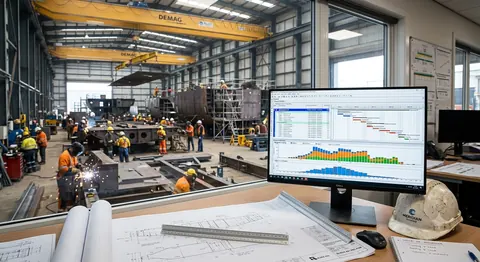
3D model-based quantity take-offs and ERP-integrated cost tracking reduce the manual work of keeping a cost report current, and that alone is valuable, a report that's two weeks stale by the time anyone reads it isn't much of an early-warning system. What these tools don't do is substitute for the underlying judgment: a dashboard built on a bad WBS or an unrealistic productivity assumption will just make the same wrong numbers easier to look at.
Cost control on a newbuild is less about producing an accurate number once and more about having a live one, checked against real progress and real supplier pricing often enough that a variance shows up while there's still budget and schedule left to respond to it.