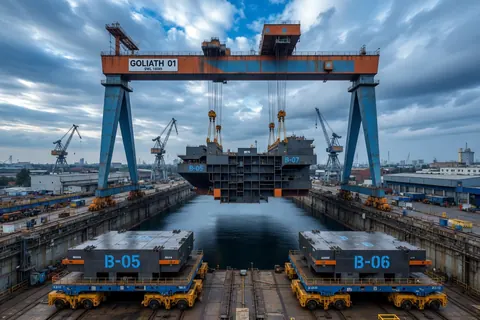

In modern shipbuilding, the procurement of major equipment from foreign manufacturers is one of the highest-risk and highest-value activities a shipyard undertakes. Main engines, shaft generators, azimuth thrusters, cargo cranes, heavy-lift systems, dynamic positioning equipment, large switchboards, exhaust gas cleaning systems, and complex HVAC packages routinely account for 35% to 55% of the total vessel cost. More importantly, these packages almost always sit on or near the critical path of the overall project schedule.
A single delayed main engine can shift the entire erection and outfitting sequence by several months. A dimensional mismatch discovered only during installation can force expensive structural modifications. A poorly worded payment clause can leave the yard exposed to significant financial loss if the manufacturer encounters difficulties. These are not theoretical risks; they are regular occurrences in yards that treat equipment procurement as a simple purchasing exercise rather than a structured project-management process.
This article provides a complete, end-to-end framework for the international procurement of major ship equipment. It covers every major stage from supplier pre-qualification through final warranty closure. The guidance is practical and written for project managers, procurement managers, contract administrators, and planning engineers working in shipyards. The focus is on real contractual mechanisms, payment structures, risk allocation, and day-to-day protocols that protect the yard’s schedule, budget, and technical integrity.
The content is organised chronologically according to the normal lifecycle of a major equipment package, while also addressing cross-cutting themes such as risk management and documentation discipline.
Strategic Importance of Major Equipment Procurement
Before examining individual process steps, it is useful to understand why major equipment packages require a different approach from routine material purchasing.
First, lead times are long. A medium-speed main engine for a commercial vessel can commonly require somewhere in the range of 12 to 18 months from order to delivery, and specialised equipment for offshore or naval vessels often longer still, depending on the manufacturer's order book and current market conditions. These lead times force the yard to place orders very early, often before the detailed design is fully frozen.
Second, interface complexity is high. Major equipment must connect mechanically, electrically, pneumatically, hydraulically, and digitally with the rest of the vessel. Foundations, piping connections, cable penetrations, automation signals, weight distribution, and accessibility for maintenance must all be coordinated. Errors in interface definition are among the most expensive problems discovered during construction.
Third, the financial exposure is substantial. Advance payments of 15–30% are common. If a manufacturer experiences financial distress or simply fails to perform, recovering money paid in advance can be difficult and slow, particularly across international borders.
Fourth, the contractual relationship is usually long-term. After delivery, the manufacturer remains involved through installation supervision, commissioning support, and warranty obligations that may extend one or two years after vessel delivery.
Because of these characteristics, the procurement of major equipment must be managed with the same rigour applied to the hull construction schedule itself.
Pre-Qualification and Supplier Selection
The process begins with deciding which manufacturers are even allowed to submit offers.
Establishing Evaluation Criteria
A robust pre-qualification exercise should examine at least the following areas:
Technical capability
- Has the manufacturer supplied identical or very similar equipment to vessels of comparable size, power, and Class notation?
- Are reference lists recent and verifiable?
- Does the manufacturer maintain a design department capable of handling project-specific adaptations?
Production capacity and current workload
- What is the current order book relative to manufacturing capacity?
- Are there known bottlenecks in key production areas (casting, machining, assembly, testing)?
- Can the manufacturer demonstrate realistic capacity for the required delivery window?
Financial stability
- Recent audited financial statements should be reviewed.
- Credit reports from recognised agencies provide additional insight.
- Sudden growth or aggressive pricing may indicate capacity or cash-flow problems.
Quality and Class experience
- Experience with the specific Classification Society involved in the project is highly desirable.
- A manufacturer that has never worked with the relevant Class will introduce additional approval risk and potential delay.
Export control and compliance
- For equipment that may have dual-use characteristics or that is destined for certain flag states or end-users, early screening against sanctions lists and export-control regulations is essential.
- The manufacturer should provide written confirmation of compliance capability.
After-sales support
- Availability of spare parts and service engineers in the vessel’s intended operating region should be assessed.
- Long-term support capability is particularly important for specialised or military-related equipment.
Practical Pre-Qualification Process
Many yards maintain a standing Approved Vendor List. Even when a manufacturer appears on that list, a project-specific questionnaire should be issued for high-value packages. The questionnaire should request:
- Reference list with contact details
- Current production schedule overview
- Quality certifications
- Proposed project organisation chart
- Statement on export-control compliance
- Confirmation of willingness to provide the required bank guarantees
Site visits to the manufacturer’s facilities remain one of the most effective evaluation tools, particularly for first-time suppliers or unusually complex packages.
Development of the Technical Specification
The technical specification is the foundation of the entire contractual relationship. A weak specification creates ambiguity that manufacturers will exploit and that will later generate variation claims and disputes.
Core Content Requirements
A high-quality technical specification for major equipment should contain at least the following elements:
- Clear statement of applicable rules, regulations, and Class notations
- Performance requirements with measurable acceptance criteria
- Environmental conditions (ambient temperature, humidity, vessel motion, vibration)
- Interface definition (mechanical, piping, electrical, automation, structural foundations)
- Weight and centre-of-gravity limitations
- Noise and vibration limits
- Painting, preservation, and packing standards
- Documentation requirements (list of drawings, manuals, certificates, as-built data)
- Factory Acceptance Test scope and participation rights
- Spare parts and special tools to be supplied
- Training to be provided
- Supervision and commissioning support obligations
Interface Management
Interface definition deserves special emphasis. The specification should state clearly which party is responsible for each interface point. Common practice is to define a “terminal point” for every connection. Everything on the equipment side of the terminal point is the manufacturer’s responsibility; everything beyond it is the yard’s or another supplier’s responsibility.
Weight and centre-of-gravity data must be provided at defined stages (preliminary, final, and as-built) because these figures affect structural design and vessel stability calculations.
Document Hierarchy
The contract should establish a clear hierarchy of documents. In case of conflict, the following order of precedence is commonly used:
- The Contract Agreement
- The Project-Specific Technical Specification
- The Manufacturer’s Technical Proposal (only where it improves upon the specification)
- Applicable Rules and Standards
- Manufacturer’s standard documentation
This hierarchy prevents the manufacturer from later claiming that its standard brochure takes precedence over the project requirements.
Enquiry, Clarification and Tender Evaluation
Once the technical specification is ready, a formal Request for Quotation is issued to the shortlisted manufacturers.
The RFQ package should include:
- The full technical specification
- Required delivery date or delivery window
- Outline of preferred commercial terms
- Required guarantees and securities
- Evaluation criteria and weighting (if the yard chooses to disclose them)
- Deadline for questions and for submission of offers
A formal clarification phase is strongly recommended. Manufacturers should be invited to submit written questions by a fixed date. Answers should be circulated to all participants so that every bidder works from the same information. For complex packages, a clarification meeting (physical or online) is valuable.
When evaluating offers, price should never be the sole criterion. A structured evaluation matrix that scores technical compliance, delivery certainty, commercial terms, and residual risk produces more reliable results than simple lowest-price selection.
Contract Negotiation and Key Clauses
The contract is the primary instrument for allocating risk. The following clauses require particular care in international equipment contracts.
Governing Law and Dispute Resolution
Choosing the manufacturer’s national law and courts places the yard at a significant disadvantage. Prefer a neutral governing law (English law and Swiss law are widely accepted) and arbitration under recognised rules (ICC, LCIA, or SIAC). Arbitration awards are generally easier to enforce internationally than court judgments.
Delivery Date and Delay Damages
The Contractual Delivery Date must be defined with precision (for example, “ex-works ready for shipment” or “delivered to the yard’s quay”). Liquidated damages for delay are typically set at 0.5% to 1.0% of the contract price per week of delay, capped at 5% to 10%. The contract should state that liquidated damages are the sole remedy for delay, while preserving the yard’s right to terminate for prolonged delay.
Payment Terms
Payment terms are examined in detail in the next section. At contract stage, the parties must agree the milestone definitions, the percentage values, and the documentation required to trigger each payment.
Performance Guarantees
Where the equipment has measurable performance parameters (fuel consumption, power output, noise levels, positioning accuracy, etc.), these should be stated as contractual guarantees with associated liquidated damages or rejection rights.
Variation Procedure
All changes must be instructed in writing. The contract should define how engineering time, material, and delay impact will be evaluated and priced. Work should not proceed on a variation until the commercial consequence is agreed, except in genuine emergency situations.
Termination Rights
The yard should retain the right to terminate for convenience (with defined compensation) and for manufacturer default. The consequences of termination, including ownership of partly completed work and repayment of advances, must be clearly stated.
Payment Structures, Securities and Financial Risk Management
Payment terms and the associated securities form the financial backbone of the contract.
Typical Milestone Structure
A balanced structure for a major equipment package often looks like this:
- 10–15% on contract signature against an Advance Payment Guarantee
- 10–15% on approval of critical drawings
- 15–20% on commencement of major manufacturing or material procurement
- 15–25% on intermediate production milestones
- 15–20% on successful completion of Factory Acceptance Test
- 10–15% on shipment or arrival at the yard
- 5–10% retention, released at the end of the warranty period or against a Warranty Bond
The exact percentages are negotiable, but the principle of progressive payment against demonstrated progress should be maintained.
Bank Guarantees
Three instruments are commonly used:
- Advance Payment Guarantee: An unconditional, irrevocable bank guarantee that allows the yard to recover the advance if the manufacturer fails to perform.
- Performance Bond: Usually 5–10% of contract value, valid until provisional acceptance or the start of the warranty period.
- Warranty Bond: Used when the yard agrees to release retention early.
The wording of these guarantees should be reviewed carefully. “On-demand” or “unconditional” language is strongly preferable to conditional guarantees that require proof of default.
Letters of Credit
An irrevocable, confirmed Letter of Credit provides strong security for both parties when the documentary conditions are properly drafted. The LC should mirror the contractual payment milestones and required documents as closely as possible. Discrepancies between the contract and the LC are a frequent source of delay and dispute.
Currency Risk
If the contract is denominated in a foreign currency, the yard is exposed to exchange-rate movement. Possible approaches include contracting in the yard’s home currency, sharing the risk through a formula, or using financial hedges (forward contracts or options).
Post-Contract Management and Manufacturing Follow-up
After signature, the focus shifts to execution.
Kick-off Meeting
A formal kick-off meeting should be held as soon as practical. The agenda should cover:
- Introduction of both project teams and communication matrix
- Review of contractual key dates and obligations
- Detailed manufacturing schedule
- Drawing submission and approval cycle
- Inspection and Test Plan, including hold and witness points
- Progress reporting format and frequency
- Variation and claim procedure
- Open technical issues list
Minutes of the meeting should be prepared and signed by both parties.
Progress Monitoring
Monthly (or more frequent) progress reports should include:
- Updated manufacturing schedule
- Percentage completion of major stages
- Status of drawing approvals
- Photographs of current production
- List of open issues and recovery plans
- Forecast of remaining work
For very high-value or complex packages, the yard may place a resident inspector at the manufacturer’s facility for critical phases.
Inspection and Test Plan
The ITP defines which activities require notification, which require presence of the yard or Class, and which are simply recorded. Hold points (work cannot proceed until released) and witness points should be clearly identified.
Factory Acceptance Test
The Factory Acceptance Test is the last practical opportunity to detect major deficiencies before the equipment is shipped.
A detailed FAT procedure should be submitted by the manufacturer and approved by the yard and Class well in advance. The procedure should list every test, the acceptance criteria, the required instrumentation, and the participants.
Common weaknesses observed during FAT include incomplete interface simulation, missing documentation, and unresolved punch-list items. The yard should resist pressure to sign a clean FAT protocol while significant issues remain open. Outstanding points should be recorded and linked to a clear corrective-action plan with deadlines.
Logistics, Shipping, Customs and Delivery
Responsibilities are governed by the chosen Incoterm. Even when the manufacturer is responsible for transport, the yard should:
- Approve the packing and preservation method
- Ensure adequate cargo insurance is in place
- Receive shipping documents in sufficient time for import formalities
- Coordinate heavy-lift and transport arrangements at the receiving end
For oversized or heavy cargo, early engagement with the port and the yard’s heavy-lift contractor is essential to avoid demurrage or storage problems.
Site Receipt, Installation Support and Commissioning
Upon arrival at the yard, a formal receipt inspection should be carried out against the packing list and approved drawings. Any transport damage or shortage must be recorded immediately and notified to the manufacturer and the insurer.
The contract should define the manufacturer’s obligations regarding installation supervision and commissioning support, number of personnel, duration, responsibilities for living expenses, and the level of authority the manufacturer’s representatives will have on site.
Risk Management Framework
The principal risk categories and corresponding mitigation measures are summarised below.
Schedule risk
Mitigation: realistic contractual delivery date, liquidated damages, progressive payment linked to milestones, regular progress monitoring, and early warning mechanisms.
Technical and interface risk
Mitigation: comprehensive technical specification, clear terminal points, staged drawing approval, and rigorous FAT.
Quality risk
Mitigation: Inspection and Test Plan, access rights for inspection, Class involvement, and retention or warranty bond.
Financial risk
Mitigation: staged payments, advance payment guarantee, performance bond, and careful review of the manufacturer’s financial position.
Export control and compliance risk
Mitigation: early screening, contractual warranties, and ongoing monitoring of sanctions lists.
Currency and payment risk
Mitigation: appropriate contract currency, letters of credit, and financial hedging where necessary.
A project-specific risk register for each major equipment package should be maintained and reviewed at regular intervals.
Documentation Discipline and Record Keeping
A complete file for each major equipment package should contain at least:
- Pre-qualification records
- Technical specification and all revisions
- Contract and amendments
- Drawing approval register
- Progress reports
- Inspection records and ITP
- FAT protocol and punch list
- Shipping and customs documents
- Site receipt report
- Commissioning records
- Warranty correspondence
Electronic document management systems are preferable, provided that access rights and revision control are properly managed.
Common Pitfalls and How to Avoid Them
Several recurring mistakes undermine equipment procurement:
- Issuing vague technical specifications and relying on the manufacturer’s standard offering
- Accepting payment terms that are heavily front-loaded without adequate security
- Failing to define interface responsibilities clearly
- Neglecting to monitor progress until it is too late
- Signing FAT protocols with significant open points
- Allowing informal variations without commercial agreement
Each of these errors is avoidable through disciplined application of the process described in this article.
Conclusion
International procurement of major ship equipment is a complex, multi-disciplinary activity that sits at the intersection of engineering, commercial management, and project control. Success depends less on negotiating the lowest possible price and more on creating a balanced contractual framework, protecting payments with appropriate securities, defining technical requirements without ambiguity, and monitoring execution with the same attention given to the vessel’s structural schedule.
A consistent, rigorous approach to major equipment packages, covering supplier selection, specification development, contract structure, payment security, manufacturing follow-up, testing, logistics and risk management, is what keeps this kind of purchase from becoming a recurring source of schedule overruns, rework and disputes.
When these principles are applied systematically, major equipment ceases to be a recurring source of crisis and becomes a controlled, predictable element of the overall newbuilding project.