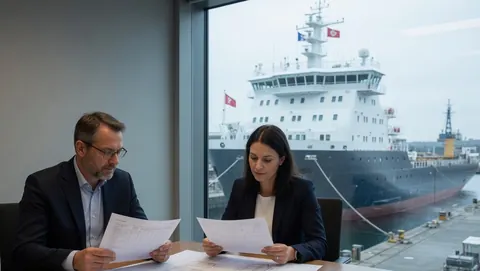

The weeks between contract signature and keel laying decide whether a newbuild starts on a solid foundation or chases its tail for the next two years.
Keel laying is not just a ceremonial milestone. Under SOLAS's "similar stage of construction" test, a vessel is treated as having reached its keel-laying date once at least 50 metric tons, or one percent of the estimated mass of all structural material, whichever is less, has been erected on the berth or in the building dock. That date carries real weight beyond the ceremony: it is one of the reference points IMO uses to decide which generation of construction and environmental rules, EEDI/EEXI phase requirements among them, a given vessel is built to. How long it takes to reach that point after contract signature varies enormously by vessel type, yard backlog, contract structure and how mature the basic design already was at signature, a repeat vessel on an established production line reaches it far faster than a first-of-type design still working through class approval. What matters more than the interval itself is what has to happen inside it, because this is where the schedule either gets built on solid ground or starts accumulating debt that shows up months later as a steel shortage, a re-sequenced block, or a class comment nobody budgeted time to close out.
What Has to Happen Before Steel Gets Cut
Four workstreams have to move in parallel from day one: team mobilization, engineering, procurement and production planning. In practice that means tracking engineering release dates, the block-level bill of materials, production drawing status, class approval status, vendor document status and owner approval turnaround against each other continuously, not managing each thread on its own calendar. A yard that waits for engineering to "finish" before starting procurement, or waits for procurement before locking the block breakdown, is the yard that misses its keel-laying date.
Mobilizing the Team in the First Two Weeks
The core team, Project Manager, Planning Engineer, Procurement Lead, Engineering Coordinator and QA representative, should be named and in the room before the contract is a week old. The first kick-off meeting with the owner needs to leave with three things settled on paper, not just discussed: the approval workflow for drawings and technical queries, the change-management process, and who on the owner's side actually has sign-off authority. Vague answers to that last question are one of the more common sources of stalled approvals later, when a drawing sits waiting for a decision because nobody is sure who is allowed to make it.
Alongside the kick-off, the contract package, specification, drawings and any owner-furnished equipment list, gets a line-by-line technical review. This is where ambiguous clauses, missing interface definitions and unrealistic delivery dates for owner-supplied items surface. Catching a contradiction between the specification and a referenced class rule in week one costs an email. Catching it during production costs a rework order.
Building the Work Breakdown Structure
The WBS is what turns the vessel into manageable, assignable pieces. The underlying tension is that engineering and classification work is naturally organized by system, the kind of system-based coding structures used in technical specifications and class documentation, while production has to be organized by block or zone, since a hull section doesn't care which system a pipe run belongs to once it's inside the block. Translating between a system-based structure and a zone or block-based production breakdown, sometimes called a Product Work Breakdown Structure, is one of the WBS's real jobs, not just a labeling exercise. Get it wrong and every schedule and cost report built on top of it inherits the mismatch.
A useful WBS does more than divide the vessel into blocks: it creates the structure through which engineering, procurement, production progress and cost can later be measured. If it can't support a meaningful progress update or a credible forecast, it's probably too coarse. The two mistakes that show up most often: a WBS built around the drawing list instead of the actual production sequence, and work packages sized so large that a "90% complete" status hides a stalled critical activity inside it. For a closer look at how to structure this, see our lesson on building the newbuild WBS.
Engineering: Releasing the Right Information, Not Just Finishing Drawings
For a well-developed newbuild contract, the basic design should be sufficiently mature at contract signature to support detailed engineering, procurement and production planning, though on specialized, owner-customized or first-of-type vessels, meaningful design development can still be running in parallel with early production activities. Either way, what happens in this window is detailed structural drawings, block definitions, piping and outfitting drawings, electrical and automation design, and the bill of materials.
The practical risk isn't the engineering workload itself, it's releasing the right information at the right time. A structural drawing can be technically complete and still unusable for production if the related material list, penetration details or interface information isn't released with it. A two-week engineering slip rarely stays a two-week slip by the time it reaches the dock: if the drawing release pushes the material take-off, purchasing and material delivery by the same amount, the production impact can grow further still, because a lost slot in the block shop isn't always recoverable later.
Procurement: Racing the Long-Lead Clock
Main engines, generators and major deck machinery routinely become critical-path procurement items. Lead times for two-stroke and dual-fuel engine models in particular can run well over a year depending on manufacturer, specification and current market conditions, worth confirming directly with the OEM at contract stage rather than assuming last year's lead times still hold. Steel grades subject to specific certification, testing or traceability requirements need to be on order well before the keel-laying date, not after it. The practical rule: if an item's lead time is longer than the remaining time to its required on-board date, it should already have a purchase order against it, not a request for quotation. Building a procurement schedule that works backward from required on-site dates, rather than forward from "when we get around to it," is what keeps this from becoming the project's critical path.
The Block Construction Strategy
How the hull is divided into blocks, how much outfitting happens before erection, and the erection sequence in the dock all get decided here, and all three interact. In practice, many yards set an internal pre-outfitting target for each block or zone rather than applying a single percentage across the vessel, a flat-bottom double-hull section and an engine-room block dense with piping and equipment don't reach the same practical ceiling. The general principle holds regardless of the target chosen: work done at the shop, at eye level, with full crane access, is generally cheaper and safer than the same work done after erection. Pushing pre-outfitting too far, though, can overload block-stage capacity and starve dock erection of ready blocks, a capacity-planning problem as much as a sequencing one, since crane availability, workshop throughput and labor allocation all have to be checked against the proposed schedule before it gets treated as a baseline.
What Actually Goes Wrong: a Short List From Real Projects
- The equipment arrives before the information. The physical unit is on the yard, but the final interface drawing, foundation detail or electrical data needed to install it is still missing.
- The drawing is approved, but not released to production. "Approved" and "released for production" are not always the same status in a real project, and treating them as interchangeable is how outdated drawings end up on the shop floor.
- A change is agreed in a meeting but never enters the schedule. Engineering knows about it, production knows about it, procurement may not, and the baseline schedule still assumes the old design until someone notices the mismatch.
- Progress is reported against a work package that is too large. A block can be reported at 80% complete while a single unresolved system interface is sitting on the critical path underneath that number.
- Class plan approval is submitted late, treated as a formality rather than a scheduled activity. Basic design and key structural packages need real review time with the classification society, ABS, DNV, Lloyd's Register, Bureau Veritas or ClassNK depending on the flag and owner, and a rejected package restarts that clock.
- The risk register is created once, at kick-off, and never revisited. By month three it no longer reflects the project's actual risk profile, and nobody is tracking the mitigation actions that were supposed to come out of it.
The First Schedule Should Not Be the Baseline
The instinct right after contract signature is often to build a detailed, activity-level baseline schedule immediately. A more useful first step is establishing the milestone logic the detailed schedule will hang on: contract milestones, then design release milestones, then procurement milestones, then material availability, then production milestones, then the block erection sequence, then keel laying, launch and delivery. Each link in that chain constrains the next one.
The first schedule built on that logic isn't there to predict every activity perfectly, early estimates rarely survive contact with real engineering and procurement data. Its first job is to expose the dependencies that could prevent production from starting on time, so they can be worked before they become the reason for a missed date rather than a footnote explaining one.
Getting to a Real Keel-Laying Date
Before committing to a keel-laying date, five things need to be true, not just planned: the keel or initial bottom structure is physically ready for erection in line with the yard's own keel-laying definition, the block erection sequence and its supporting calculations are finalized, the relevant class approvals for early structural work are in hand, the dock and cranes are actually free on that date, and the engineering deliverables feeding the first erected blocks are released. A keel-laying ceremony is a milestone worth marking, but it should confirm readiness that already exists, not create pressure to start construction ahead of it.
Most of the schedule risk on a newbuild contract is set well before the pace of work in the dock becomes visible to anyone outside the planning office. Treating the run-up to keel laying as four parallel, actively managed workstreams, rather than a checklist to get through before the "real" project starts, is what separates a keel-laying date that holds from one that quietly slips.