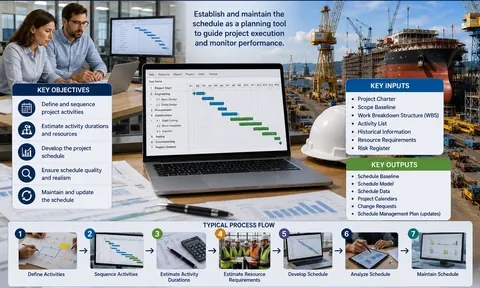


The Project Management Institute (PMI) offers the PMI Scheduling Professional (PMI-SP)® credential for practitioners dedicated to project scheduling. The examination guarantees that candidates possess the critical knowledge, tasks, and skills required to perform to industry-wide standards
This material is strictly aligned with the official PMI-SP Exam Content Outline, which is built upon a global Role Delineation Study (RDS) encompassing feedback from practitioners across 83 countries. The curriculum assesses your proficiency across five critical performance domains.
Detailed Exam Domains and Core Tasks
Domain 1: Schedule Strategy (14% of the Examination)
This domain focuses on establishing the foundational approach, policies, and procedures for the project schedule before detailed planning begins.
- Configuration Management: Establishing schedule configuration policies that incorporate best practices, regulations, and organizational procedures for storage, retrieval, and baseline control.
- Scheduling Parameters: Defining the methodology, selecting scheduling tools, setting performance thresholds, determining activity granularity, and outlining Earned Value Management (EVM) implementation.
- Integration: Developing scheduling-related components for broader project management plans, ensuring seamless integration with scope, cost, quality, resource, risk, and procurement management.
- Team Alignment: Communicating the scheduling objectives, the scheduler's role, and procedural requirements to project team members to facilitate effective participation.
Domain 2: Schedule Planning and Development (31% of the Examination)
This is a heavily weighted domain that involves the technical creation of the schedule model and the establishment of the Performance Measurement Baseline (PMB).
- Structure Development: Creating the Work Breakdown Structure (WBS), Organizational Breakdown Structure (OBS), control accounts, and work packages to ensure the full completion of the project scope.
- Activity Definition & Sequencing: Decomposing work packages into activities and milestones, and sequencing them using defined dependencies (internal, external) and constraints (calendars, contracts).
- Duration Estimating: Utilizing advanced techniques such as three-point estimates, parametric estimating, analogous estimating, and PERT (Program Evaluation and Review Technique).
- Path & Risk Analysis: Identifying the critical and near-critical paths using Critical Path Method (CPM), Critical Chain, and performing quantitative risk analysis like Monte Carlo simulations.
- Resource Allocation: Developing the Resource Breakdown Structure (RBS), assigning resources, and adjusting the schedule model based on resource availability and budget constraints.
- Baselining: Obtaining consensus from the sponsor, customer, and team to establish the official Performance Measurement Baseline (PMB).
Domain 3: Schedule Monitoring and Controlling (35% of the Examination)
The largest portion of the exam tests your ability to track progress, manage variances, and optimize the schedule dynamically.
- Status Collection: Gathering activity and resource status updates at defined intervals from owners via reports, timesheets, and inspections.
- Analysis and Auditing: Performing schedule analysis and forensic audits on both in-house and subcontractor schedules to identify impacts, issues, and variances.
- Optimization & What-If Scenarios: Identifying alternative project execution options using what-if scenario analyses to optimize the schedule dynamically.
- Change Control: Incorporating approved risk mitigation activities and updating the schedule model based on formal change-control processes to maintain an accurate baseline.
Domain 4: Schedule Closeout (6% of the Examination)
This domain ensures the proper finalization of the schedule and the capture of historical data for future projects.
- Final Acceptance: Working with sponsors and customers to obtain formal acceptance of the contractual schedule components.
- Performance Evaluation: Evaluating final schedule performance against the original baseline, utilizing EVM calculations and variance analysis.
- Lessons Learned & Archiving: Documenting best practices to update organizational process assets and archiving final schedule files (management plans, change logs) for potential forensic schedule analysis.
Domain 5: Stakeholder Communications Management (14% of the Examination)
A schedule is only as effective as its communication. This domain covers the soft skills and reporting mechanisms required to keep stakeholders informed.
- Fostering Relationships: Developing relationships consistent with the communication management plan to secure ongoing support for the schedule.
- Visibility & Reporting: Generating and maintaining schedule visibility, providing verbal and written status updates, and detailing the impacts of corrective actions to senior management.
- Issue Escalation: Proactively communicating schedule issues that threaten the delivery of the project scope or adherence to the schedule management plan.
Cross-Cutting Knowledge and Skills
To master these domains, candidates must demonstrate proficiency in several foundational concepts that span the entire scheduling lifecycle:
- Advanced Scheduling Techniques: Resource leveling, schedule compression (crashing and fast-tracking), capacity requirements, and simulation.
- Diagramming Methods: Precedence Diagramming Method (PDM) and Activity Network Diagrams (AND).
- Performance Metrics: Earned Value Management (EVM), Schedule Performance Index (SPI), Baseline Execution Index (BEI), and complex float analysis.
- Interpersonal Skills: Facilitation, negotiation, conflict resolution, and cultural sensitivity.