

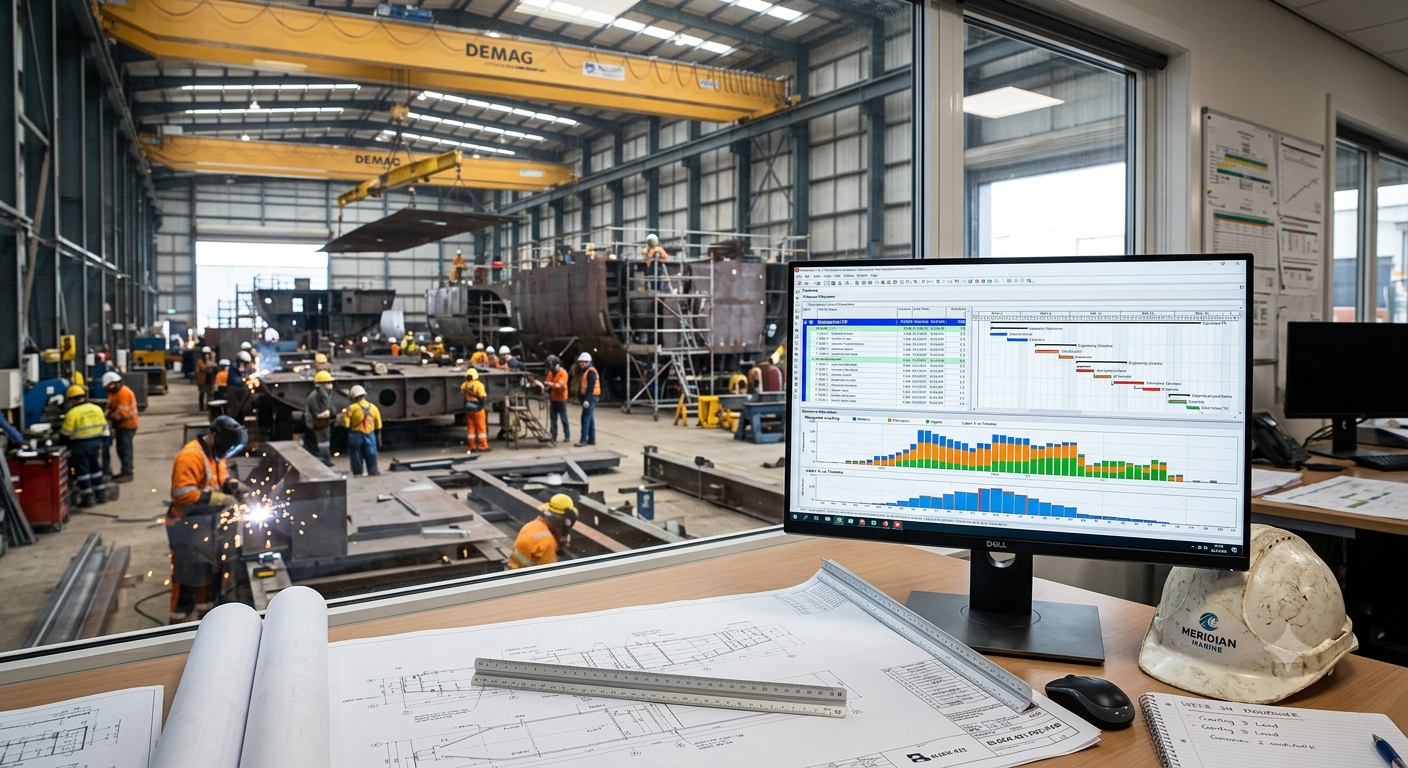
In our previous study, we took an X-ray of our newbuild project and established the backbone of the work using a Work Breakdown Structure (WBS). By descending to the Level 4 activity level, we defined every single activity essentially, every product.
However, the structure we have at this point is merely a hierarchy on paper, a skeleton without a soul or muscle mass.
To breathe life into this skeleton, set the production floor in motion, and align those bars in our planning software with real human labor, we are now at the most critical juncture of the project: Man-Hour (Mhrs) Estimation and Resource Loading.
In a dynamic sector like shipbuilding—where thousands of activities run concurrently, outfitting density varies drastically from block to block, subcontractor management fluctuates, and labor efficiency shifts constantly—answering the question "How long will this job take?" is a true engineering art. An inaccurate man-hour estimate leads to a flawed budget, idle crews or overcrowded workspaces (congestion) on the shop floor, and ultimately, inevitable delivery delays.
When determining workforce requirements in shipyard operations, we do not pull numbers out of thin air. There are three fundamental estimation methodologies widely accepted in literature and shipyard practices, which we will explore with concrete examples in these lecture notes:
1. Historical Data (Organizational Database)
This method relies on actual man-hour data collected from previously completed, similar projects within the shipyard. If a shipyard has disciplined archives of its past labor expenditures tracked by work order or activity, it possesses an invaluable treasure when starting a new project.
- Example Scenario: Pulling the actual labor data expended on "Block 101 Prefabrication" from a previously built 85-meter Wellboat project in our shipyard, and assigning this historical data as a baseline benchmark matrix for a new project with similar tonnage and structural design.
2. Expert Judgment
If the shipyard is venture into a vessel type it has never built before (such as a highly technical Live Fish Carrier - LFC or a specialized offshore platform) or if historical data is scarce, the shop floor’s experience takes center stage. This involves consulting workshop supervisors, senior planning engineers, technical managers, and especially the leaders of the subcontractors who will physically execute the job.
- Example Scenario: For the engine room piping fabrication of a newly designed hybrid propulsion system, where no historical data exists, sitting down with the piping workshop chief and the relevant subcontractor to conduct an activity-based man-hour estimation by reviewing the piping isometrics.
3. Work Measurement (Direct Measurement)
When a new production methodology, a new CNC machine, or an automated production line is introduced—or when uncertainty is exceptionally high—the work is directly measured on the field using stopwatches, work sampling, or pilot production runs.
- Example Scenario: To evaluate the performance of a newly acquired robotic welding and beveling machine, tracking the time spent during the fabrication of the first two blocks on the shop floor, timing the process directly, and projecting the resulting unit-time performance across the CNC and prefabrication activities of all remaining blocks.
Planner's Note (The Hybrid Approach):
Best practices in top-tier shipyards never rely on a single method in isolation; they always implement a Hybrid Model. They build the baseline budget using historical data, adjust for new design variances via expert judgment, and refine the schedule during early production phases (e.g., the first few blocks) through direct work measurement.
The Logic of Workforce and Man-Hour (Mhrs) Calculation
To calculate the required workforce expenditure, we first need definitive quantities and metrics at our disposal. It must be kept in mind that workforce dynamics and calculation criteria can vary significantly across different workstations. To better understand this logic, let us look at a concrete example using Prefabrication, one of the most critical stages of steel fabrication.
Recall the point where we descended to the Level 4 activity level in our WBS tree:
- 4.0 Production
- 4.1 Steel Works
- 4.1.2 Prefabrication
- 4.1.2.1 PRE.FAB.- UNIT BLOCK 101
- 4.1.2.2 PRE.FAB.- UNIT BLOCK 102
- ...
To calculate the workforce requirement for an activity at this workstation, we need the following core data points:
- Net Work Quantity: Total volume in terms of kg, tons, meters, or $m^2$.
- Quantity and Structural Distribution: Part counts, average part weights, and assembly density.
- Historical Project Data: The actual realized productivity value of similar projects at that specific workstation (kg/Mhrs).
- Target Project Productivity: The baseline productivity goal set for this new project (kg/Mhrs).
- Expert Judgment: The "Man-Days" value estimated by senior engineers or foremen.
- Subcontractor Commitment: The "Man-Days" target pledged by the subcontractor firm executing the work on-site.
While each of these values relatively points to the same target, the subtle nuances between them ensure our calculations are grounded in reality. REMEMBER! This is not a chemistry formula; production efficiency at a workstation depends on dozens of variables such as human behavior, weather conditions, and material flow, meaning it cannot remain identical every single day.
Building and Evaluating the Data Pool
We must synthesize information gathered from various stakeholders to determine the most appropriate "Estimated Productivity Value" for our project. The first step is to analyze past projects and select a template that closely matches our current project structurally (in terms of average part weight, welding length density, etc.).
For our scenario, let us assume our shipyard possesses a solid corporate memory and that a past Project C is structurally very similar to our upcoming Project A.
However, we cannot simply copy and paste the realized kg/Mhrs value from Project C directly into our new plan; we must validate this data against current field realities. This is where we bring expert opinions and feedback from the subcontractors to the table. By converting the subcontractors' estimated "Man-Days" into hours, we derive the kg/Mhrs data they are committing to achieve.
Consequently, we generate a pool of productivity values coming from different sources:
- Historical Project Data (The actual realized kg/Mhrs value of Project C)
- Expert Judgment (The baseline value envisioned by planning and production management)
- Subcontractor Forecast (The kg/Mhrs derived from the man-days committed by the field crews)
- Field Experience / Special Measurement (The labor volume calculated through our own field insights or stopwatch-based demo production metrics tailored for exceptional/custom jobs).
Two Distinct Paths: From Average to Optimum
When converting these different productivity (kg/Mhrs) alternatives into a workable schedule and budget, we generally have two paths forward:
- Path 1 (Averaging): Taking the arithmetic or weighted average of all these data points to establish a baseline value.
- Path 2 (Targeting the Optimum): Analyzing risks, subcontractor capabilities, and current shipyard workload to select the most rational, secure (optimum) value.
Whichever path we choose, the final figure reached is our calculated target budget. When we divide the total work quantity (kg) entering the workstation by this calculated target productivity value (kg/Mhrs), we arrive at the Total Man-Hours (Mhrs) required for that activity. Thus, the workforce requirement of the workstation is accurately identified.
Early Control on the Field (The "First Two Movements" Rule)
While everything may look perfect on paper, the true test happens on the shop floor. Once the project commences, a Variance Analysis (comparing actual Mhrs vs. estimated Mhrs) must be performed immediately as the first two units/blocks enter, complete fabrication, and exit the workstation. If there is a significant deviation, the plan for the remaining units must be revised right at the beginning of the journey.
💡 Key Tip: Cross-Checking with CBS and Unit Prices
If we have the subcontractor or labor unit prices ($/kg or TL/kg) applicable to that workstation, we possess an excellent validation mechanism. By working backward from the total monetary budget to be paid for that specific job, we cross-check whether the financial equivalent of our calculated man-hours stays within these budget constraints.
- If the calculated man-hour cost falls within budget boundaries, our approach is correct.
- If the calculated man-hour cost significantly exceeds the budget, there could either be an error in the unit price or the man-hour values assigned by the workstation for that product are flawed. In this case, both data points must be re-evaluated retrospectively immediately.