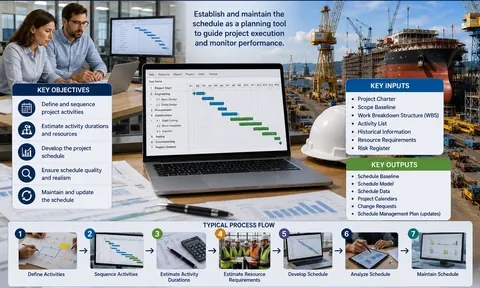


This domain is the foundational pillar of project scheduling, representing 14% of the exam content. Before diving into activity sequencing or duration estimating, a scheduling professional must establish a robust strategic framework. This framework dictates how the schedule will be created, managed, executed, and controlled throughout the project life cycle.
This guide explores the five core tasks of the Schedule Strategy domain in extreme detail, integrating principles from the Practice Standard for Scheduling and other core PMI methodologies.
Domain Overview and Core Objectives
The Schedule Strategy domain encompasses all activities related to establishing and documenting the schedule approach, policies, procedures, roles, responsibilities, and overarching scheduling objectives.
To master this domain, you must understand how to navigate the initial phases of project planning, ensuring that the scheduling effort is perfectly aligned with the project's specific constraints, enterprise environments, and contractual requirements.
Key Knowledge Areas and Skills Required
- Applicable contract requirements, regulations, and governing standards
- Schedule control processes, including baseline control, status updates, and variance thresholds
- Scheduling development concepts such as coding structures, Work Breakdown Structures (WBS), Organizational Breakdown Structures (OBS), and Resource Breakdown Structures (RBS)
- Project charter analysis and integration
Task 1: Schedule Configuration Management
Task Definition: Establish project schedule configuration management policies and procedures incorporating best practices, regulations, governing standards, and organization policies to ensure accessibility, storage, retrieval, maintenance, change control, and baseline schedule control.
The Role of Configuration Management in Scheduling
Configuration management is not just for physical products or software code; it is absolutely vital for schedule data management. A schedule model requires meticulous planning and design to ensure that the minimum infrastructure needed to support stakeholder requirements, backups, disaster recovery, and business continuity is in place.
Key Components of Schedule Data Management
- User Access and Rights: You must define the list of schedule users, their specific access rights, and their responsibilities. For instance, some users may only have rights to provide progress updates, while others have administrative rights to modify schedule logic, and others have read-only access for reporting.
- Storage and Backup: Determine the frequency for backing up schedule data (e.g., daily, weekly, or monthly). This establishes valid recovery periods in the event of catastrophic data failure and dictates business continuity.
- Retrieval Procedures: Backups are useless without tested retrieval procedures. You must determine how previous instances of the schedule will be retrieved, by whom, and at what intervals.
- Data Retention: Legal, contractual, or local requirements often dictate how long project data must be stored. The data must be easily accessible at any time for audit purposes.
Baseline Schedule Control
The first approved instance of the schedule model is the project baseline schedule model. This version is developmentally complete and serves as the benchmark against which all future project performance is measured.
- Integrity of the Baseline: The baseline must only be changed through formal integrated change control processes.
- Unique Identification: Every schedule model needs a unique identification that is specific to the project and does not change. This allows for the tracking of schedule models over time without confusion.
- Instance Tracking: Each time the schedule is updated or revised, it becomes a "schedule model instance." Each instance requires a unique identifier to ensure proper archiving and auditing.
Exam Tip: If a question asks about preventing unauthorized changes to the schedule logic or ensuring data isn't lost during a server crash, the answer always points back to the Schedule Data Management Plan and Configuration Management.
Task 2: Developing the Schedule Approach
Task Definition: Develop the schedule approach based on the unique characteristics of the project, including enterprise environmental factors (EEFs) and organizational process assets (OPAs), in order to define schedule requirements.
Analyzing Project Characteristics
No single type of life cycle is perfect for all projects. The scheduling approach provides the structural foundation for the creation of the schedule model. Your first duty is to evaluate the project's scope, complexity, and uncertainty to determine the best approach.
Project Life Cycles and Scheduling Approaches
The project life cycle falls within a continuum ranging from highly predictive to highly adaptive.
- Predictive Life Cycle: Takes advantage of projects where products are well understood, allowing major planning to occur prior to execution. This reduces uncertainty and allows for a predictable sequence of work. The Critical Path Method (CPM) is the standard scheduling approach here.
- Iterative Life Cycle: Allows feedback on partially completed work to improve and modify that work before final delivery.
- Incremental Life Cycle: Provides finished deliverables that the customer can use immediately, creating early value.
- Adaptive (Agile) Life Cycle: Leverages both iterative and incremental characteristics. The team iterates throughout the project to create finished deliverables, gaining early feedback and providing high customer visibility. This is ideal for projects with high uncertainty.
- Hybrid Life Cycle: Combines elements of different life cycles. For example, a project might use a predictive approach for the construction phase but an adaptive approach for the software integration phase.
The Influence of EEFs and OPAs
Your schedule strategy does not exist in a vacuum. It is heavily influenced by:
- Enterprise Environmental Factors (EEFs): These include industry regulations, governing standards, resource availability, market conditions, and the organization's existing software tools. If your company mandates the use of a specific enterprise project management software, your scheduling approach must align with the capabilities of that tool.
- Organizational Process Assets (OPAs): These are the established methodologies, historical data, lessons learned, and templates. If historical data indicates that a specific type of project always experiences delays in procurement, your approach should proactively incorporate robust risk reserves or rolling wave planning for that phase.
Task 3: Establishing Scheduling Policies and Procedures
Task Definition: Establish scheduling policies and procedures regarding methodology, selection of a scheduling tool, scheduling parameters, performance thresholds, activity granularity, presentation format, earned value management (EVM) implementation, analysis techniques, and approval requirements.
This task culminates in the creation of the Schedule Management Plan. This plan guides the entire development and maintenance of the schedule model.
Core Components of the Schedule Management Plan
The following table breaks down the specific policies and procedures that must be established:
ComponentStrategic DescriptionMethodologyDefines the theoretical framework (e.g., CPM, Critical Chain, Agile, Location-Based Scheduling).
Scheduling ToolThe specific software application that contains the algorithms and features to input activities and create schedule model instances. Selection must comply with organizational requirements.
Activity GranularityDetermines how detailed the activities will be. Too much detail creates an unmanageable, expensive model; too little detail prevents effective progress tracking.
Update CycleThe regular interval at which current project status is reported. This could range from hourly updates in a manufacturing outage to monthly updates for major construction.
Performance ThresholdsEstablishes the acceptable range of variance (e.g., Key Performance Indicators). These thresholds dictate when management intervention is required (management by exception).
EVM ImplementationPolicies for integrating scope, schedule, and cost. Defines how Earned Value (EV) and Planned Value (PV) will be measured and credited.
Presentation FormatDictates how the schedule will be communicated (e.g., Gantt charts, network diagrams, milestone tables) based on the audience level.
Defining Calendars and Work Periods
The strategy must define the default project calendar. This includes establishing working days in a week, shift durations, scheduled overtime, and nonworking time such as holidays or blackout dates. For geographically distributed teams, managing multiple time zones and regional holidays is a critical strategic consideration.
Activity Coding Structures
A sound, well-conceived activity coding structure is essential. Codes allow the schedule to be sorted, grouped, and filtered to meet various reporting requirements. Codes can identify project phases, locations of work, sources of funding, or the organization responsible for performing the activity.
Task 4: Integrating Scheduling Components into the Project Management Plan
Task Definition: Develop the scheduling-related components for project management plans through the review of contract requirements in order to integrate scheduling activities into the overall project management process.
A schedule is not an isolated document. It is a highly integrated engine that drives the execution of the entire project. The schedule strategy must dictate how time-phasing aligns with all other Knowledge Areas.
Integration with Project Scope
- The WBS Connection: The Work Breakdown Structure (WBS) is the bridge between scope and schedule. All work packages in the WBS must be directly traceable to a schedule activity or group of activities.
- Strategic Rule: Each schedule activity should roll up into only one WBS element. The schedule model essentially maps the "when" to the WBS's "what."
Integration with Cost and Resources
- Resource Planning: The schedule management plan must identify elements required for resource planning, including resource availability, calendars, and skill sets. Understanding critical resources and their availability allows for the mitigation of negative impacts on the project.
- Cost-Schedule Interrelationship: Project cost is fundamentally impacted by project duration. A shortage of resources may require a longer duration, increasing overhead costs, whereas crashing the schedule to meet an urgent deadline will directly increase direct labor costs.
Integration with Risk Management
- Schedule Risk Assessment: The strategy must define how risk will be accommodated. Will you use Monte Carlo simulations to determine the probability of meeting milestone dates?
- Contingency Reserves: Time or money allocated in the schedule baseline for known risks with active response strategies. The strategy dictates whether these buffers are placed at the activity level, the control account level, or as project buffers at the end of the critical chain.
Integration with Procurement
If project execution relies on external vendors, the schedule strategy must incorporate procurement lead times, vendor bid analysis timelines, and contractually mandated milestone delivery dates. The schedule must align with the payment cycles and deliverables defined in the procurement management plan.
Task 5: Team Communication and Onboarding
Task Definition: Provide information about project scheduling objectives and goals, the role of the scheduler, and scheduling procedures to project team members to facilitate effective participation in the project.
A perfectly constructed schedule model will fail if the project team does not understand how to interact with it. The Schedule Strategy domain emphasizes the human element of schedule management.
The Role of the Scheduler
The scheduler acts as the architect of the project's timeline and the primary analyst of its performance. The strategy must clearly define the scheduler's authority versus the project manager's authority.
- Who owns the schedule data?
- Who is authorized to approve baseline changes?
- Who is responsible for gathering weekly actuals?
Establishing Communication Protocols
Clear communication builds credibility with the stakeholders. The scheduling strategy must define:
- Status Update Mechanics: How will team members report their progress? (e.g., entering actual start/finish dates into a PMIS system, submitting weekly timesheets, or attending daily stand-up meetings).
- Understanding the "Why": Team members must understand why timely updates are critical. Providing accurate progress measurement prevents Out of Sequence (OOS) logic errors and ensures that Key Performance Indicators (KPIs) like the Schedule Performance Index (SPI) accurately reflect reality.
- Feedback Loops: The strategy must establish how the scheduler provides feedback to the team regarding near-critical paths, upcoming resource bottlenecks, and the impact of delayed tasks.
Training Requirements
Schedule management encompasses training requirements for project team members. This includes establishing a common understanding of scheduling policies, procedures, and software technologies. For example, training should address how to properly capture project risks and reflect mitigation activities in the schedule model.
Core Knowledge and Skills for Schedule Strategy
To effectively execute the five tasks above, you must have a deep understanding of the following foundational concepts.
Breakdown Structures
- Work Breakdown Structure (WBS): A hierarchical decomposition of the total scope of work. It is the foundation upon which the schedule is built.
- Organizational Breakdown Structure (OBS): A hierarchical representation of the project organization that illustrates the relationship between project activities and the organizational units performing them.
- Resource Breakdown Structure (RBS): A hierarchical representation of resources by category and type.
- The Control Account (CA) Intersection: A management control point where scope, budget, actual cost, and schedule are integrated. The Control Account is strategically placed at the intersection of the WBS and the OBS.
Schedule Control Processes
The strategy must define how control will be maintained.
- Status Update Procedures: Establishing the "Data Date" (the point in time when project status is recorded).
- Managing Change: Defining how approved changes (via the Integrated Change Control process) are incorporated into the schedule model to establish a new performance measurement baseline.
Contract Requirements and Governing Standards
The schedule strategy is legally bound by the project contract. If a contract stipulates "retained logic" for out-of-sequence updates, the scheduler cannot strategically choose to use "progress override". If a governing standard dictates specific safety review durations, those durations must be strategically coded into the baseline timeline as hard constraints.
Strategic Review and Application Scenarios
To solidify your understanding of the Schedule Strategy domain, consider how these concepts apply to real-world scenarios.
Scenario 1: The Adaptive Software Rollout
Context: Your organization is developing a new mobile application. Market demands shift rapidly, and the exact features required for the final product are unknown.
Strategic Approach: * Life Cycle: You select an Adaptive (Agile) approach.
- Granularity: You utilize Rolling Wave Planning. Work to be performed in the near term (the next iteration) is planned in extreme detail, while future work is held in high-level planning packages.
- Tooling & Presentation: You utilize Kanban boards to visualize the flow of work and limit work-in-progress, rather than heavily utilizing traditional CPM Gantt charts.
Scenario 2: The Regulated Infrastructure Project
Context: You are scheduling the construction of a new water treatment facility. The project is heavily regulated by government environmental agencies and involves hundreds of external subcontractors.
Strategic Approach:
- Life Cycle: You select a Predictive (CPM) approach due to the high cost of change and the necessity of strict sequential execution.
- Configuration Management: You establish incredibly rigid baseline schedule control. Only the lead scheduler can make logic changes, and all versions are archived weekly for government audit compliance.
- Coding Structure: You establish a complex activity coding structure that tags every activity by Subcontractor ID, Physical Location (e.g., Pump Station A, Filtration Building B), and Funding Source.
Final Exam Preparation Focus
When studying for the PMI-SP exam, remember that Domain 1 is not about doing the scheduling work; it is about planning how the scheduling work will be done. Every decision made in this domain—from selecting the software tool to defining the update cycle—sets the rules of engagement for the rest of the project. Focus heavily on the integration between the Schedule Management Plan, the WBS, and Configuration Management.