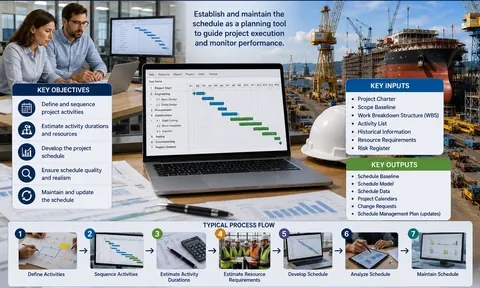


Schedule Monitoring and Controlling is the heaviest section of the PMI Scheduling Professional (PMI-SP)® examination, carrying approximately 35% of the total exam weight. This domain focuses on the ongoing processes required to track, analyze, update, and control the project schedule throughout the project lifecycle.
While Domain 1 addresses strategy and Domain 2 covers planning and development, Domain 3 ensures the schedule remains a living, accurate, and useful management tool. It transforms the approved baseline into a dynamic instrument for performance measurement, forecasting, decision-making, and corrective action.
The core objective of Domain 3 is to answer these critical questions continuously:
- Where are we compared to where we planned to be?
- What is the impact of current performance on the project completion date and cost?
- What actions are required to bring the project back on track or to optimize future performance?
- How should we communicate schedule status and forecasts to stakeholders?
This domain integrates heavily with Earned Value Management (EVM), risk management, change control, and stakeholder communications. It draws directly from the Practice Standard for Scheduling (particularly the sections on schedule model maintenance, analysis, and communication) and The Standard for Earned Value Management.
Official Domain 3 Tasks (from PMI-SP Examination Content Outline)
Candidates are expected to demonstrate competency in the following areas:
- Monitor schedule performance against the baseline
- Collect and analyze schedule progress data
- Perform variance analysis (time and cost)
- Update the schedule model with actual progress
- Manage changes to the schedule baseline through formal change control
- Develop schedule forecasts (completion date, remaining duration, and effort)
- Report schedule performance to stakeholders
- Recommend and implement corrective and preventive actions
- Monitor schedule-related risks and opportunities
These tasks represent the day-to-day work of a scheduling professional during project execution and monitoring & controlling phases.
1. Schedule Baseline versus Current Schedule
A fundamental concept in Domain 3 is the distinction between the Schedule Baseline and the Current (or Updated) Schedule.
Schedule Baseline
The approved version of the schedule model that serves as the comparison point for all performance measurement. It includes the approved start and finish dates, activity durations, logical relationships, and resource assignments. Once approved, the baseline can only be changed through formal change control procedures.
Current Schedule
The working version of the schedule that reflects actual progress, approved changes, and the latest forecasts. It is updated regularly (daily, weekly, or according to the defined update cycle).
Key Good Practice (from Practice Standard for Scheduling):
Maintain strict configuration management over the baseline. Uncontrolled changes to the baseline destroy the ability to perform meaningful variance analysis and trend reporting. Every rebaselining must be formally documented with justification, impact analysis, and stakeholder approval.
Rebaselining Considerations
Rebaselining should be treated as an exception, not a routine activity. Common triggers include:
- Significant approved scope changes
- Major risk events that fundamentally alter the project approach
- Customer-directed changes that make the original baseline irrelevant
- Project re-planning due to force majeure or major external constraints
In shipbuilding and ship repair projects, rebaselining is sometimes necessary when major equipment delivery delays occur or when class society requirements change significantly.
2. Progress Data Collection and Measurement Methods
Accurate progress measurement is the foundation of effective schedule monitoring.
Common Measurement Methods
MethodDescriptionObjectivitySuitability for Complex ProjectsExample in ShipbuildingPercent Complete (0-100)Subjective estimate of work completedLowLowRarely recommended alonePhysical Percent CompleteMeasurable units (meters welded, tons erected, square meters painted)HighHighWelding meters, block erection percentageWeighted MilestonesPre-defined milestones with assigned weightsHighHighKey events with weighted valueEarned ValueValue of work actually performed measured against the baseline budgetHighVery HighIntegrated with cost controlLevel of Effort (LOE)Activities that are time-dependent rather than deliverable-dependentMediumMediumProject management support activities
Recommended Approach for Complex Projects
For shipbuilding and large engineering projects, a hybrid approach combining physical percent complete for production activities and milestone-based measurement for key events delivers the most reliable data. This method reduces subjectivity and provides early warning signals.
Data Collection Best Practices
- Define clear, measurable units of progress during schedule development (Domain 2).
- Establish a consistent update cycle (e.g., every Monday by 10:00).
- Use standardized progress collection forms or digital tools integrated with the scheduling software.
- Validate progress data with responsible team leads or discipline supervisors.
- Document assumptions and sources of progress data for auditability.
3. Variance Analysis – The Core of Domain 3
Variance analysis compares actual performance against the baseline and identifies deviations in time and cost.
Primary Time-Related Formulas
Schedule Variance (SV)
𝑆𝑉=𝐸𝑉−𝑃𝑉SV=EV−PV
Schedule Performance Index (SPI)
𝑆𝑃𝐼=𝐸𝑉𝑃𝑉SPI=PVEV
Interpretation Rules
- SV positive and SPI > 1.0 → Project is ahead of schedule
- SV negative and SPI < 1.0 → Project is behind schedule
- SPI = 1.0 → Project is exactly on schedule
Additional Important Metrics
- Critical Path Float Consumption: Monitor how much total float is being consumed on the critical and near-critical paths.
- Milestone Variance: Track planned versus actual milestone dates.
- Earned Schedule (ES): An advanced technique that converts earned value into a time-based metric for more accurate schedule performance measurement.
Practical Example (Shipbuilding Context)
Consider a block erection phase in an offshore patrol vessel project at month 8:
- Planned Value (PV) = $8,400,000
- Earned Value (EV) = $7,560,000
- Actual Cost (AC) = $9,100,000
Calculations:
- SV = 7,560,000 − 8,400,000 = −$840,000
- SPI = 7,560,000 / 8,400,000 = 0.90 (10% behind schedule)
This indicates the project is behind schedule and requires immediate analysis of root causes (resource shortages, material delays, productivity issues, or logic problems).
4. Earned Value Management Integration
Domain 3 requires strong competency in Earned Value Management because schedule performance cannot be fully understood without cost context.
Complete EVM Formula Set
MetricFormulaPurposeSchedule Variance (SV)EV − PVTime deviation in monetary termsSchedule Performance Index (SPI)EV / PVEfficiency of schedule performanceCost Variance (CV)EV − ACCost deviationCost Performance Index (CPI)EV / ACCost efficiencyEstimate at Completion (EAC)BAC / CPI (or other formulas)Projected total cost at completionEstimate to Complete (ETC)EAC − ACRemaining cost to finish the projectVariance at Completion (VAC)BAC − EACExpected budget variance at endTo Complete Performance Index (TCPI)(BAC − EV) / (BAC − AC)Required future cost performance
TCPI Interpretation
If TCPI is greater than 1.0, the remaining work must be performed more efficiently than the work completed to date. A TCPI significantly above 1.1 is often unrealistic and signals the need for re-planning.
Forecasting Methods
- EAC = BAC / CPI (assumes future performance will continue at current CPI)
- EAC = AC + (BAC − EV) / (CPI × SPI) (accounts for both cost and schedule performance)
- Earned Schedule-based forecasting for improved time predictions
5. Schedule Updating Process
Regular schedule updates are essential. A typical update cycle includes:
- Collect actual start/finish dates and remaining durations
- Update percent complete or physical progress
- Run the scheduling engine (forward and backward pass)
- Review new critical path and float values
- Analyze variances and trends
- Update forecasts
- Prepare reports and recommend actions
- Archive the previous version (configuration management)
Rolling Wave Planning in Updates
Near-term activities are updated in detail, while future activities remain at a higher level until they enter the planning window. This approach balances accuracy with the reality that distant activities are subject to change.
6. Change Control and Rebaselining
All changes to the schedule baseline must follow a formal change control process.
Change Control Steps
- Change request submission with justification
- Impact analysis (time, cost, risk, resources, quality)
- Review by Change Control Board (CCB) or designated authority
- Approval or rejection decision
- Implementation of approved changes
- Baseline update and documentation
- Communication to all affected stakeholders
Rebaselining Guidelines
Rebaselining should only occur when the current baseline no longer provides a meaningful basis for performance measurement. Every rebaselining must include:
- Clear justification
- Full impact analysis
- Formal approval documentation
- Updated risk assessment
- Revised forecasts
7. Schedule Risk Monitoring and Control
Domain 3 requires ongoing monitoring of schedule-related risks.
Key Activities
- Regular review of the risk register for schedule impacts
- Monitoring of critical and near-critical path activities
- Tracking of schedule reserve (buffer) consumption
- Updating of Monte Carlo simulations with latest progress data
- Identification of new risks arising from current performance trends
Float Management
Excessive consumption of total float on non-critical activities can push them onto the critical path. Proactive float management is a key preventive control technique.
8. Performance Reporting and Communication
Effective reporting translates data into actionable information for decision-makers.
Recommended Report Types
- Weekly status reports (progress, issues, upcoming milestones)
- Monthly progress reports with variance analysis and forecasts
- Executive dashboards showing SPI, CPI, and completion date trends
- S-curve reports comparing planned, earned, and actual values
- Milestone trend charts
- Critical path and near-critical path status
Reporting Best Practices
- Tailor detail and format to the audience
- Always include forward-looking information (forecasts and recommended actions)
- Use visual management tools (traffic lights, trend arrows, dashboards)
- Maintain consistency in metrics and terminology across reporting periods
9. Corrective and Preventive Actions
When variances are identified, appropriate responses must be developed and implemented.
Corrective Actions (Reactive)
- Resource reallocation or addition (crashing)
- Fast-tracking (performing activities in parallel)
- Scope reduction or de-scoping (with stakeholder approval)
- Process improvements to increase productivity
- Overtime or additional shifts
Preventive Actions (Proactive)
- Early implementation of risk mitigation plans
- Protecting or increasing schedule buffer on critical paths
- Accelerating near-critical activities before they become critical
- Improving coordination between disciplines or contractors
- Revising unrealistic productivity assumptions
Action Planning Requirements
Every recommended action should include:
- Clear objective
- Responsible party
- Timeline for implementation
- Expected impact on SPI, CPI, and completion date
- Resource and cost implications
- Risk of the action itself
10. Tools and Techniques for Domain 3
Modern scheduling professionals use a variety of tools:
- Scheduling software (Oracle Primavera P6, Microsoft Project) for updates, what-if analysis, and resource leveling
- Earned Value Management systems integrated with scheduling tools
- Business intelligence tools (Power BI, Tableau) for dashboards and trend analysis
- Monte Carlo simulation software for probabilistic forecasting
- Collaboration platforms for progress data collection across distributed teams
11. Agile and Hybrid Approaches in Schedule Monitoring
Many organizations now use hybrid methodologies. Domain 3 knowledge must extend to these environments.
Agile/Hybrid Monitoring Techniques
- Sprint velocity tracking and burndown charts
- Release burn-down and burn-up charts
- Cumulative flow diagrams
- Hybrid EVM using story points or feature completion as the earned value measure
- Continuous re-planning within iteration boundaries while maintaining overall roadmap milestones
12. Shipbuilding and Complex Project Applications
For professionals working in shipbuilding, ship repair, and offshore construction (such as the user’s context), Domain 3 practices require specific adaptations:
- Long-lead equipment tracking and integration with the master schedule
- Block construction progress measurement using physical units (welding meters, erected steel tonnage)
- Multiple contractor and subcontractor coordination
- Regulatory milestone management (class society, flag state, owner approvals)
- Weather, dock availability, and logistics constraints
- Integration of production planning systems with the project schedule
In these environments, a robust physical progress measurement system combined with Earned Value is generally more reliable than pure percent-complete estimates.
Summary Tables and Quick Reference
Key Formulas Summary
MetricFormulaInterpretation GuideSVEV − PVPositive = ahead, Negative = behindSPIEV / PV>1.0 = efficient, <1.0 = inefficientCVEV − ACPositive = under budgetCPIEV / AC>1.0 = cost efficientEACBAC / CPIProjected final costTCPI(BAC − EV) / (BAC − AC)Required future cost performance
Domain 3 Study Checklist
- Can you explain the difference between baseline and current schedule?
- Can you calculate and interpret SV, SPI, CV, CPI, EAC, and TCPI?
- Do you understand when rebaselining is appropriate?
- Can you describe multiple progress measurement methods and their advantages?
- Can you develop corrective and preventive action recommendations based on variance analysis?
- Are you familiar with both traditional EVM and hybrid Agile monitoring techniques?
Final Notes and Exam Preparation Advice
Domain 3 tests both conceptual understanding and the ability to apply techniques in realistic project scenarios. Focus on:
- Mastering EVM calculations and interpretation
- Understanding the relationship between schedule performance and cost performance
- Knowing when and how to apply change control versus rebaselining
- Recognizing the importance of trend analysis over single-point data
- Being able to recommend practical, context-appropriate corrective actions
This comprehensive guide has covered all major aspects of Domain 3, including theoretical foundations, practical application, formulas, reporting, risk integration, and industry-specific considerations for complex projects such as shipbuilding.
Mastery of this domain will not only help you pass the PMI-SP examination but will also significantly improve your ability to deliver projects on time through effective schedule control.