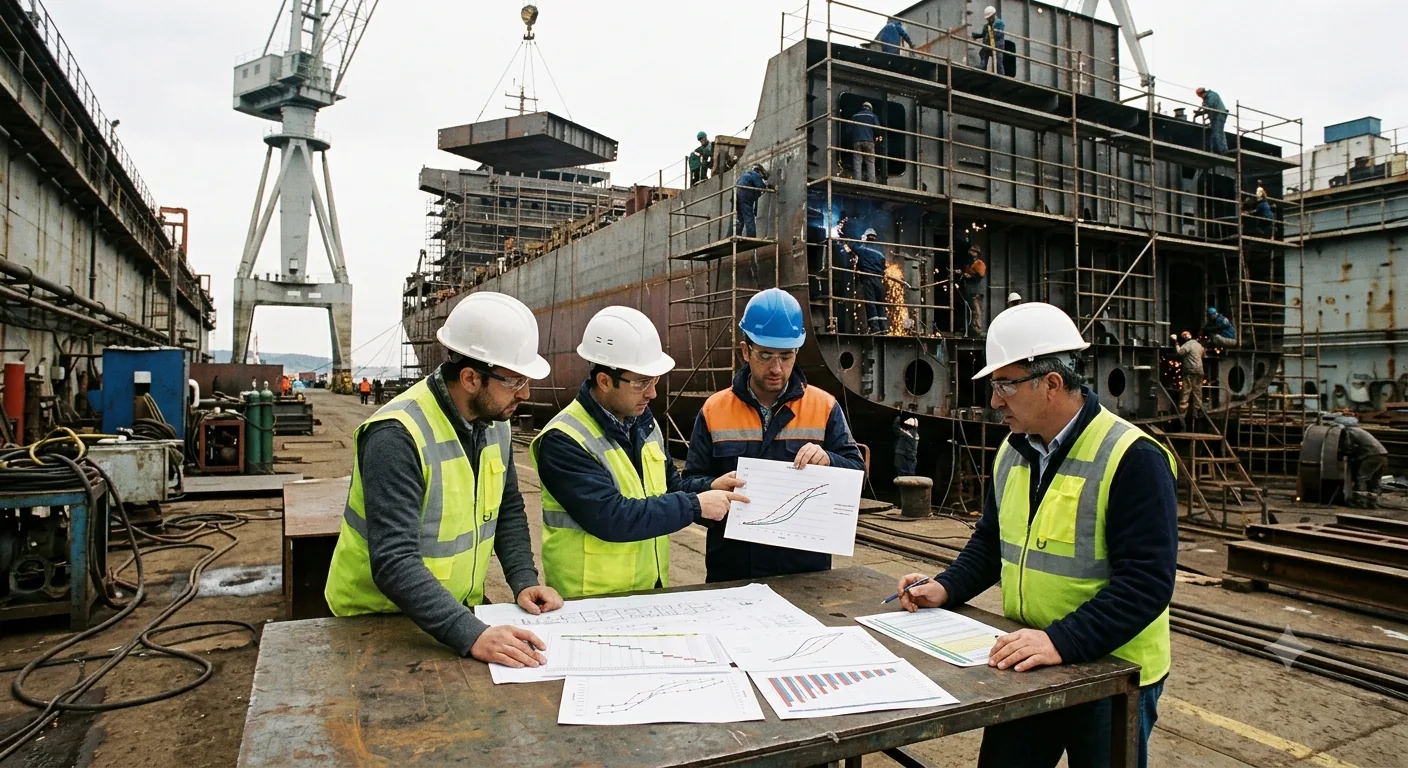
In the highly complex environment of shipyard new building projects, traditional project management metrics often fall short. Simply tracking how much money has been spent or how much time has passed provides a dangerous illusion of control.
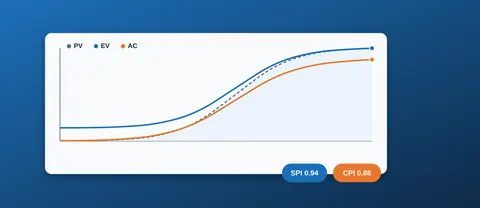
For instance, knowing that a project has consumed 40% of its budget and 50% of its schedule does not answer the most vital question: How much of the ship has actually been built? The primary purpose of Earned Value Management (EVM) in shipbuilding is to bridge this gap by objectively integrating project scope, schedule, and cost into a single, unified measurement system.
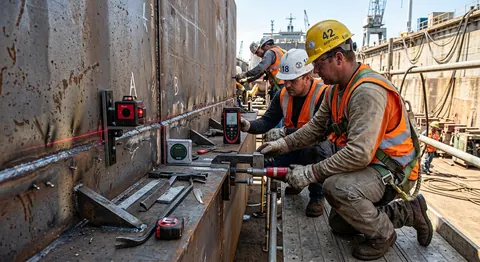
The immediate benefit of EVM is its ability to translate physical shop-floor progress into quantifiable financial metrics. By assigning a financial value to physical tasks (such as steel cutting, block assembly, or outfitting), shipyards can definitively measure what they have "earned" for the money spent. This eliminates the subjective guesswork of "we are almost done with this block" and replaces it with empirical data. It provides the planning department and yard management with a brutally honest, real-time picture of project health.
Furthermore, EVM provides a profound strategic advantage through its predictive capabilities. Rather than acting as a post-mortem financial report, EVM functions as an early warning radar. By calculating performance indices early in the construction phase, a planning chief can forecast the final cost and completion date of the vessel with high accuracy. This allows management to be proactive rather than reactive, shifting resources from non-critical areas, adjusting outfitting workflows, or negotiating with suppliers before minor delays snowball into massive financial losses.
Ultimately, utilizing EVM transforms a shipyard's approach from reactive firefighting to predictable, data-driven execution. It not only ensures tighter control over the current vessel's cash flow but also generates highly accurate historical data. This data becomes invaluable for the commercial department, enabling them to bid on future sister ships or similar complex vessels with complete financial confidence.
Core Requirements for Implementing EVM
To successfully deploy EVM, a shipyard cannot rely on spreadsheets alone; it requires a mature, highly structured project control environment.
The Structural Framework:
- Work Breakdown Structure (WBS): The project must be decomposed into manageable, deliverable-oriented components. For a complex vessel, this means detailing the structure down to Level 3 or 4 (e.g., New Build -> Machinery Space -> Piping -> Lube Oil System).
- Cost Breakdown Structure (CBS): Every element in the WBS must be mapped to a specific budget, ensuring that labor hours, material costs, and subcontractor fees are allocated to specific physical deliverables.
- Performance Measurement Baseline (PMB): The approved, integrated scope-schedule-cost plan against which all execution will be compared.
- Rules of Credit: Objective rules defining how physical progress is measured on the floor (e.g., 20% for fit-up, 50% for welding, 100% for passing NDT).
Inputs (What feeds the system):
- Planned Value (PV): The authorized budget assigned to the scheduled work at any given point in time.
- Actual Cost (AC): The total costs actually incurred (from ERP systems, timesheets, and procurement data) for the work performed to date.
- Physical Progress (% Complete): The verified, physical completion status of WBS elements gathered from the yard supervisors.
Outputs (What the system tells you):
- Earned Value (EV): The quantified value of the work actually accomplished (PV × % Complete).
- Variances: Schedule Variance (SV = EV − PV) and Cost Variance (CV = EV − AC).
- Indices: Schedule Performance Index (SPI = EV / PV) and Cost Performance Index (CPI = EV / AC).
- Forecasts: Estimate at Completion (EAC), which predicts the final project cost based on current performance trends.
Essential Tools:
- Advanced Scheduling Software: Tools like Primavera P6 are critical for sequencing the WBS, assigning resources, and establishing the baseline.
- Integrated ERP System: To capture real-time material costs and labor hours (Actual Costs) accurately.
A Practical Example: Advanced Outfitting
To understand how this projects onto the field, consider the installation of a high-tech water treatment and circulation plant on a Live Fish Carrier (LFC). Because LFCs have distinct, highly specialized purposes requiring massive continuous water flow and oxygenation, this outfitting phase is critical and expensive.
Let's assume the installation of the main circulation pumps and associated titanium piping is a specific WBS package.
- Budget At Completion (BAC): $300,000
- Scheduled Checkpoint: Month 3
The Scenario:
According to Primavera P6, by Month 3, the team should have completed 50% of the installation.
- Planned Value (PV): 50% × 300,000 = 150,000
The finance department pulls the labor and material costs from the ERP and reports that $180,000 has been spent so far.
- Actual Cost (AC): $180,000
The planning engineer walks the ship and applies the "Rules of Credit." They find that due to a delay in a specialized valve delivery, the physical installation is only 40% complete.
- Earned Value (EV): 40% × 300,000 = 120,000
The Projection:
- Cost Performance Index (CPI): $120,000 / 180,000 = 0.66$
- Schedule Performance Index (SPI): $120,000 / 150,000 = 0.80$
Conclusion: The EVM data instantly reveals a severe problem. The SPI of 0.80 means the team is working 20% slower than planned. Worse, the CPI of 0.66 shows that for every dollar the shipyard spends on this LFC system, they are only getting 66 cents worth of actual work. Armed with this exact data, the planning chief can immediately investigate if the issue is low labor productivity, excessive overtime, or material bottlenecks, and fix the trajectory before the entire vessel's budget is compromised.