How two competing shipyards, General Dynamics Electric Boat and HII Newport News, jointly build every Virginia-class submarine, and what that means for program management.
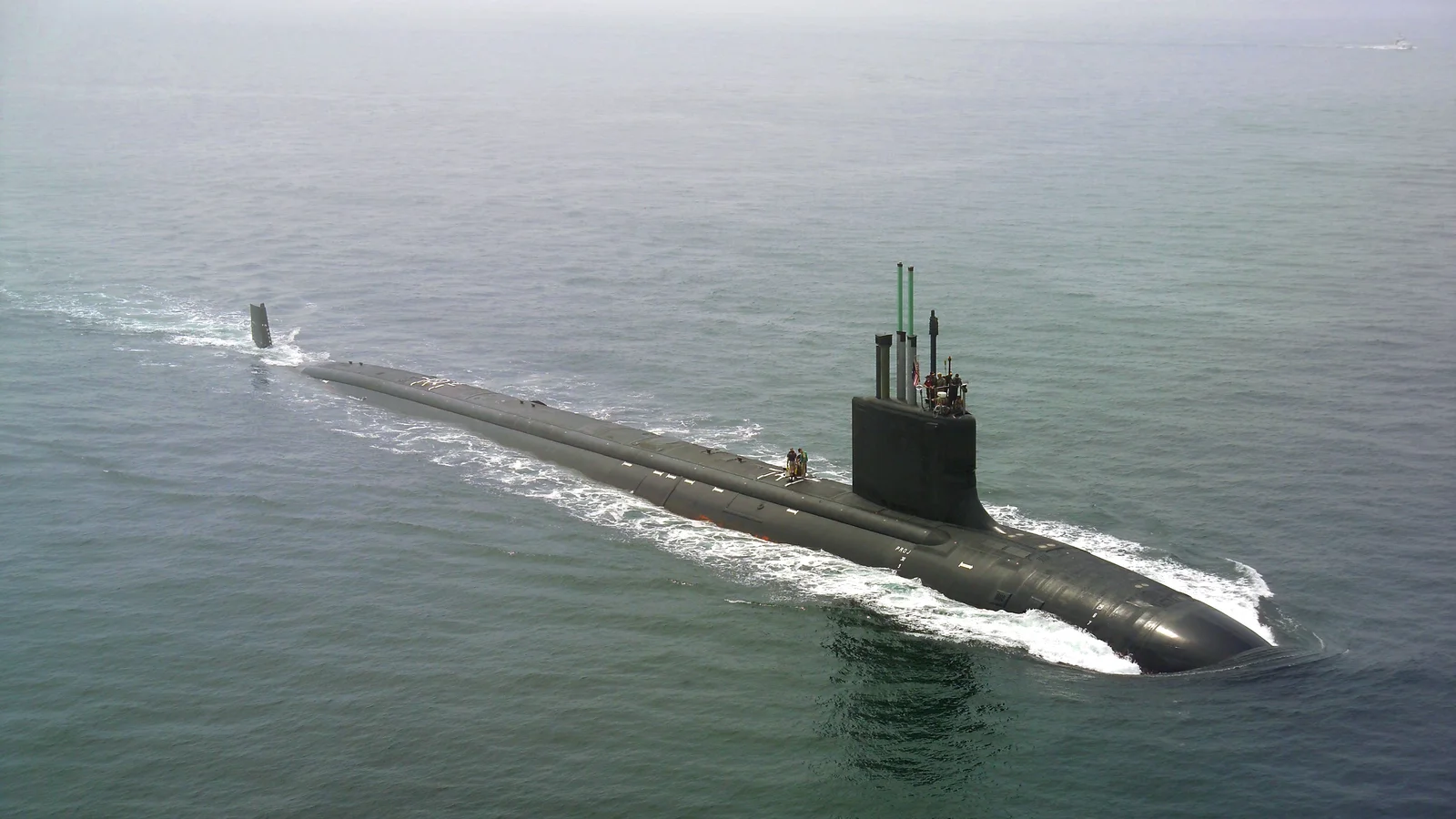
Most defense shipbuilding programs follow a recognizable structure: a single prime contractor holds the contract and manages a supply chain of subcontractors beneath it. The Virginia-class attack submarine program breaks that pattern entirely. Two shipyards that would otherwise be direct competitors, General Dynamics Electric Boat (EB) in Connecticut and HII Newport News Shipbuilding (NNS) in Virginia, jointly build every Virginia-class boat under a teaming agreement, each constructing physical sections of the same submarine and alternating which of them performs final assembly and delivery. There is no equivalent to this arrangement in commercial shipbuilding, where a single yard designs, builds, and delivers a vessel from its own facility start to finish.
Understanding why this model exists, how it actually works logistically, and what it demands of program management is essential for anyone evaluating how the US submarine industrial base, and by extension, one of the most consequential shipbuilding programs in the country: is actually run.
A Teaming Agreement, Not a Prime-Sub Relationship
The distinction matters. In a conventional prime-subcontractor structure, the prime holds full contractual and technical responsibility for the finished product, and subcontractors deliver components or services against a statement of work the prime controls. Under the Virginia-class teaming agreement, EB and NNS are not in that relationship with each other. Both are treated as co-builders of the class, each responsible for specific hull modules, and each yard alternates serving as the deliverer of record for completed submarines, meaning a given boat may be finally assembled and handed over to the Navy at either yard, depending on the build schedule.
22 Virginia-class boats have been delivered since 2004 under this arrangement, making it a mature, repeat-production program rather than an experimental structure. Reflecting that maturity, current Virginia-class work runs mostly on Cost-Plus-Fixed-Fee (CPFF) contract modifications: a contract type suited to a program with a well-established design and production baseline, in contrast to the design-heavy, higher-risk contract types typically used on a first-of-class program.
How the Module Split Actually Works
Physically, a submarine's pressure hull is built in large cylindrical and shaped sections, hull modules, before being joined into a complete vessel. Under the teaming arrangement, each yard is responsible for fabricating specific modules rather than the whole boat. Because a submarine cannot simply be trucked between two shipyards several hundred miles apart once its hull sections reach a certain size and weight, the coordination challenge is as much about physical logistics as it is about program management: completed modules built at one yard have to be transported, historically by heavy barge, to whichever yard is performing final assembly on that particular hull, where the modules from both yards are joined, outfitted, tested, and ultimately delivered to the Navy.
Which yard performs final assembly alternates across the build sequence, meaning EB and NNS take turns being the "delivering" yard even though both contribute structural modules to every boat regardless of who delivers it. This means neither yard ever fully "owns" an individual submarine the way a single commercial yard owns a ship it builds independently: every hull is, by design, a joint product of both facilities.
Why This Is a Fundamentally Different Coordination Problem
For a project manager used to a single prime managing its own subcontractors, the Virginia-class model inverts several normal assumptions. A prime typically has contractual leverage over its subcontractors: it can enforce schedule commitments, inspect work in progress, and resolve disputes through the subcontract terms it wrote. Under a teaming agreement between two large, independently capable, and commercially competing shipbuilders, that leverage doesn't exist in the same way. Schedule slippage, quality issues, or design-interpretation disagreements at one yard cannot simply be managed the way a prime would manage an underperforming vendor: both yards are principals in the arrangement, not one directing the other.
This creates a genuinely different set of program management demands:
- Shared configuration management: Both yards have to work from a single, consistent set of design data and engineering changes, even though they are separate companies with their own internal systems, processes, and engineering organizations. A module built to an out-of-sync revision at one yard doesn't just cause local rework: it can prevent final assembly from proceeding at all once that module reaches the other yard.
- Interdependent scheduling across two independently managed production lines: Because final assembly at either yard depends on receiving completed modules from the other, a schedule delay at one facility doesn't stay contained to that facility's own workload: it directly delays whichever yard is waiting to receive modules for final assembly on a given hull. Managing this requires schedule integration across two organizations that each control their own internal production planning, rather than a single integrated master schedule one prime can unilaterally enforce.
- Joint accountability without a single point of authority: When something goes wrong on a Virginia-class boat, responsibility can genuinely sit with either yard's work, and resolving that requires a level of inter-company coordination, and government program-office involvement, that a normal prime-subcontractor dispute wouldn't need, since a prime would typically resolve an internal quality issue with its own subcontractor directly.
In practice, this means the government program office overseeing Virginia-class construction plays a more active coordinating role between the two yards than a Navy program office typically needs to play in a conventional single-prime program: it is, in effect, managing an interface between two large industrial organizations that would otherwise have no reason to align their internal schedules or engineering data with one another.
Why the Navy Accepts This Complexity
Splitting submarine construction across two yards rather than concentrating it at one is generally understood as a deliberate industrial-base resilience strategy rather than a cost-optimization choice: maintaining two independently capable submarine-building yards avoids a single point of failure in what are, in practice, the only two shipyards in the United States capable of building nuclear submarines. If either yard were unable to produce, for any reason, from a labor disruption to a facility-level incident, a single-yard model would leave the entire submarine construction program exposed. Splitting the work keeps both facilities' workforces, tooling, and supplier relationships active and capable.
That resilience strategy has a real, current price tag attached to it. Since 2018 the Navy has invested more than $2.6 billion into the broader submarine industrial base, the network of suppliers and the skilled workforce both yards depend on, but this is an area where the return on that investment is still an open question rather than a settled success story: GAO has found that the Navy lacks consistent metrics demonstrating that this industrial-base investment has actually increased supplier output. That doesn't mean the investment has failed; it means the government's own oversight body has flagged a genuine measurement gap, and a project manager evaluating the health of the broader submarine enterprise should treat "how much has been invested" and "how much capacity has actually resulted" as two separate questions that are not yet reliably connected in public reporting.
The scale of the ongoing commitment to this model is substantial: a 2026 contract modification worth a combined ~$76.6 billion covers 9 more Block VI Virginia-class boats and 5 more Columbia-class boats, split between the two yards, meaning the teaming arrangement is not a legacy structure being phased out, but the active production model for both the Navy's current attack submarine class and, through the two yards' shared industrial base, a contributing factor to how the next-generation ballistic missile submarine program is resourced as well.
What This Means for Project Managers Coming From Other Structures
A project manager who has only worked within a single-prime, prime-subcontractor world should not assume that a teaming arrangement like this is simply a subcontracting relationship with better branding. It is a fundamentally different governance structure: two independent, commercially competing organizations sharing direct responsibility for one physical product, with no single company holding unilateral authority over the other's work. Success depends on configuration management discipline, transportation logistics for physically moving large hull sections between the two sites, and a level of interdependent schedule integration that a conventional prime-subcontractor program simply doesn't require: because in a conventional program, one company's internal schedule ultimately governs, and here, neither yard's schedule can move independently of the other's without delaying the shared product both are building.