
Have you ever looked at a massive cargo ship or a huge cruise liner and wondered: How on earth does something that heavy stay afloat? A modern container ship can weigh over 200,000 tons when fully loaded yet it glides across the ocean instead of sinking like a rock.
The answer lies in one of the most elegant principles in physics: buoyancy, first discovered by the ancient Greek mathematician Archimedes more than 2,000 years ago. Combined with clever ship design and the concept of density, this principle allows even the largest vessels ever built by humans to float safely.
In this comprehensive guide, we will break down exactly why ships float, explain the science in simple terms, explore real-world examples, and even give you experiments you can try at home. Whether you are a student, a teacher, or simply curious about the physics of the sea, this article will give you a clear and complete understanding.
1. The Everyday Puzzle: Why Don’t Ships Sink?
A small steel nail or a solid steel ball sinks immediately in water. Yet a ship made of the same material (steel) floats. This seems contradictory at first.
The key difference is not the material itself, but how that material is shaped and what is inside it.
Ships are not solid blocks of steel. They are carefully engineered structures with:
- Large hollow spaces filled with air
- Watertight compartments
- Specially designed hull shapes that displace huge volumes of water
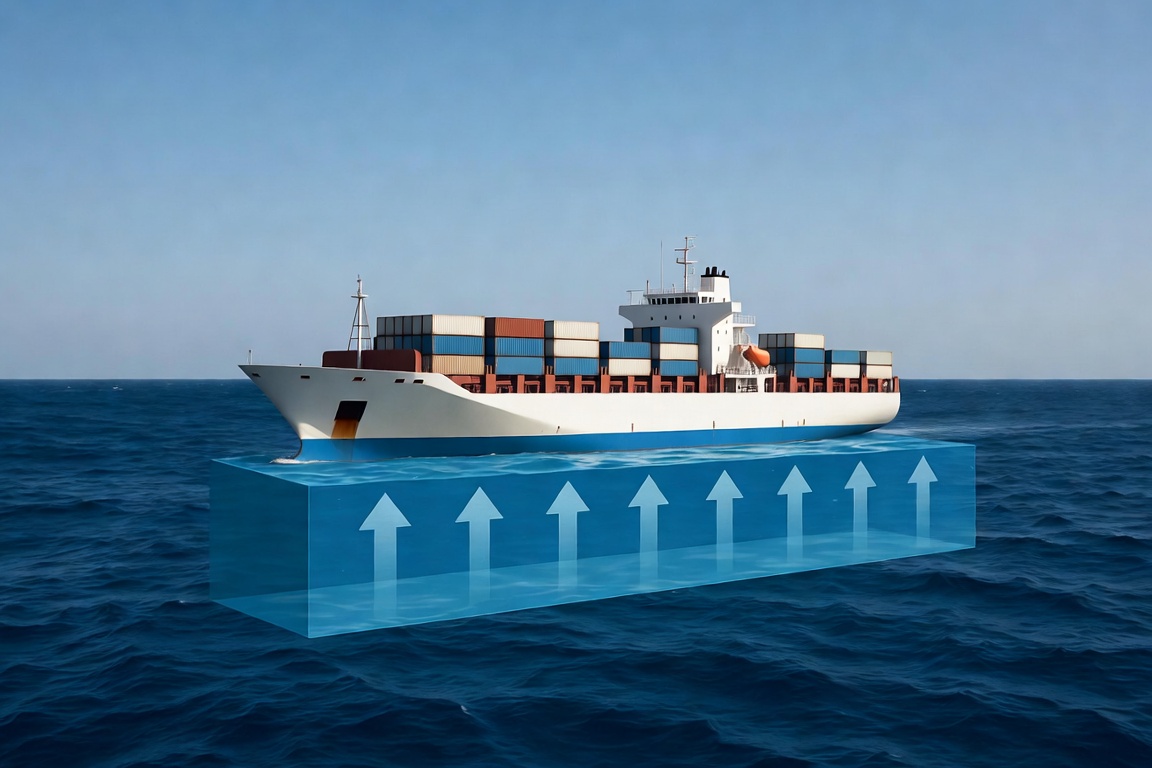
When a ship is placed in water, it pushes water out of the way (displaces it). The water pushes back upward with a force called buoyant force. If this upward force is equal to or greater than the ship’s weight, the ship floats.
2. Archimedes’ Principle — The Foundation of Floating
In the 3rd century BC, Archimedes discovered that:
Any object immersed in a fluid experiences an upward buoyant force equal to the weight of the fluid it displaces.
This is now known as Archimedes’ Principle.
For a ship to float, two things must be equal:
- The weight of the ship (including cargo, fuel, passengers, etc.)
- The weight of the water displaced by the submerged part of the hull
When these two forces balance, the ship neither sinks nor rises further — it floats in equilibrium.
The formula:
Fb=ρfluid×Vdisplaced×gF_b = \rho_{fluid} \times V_{displaced} \times gFb=ρfluid×Vdisplaced×g
Where:
- Fb F_b Fb = Buoyant force (upward)
- ρfluid \rho_{fluid} ρfluid = Density of the fluid (for seawater ≈ 1025 kg/m³)
- Vdisplaced V_{displaced} Vdisplaced = Volume of fluid displaced
- g g g = Acceleration due to gravity (≈ 9.81 m/s²)
For floating objects:
Weight of object = Buoyant force
3. Density: The Real Secret Behind Floating
Density is defined as mass per unit volume:
ρ=mV\rho = \frac{m}{V}ρ=Vm
Water has a density of about 1000 kg/m³ (fresh water) or 1025 kg/m³ (seawater).
A solid piece of steel has a density of roughly 7800 kg/m³ — much higher than water, so it sinks.
However, a ship is not solid steel. Most of its volume is air (density ≈ 1.2 kg/m³). The average density of the entire ship (steel + air + cargo) is therefore much lower than that of water.
This is why a ship can weigh hundreds of thousands of tons but still float: its overall density is less than the density of the water it displaces.
4. How Ship Design Makes Floating Possible
Modern ships are engineering masterpieces built around buoyancy principles:
- Hull Shape: The wide, curved hull displaces a large volume of water without needing to submerge deeply.
- Air Compartments: Most of the internal volume is air, dramatically lowering average density.
- Double Bottom & Watertight Bulkheads: These create separate compartments. Even if one section floods, the others keep the ship afloat.
- Ballast Tanks: Ships pump seawater into or out of tanks to adjust their weight and stability (especially important when empty or carrying different cargoes).
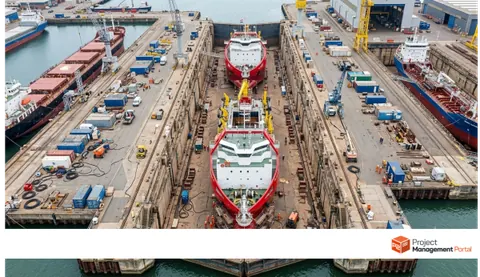
These design features are developed during the new build planning phase in shipyards, where engineers calculate exact displacement, stability, and load conditions long before the ship is launched.
5. Real-World Examples
Container Ships & Bulk Carriers
A large container ship can displace over 200,000 tons of water while carrying 20,000+ containers. Its hull is shaped to maximize displaced volume while keeping the center of gravity low for stability.
Cruise Ships
Cruise ships are even more impressive because they carry thousands of passengers and have many open decks. Their enormous volume (mostly air and lightweight structures) keeps average density low.
Historical Insight
Ancient civilizations already understood basic buoyancy. The Greeks and Phoenicians built ships that could carry heavy cargo across the Mediterranean using the same principles we use today.
6. What Happens When a Ship Takes on Water?
When water enters a ship (through damage or flooding), two dangerous things occur:
- The ship’s weight increases.
- The average density rises because air is replaced by water.
If too much water enters, the buoyant force can no longer support the total weight and the ship sinks.
This is why modern ships have sophisticated damage stability calculations and why ship designers spend enormous effort on compartmentalization.
7. Simple Experiments You Can Try at Home
Experiment 1: Clay Boat vs Clay Ball
Take a piece of modeling clay.
- Roll it into a tight ball → it sinks.
- Flatten and shape it into a boat hull → it floats.
The shape changed the displaced volume dramatically.
Experiment 2: Aluminum Foil Boat
Make a small boat from aluminum foil. It floats easily. Now carefully add coins or small weights until it sinks. You are directly experiencing the balance between weight and displaced water.
Experiment 3: Cartesian Diver (Advanced)
A classic science experiment that demonstrates how changing density (by squeezing a bottle) makes an object sink or rise.
8. Common Myths Debunked
Myth 1: “Ships float because they are lighter than water.”
Reality: The ship as a whole is heavier than the water it displaces, but its average density is lower.
Myth 2: “Only wood or plastic can float.”
Reality: Steel ships float because of shape and air, not the material.
Myth 3: “A ship will always float if it’s made of metal.”
Reality: A solid metal block sinks. Only properly designed vessels with sufficient displaced volume float.
Frequently Asked Questions (FAQ)
Q: Can a ship ever be too heavy to float?
A: Yes. If its total weight exceeds the weight of the water its hull can displace at maximum draft, it will sink. This is why ships have strict load lines (Plimsoll marks).
Q: Why do some ships float higher in seawater than in freshwater?
A: Seawater is denser, so the same ship displaces less volume to achieve the same buoyant force.
Q: How do submarines control whether they float or sink?
A: By changing their density — they pump water into or out of ballast tanks to increase or decrease average density.
Q: What is the largest ship ever built and does it follow the same rules?
A: Yes. Even the largest ultra-large crude carriers (ULCCs) and container ships obey Archimedes’ Principle exactly.
Conclusion
Ships float not despite their weight, but because of how that weight is distributed and how much water they displace. Archimedes’ ancient discovery, combined with modern naval architecture, allows humanity to build vessels that carry millions of tons of cargo across the world’s oceans every day.
Understanding buoyancy and density gives us a beautiful window into both physics and engineering. The next time you see a giant ship on the horizon, remember: it is not defying gravity — it is perfectly balanced with the ocean itself.