

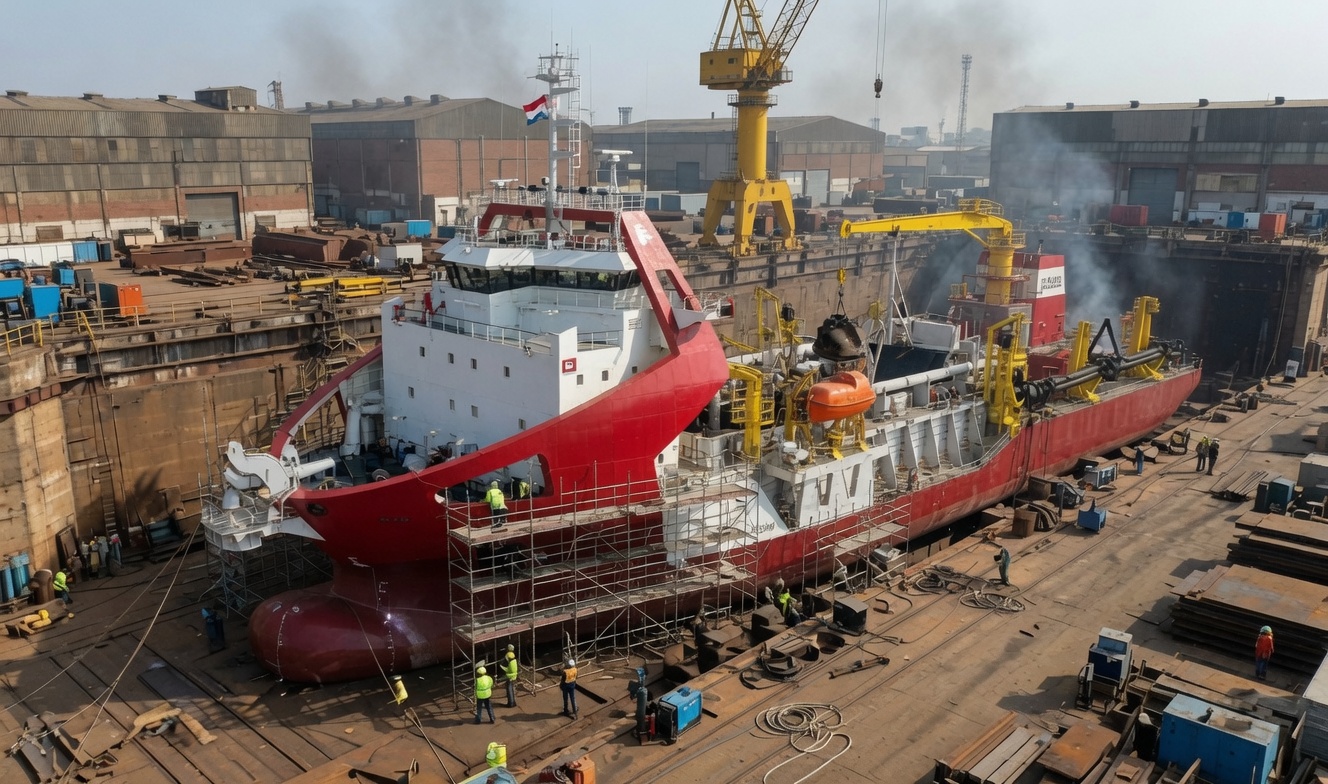
Ship newbuilding projects are massive operations that contain thousands of dynamic components, intensive engineering processes, and multidisciplinary workforces combined.
In this complex process, one of the primary elements that challenge management teams the most when starting a project is the accurate definition of activities and the logical correlation of these activities among themselves. This structure, created in the most fundamental phase of the project, forms the foundation of all planning; bricks placed incorrectly at the beginning will ultimately cause the wall to rise crookedly. Therefore, the initial steps of the planning process must be handled with great meticulousness, and the backbone of the project must be built on sound logic.
Creation of the Work Breakdown Structure (WBS) The first prerequisite for creating an effective Work Breakdown Structure (WBS) is to meticulously review the project's Technical Specification and contract scope to completely identify all the needs of the project. After determining the project needs in the shipbuilding sector; breakdowns are created based on main occupational groups, production methods, and shipyard stations. These main headings are generally implemented universally in global shipbuilding standards with the following hierarchy:
- DESIGN AND ENGINEERING (Management, Class, and Production Drawings)
- PROCUREMENT AND LOGISTICS (Main and Auxiliary Equipment Supply)
- STEEL WORKS (Hull Fabrication and Block Erection)
- OUTFITTING WORKS (Ship Outfitting)
- PIPING WORKS (Fabrication and Installation)
- ELECTRICAL AND AUTOMATION
- MECHANICAL (Propulsion System and Engine Room Installation)
- ACCOMMODATION / FURNITURE
- SURFACE PREPARATION AND PAINTING
- LAUNCHING REORGANIZATION
- HAT & SAT TESTS (Harbour and Sea Acceptance Tests)
- DELIVERY PROCESS
Once the main headings are clarified, the project's lower breakdowns (Work Packages) can be initiated. Sub-breakdowns must be created based on the relevant production stations and workshops, at a depth where data can be collected from the field and managed operationally. The critical balance here is to leave the breakdown neither too complex to manage nor too superficial to track.
Sample Breakdown Structure:
3. STEEL WORKS
3.1 Steel Plate and Profile Cutting
3.1.1 UNIT 101 Block Steel Plate Cutting
3.1.2 UNIT 102 Block Steel Plate Cutting
3.2 Pre-fabrication
3.2.1 UNIT 101 Pre-fabrication Process
3.2.2 UNIT 102 Pre-fabrication Process
After this hierarchical structure under the WBS matures, it should be shared with the relevant discipline managers, workshop chiefs, and subject matter experts to reach a full consensus on how the works will be tracked in the field. The next stage, after clarifying "what will be done" with the WBS, is to determine the volume of these work packages. This is exactly where the Bill of Quantities (BOQ) comes into play. A properly structured WBS determines in which pool the BOQ items (tonnages, linear meters, square meters, and labor hours) will be gathered, ensuring the flawless operation of the project's budget, cost, and progress payment management.
The Concept of BOQ (Bill of Quantities) and Determination of Quantities in Shipbuilding Projects While the Work Breakdown Structure (WBS) lays out the scope of the project and "what will be done" in a hierarchical order; the Bill of Quantities (BOQ) quantitatively defines "how much" these works are, that is, their physical sizes. In ship newbuilding projects, the BOQ is not merely a Bill of Materials (BOM); it is also a dynamic pool that includes the labor volume required to process those materials. When creating a BOQ in the shipbuilding sector, different units of measurement are used for each occupational group in accordance with the data provided by the engineering (design) department:
- Steel and Hull Works: Tonnage (plate and profile weights), welding length (meters).
- Piping Systems: Pipe lengths (meters) according to nominal pipe sizes (DN), number of isometrics, quantities of valves, flanges, and fittings.
- Surface Preparation and Painting: Surface areas to be blasted and painted ($m^2$), number of coats, and dry film thicknesses (DFT).
- Electrical and Automation: Cable pulling lengths (meters), hot work (cable tray/ladder) lengths, and termination quantities.
- Outfitting and Accommodation: Ventilation duct surface areas ($m^2$), quantities of doors, windows, portholes, and furniture.
WBS and BOQ Integration: "Addressing" the Project Managing WBS and BOQ independently of each other is one of the most common planning mistakes encountered in shipyards. For successful project management, each quantity item located in the BOQ must be "addressed" to its corresponding Work Package in the WBS. This integration practically creates a digital matrix of the project. Following the example given above; if the total amount of steel to be consumed for the UNIT 101 block according to the cutting plans (nesting) issued by the design office is 120 tons, this quantity is directly entered under the "3.1.1 UNIT 101 BLOCK STEEL PLATE CUTTING" WBS code as a BOQ item. Thus, planning engineers can clearly see the physical size and, consequently, the budget of that WBS activity. This pairing also forms the fundamental algorithm of modern Shipyard Enterprise Resource Planning (ERP) and project management software. Material procurement, warehouse issuances, work order assignments, and budget controls are conducted entirely over this WBS-BOQ matrix.
Operational Advantages Provided by Integration Correctly marrying the WBS and BOQ structures provides the shipyard management with the following critical advantages during the production and control phases of the project:
- Precise Progress Tracking (Physical Progress %): Progress tracking based solely on time (according to start-finish dates) can be misleading in shipbuilding. Thanks to the WBS and BOQ integration, progress in the piping workshop, for instance, is tracked with precise and measurable data such as "480 meters of the 1,200-meter pipe BOQ volume in the relevant WBS package has been manufactured (40% physical progress)" instead of a vague statement like "System X pipe fabrication is 40% complete".
- Subcontractor and Progress Payment Management: A significant portion of the work in shipbuilding is carried out through subcontractors. Subcontractor agreements are generally made based on BOQ unit prices (e.g., Euro/Ton, Dollar/Meter, TL/$m^2$). Completed works in the field are approved by comparing them with the BOQ quantity under the relevant WBS code. This situation ensures that progress payment processes are managed transparently, quickly, and flawlessly, reinforcing the trust between the shipyard and the subcontractor.
- Resource Planning and Resource Leveling: BOQ data (for example, welding linear meters or blasting area) is multiplied by the man-hour norms obtained from past projects to reveal the net labor (man-day or man-hour) requirement needed to complete that work package. The planning department can thereby foresee exactly how many certified welders or blasting operators will be needed, at which station, and in which week.
Conclusion In ship newbuilding projects, WBS and BOQ represent both the backbone and the blood in the veins of the project. Accurate quantities (BOQ) built upon a comprehensive WBS that is compatible with the shipyard's production stations minimize the project's budget overrun risks. This process, starting with placing the first brick correctly; ensures that design, procurement, planning, and production departments speak the same language, standing as the greatest guarantee that the ship will be launched and delivered on time, at the targeted quality, and within budget limits.