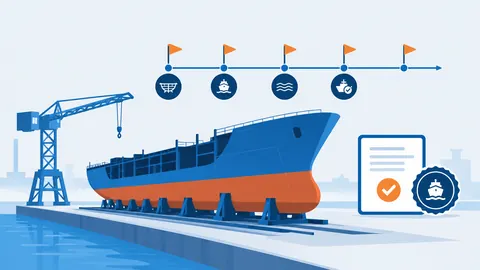
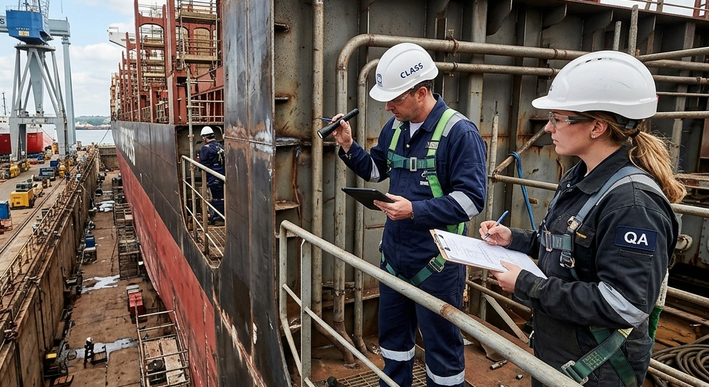
On a newbuild, quality is not inspected in at the end. It is surveyed in continuously by class. Plan the inspection-and-test plan as carefully as the build itself.
By the time a class surveyor is standing at a hold point deciding whether to release a weld for coverage, the quality outcome has already mostly been decided, by the welding procedure qualification, the material certificates, and the in-process inspections that happened well before the surveyor arrived. Survey attendance verifies quality; it doesn't create it. Treating the two as the same thing is how yards end up surprised by a survey finding that a functioning QA system would have caught weeks earlier.
Why Class Involvement Isn't Simply "Mandatory"
Classification isn't a single, uniform legal requirement in the way that's sometimes implied. What's actually true: flag states delegate much of their statutory survey authority to recognized classification societies, insurers and financiers generally require a vessel to be in class as a condition of cover or financing, and SOLAS and other IMO instruments require specific surveys that class societies are authorized to carry out on the flag state's behalf. In practice this adds up to class being effectively unavoidable for almost any commercial vessel of meaningful size, but the mechanism, statutory delegation plus commercial necessity, matters for understanding where class's authority actually comes from and where it doesn't.
What a Real Inspection and Test Plan Does
An ITP that just lists activities and marks some "hold" and some "witness" isn't doing its real job unless it also specifies who gets notified, how much lead time they need, and what evidence closes the point out. A hold point is a stop: work cannot proceed until the surveyor releases it, which means the ITP's notice period has to be built into the production schedule as a real constraint, not an afterthought that gets discovered when a crew is standing around waiting for a surveyor who was never actually booked. A witness point, by contrast, is recorded but doesn't stop work, and confusing the two in either direction either idles a crew unnecessarily or, worse, proceeds past a point that needed a hold.
Where Documentation Actually Fails
The traceability chain that matters at survey time, material certificate to heat number to weld log to NDT report, is usually fine when built as the work happens and genuinely painful to reconstruct after the fact. The failure mode isn't usually that records don't exist, it's that they exist in different systems or different formats maintained by different trades, so pulling together a complete package for a single hold point becomes its own multi-day task right when the schedule has the least slack to absorb it.
Interpretation Differences: Where They Actually Come From
A disagreement between a shipyard and a surveyor over how a rule applies is rarely about either party being wrong on the rule text, it's usually about an interface or a specific application the rule didn't anticipate cleanly. These get resolved faster and cheaper before steel is cut than after: a technical query submitted during plan approval, asking explicitly how a specific detail will be assessed, costs a delay in the drawing review cycle. The same disagreement discovered during an in-process survey, after the detail is already built, costs a rework order and a schedule impact that's much harder to absorb.
What Actually Goes Wrong
- Class gets engaged only at contractually mandated milestones, not when a genuine technical question arises between them, so a question that should have been resolved in week three surfaces as a survey finding in month eight.
- A non-conformance gets closed on paper before the corrective action is actually verified, which just moves the same problem to a later survey where it's more expensive to fix.
- Surveyor scheduling is treated as guaranteed availability rather than a resource that has to be booked against the yard's own production schedule, particularly during periods when several projects across the yard need survey attention at once.
- The QA system's own internal inspection records aren't shared proactively with class, so the surveyor is working with less information than the yard already has, and finds independently what the yard's own QC already knew.
Where Digital Tools Help
A digital document system that assembles the traceability chain automatically as records are generated, rather than requiring someone to reconstruct it at survey time, is one of the more directly useful applications of digitization in this area. Remote survey methods (video, photo documentation, drone inspection for hard-to-access spaces), increasingly accepted by class societies for certain survey types, can reduce scheduling friction, but they don't substitute for genuine access rights and evidence quality where a physical inspection is actually required.
QA and class surveys work well together when the shipyard's own inspection standard is at least as rigorous as what class will check, so a survey confirms what the yard already knows rather than discovering what it didn't.