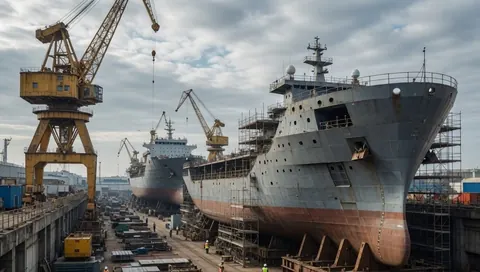


A practical guide to managing Change Orders and Variation Orders in ship newbuilding contracts — the SAJ Form and BIMCO NEWBUILDCON frameworks, the step-by-step VO process, cost impact calculation methodology, disruption analysis, and documentation best practices — with downloadable Variation Order Form and Cost Impact Calculation Sheet templates.
In the complex environment of commercial ship newbuilding, the contract signed between the Buyer (shipowner) and the Builder (shipyard) is only the starting point of a multi-year technical and commercial relationship. During design finalisation, steel cutting, block construction, outfitting and trials, numerous changes inevitably arise — from the Buyer’s evolving operational requirements, classification-society rule updates, regulatory mandates, design-development discoveries, or the Builder’s own optimisation proposals.
The formal mechanism used to manage, price and authorise these alterations is known as a Change Order (predominantly American terminology) or a Variation Order (VO — more common in international and Asian/European shipbuilding contracts). Regardless of nomenclature, the commercial purpose is identical: a clear, written record of a modification to the original scope, together with the agreed (or reserved) adjustments to Contract Price and Delivery Date.
Failure to administer Variation Orders rigorously is one of the primary sources of disputes, cost overruns and relationship damage in shipbuilding projects. A disciplined VO process, by contrast, protects both parties, maintains schedule integrity and provides transparent commercial accountability. This article draws on the two most widely used standard forms — the Shipbuilders’ Association of Japan (SAJ) Form and BIMCO NEWBUILDCON — while remaining applicable to bespoke and heavily amended contracts.
1. Contractual Framework in Shipbuilding
1.1 The SAJ Form — Article V Modifications
The SAJ Form, first published in 1974 and still the foundational document for most Asian newbuilding contracts (China, South Korea, Japan and many other yards), addresses modifications in Article V, which distinguishes three categories:
- Buyer’s Modifications — the Buyer may request changes to the Specifications at any time; the Builder may decline if the change would adversely affect its other commitments, and the parties must agree Price and Delivery Date adjustments before the change becomes binding.
- Class and Regulatory Modifications — compulsory changes required after the contract date must be incorporated, subject to agreement on consequential adjustments; non-compulsory (recommended) changes are treated like Buyer’s modifications.
- Builder’s Modifications — the Builder may propose minor modifications or material substitutions, generally subject to Buyer and Class approval, with any cost saving credited to the Buyer.
A critical practical point under the SAJ Form: the Builder is not obliged to proceed with a Buyer-requested modification until price and time consequences have been agreed. Many modern contracts therefore introduce a Disputed Variation Order mechanism (see Section 3.4) to let work continue while quantum remains open.
1.2 BIMCO NEWBUILDCON — Clauses 24 and 26
NEWBUILDCON (2007) was deliberately drafted to rebalance the perceived builder-friendly nature of the SAJ Form. Clause 24 (Modifications and Changes) and Clause 26 (Changes in Rules and Regulations) set out more detailed procedural requirements. Under Clause 24 the Builder must respond to a Buyer request with a priced proposal and may decline only on reasonable grounds. For compulsory Class or regulatory changes under Clause 26, the Builder is generally obliged to incorporate the change even before commercial agreement is reached, with quantum settled later by expert determination or arbitration if necessary. NEWBUILDCON also gives clearer payment mechanics (Clause 15) and a more structured dispute pathway (Clause 42), making it attractive to Owners seeking procedural certainty.
1.3 Written Form Requirement and English Law
Most shipbuilding contracts are governed by English law, and English courts give full effect to clauses requiring variations to be in writing. Oral instructions, informal emails, or site-level “gentlemen’s agreements” may be commercially persuasive but are frequently held legally ineffective for adjusting price or time. Shipyard project managers and Owner’s Representatives must insist on proper documentation before committing significant resources to changed work — the cost of administrative discipline is trivial compared with the cost of an unrecoverable variation.
2. Types of Variations and Change Orders
2.1 Buyer-Initiated Variations
The most common and commercially significant category. Typical examples include an upgraded main engine or added shaft generators, changed cargo-handling capacity, enhanced accommodation standards, additional environmental equipment (scrubbers, ballast water treatment beyond original spec, shore power), bridge or cargo-control-room layout changes, and changes driven by a charterer or end-user after signature. These are almost always for the Buyer’s account, subject to the Builder’s right to decline or to claim full cost plus disruption and time extension.
2.2 Classification Society and Regulatory Variations
Class rules and flag-state regulations evolve continuously. When a new compulsory requirement enters into force after the contract date and applies before delivery, the contract almost invariably requires the Builder to incorporate it. Under pure SAJ language, agreement on adjustments is a condition precedent to that obligation; under NEWBUILDCON and many modern riders, the Builder must proceed and quantum is determined later if necessary. Non-compulsory (recommended) Class notations are treated as Buyer options.
2.3 Builder-Initiated Variations and Substitutions
Builders frequently propose changes for production efficiency, material availability or supply-chain reasons. Provided performance, Class status and contractual guarantees are unaffected, and any cost saving passes to the Buyer, such changes are usually accepted — but the formal VO process should still be followed so the as-built configuration is properly documented.
2.4 Constructive Changes and Implied Variations
A constructive change occurs when the Owner (or its representative) issues an instruction, withholds an approval, or provides late information in a way that effectively requires work outside the original scope, even though no formal VO has been issued. Reliance on constructive-change arguments is high-risk; best practice is to issue a formal notice immediately whenever a constructive change is suspected, and to request a formal VO.
3. The Formal Variation Order Process — Step by Step
A robust VO process contains the following sequential stages. Skipping or compressing stages is the most common cause of later disputes.
3.1 Identification and Early Warning
Any party — Owner’s Representative, Class surveyor, design office, production supervisor or commercial department — who becomes aware of a potential change should raise it immediately through a formal channel, typically a Potential Variation Notice or Early Warning Notice, describing the technical nature of the change and a preliminary qualitative assessment of cost and schedule impact. No commercial commitment is made at this stage.
3.2 Formal Request and Builder’s Proposal
The party seeking the change (usually the Buyer) issues a written request referencing the relevant contract clause, detailed enough for the Builder to prepare a quotation. The Builder’s commercial and planning teams then prepare a formal Variation Order Proposal containing:
- A clear description of the technical change and affected systems/blocks
- A detailed breakdown of direct costs (labour hours by trade, materials, equipment, subcontract)
- An assessment of disruption and indirect costs with supporting rationale
- A Time Impact Analysis showing effect on the critical path and Delivery Date
- Any consequential effect on other contractual guarantees (speed, fuel consumption, deadweight, etc.)
- Proposed payment terms and conditions
3.3 Negotiation and Agreement, or Disputed Variation Order
Ideally the parties reach full agreement and a bilateral Variation Order is signed by both (and by the Classification Society if Class is affected). Where quantum cannot be agreed quickly but the Buyer still needs the work to proceed, many contracts permit a Disputed Variation Order: the Builder proceeds with the technical change, the work is recorded, and the commercial consequences are referred to the contract’s dispute-resolution mechanism while construction continues — preventing the project from stalling while protecting both parties’ positions.
3.4 Implementation, Tracking and Close-Out
Once authorised, the change is incorporated into the production schedule, drawings, material orders and work packages, with progress and actual cost tracked against the approved VO budget. At completion (or at defined milestones) a final account for that VO is prepared and agreed, and any variance between estimated and actual cost is analysed for lessons learned.
4. Cost Impact Calculation Methodology
Accurate cost impact calculation is the heart of commercial VO management.
4.1 Direct Cost Components
Labour — estimate additional man-hours by trade (steelwork, pipework, electrical, painting, insulation, outfitting, etc.) using the yard’s historical norms or detailed work-content analysis, applying current labour rates and distinguishing normal-time from overtime/premium rates if acceleration is required.
Materials and Equipment — current quotations including freight, insurance, customs duties and expediting costs, with credit for any materials already ordered that become redundant.
Subcontract Packages — the subcontractor’s quotation plus the Builder’s management and coordination mark-up for renegotiated scopes (accommodation, HVAC, electrical, painting, etc.).
Design and Engineering — additional hours for revised drawings, calculations and Class submissions, including any third-party design-office cost.
4.2 Overhead and Profit Mark-Up
Most contracts allow the Builder to apply agreed percentages for yard overhead and profit on the direct costs of variations — typically 8–15% for overhead and 5–10% for profit in commercial shipbuilding, though figures are project-specific and often heavily negotiated. The mark-up should be applied consistently and transparently.
4.3 Pricing Methods
- Lump-sum quotation — preferred when scope is well defined; transfers estimating risk to the Builder.
- Unit rates / BOQ rates — used when the original contract contains applicable rates; simple, but may not capture disruption.
- Time and materials (daywork) — for uncertain or exploratory work; requires strict time-recording and audit rights.
- Cost-plus with agreed fee — transparent, but can reduce the Builder’s incentive to control cost.
A professional VO cost proposal presents the calculation in layered form — direct labour, materials, subcontract and design costs, then overhead, profit and a disruption/indirect allowance, rolling up to a total variation price — with all supporting calculations, quotations and assumptions attached as appendices so the Buyer’s commercial team can audit the build-up. The downloadable Cost Impact Calculation Sheet template follows exactly this structure.
5. Time Impact Analysis and Schedule Consequences
Most significant variations also affect the construction schedule, and under virtually all shipbuilding contracts the Builder is entitled to a Delivery Date extension if the variation delays the critical path. The standard tool is a Time Impact Analysis (TIA), comparing the current accepted (or latest updated) programme with a revised programme inserting the additional or changed activities. The resulting difference in forecast Delivery Date, provided the changed activities lie on the critical path, is the entitlement to extension of time.
- The analysis must use the logic and durations of the current working programme, not an outdated baseline.
- Concurrent delays for which the Builder is already responsible must be carefully identified — many contracts and legal systems reduce or eliminate EOT entitlement where concurrent delay exists.
- Acceleration (overtime, additional shifts, extra resources) may be offered as an alternative to EOT, with its cost becoming part of the VO price.
- Float ownership is a frequent source of argument; contracts should ideally state whether the Builder or the Buyer owns programme float.
6. Disruption, Indirect and Consequential Costs
Direct costs alone rarely capture the full commercial impact of a variation in a complex shipyard environment. Ship construction is characterised by high interdependence — a late change to a pipe route in an engine-room block can ripple into steel outfitting, cable pulling, insulation, painting and the erection sequence. Studies of naval and commercial shipbuilding programmes have shown that the total man-hour impact of changes can be 2.5 to 3.5 times the “hard-core” change hours themselves once disruption is included, varying by trade, construction stage and yard labour stability.
Common evaluation methods include:
- Measured mile / productivity comparison — comparing productivity on identical or similar work before and after the disruptive event.
- Industry or yard-specific disruption factors — percentage uplifts from historical data (commonly 15–40% on affected labour, depending on timing).
- Influence curves / timing factors — a change introduced after a block is erected or systems are tested carries a much higher disruption factor than the same change introduced during design or early fabrication.
- Detailed resource-loaded simulation — for major changes, re-running the resource-loaded schedule to quantify additional labour and equipment days.
Whatever method is chosen, the Builder must be able to demonstrate the calculation with transparency — unsupported “global” disruption claims are routinely rejected by arbitrators and experts. Other frequently claimed indirect items include extended site supervision, additional Class survey fees, extra insurance premiums and financing costs on delayed milestone payments; entitlement depends strictly on contract wording and proof of causation.
7. Documentation, Forms and Record Keeping
The quality of contemporaneous records often determines the outcome of a VO dispute more than the underlying technical merit. Recommended minimum documentation includes Potential Variation / Early Warning Notices, formal Variation Requests and Builder’s Proposals with full backup, signed (or Disputed) Variation Orders, updated drawings and revision registers cross-referenced to VO numbers, labour time sheets coded to specific VO numbers, material and subcontract purchase orders linked to VOs, progress photographs, and final account statements for each closed VO. A central VO register — ideally in the project’s ERP or document-control system — should track every change from initiation to final financial close-out.
Use the downloadable Variation Order Form and Cost Impact Calculation Sheet templates as the two core documents of that register — one to formalise and authorise each change, the other to build up and audit its price.
8. Practical Worked Examples
Example 1 — Mid-Contract Engine Upgrade
Six months after signature, the Buyer requests a newer, more efficient main engine with different dimensions, higher power, and revised seating, shaft-line alignment, cooling-water capacity and electrical generation balance. Direct costs include the engine price differential, extra design hours, steelwork, piping, cabling and Class fees, plus possible dry-dock or berth time if the change is late. Disruption depends heavily on construction stage — far higher once blocks are erected and outfitting is advanced. A full TIA examines the engine-room critical path and overall Delivery Date; the resulting VO can easily reach several million dollars and several weeks of EOT.
Example 2 — Compulsory Ballast Water Treatment Upgrade
After contract date, the flag state or Class makes a previously optional ballast-water treatment standard compulsory. Under NEWBUILDCON-style wording the Builder must incorporate the change; under pure SAJ wording, price and time agreement is required first. The evaluation must capture equipment cost, installation labour, additional power demand, space impact and any effect on deadweight or stability — and because the change is compulsory, negotiation leverage differs from a pure Buyer option.
Example 3 — Late Accommodation Layout Change
After the accommodation block is erected and outfitting has begun, the Buyer requests additional cabins and a revised mess-room layout. Direct costs are significant, but disruption costs dominate: already-installed bulkheads, HVAC ducting, electrical distribution and fire insulation must be partially removed and reworked, and productivity on the remaining work falls sharply. A measured-mile analysis comparing pre- and post-change productivity on similar spaces provides the strongest support for the disruption claim.
9. Risk Management, Negotiation and Dispute Avoidance
Prevention is more valuable than perfect claims preparation:
- Freeze design as early as practicable and resist non-essential changes after steel cutting.
- Maintain a clear, single point of authority for issuing and accepting Variation Orders.
- Never commence significant changed work without written authorisation (or a Disputed VO).
- Price and schedule-impact every potential change promptly, while information is fresh.
- Keep commercial and technical discussions linked — avoid “technical agreement first, commercial later” traps.
- Use the contract’s expert-determination provisions for valuation disputes rather than letting them escalate to full arbitration.
- Conduct periodic joint VO reviews between Owner and Builder commercial teams to clear backlogs.
10. Best Practice Recommendations
For Shipyards
- Establish a dedicated Change Management function within the commercial or project-controls department.
- Standardise VO proposal templates and calculation spreadsheets so every proposal follows the same transparent structure.
- Train production supervisors to recognise and escalate potential variations immediately.
- Link the VO register to the ERP and scheduling systems so approved changes flow automatically into work packages and programmes.
- Maintain historical disruption factors by trade and construction stage for future estimates.
For Owners / Buyers
- Define a clear internal approval matrix for change requests, including cost and schedule thresholds.
- Require the Builder to submit fully supported proposals within defined time limits.
- Avoid instructing work on site without simultaneous commercial authorisation.
- Budget a realistic contingency for variations — commonly 3–8% of contract price for commercial vessels, higher for complex or prototype designs.
- Engage Class early on any change that may affect notation or compliance.
Conclusion
Variation Orders are an unavoidable feature of ship newbuilding. Administered with discipline, transparency and technical competence, they protect both the Builder’s commercial position and the Owner’s desire for a vessel that meets evolving requirements; administered poorly, they become a primary driver of cost growth, delay and adversarial relationships.
The essential elements of good practice are early identification, written formalisation, fully supported cost and time proposals, a clear distinction between agreed and disputed items, rigorous contemporaneous records, and prompt final accounting. The goal is not to eliminate change — an impossibility in a multi-year, highly technical project — but to ensure every change is visible, quantified, authorised and paid for in accordance with the contract. That is the foundation of successful shipbuilding project management.
This article and the accompanying templates are intended for professional guidance in ship newbuilding project management. They do not constitute legal advice — always refer to the specific terms of the applicable shipbuilding contract and seek qualified legal counsel when preparing or responding to Variation Orders.